华南理工大学学报(自然科学版) ›› 2026, Vol. 54 ›› Issue (1): 115-123.doi: 10.12141/j.issn.1000-565X.250124

• 机械工程 • 上一篇    下一篇

基于颗粒阻尼器的电梯曳引机制动降噪

陈忠1(), 刘琦1, 吴红兵2, 肖佳锋2, 徐杨2, 詹晓宇2, 申爽2   

  1. 1.华南理工大学 机械与汽车工程学院,广东 广州 510640
    2.日立电梯电机(广州)有限公司,广东 广州 510660
  • 收稿日期:2025-04-24 出版日期:2026-01-10 发布日期:2025-07-11
  • 通信作者: 吴红兵 E-mail:mezhchen@scut.edu.cn
  • 作者简介:陈忠(1968—),男,博士,教授,主要从事柔顺机构动力系统、机器视觉及其应用、精密测量和故障诊断研究。E-mail:mezhchen@scut.edu.cn
  • 基金资助:
    广东省自然科学基金项目(2022A1515011263)

Brake Noise Reduction of Elevator Traction Machine Based on Particle Dampers

CHEN Zhong1(), LIU Qi1, WU Hongbing2, XIAO Jiafeng2, XU Yang2, ZHAN Xiaoyu2, SHEN Shuang2   

  1. 1.School of Mechanical and Automotive Engineering,South China University of Technology,Guangzhou 510640,Guangdong,China
    2.Hitachi Elevator Motor (Guangzhou) Co. ,Ltd. ,Guangzhou 510660,Guangdong,China
  • Received:2025-04-24 Online:2026-01-10 Published:2025-07-11
  • Contact: WU Hongbing E-mail:mezhchen@scut.edu.cn
  • Supported by:
    the Natural Science Foundation of Guangdong Province(2022A1515011263)

摘要:

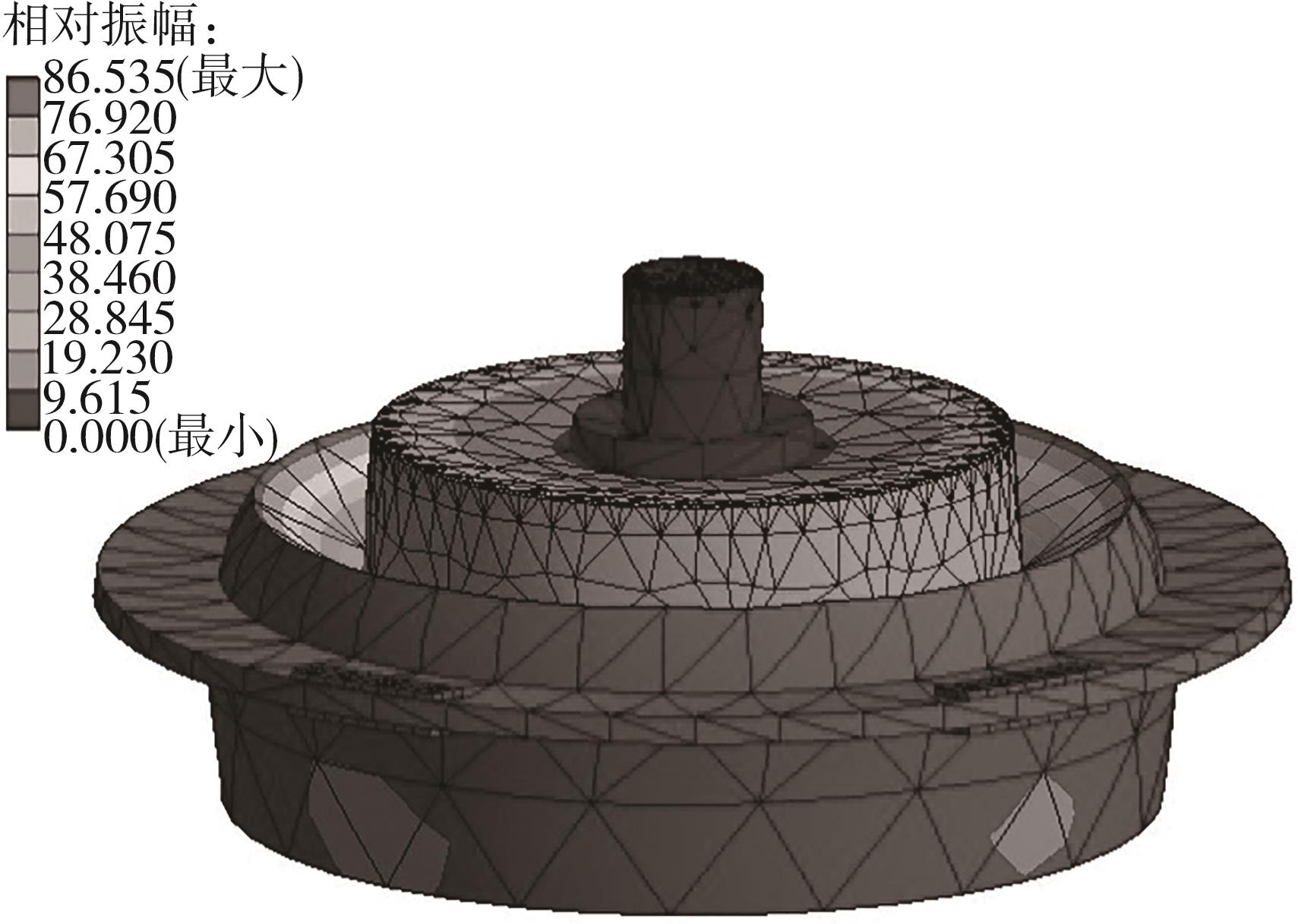
为克服电梯曳引机在制动过程中产生的较高声压级噪声,该文提出了一种基于颗粒阻尼器的减振降噪方案。首先,通过有限元仿真模态分析对制动轮及刹车片进行振动特性研究,并结合整机振动噪声测试结果得到的重点振动频率来确定关键振动模态。在此基础上,结合制动轮结构的对称性和空间布局特点,创新性地在制动轮内部设计可安装颗粒阻尼器的空腔结构。然后,通过EDEM-ADAMS联合仿真对固体粒子参数进行优化,重点解决3个关键技术问题:①粒子材料的选择(考虑到需规避磁场干扰,最终选用纯铝作为阻尼颗粒);②颗粒阻尼器在空腔结构内的能量耗散过程分析(采用离散元分析法进行仿真);③阻尼器粒子半径和填充率的优化(通过结合离散元分析法和多体动力学仿真实现)。在半消声室环境下对所提出的制动降噪策略进行实验验证,设置周期为5 s的定时制动控制策略,采用加速度传感器阵列采集振动信号,同步记录声压级数据。结果表明,安装颗粒阻尼器后曳引机制动过程的平均声压级降低20.7%,验证了所提方案的有效性。该研究为电磁制动系统的噪声控制提供了一条新的技术路径,具有较大的工程应用价值。

关键词: 电梯曳引机, 颗粒阻尼器, 有限元分析, 离散元分析, 振动, 噪声

Abstract:

To overcome the relatively high sound pressure level noise generated by the elevator traction machine during the braking process, this study proposes a vibration and noise reduction solution based on particle dampers. Firstly, the vibration characteristics of the brake wheel and brake pads are investigated through finite element analysis, and the key vibration modes are identified by correlating the principal vibration frequencies obtained from whole-machine vibration and noise tests. On the basis of these findings and by considering the symmetry and spatial layout of the brake wheel structure, an innovative cavity design is introduced in the brake wheel to accommodate particle dampers. Then, coupled EDEM-ADAMS simulation technology is employed to optimize the parameters of solid particles, with a focus on addressing three critical technical issues: (1) the selection of damping particle material (to avoid the interference from magnetic fields, pure aluminum is ultimately selected); (2) the analysis of energy dissipation process of the particle damper within the cavity (with the adoption of discrete element analysis); and (3) the optimization of particle radius and filling ratio of the damper (by integrating the discrete element analysis with the multi-body dynamics simulation). Finally, an experimental validation is conducted in a semi-anechoic chamber, by setting a timed braking control strategy with a 5-second cycle, using an acceleration sensor array to collect vibration signals, and synchronously recording sound pressure level data. The results indicate that, the installation of particle dampers helps to reduce the average sound pressure level during the braking process by 20.7%, thus confirming the effectiveness of the proposed solution. This research provides a novel technical approach to noise control of electromagnetic braking systems and is of significant engineering application value.

Key words: elevator traction machine, particle damper, finite element analysis, discrete element analysis, vibration, noise

中图分类号: