Journal of South China University of Technology(Natural Science Edition) ›› 2025, Vol. 53 ›› Issue (11): 52-61.doi: 10.12141/j.issn.1000-565X.250086
• Computer Science & Technology • Previous Articles Next Articles
CO2 Emission Measurement and Forecasting for Power Plants Based on Multi-Source Data and Machine Learning
SUN Zunqiang1, TIAN Yichun2, SU Nan2, ZHENG Chenghang3, ZHANG Zhen4, YANG Hongmin4, GAO Xiang3
- 1.State Power Environmental Protection Research Institute,Nanjing 210031,Jiangsu,China
2.National Institute of Clean and Low-Carbon Energy,Beijing 102200,China
3.College of Energy Engineering,Zhejiang University,Hangzhou 310027,Zhejiang,China
4.School of Energy and Mechanical Engineering,Nanjing Normal University,Nanjing 210042,Jiangsu,China
-
Received:2025-03-31Online:2025-11-25Published:2025-07-01 -
Contact:杨宏旻(1972—),男,教授,博士生导师,主要从事能源高效清洁利用研究。 E-mail:yanghongmin@njnu.edu.cn -
About author:孙尊强(1982—),男,博士生,高级工程师,主要从事电力环境保护设计研究。E-mail: sunzunqiang@126.com -
Supported by:the National Key Research & Development Program of China(2022YFC3701504)

CLC Number:
Cite this article
SUN Zunqiang, TIAN Yichun, SU Nan, ZHENG Chenghang, ZHANG Zhen, YANG Hongmin, GAO Xiang. CO2 Emission Measurement and Forecasting for Power Plants Based on Multi-Source Data and Machine Learning[J]. Journal of South China University of Technology(Natural Science Edition), 2025, 53(11): 52-61.
share this article

Table 1
Daily coal consumption and CO2 emission for different units"
| 日期 | 日耗煤量 | CO2日排放量 | ||||
|---|---|---|---|---|---|---|
| 1# | 3# | 4# | 1# | 3# | 4# | |
| 2024-01-01 | 4 967.54 | 5 201.15 | 5 181.70 | 9 225.26 | 9 659.10 | 9 622.98 |
| 2024-01-02 | 5 215.73 | 5 316.59 | 5 432.57 | 9 686.17 | 9 873.48 | 10 088.87 |
| ︙ | ︙ | ︙ | ︙ | ︙ | ︙ | ︙ |
| 2024-03-30 | 4 118.96 | 4 855.57 | 1 852.01 | 7 757.38 | 9 281.70 | 3 560.14 |
| 2024-03-31 | 3 651.09 | 4 166.70 | 4 316.76 | 6 876.23 | 7 964.89 | 8 298.15 |
| 平均值 | 4 190.56 | 4 895.67 | 4 577.81 | 7 871.14 | 9 239.40 | 9 434.42 |
| 最大值 | 5 301.16 | 6 303.35 | 6 482.32 | 9 900.48 | 11 706.00 | 13 266.07 |
| 最小值 | 317.18 | 3 764.04 | 12.11 | 598.99 | 7 140.53 | 19.27 |
Table 2
CO2-CEMS monitoring data of Unit 1# (Partial)"
时间 (2024-01-01) | CO2体积分数/% | CO2标干浓度/(mg·m-3) | CO2修正浓度/(mg·m-3) | 修正后CO2排放量/(t·h-1) | 标干浓度/(mg·m-3) | 烟气标干流量/ (m3·h-1) | 烟气修正流量/ (m3·h-1) | 干基O2百分比/% | 烟温/℃ | 含湿量/% | 负荷(蒸气)/% | CO2日 排放量/t | ||
|---|---|---|---|---|---|---|---|---|---|---|---|---|---|---|
| SO2 | NO x | 颗粒物 | ||||||||||||
| 00:00—01:00 | 14.80 | 290 809.39 | 215 040.59 | 465.51 | 10.23 | 20.84 | 2.28 | 1 717 939.50 | 2 164 746.99 | 4.60 | 51.29 | 13.86 | 85.70 | 9 671.20 |
| 01:00—02:00 | 14.09 | 276 782.41 | 205 892.88 | 387.91 | 9.75 | 21.81 | 2.72 | 1 504 103.50 | 1 884 022.95 | 5.35 | 50.78 | 13.36 | 69.70 | |
| 02:00—03:00 | 13.75 | 270 143.71 | 202 666.64 | 370.50 | 9.44 | 22.13 | 2.31 | 1 471 936.50 | 1 828 154.83 | 5.77 | 50.00 | 12.67 | 64.67 | |
| 03:00—04:00 | 13.69 | 268 833.16 | 202 530.89 | 362.95 | 13.85 | 22.45 | 2.19 | 1 448 955.63 | 1 792 082.32 | 5.84 | 49.60 | 12.34 | 62.98 | |
| 04:00—05:00 | 13.01 | 255 514.08 | 193 549.90 | 315.98 | 12.16 | 23.24 | 2.25 | 1 327 179.38 | 1 632 536.25 | 6.57 | 49.05 | 11.92 | 54.47 | |
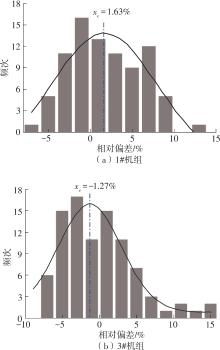
Fig.1
Comparison of results obtained by emission factor method and CO2-CEMS method for Units 1# and 3#"
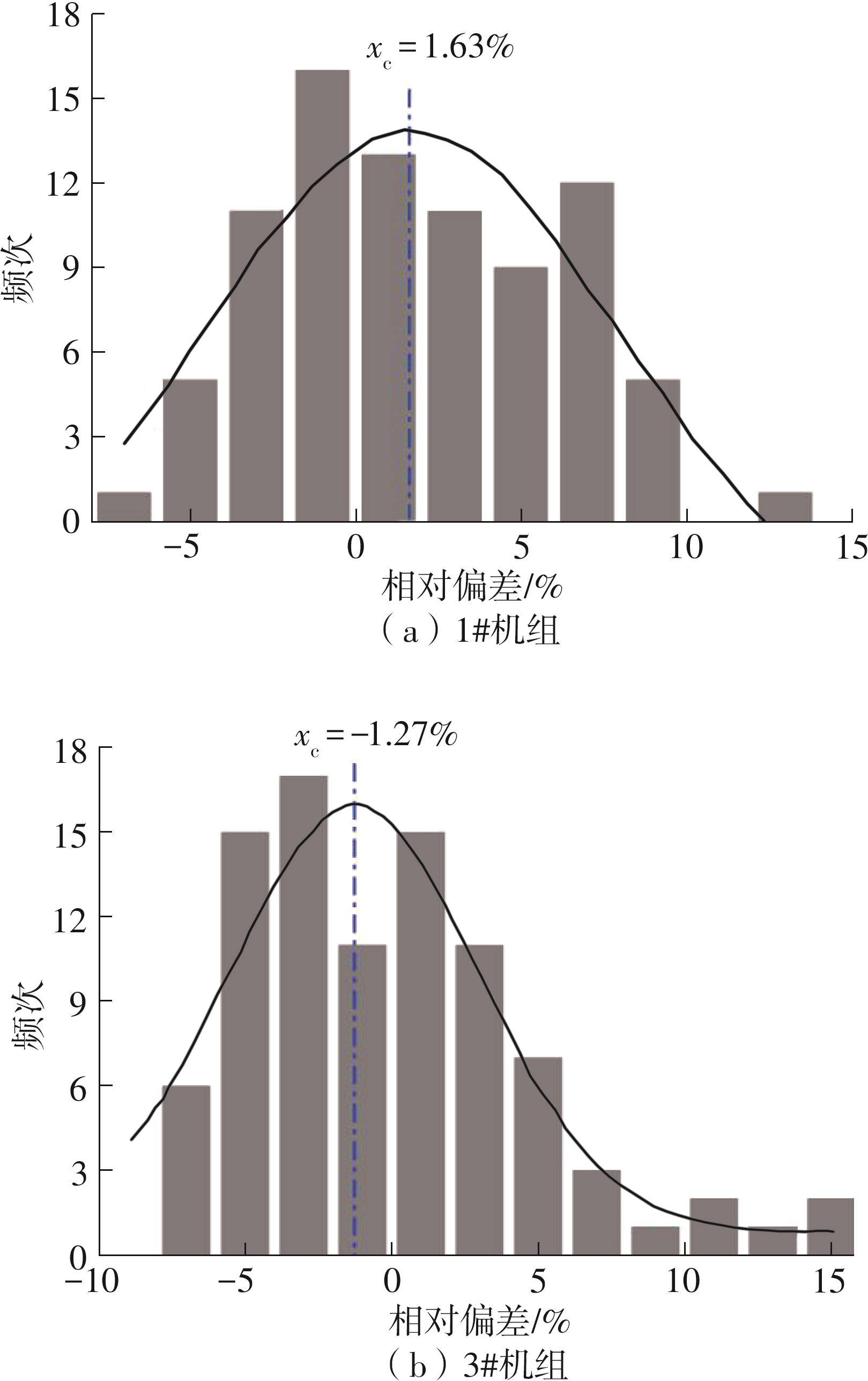
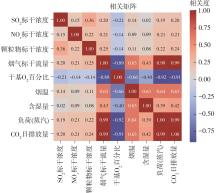
Fig.2
Heatmap of correlation analysis between CO2 emission prediction variables for Unit 3#"
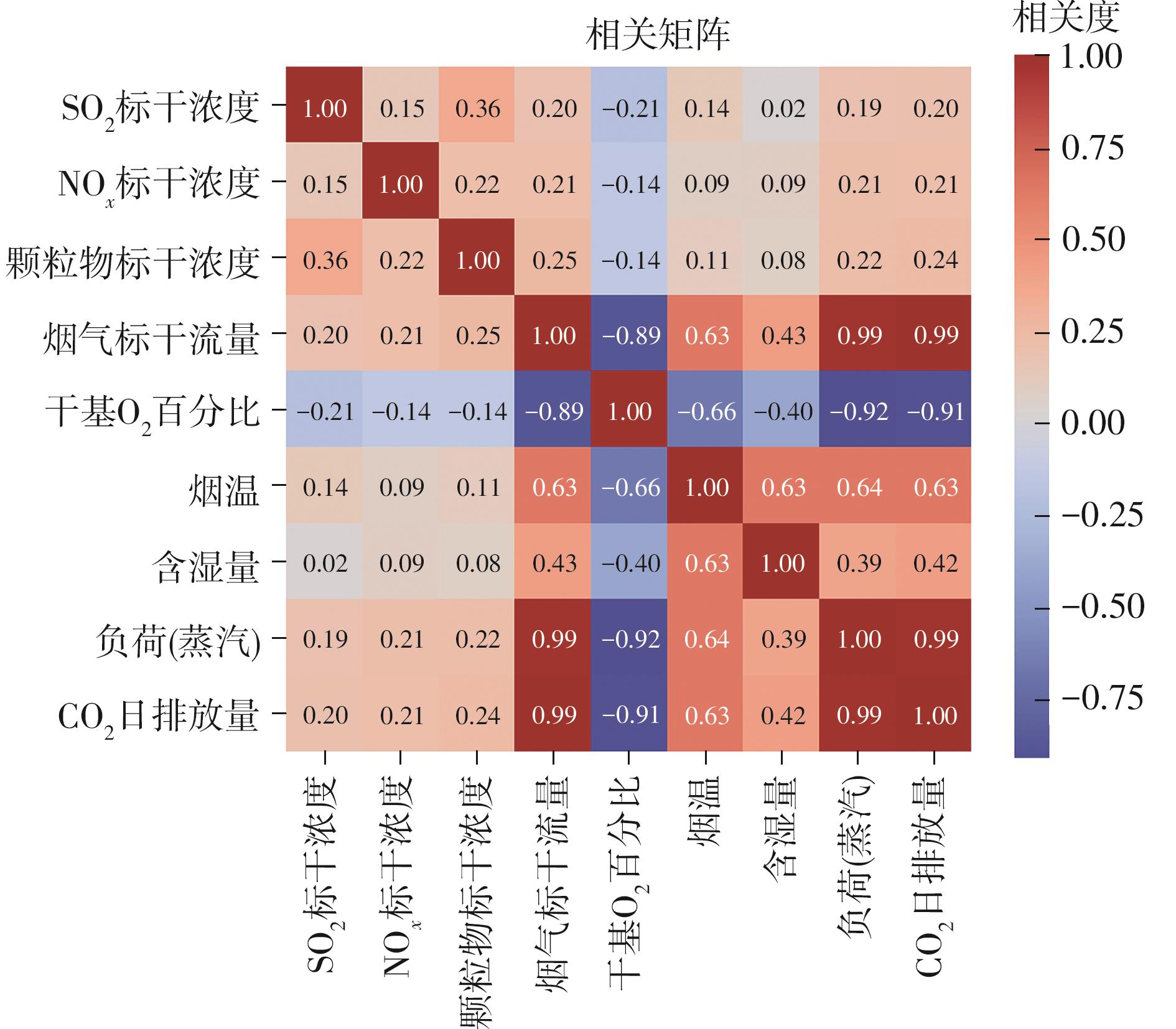
Table 3
Comparison of R²and MAPE among different algorithms for Units 1# and 3#"
| 算法 | R2 | MAPE/% | ||
|---|---|---|---|---|
| 1#机组 | 3#机组 | 1#机组 | 3#机组 | |
| 多元线性回归 | 0.994 35 | 0.994 29 | 1.17 | 1.25 |
| 随机森林 | 0.991 37 | 0.993 85 | 1.38 | 1.29 |
| 决策树 | 0.986 14 | 0.989 48 | 1.67 | 1.65 |
| LightGBM | 0.994 28 | 0.994 36 | 1.14 | 1.26 |
| AdaBoost | 0.986 13 | 0.992 12 | 1.85 | 1.60 |
| XGboost | 0.995 43 | 0.994 86 | 1.03 | 1.21 |
| 岭回归 | 0.994 37 | 0.994 30 | 1.17 | 1.25 |
| MLPRegressor | -24.350 00 | -18.320 00 | 93.78 | 93.45 |
| SVR | 0.002 00 | -0.006 00 | 15.55 | 19.94 |
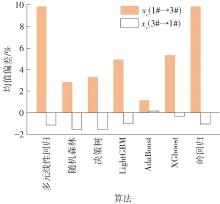
Fig.3
Comparison of xc(1#→3#) and xc(3#→1#) for different machine learning algorithms"
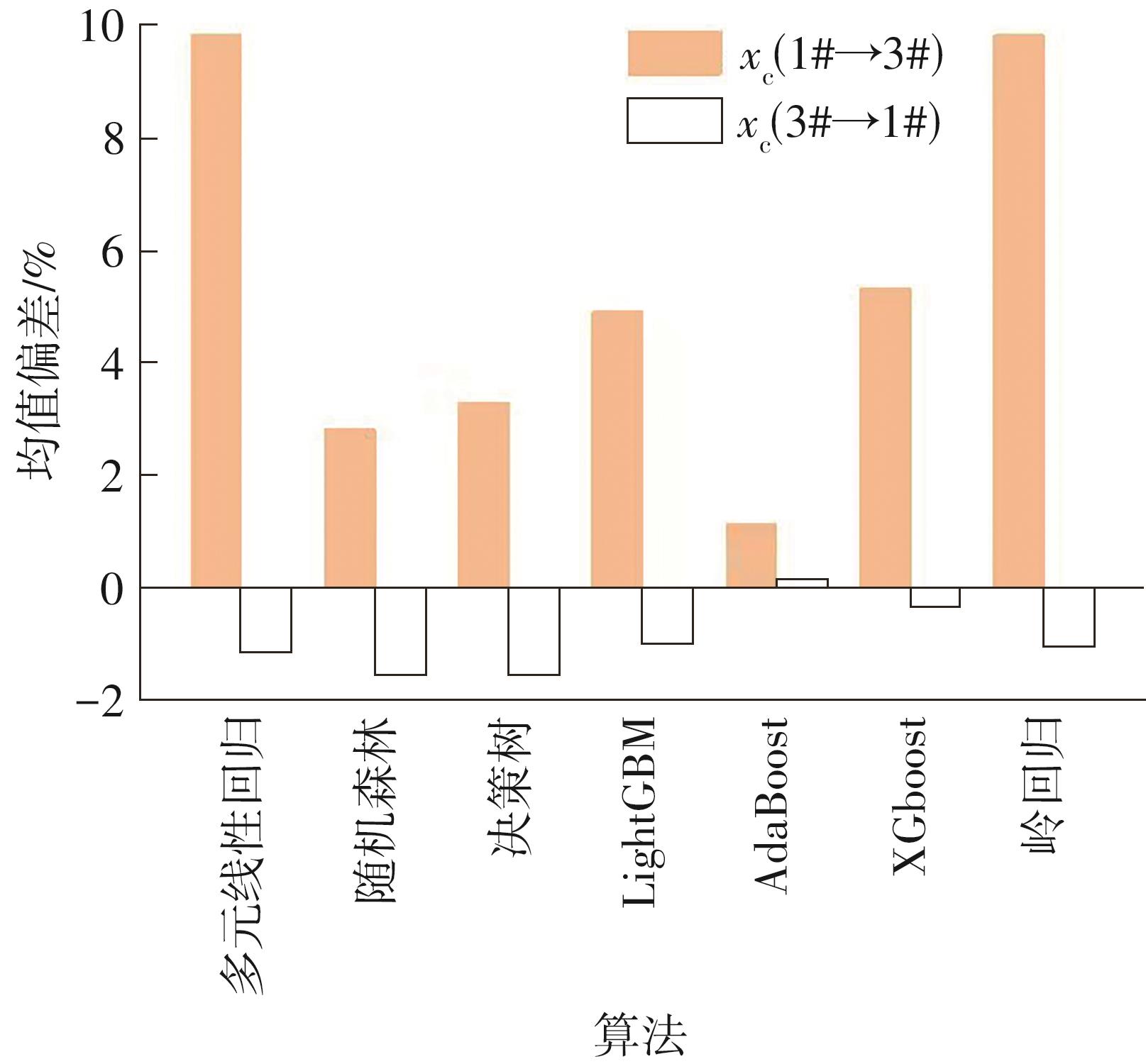
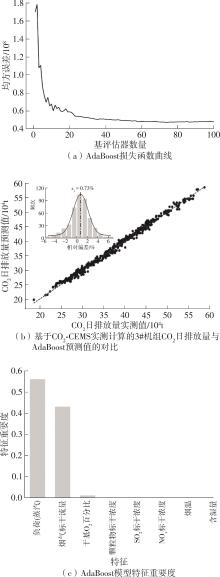
Fig.4
AdaBoost-based CO₂ dynamic emission prediction-related results"
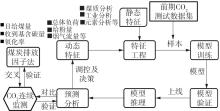
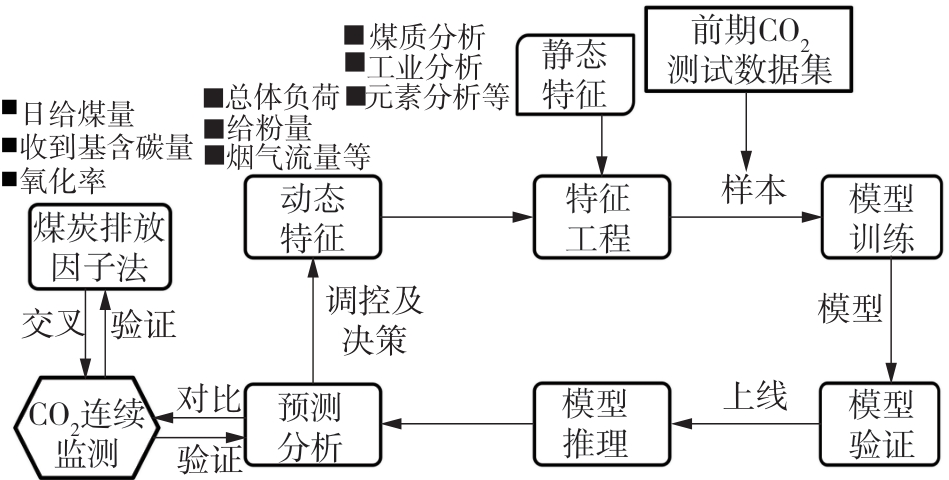
Fig.5
Flowchart of crbon emission measurement and prediction based on multi-source data fusion"
| [1] | D-H OH, DAT V N, LEE J-C,et al .Prediction of CO2 capture capability of 0.5 MW MEA demo plant using three different deep learning pipelines[J].Fuel,2022,315:123229. |
| [2] | 姚顺春,李龙千,卢志民,等 .机器学习驱动锅炉燃烧优化技术的现状与展望[J].洁净煤技术,2024,30(2):228-243. |
| YAO Shunchun, LI Longqian, LU Zhimin,et al .Current situation and prospect of machine learning-driven boiler combustion optimization technology[J].Clean Coal Technology,2024,30(2):228-243. | |
| [3] | 陈公达,程国辉,蔡汝金,等 .烟气碳排放监测数据补缺方法适用性[J].洁净煤技术,2024,30(8):32-41. |
| CHEN Gongda, CHENG Guohui, CAI Rujin,et al .Applicability of data gaps imputation methods for monitoring flue gas carbon emissions[J].Clean Coal Techno-logy,2024,30(8):32-41. | |
| [4] | 李振山,李维成,刘海洋,等 .中国化学链燃烧技术研发进展与展望[J].中国电机工程学报,2024,44(18):7200-7220. |
| LI Zhenshan, LI Weicheng, LIU Haiyang,et al .Development and prospect of chemical looping combustion technology in China[J].Proceedings of the CSEE,2024,44(18):7200-7220. | |
| [5] | 王萍萍,赵永椿,张军营,等 .双碳目标下燃煤电厂碳计量方法研究进展[J].洁净煤技术,2022,28(10):170-183. |
| WANG Pingping, ZHAO Yongchun, ZHANG Junying,et al .Research progress on carbon measurement methods of coal-fired power plants under the background of carbon neutrality[J].Clean Coal Technology,2022,28(10):170-183. | |
| [6] | 郭军军,张泰,李鹏飞,等 .中国煤粉富氧燃烧的工业示范进展及展望[J].中国电机工程学报,2021,41(4):1197-1208. |
| GUO Junjun, ZHANG Tai, LI Pengfei,et al .Industrial demonstration progress and trend in pulverized coal oxy-fuel combustion in China[J].Proceedings of the CSEE,2021,41(4):1197-1208. | |
| [7] | 姚顺春,刘泽明,卢志民,等 .软测量技术赋能燃煤电厂碳排放计量的研究进展[J].洁净煤技术,2024,30(8):18-31. |
| YAO Shunchun, LIU Zeming, LU Zhimin,et al .Research progress of soft measurement technology optimizing carbon emission measurement of coal-fired power plants[J].Clean Coal Technology,2024,30(8):18-31. | |
| [8] | 李惠,黄修行,周于惠 .“双碳”目标视角下燃煤电厂碳计量方法的研究[J].资源节约与环保,2024(6):100-103. |
| LI Hui, HUANG Xiuxing, ZHOU Yuhui .Research on carbon measurement methods of coal-fired ower plants from the perspective of the “Dual Carbon” goals[J].Resource Conservation and Environmental Protection,2024(6):100-103. | |
| [9] | 曾瑞新,胡松伯,倪忠晓,等 .燃煤电厂碳排放典型计算及分析[J].化工设计通讯,2023,49(3):167-169. |
| ZENG Rui-xin, HU Song-bo, NI Zhong-xiao,et al .Typical calculation and analysis of carbon emissions from coal-fired power plants[J].Chemical Engineering Design Communications,2023,49(3):167-169. | |
| [10] | 宋明光,李小江,孙友源,等 .基于在线监测法的火电机组碳排放分析[J].洁净煤技术,2024,30(S1):464-73. |
| SONG Mingguang, LI Xiaojiang, SUN Youyuan,et al .Analysis of carbon emission for thermal power units based on online monitoring method[J].Clean Coal Technology,2024,30(S1):464-473. | |
| [11] | 包放 .燃煤电厂碳排放核算技术体系研究与应用[J].能源与节能,2023(9):94-97. |
| BAO Fang .Research and application of carbon emi-ssion accounting technology system for coal-fired power plants[J].Energy and Energy Conservation,2023(9):94-97. | |
| [12] | 陈齐,许明海,沈赛燕,等 .基于残差双向长短期记忆效应网络模型的电力企业碳排放预测[J].环境污染与防治,2024,46(5):689-93,720. |
| CHEN Qi, XU Minghai, SHEN Saiyan,et al .Carbon emission prediction for power companies based on ResNet-BiLSTM model[J].Environmental Pollution Control,46(5):689-93,720. | |
| [13] | LEERBECK K, BACHER P, JUNKER RG,et al .Short-term forecasting of CO2 emission intensity in power grids by machine learning[J].Applied Energy,2020,277:115527. |
| [14] | WU W, LIN Y-T, LIAO P-H,et al .Prediction of CO-NO x emissions from a natural gas power plant using proper machine learning models[J].Energy Techno-logy,2023,11(7):2300041. |
| [15] | 王妍艳,陆骏超,赵冬建 .燃煤电厂二氧化碳排放的核算与管理分析[J].电力与能源,2024,45(1):102-106. |
| WANG Yanyan, LU Junchao, ZHAO Dongjian .Accounting and management analysis of CO2 emissions from coal-fired power plants[J].Electricity and Energy,2024,45(1):102-106. | |
| [16] | 李朋,周卫青,白孝轩,等 .燃煤电厂碳排放绩效核算及影响分析[J].洁净煤技术,2024,30(8):66-74. |
| LI Peng, ZHOU Weiqing, BAI Xiaoxuan,et al .Carbon emission performance calculation and impact analysis of coal-fired power plants[J].Clean Coal Techno-logy,2024,30(8):66-74. | |
| [17] | 王正阳 .燃煤电厂的二氧化碳排放计算与影响分析[J].节能与环保,2022(5):39-40. |
| WANG Zheng-yang .Calculation and Impact Analysis of carbon dioxide emission from coal-fired power plants[J].Energy Conservation and Environmental Protection,2022(5):39-40. | |
| [18] | 吴杏平,康重庆,袁启恒 .我国碳排放影响因素及电力碳排放核算方法研究综述[J].中国电机工程学报,2024,44(S1):1-18. |
| WU Xingping, KANG Chongqing, YUAN Qiheng .A review of the impact factors of carbon emissions and the accounting methods for electricity carbon emissions in China[J].Proceedings of the CSEE,2024,44(S1):1-18. | |
| [19] | 王明,周志兴,封明敏,等 .火电机组实测法CO2排放监测模型及准确性验证[J].煤化工,2022,50(2):18-21,33. |
| WANG Ming, ZHOU Zhixing, FENG Mingmin,et al. Online CO 2 emission monitoring system for coal-fired power plant based on direct measurement and its accuracy verification[J].Coal Chemical Industry,2022,50(2):18-21,33. | |
| [20] | MA Y, HE P-J, LÜ F,et al .Machine learning-based prediction of the CO2 concentration in the flue gas and carbon emissions from a waste incineration plant[J].ACS ES&T Engineering,2024,4(3):737-747. |
| [21] | WEN L, CAO Y .Influencing factors analysis and forecasting of residential energy-related CO2 emissions utilizing optimized support vector machine[J].Journal of Cleaner Production,2020,250:119492. |
| [22] | YUAN Z, MENG L, GU X,et al .Prediction of NO x emissions for coal-fired power plants with stacked-generalization ensemble method[J].Fuel,2021,289:119748. |
| [1] | LING Fei, GU Xuerong. Prediction of Target Inhibitor Activity by Integrating Machine Learning and Metaheuristic Algorithms [J]. Journal of South China University of Technology(Natural Science Edition), 2026, 54(2): 91-101. |
| [2] | WEN Huiying, HUANG Kunhuo, CHEN Zhe, ZHAO Sheng, HU Yuqing, HUANG Junda. An Investigation into Expressway Merging Behavior and Safety Based on ExiD Data [J]. Journal of South China University of Technology(Natural Science Edition), 2025, 53(8): 50-60. |
| [3] | WEN Huiying, MA Zhaoliang, ZHAO Sheng, WU Liming, HUANG Kunhuo. Analysis of Factors Affecting Truck Accidents on Mountainous Freeways [J]. Journal of South China University of Technology(Natural Science Edition), 2025, 53(7): 93-103. |
| [4] | LIU Wenshuo, ZHONG Mingfeng, ZHOU Bo, LÜ Fangzhou. Research on Temperature Model of Steel Box Girder of High-Speed Railway Cable-Stayed Bridge Based on Machine Learning [J]. Journal of South China University of Technology(Natural Science Edition), 2025, 53(6): 25-33. |
| [5] | GONG Zhongwen, XIONG Ergang, WANG Wenxiang, et al. Shear Strength Calculation of RC Beams Without Shear Reinforcement Based on Crack Sliding Model [J]. Journal of South China University of Technology(Natural Science Edition), 2024, 52(5): 114-126. |
| [6] | ZHAO Jiandong, XU Huiling, LÜ Xing, et al. Recognition Model of Highway Toll Evasion Behavior Considering Cost-Sensitivity [J]. Journal of South China University of Technology(Natural Science Edition), 2024, 52(5): 10-19. |
| [7] | YAO Shunchun, ZHI Jiaqi, FU Jinbei, et al. Research Progress of Online Carbon Emission Monitoring Technology for Thermal Power Enterprises [J]. Journal of South China University of Technology(Natural Science Edition), 2023, 51(6): 97-108. |
| [8] | ZHOU Chuhao, LIN Peiqun, YAN Mingyue. Traffic Data Imputation Based on Self-Supervised Learning [J]. Journal of South China University of Technology(Natural Science Edition), 2023, 51(4): 101-114. |
| [9] | DONG Ping, WEI Shuyang, LIU Mingbo. Scheduling Strategies for Electric Vehicle Participation in Electricity Markets Under Multi-Network Collaboration [J]. Journal of South China University of Technology(Natural Science Edition), 2023, 51(12): 83-94. |
| [10] | WANG Xiaofei, LI Siyu, CHEN Mi, et al. Influence of the Combination Equilibrium of Horizontal and Crest Vertical Curves on Highway Safety [J]. Journal of South China University of Technology(Natural Science Edition), 2022, 50(7): 76-84. |
| [11] | SONG Jian, WANG Wenlong, LI Dong, et al. Injection Molding Part Size Prediction Method Based on Stacking Ensemble Learning [J]. Journal of South China University of Technology(Natural Science Edition), 2022, 50(6): 19-26. |
| [12] | XIA Shaojun, JIN Qinglong, WU Zhixiang. Exergy Efficiency Analyses and Optimization of Regenerative S-CO2 Brayton Cycle [J]. Journal of South China University of Technology(Natural Science Edition), 2022, 50(2): 111-120. |
| [13] | LIN Peiqun XIA Yu ZHOU Chuhao. Freeway Travel Time Prediction Based on Spatial and Temporal Characteristics of Road Networks [J]. Journal of South China University of Technology(Natural Science Edition), 2021, 49(8): 1-11. |
| [14] | JIA Ruo, DAI Shenghong, HUANG Ni, et al. Literature Review on Traffic Congestion Identification Methods [J]. Journal of South China University of Technology (Natural Science Edition), 2021, 49(4): 124-139. |
| [15] | ZHAO Jing, WANG Xuancang, FAN Zhenyang, et al. Evaluation on Performance of Asphalt Pavement Based on Support Vector Machine [J]. Journal of South China University of Technology (Natural Science Edition), 2020, 48(9): 116-123. |
| Viewed | ||||||
|
Full text |
|
|||||
|
Abstract |
|
|||||