Journal of South China University of Technology(Natural Science Edition) ›› 2026, Vol. 54 ›› Issue (2): 91-101.doi: 10.12141/j.issn.1000-565X.250020
• Biological Engineering • Previous Articles Next Articles
Prediction of Target Inhibitor Activity by Integrating Machine Learning and Metaheuristic Algorithms
LING Fei, GU Xuerong
- School of Biology and Biological Engineering/ Guangdong Provincial Key Laboratory of Fermentation and Enzyme Engineering,South China University of Technology,Guangzhou 510006,Guangdong,China
-
Received:2025-01-17Online:2026-02-25Published:2025-09-19 -
Contact:顾学荣(1997—),男,硕士生,主要从事靶点药物活性预测研究。 E-mail:202120124398@mail.scut.edu.cn -
About author:凌飞(1972—),女,博士,教授,主要从事单细胞转录组、药物设计研究。E-mail: fling@scut.edu.cn -
Supported by:the National Natural Science Foundation of China(12322119)

CLC Number:
Cite this article
LING Fei, GU Xuerong. Prediction of Target Inhibitor Activity by Integrating Machine Learning and Metaheuristic Algorithms[J]. Journal of South China University of Technology(Natural Science Edition), 2026, 54(2): 91-101.
share this article

Table 1
Detailed molecular characteristic information"
| 类型 | 名字 | 维度/位 | 模块 |
|---|---|---|---|
| 描述符 | RDKit | 210 | rdkit.Chem.Descriptors |
| 分子指纹 | ECFP | 1 024 | deepchem.feat.CircularFingerprint |
| 分子指纹 | MACCS | 167 | rdkit.Chem.MACCSkeys |
| 分子指纹 | AtomParis | 1 024 | rdkit.Chem.AtomPairs |
| 分子指纹 | FP2 | 1 024 | rdkit.Chem.RDKFingerprint |
| 分子指纹 | PharmacoPFP | 38 | rdkit.Chem.Pharm2D |
| 分子图 | MolGraphConvMolFeaturizer | ||
| 分子图 | ConvMolFeaturizer |
Table 2
Heuristic hyperparameter optimization algorithm"
| 名称 | 基本思想 |
|---|---|
| 遗传算法(GA) | 模拟自然选择和遗传机制,通过选择、交叉和变异等操作逐步逼近最优解 |
| 差分进化算法(DE) | 通过个体之间的差分变异和重组合来探索解空间和实现全局最优 |
| 朴素贝叶斯算法(NB) | 基于贝叶斯定理和条件独立假设,通过计算后验概率进行分类决策 |
| 粒子群算法(PSO) | 模拟群体觅食行为,通过粒子的速度和位置更新,在解空间中搜索最优解 |
| 模拟退火算法(SA) | 模仿物理退火过程,通过控制温度逐步减少系统能量,以寻找全局最优解 |
| 蚁群算法(ACO) | 模仿蚂蚁觅食过程,通过信息素的传播与更新,在解空间中逐步逼近最优解 |
| 麻雀搜索算法(SSA) | 模拟麻雀群体觅食行为,结合探索与开发策略实现全局最优化 |
| 海鸥算法(SOA) | 模拟海鸥群体飞行和觅食行为,通过局部与全局搜索的相互结合优化解空间 |
| 鲸鱼算法(WOA) | 模仿鲸鱼围捕猎物的过程,通过包围与螺旋更新策略寻找到最优解 |
| 飞蛾扑火算法(MFO) | 模拟飞蛾趋光的行为,通过光源的吸引力引导搜索以找到全局最优解 |
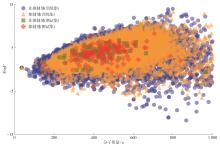
Fig.1
Chemical spatial analysis of datasets"
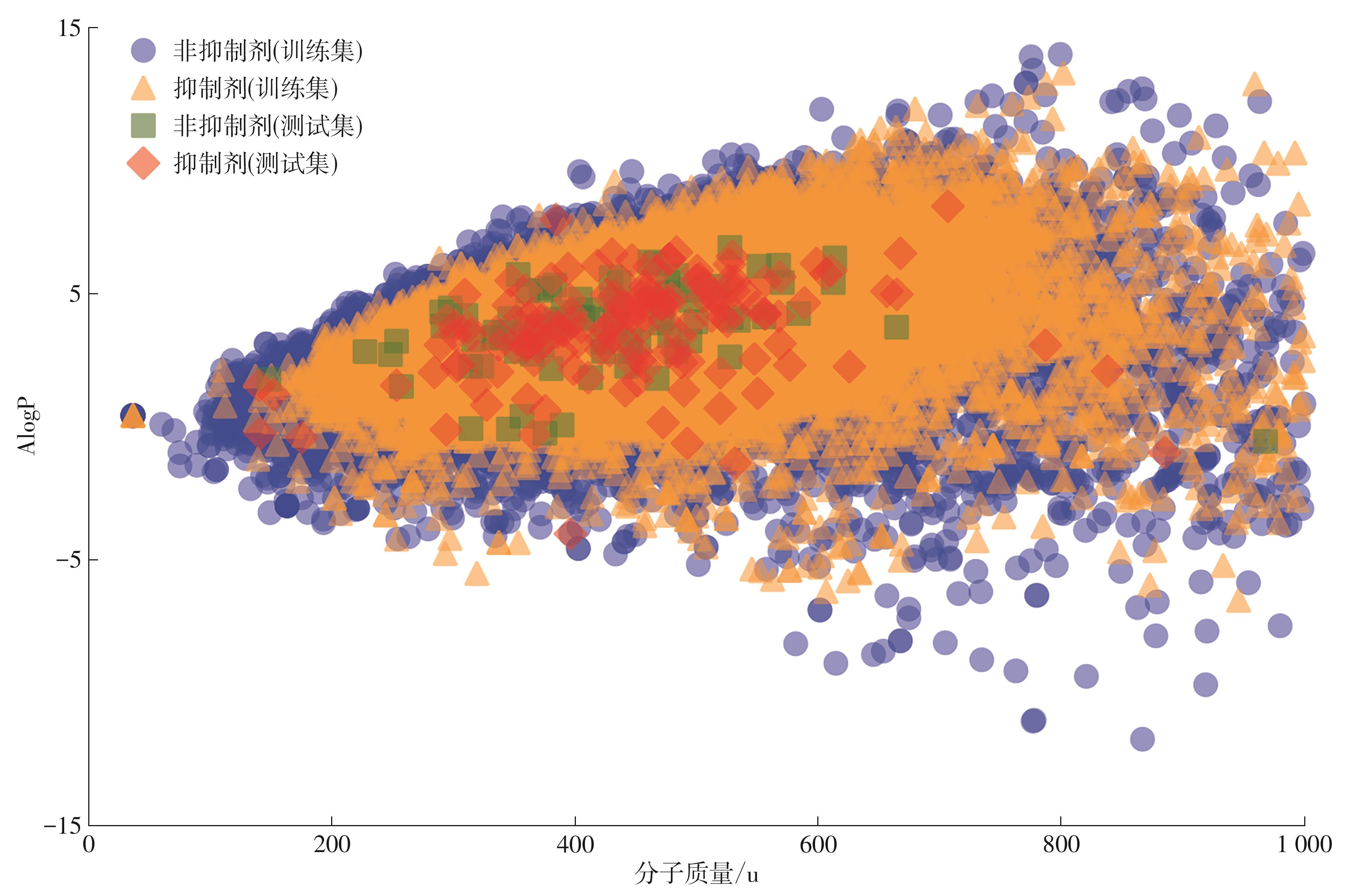
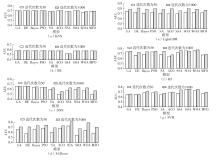
Fig.2
Effect of iteration number on model predictive performance"
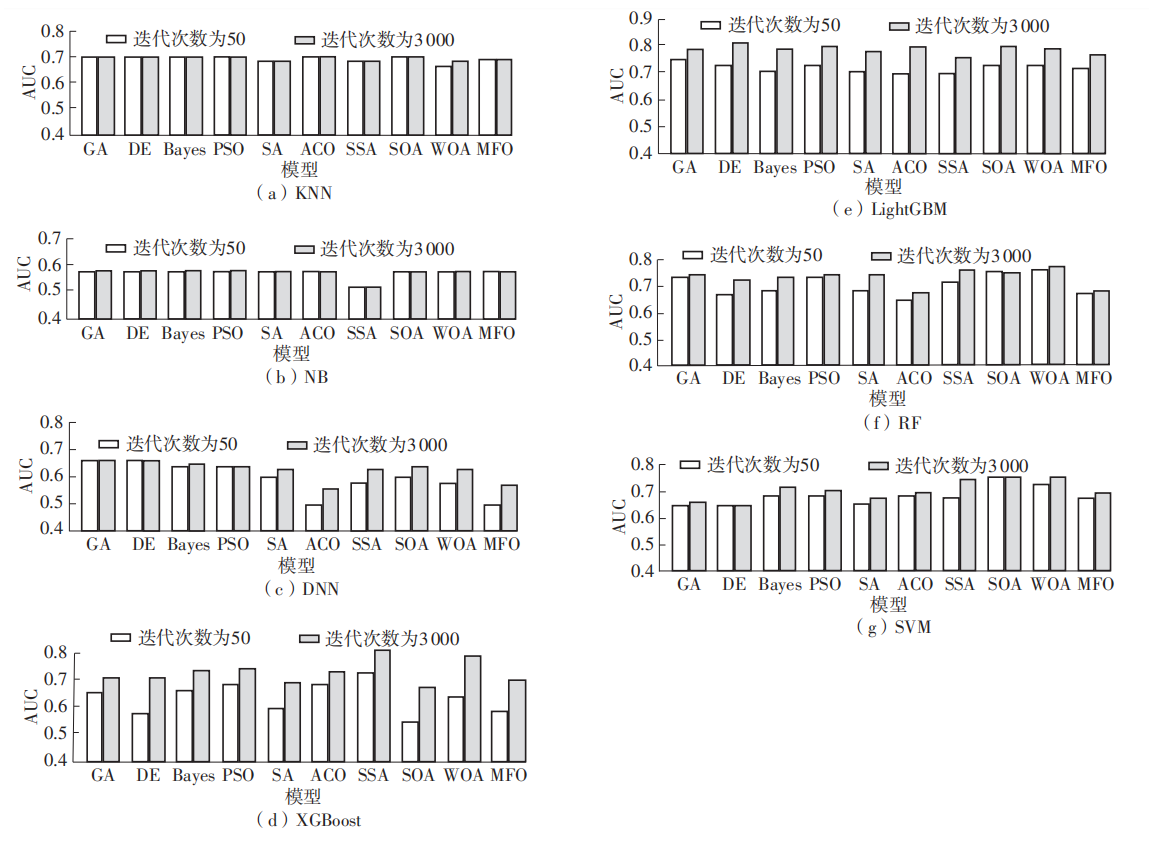
Fig.3
Evaluation of optimal model predictive performance"
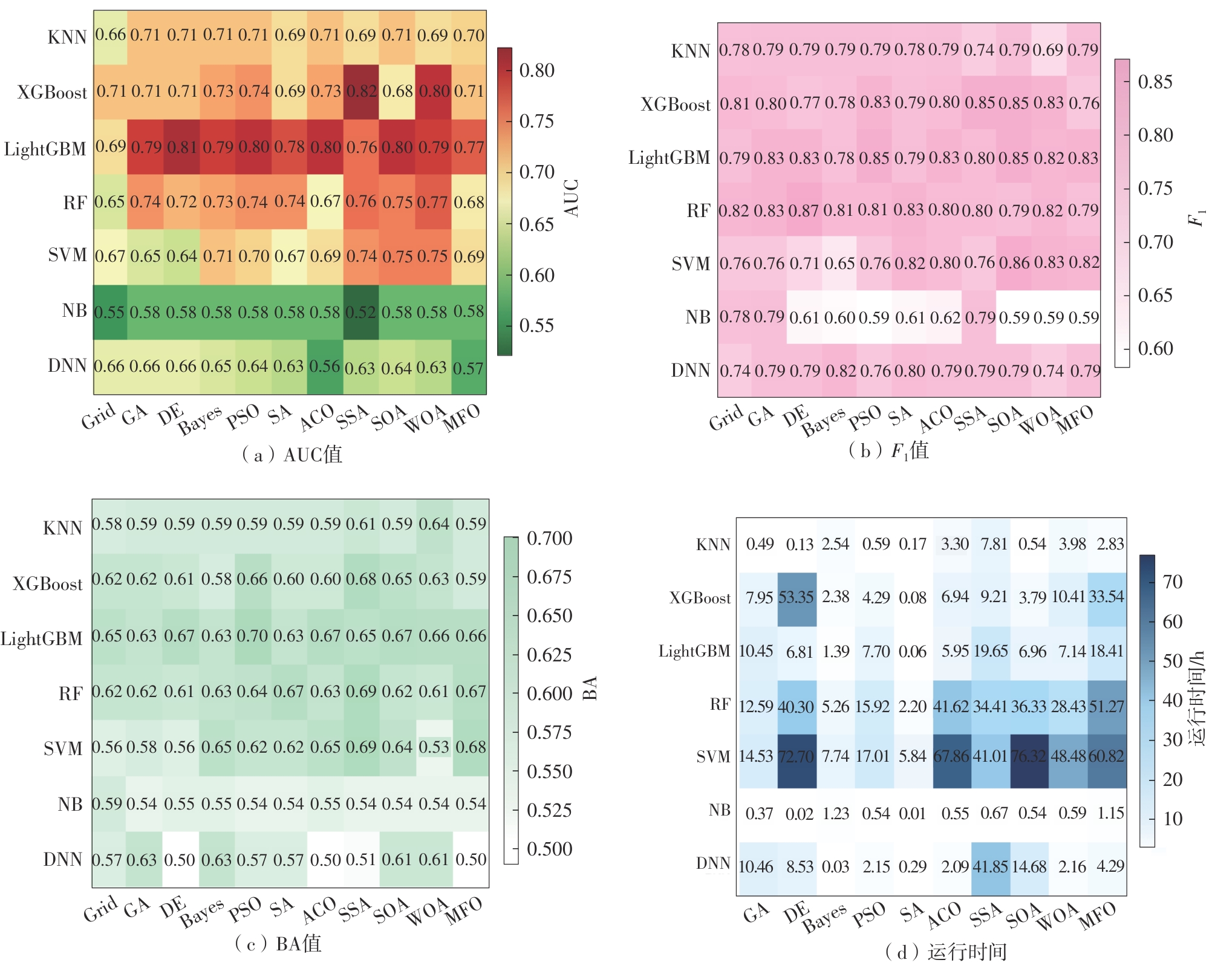
Fig.4
Effect of combining two types of molecular features on model predictive performance"
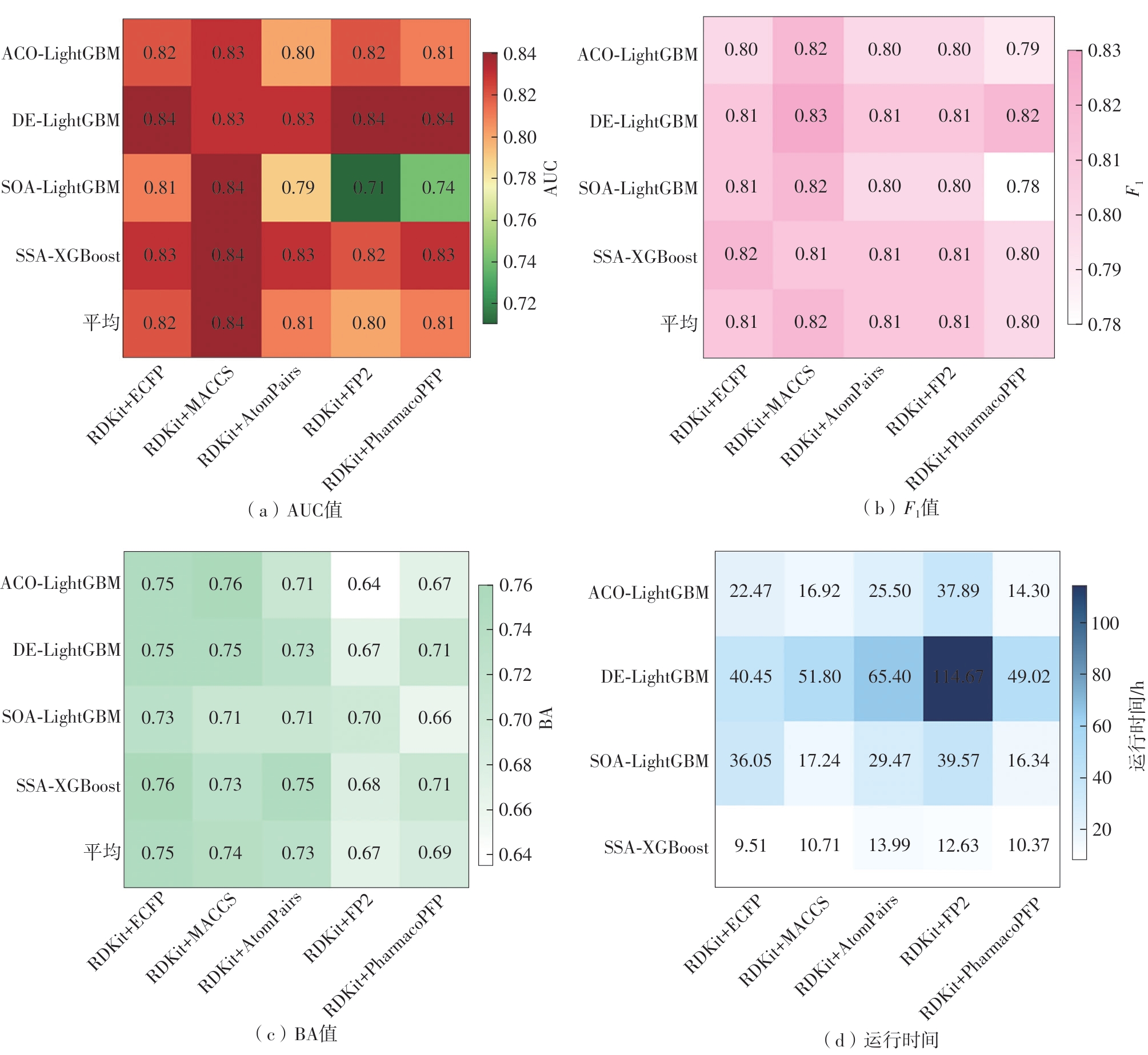
Fig.5
Effect of combining three types of molecular features on model predictive performance"
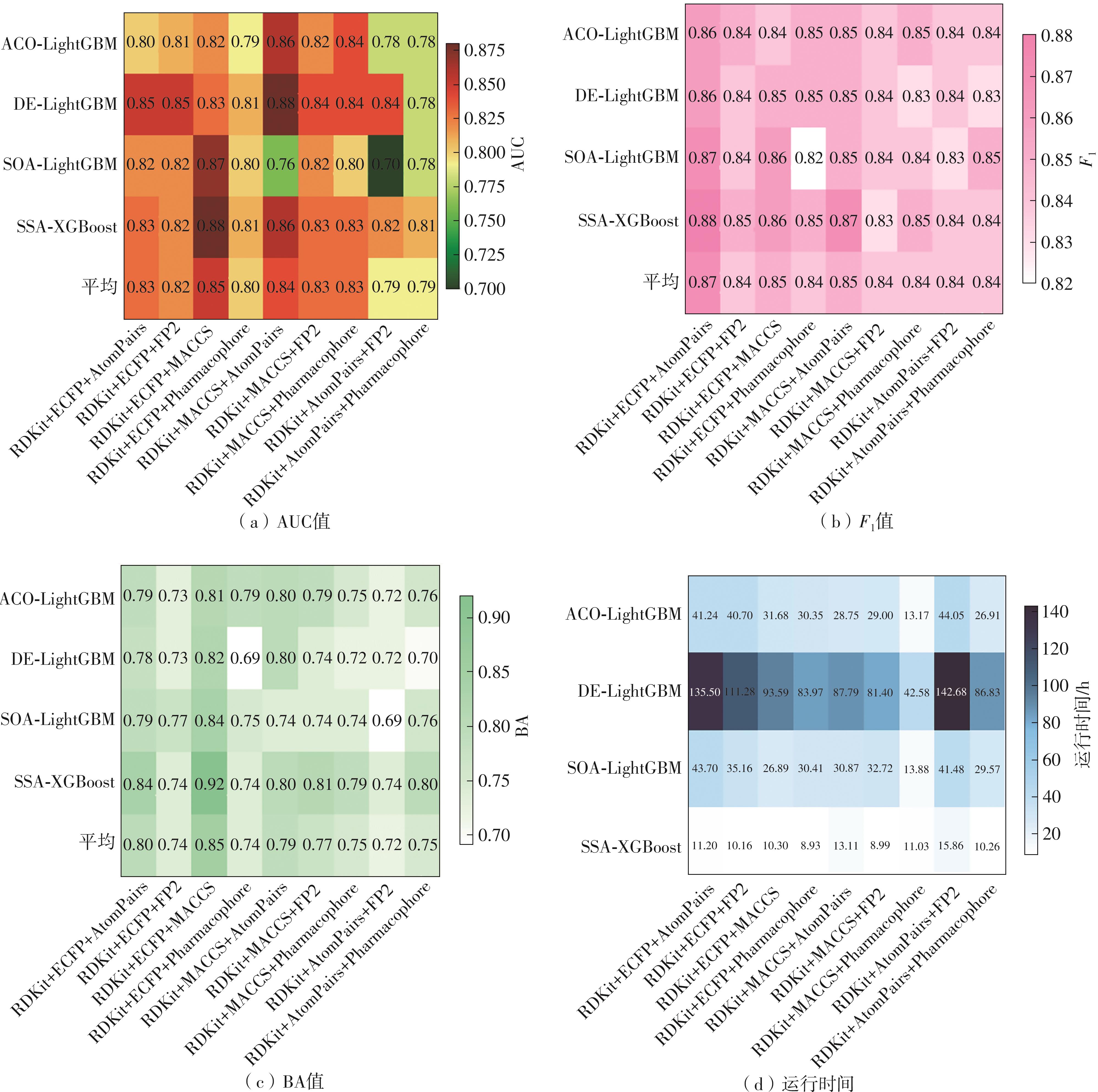
Fig.6
Effect of combining four or five types of molecular features on model predictive performance"
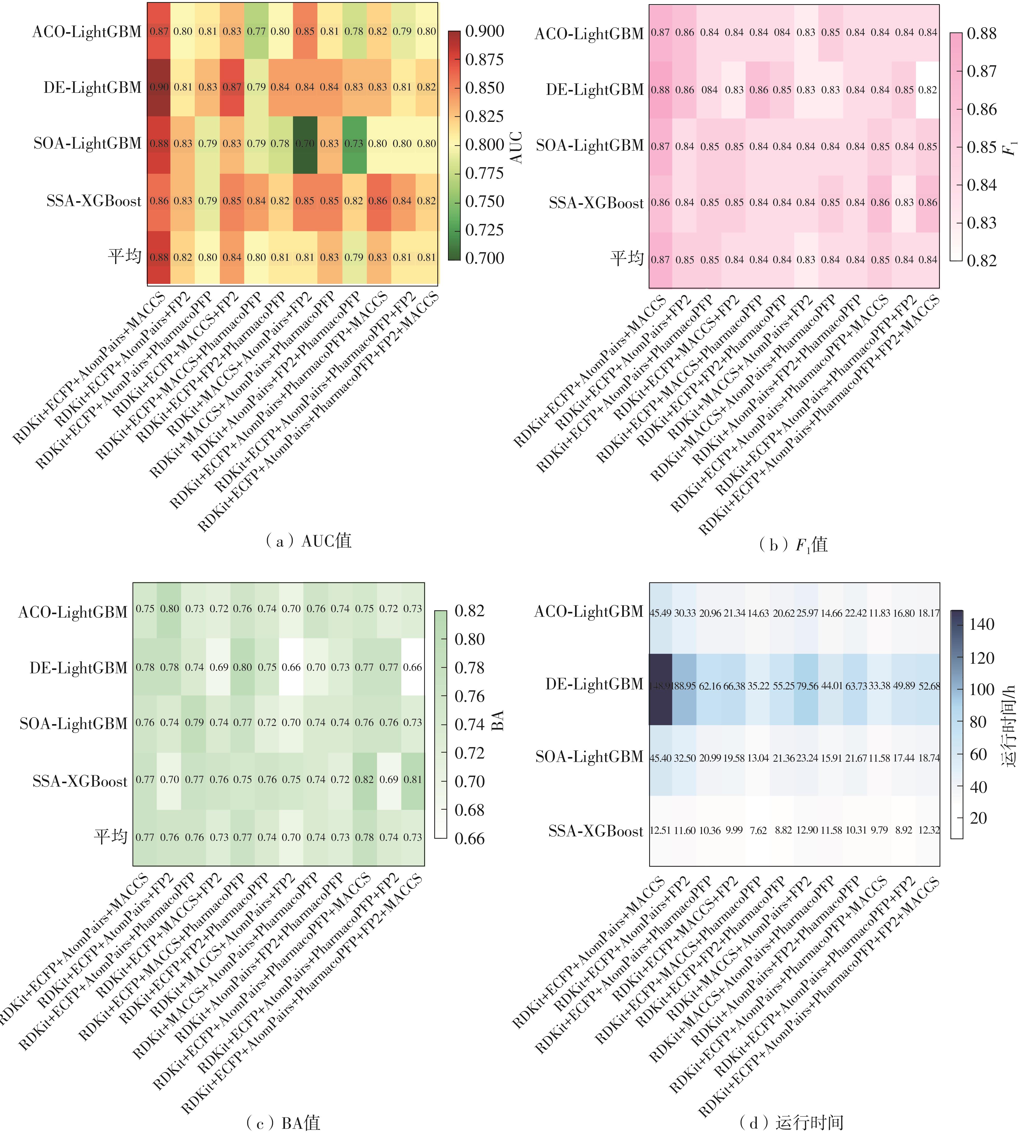
Table 3
Comparison of predictive performance between grid search and SSA model based on molecular graphs"
| 模型 | AUC | F1 | BA | 时间/h | ||||
|---|---|---|---|---|---|---|---|---|
| Grid | SSA | Grid | SSA | Grid | SSA | Grid | SSA | |
| GAT | 0.78 | 0.87 | 0.78 | 0.91 | 0.67 | 0.89 | 1.58 | 7.47 |
| GCN | 0.74 | 0.83 | 0.73 | 0.77 | 0.66 | 0.73 | 5.11 | 10.85 |
| MPNN | 0.80 | 0.82 | 0.65 | 0.83 | 0.69 | 0.75 | 2.90 | 25.53 |
| Attentive FP | 0.70 | 0.89 | 0.67 | 0.89 | 0.65 | 0.79 | 3.02 | 24.75 |
Table 4
Comparison of predictive performance of SSA-XGBoost model based on external dataset"
| 方法(特征) | AUC | F1 | BA | |||
|---|---|---|---|---|---|---|
| 外部数据集 | 原数据集 | 外部数据集 | 原数据集 | 外部数据集 | 原数据集 | |
| RDKit+MACCS | 0.83 | 0.74 | 0.86 | 0.84 | 0.73 | 0.81 |
| RDKitDes+ECFP | 0.81 | 0.78 | 0.86 | 0.83 | 0.76 | 0.82 |
| RDKit+ECFP+MACCS | 0.85 | 0.80 | 0.84 | 0.88 | 0.92 | 0.86 |
| RDKit+MACCS+AtomPairs | 0.85 | 0.77 | 0.85 | 0.83 | 0.84 | 0.88 |
| RDKit+ECFP+AtomPairs+MACCS | 0.88 | 0.79 | 0.87 | 0.86 | 0.77 | 0.86 |
| [1] | FENG B, LIU Z, HUANG N,et al .A bioactivity foundation model using pairwise meta-learning[J].Nature Machine Intelligence,2024,6(8):962-974. |
| [2] | ZHANG H, MAO J, QI H Z,et al .Developing novel computational prediction models for assessing chemical-induced neurotoxicity using naïve Bayes classifier technique[J].Food and Chemical Toxicology,2020,143:111513/1-11 |
| [3] | PRABHA N K, SHARMA A, SANDHU H,et al .TNFipred:a classification model to predict TNF-α inhibitors[J].Molecular Diversity,2024,28(3):1697-1707. |
| [4] | LI B, KANG X, ZHAO D,et al .Machine learning models combined with virtual screening and molecular docking to predict human topoisomerase I inhibitors[J].Molecules,2019,24(11):2107/1-16. |
| [5] | SHI J, ZHAO G, WEI Y .Computational QSAR model combined molecular descriptors and fingerprints to predict HDAC1 inhibitors[J].Medecine Sciences,2018,34:52-58. |
| [6] | KANG M G, KANG N S .Predictive model for drug-induced liver injury using deep neural networks based on substructure space[J].Molecules,2021,26(24):7548/1-16 |
| [7] | DENG J, YANG Z, WANG H,et al .A systematic study of key elements underlying molecular property prediction[J].Nature Communications,2023,14(1):6395/1-20. |
| [8] | LV Q, CHEN G, YANG Z,et al .Meta learning with graph attention networks for low-data drug discovery[J].IEEE Transactions on Neural Networks and Learning Systems,2023,35(8):11218-11230. |
| [9] | YANG K, SWANSON K, JIN W,et al .Analyzing learned molecular representations for property prediction[J].Journal of Chemical Information and Modeling,2019,59(8):3370-3388. |
| [10] | MASTROPIETRO A, PASCULLI G, BAJORETH J .Learning characteristics of graph neural networks predicting protein-ligand affinities[J].Nature Machine Intelligence,2023,5(12):1427-1436. |
| [11] | MAYR A, KLAMBAUER G, UNTERTHINER T,et al .Large-scale comparison of machine learning methods for drug target prediction on ChEMBL[J].Chemical Science,2018,9:5441-5451. |
| [12] | WAINER J, FONSECA P .How to tune the RBF SVM hyperparameters?An empirical evaluation of 18 search algorithms[J].Artificial Intelligence Review,2021,54(6):4771-4797. |
| [13] | BERGSTRA J, BENGIO Y .Random search for hyper-parameter optimization[J].Journal of Machine Lear-ning Research,2012,13(2):281-305. |
| [14] | WANG X, JIN Y, SCHMITT S,et al .Recent advances in Bayesian optimization[J].ACM Computing Surveys,2023,55(13s):1-36. |
| [15] | YAMASHITA R, NISHIO M, DO R K G,et al .Convolutional neural networks:an overview and application in radiology[J].Insights into Imaging,2018,9:611-629. |
| [16] | CERETO-MASSAGUÉ A, OJEDA M J, VALLS C,et al .Molecular fingerprint similarity search in virtual screening[J].Methods,2015,71:58-63. |
| [17] | CARHART R E, SMITH D H, VENKATARAGHAVAN R .Atom pairs as molecular features in structure-activity studies:definition and applications[J].Journal of Chemical Information and Computer Sciences,1985,25(2):64-73. |
| [18] | O’ BOYLE N M, BANCK M, JAMES C A,et al .Open Babel:an open chemical toolbox[J].Journal of Cheminformatics,2011,3:33/1-14. |
| [19] | GOBBI A, POPPINGER D .Genetic optimization of combinatorial libraries[J].Biotechnology and Bioengineering,1998,61(1):47-54. |
| [20] | SIEG J, FELDMANN C W, HEMMERICH J,et al .MolPipeline:a Python package for processing mole-cules with RDKit in scikit-learn[J].Journal of Chemical Information and Modeling,2024,64(24):9027-9033. |
| [21] | DUVENAUD D K, MACLAURIN D, IPARRAGUIRRE J,et al .Convolutional networks on graphs for learning molecular fingerprints[C]∥ Proceedings of the 29th International Conference on Neural Information Proce-ssing Systems.Cambridge:MIT Press,2015:2224-2232. |
| [22] | ZHAO W, WANG L, MIRJALILI S .Artificial hummingbird algorithm:a new bio-inspired optimizer with its engineering applications[J].Computer Methods in Applied Mechanics and Engineering,2022,388:114194/1-45. |
| [23] | DORIGO M, MANIEZZO V, COLORNI A .Ant system:optimization by a colony of cooperating agents[J].IEEE Transactions on Systems,Man,and Cybernetics,Part B (Cybernetics),1996,26(1):29-41. |
| [24] | WU J, CHEN Y, WU J,et al .Large-scale comparison of machine learning methods for profiling prediction of kinase inhibitors[J].Journal of Cheminformatics,2024,16:13/1-22. |
| [25] | JIANG D, WU Z, HSIEH C Y,et al .Could graph neural networks learn better molecular representation for drug discovery?A comparison study of descriptor-based and graph-based models[J].Journal of Cheminformatics,2021,13:12/1-23. |
| [26] | DE P, KAR S, AMBURE P,et al .Prediction reliability of QSAR models:an overview of various validation tools[J].Archives of Toxicology,2022,96:1279-1295. |
| [1] | LI Anran, PAN Yuyan, XU Zhenlin, et al. Research on Predictive Motion Planning for Intelligent Connected Vehicles based on Transformer [J]. Journal of South China University of Technology(Natural Science Edition), 2026, 54(3): 52-64. |
| [2] | WANG Dehong, ZHANG Zixuan. Transmission Tower Bolt Looseness Detection Based on Improved YOLOv5s [J]. Journal of South China University of Technology(Natural Science Edition), 2026, 54(2): 25-37. |
| [3] | YANG Junmei, ZHANG Bangcheng, YANG Lu, ZENG Delu. A Single-Channel Speech Separation Model Based on Time-Domain Comprehensive Attention Mechanism [J]. Journal of South China University of Technology(Natural Science Edition), 2026, 54(1): 70-82. |
| [4] | CHEN Cheng, WANG Miao, WANG Xinyao, GAO Zhiming, ZHOU Xuan, YAN Junwei. Multi-Working Condition Energy Consumption Anomaly Detection Method for Office Building Lighting Sockets Based on LSTM-AE [J]. Journal of South China University of Technology(Natural Science Edition), 2025, 53(9): 117-126. |
| [5] | YUE Yongheng, ZHAO Zhihao. Lane Line Detection Algorithm Based on Deep Learning [J]. Journal of South China University of Technology(Natural Science Edition), 2025, 53(9): 22-30. |
| [6] | WEN Huiying, HUANG Kunhuo, CHEN Zhe, ZHAO Sheng, HU Yuqing, HUANG Junda. An Investigation into Expressway Merging Behavior and Safety Based on ExiD Data [J]. Journal of South China University of Technology(Natural Science Edition), 2025, 53(8): 50-60. |
| [7] | ZUO Bin, DONG Tianhang, ZHANG Zehui, WANG Huajun, HUO Weiwei, GONG Wenfeng, CHENG Junsheng. Proton Exchange Membrane Fuel Cell Fault Prediction Method Based on Deep Learning [J]. Journal of South China University of Technology(Natural Science Edition), 2025, 53(7): 21-30. |
| [8] | WEN Huiying, MA Zhaoliang, ZHAO Sheng, WU Liming, HUANG Kunhuo. Analysis of Factors Affecting Truck Accidents on Mountainous Freeways [J]. Journal of South China University of Technology(Natural Science Edition), 2025, 53(7): 93-103. |
| [9] | LIU Wenshuo, ZHONG Mingfeng, ZHOU Bo, LÜ Fangzhou. Research on Temperature Model of Steel Box Girder of High-Speed Railway Cable-Stayed Bridge Based on Machine Learning [J]. Journal of South China University of Technology(Natural Science Edition), 2025, 53(6): 25-33. |
| [10] | HU Guanghua, DAI Zhigang, WANG Qinghui. Machining Feature Recognition Method of B-Rep Model Based on Graph Neural Network [J]. Journal of South China University of Technology(Natural Science Edition), 2025, 53(5): 20-31. |
| [11] | SUN Zunqiang, TIAN Yichun, SU Nan, ZHENG Chenghang, ZHANG Zhen, YANG Hongmin, GAO Xiang. CO2 Emission Measurement and Forecasting for Power Plants Based on Multi-Source Data and Machine Learning [J]. Journal of South China University of Technology(Natural Science Edition), 2025, 53(11): 52-61. |
| [12] | HU Xizhi, CUI Bofei, WANG Qin, LIU Hong. Visual SLAM Algorithm Based on Memory Parking Scene [J]. Journal of South China University of Technology(Natural Science Edition), 2024, 52(6): 1-11. |
| [13] | LIU Hao, YUAN Hui, CHEN Chen, GAO Wei. Point Cloud Geometry Coding Framework Based on Sampling [J]. Journal of South China University of Technology(Natural Science Edition), 2024, 52(6): 148-156. |
| [14] | GONG Zhongwen, XIONG Ergang, WANG Wenxiang, et al. Shear Strength Calculation of RC Beams Without Shear Reinforcement Based on Crack Sliding Model [J]. Journal of South China University of Technology(Natural Science Edition), 2024, 52(5): 114-126. |
| [15] | ZHAO Jiandong, XU Huiling, LÜ Xing, et al. Recognition Model of Highway Toll Evasion Behavior Considering Cost-Sensitivity [J]. Journal of South China University of Technology(Natural Science Edition), 2024, 52(5): 10-19. |
| Viewed | ||||||
|
Full text |
|
|||||
|
Abstract |
|
|||||