Journal of South China University of Technology(Natural Science Edition) ›› 2026, Vol. 54 ›› Issue (1): 115-123.doi: 10.12141/j.issn.1000-565X.250124
• Mechanical Engineering • Previous Articles Next Articles
Brake Noise Reduction of Elevator Traction Machine Based on Particle Dampers
CHEN Zhong1, LIU Qi1, WU Hongbing2, XIAO Jiafeng2, XU Yang2, ZHAN Xiaoyu2, SHEN Shuang2
- 1.School of Mechanical and Automotive Engineering,South China University of Technology,Guangzhou 510640,Guangdong,China
2.Hitachi Elevator Motor (Guangzhou) Co. ,Ltd. ,Guangzhou 510660,Guangdong,China
-
Received:2025-04-24Online:2026-01-25Published:2025-07-11 -
Contact:吴红兵(1977—),男,高级工程师,主要从事超高速电梯和电梯曳引机技术研究。 E-mail:mezhchen@scut.edu.cn -
About author:陈忠(1968—),男,博士,教授,主要从事柔顺机构动力系统、机器视觉及其应用、精密测量和故障诊断研究。E-mail:mezhchen@scut.edu.cn -
Supported by:the Natural Science Foundation of Guangdong Province(2022A1515011263)

CLC Number:
Cite this article
CHEN Zhong, LIU Qi, WU Hongbing, XIAO Jiafeng, XU Yang, ZHAN Xiaoyu, SHEN Shuang. Brake Noise Reduction of Elevator Traction Machine Based on Particle Dampers[J]. Journal of South China University of Technology(Natural Science Edition), 2026, 54(1): 115-123.
share this article
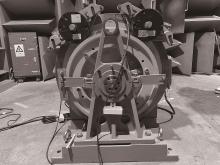
Fig.1
Elevator traction machine for testing experiments"


Fig.2
Schematic diagrams of braking and releasing operations of traction machine"

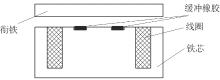
Fig.3
Electromagnetic structure with buffer rubbers"


Fig.4
Design flowchart of particle damper"


Table 1
Brake wheel’s modal frequency"
| 模态阶数 | 模态频率/Hz | 模态阶数 | 模态频率/Hz | ||
|---|---|---|---|---|---|
| 1 | 282.96 | 7 | 961.73 | ||
| 2 | 361.02 | 8 | 963.35 | ||
| 3 | 362.52 | 9 | 1 209.50 | ||
| 4 | 440.76 | 10 | 1 216.10 | ||
5 6 | 441.79 774.90 | 11 12 | 1 662.30 1 668.00 | ||
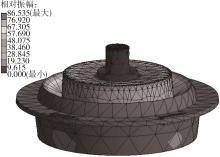
Fig.5
The 6th-order vibration modal shape of the rotor (774.90 Hz)"
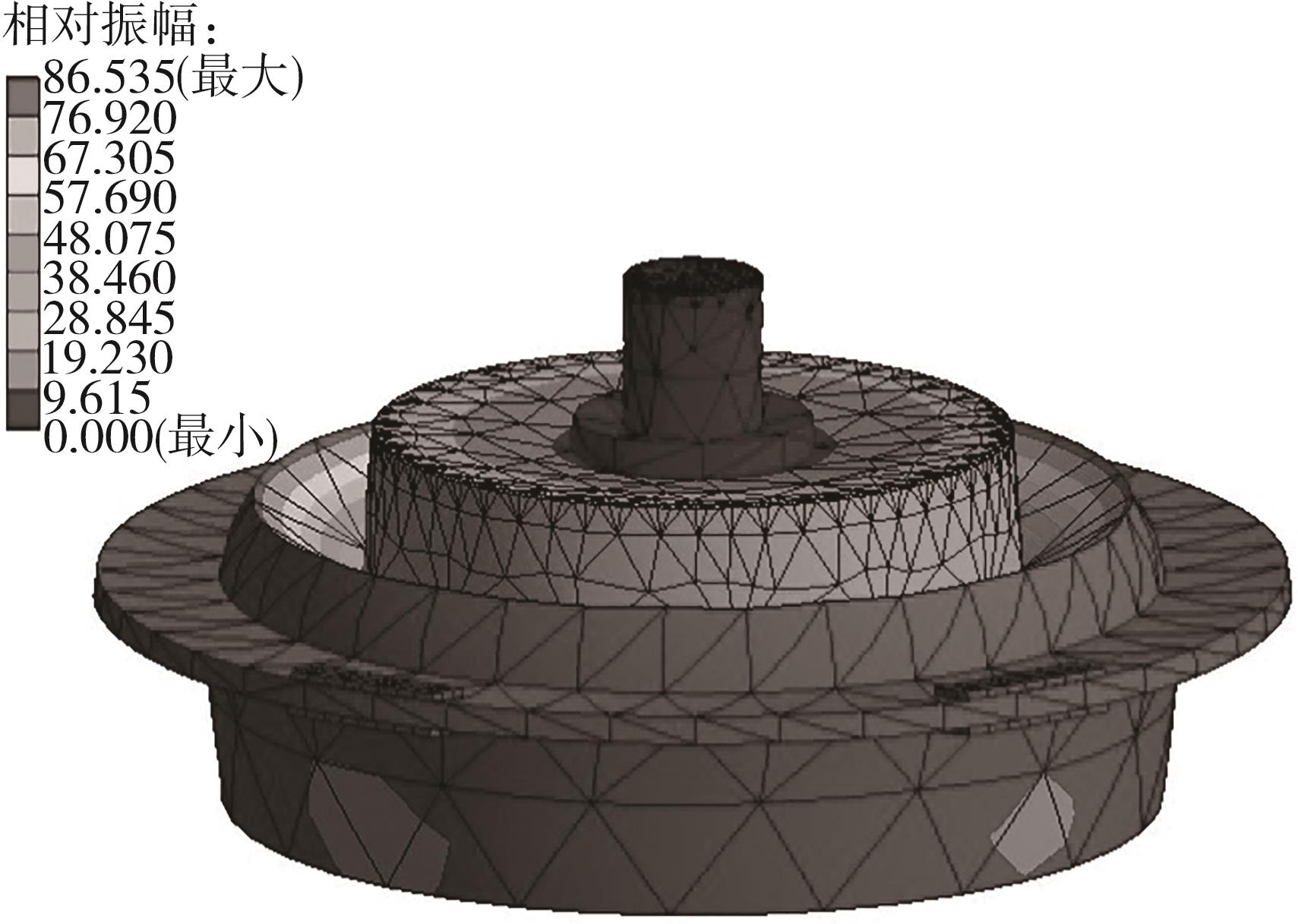

Fig.6
Selection strategy for installation direction of particle dampers"


Fig.7
Particle damper’s cavity position in the brake wheel"


Fig.8
Geometric parameters of the damper cavity (Unit: mm)"


Fig.9
Joint simulation analysis flowchart using EDEM-ADAMS tools"

Table 2
Optimal particle parameters and their loss factors at various tilt angles"
| 倾斜角度/(°) | 粒子半径/mm | 填充率/% | 损失因子 |
|---|---|---|---|
| 0.0 | 1.5 | 50 | 0.241 9 |
| 22.5 | 1.5 | 60 | 0.340 2 |
| 45.0 | 1.5 | 50 | 0.323 6 |
| 67.5 | 1.5 | 60 | 0.322 3 |
| 90.0 | 1.5 | 60 | 0.333 6 |

Fig.10
Actual brake wheel with installed particle dampers"

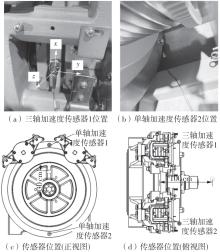
Fig.11
Schematic diagrams of measuring points and sensor locations"


Fig.12
Noise test results before and after the installation of particle dampers"

Table 3
Noise levels before and after the installation of particle dampers"
| 颗粒阻尼器安装情况 | 平均声压级/dBA | 最大声压级/dBA | 710 Hz频带声压级/dBA |
|---|---|---|---|
| 无 | 66.03 | 81.42 | 62.45 |
| 有 | 52.36 | 67.51 | 49.39 |

Fig.13
Vibration results obtained by single-axis acceleration sensor before and after the installation of particle dampers"


Fig.14
Vibration results along Y axis obtained by three-axis acceleration sensor before and after the installation of particle dampers"

| [1] | 蔡晓华 .与电梯运行相关的居室噪声分析及降噪对策[J].中国电梯,2022,33(2):25-28. |
| CAI Xiaohua .Analysis and denoising methods on the bedroom noise related to elevator operation[J].China Elevator,2022,33(2):25-28. | |
| [2] | 孙舒然 .曳引式电梯垂直振动仿真及振动故障分析[J].中国特种设备安全,2022,38(2):21-25,30. |
| SUN Shuran .Vibration simulation and faut analysis on traction elevator[J].China Special Equipment Safety,2022,38(2):21-25,30. | |
| [3] | 周茜茜,翟国庆,苏兰 .货梯曳引机结构传播的噪声治理[J].噪声与振动控制,2013,33(2):214-217. |
| ZHOU Xi-xi, DI Guo-qing, SU Lan .Structure borne noise of goods elevator traction machine[J].Noise and Vibration Control,2013,33(2):214-217. | |
| [4] | 任志英,刘荣阳,黄伟,等 .用于电梯曳引机减振的MR-SRC减振器设计与分析[J].振动与冲击,2024,43(3):295-304. |
| REN Zhiying, LIU Rongyang, HUANG Wei,et al .Design and analysis of MR-SRC shock absorber for elevator traction machine vibration reduction[J].Vibration and Control,2024,43(3):295-304. | |
| [5] | LU Z, WANG Z, MASRI S F,et al .Particle impact dampers:past,present,and future[J].Structural Control and Health Monitoring,2018,25(1):e2058/1-25. |
| [6] | MEYER N, SCHWARTZ C, MORLOCK M,et al .Systematic design of particle dampers for horizontal vibrations with application to a lightweight manipulator[J].Journal of Sound and Vibration,2021,510:116319. |
| [7] | LU Z, ZHANG Q, FAN Q,et al .Studies on dissipative characteristics and equivalent model of particle damper in railway application[J].Journal of Sound and Vibration,2023,560:117788. |
| [8] | 蒋捷,杨元龙,强陈,等 .基于障碍网络颗粒阻尼器的悬臂梁减振特性研究[J].机械工程学报,2024,60(17):208-222. |
| JIANG Jie, YANG Yuanlong, QIANG Chen,et al .Study on vibration reduction characteristics of cantilever beam based on particle damper of obstacle network[J].Journal of Mechanical Engineering,2024,60(17):208-222. | |
| [9] | 王明,徐慧东,和东平,等 .颗粒阻尼吸振器对轧机辊系减振特性的研究[J].振动与冲击,2023,42(2):23-34,78. |
| WANG Ming, XU Huidong, HE Dongping,et al .Vibration reduction characteristics of a rolling mill roll system with particle damping vibration absorber[J].Journal of Vibration and Shock,2023,42(2):23-34,78. | |
| [10] | 肖望强,陈辉,许展豪,等 .基于颗粒阻尼的内燃动车组动力包构架多工况减振研究[J].机械工程学报,2022,58(4):250-257. |
| XIAO Wangqiang, CHEN Hui, XU Zhanhao,et al .Study on the vibration reduction of internal combustion EMU powerpack frame under multiple loading conditions based on particle damping[J].Journal of Mechanical Engineering,2022,58(4):250-257. | |
| [11] | 闫维明,王宝顺,黄绪宏 .颗粒阻尼器的研究进展及其在土木工程中的应用展望[J].土木工程学报,2020,53(5):32-41. |
| YAN Weiming, WANG Baoshun, HUANG Xuhong .Research progress of particle damper and its application prospect in civil engineering[J].China Civil Engineering Journal,2020,53(5):32-41. | |
| [12] | XIAO W, XU Z, BIAN H,et al .Lightweight heavy-duty CNC horizontal lathe based on particle damping materials[J].Mechanical Systems and Signal Processing,2021,147:107127. |
| [1] |
CHEN Yu, LUO Chuyu, ZHANG Yamei.
Research Progress of 3D-Printed Concrete Materials for Sound Absorption and Insulation [J]. Journal of South China University of Technology(Natural Science Edition), 2026, 54(3): 148-159. |
| [2] | PENG Jianxin, WU Weizhen. Investigation on Acoustic Environment of Experimental Teaching Rooms in Universities [J]. Journal of South China University of Technology(Natural Science Edition), 2026, 54(2): 145-151. |
| [3] | QIU Zhicheng, LI Meng, LI Min. Vibration Control of Three-Flexible Beam Coupling System Based on Fuzzy Algorithm [J]. Journal of South China University of Technology(Natural Science Edition), 2026, 54(1): 104-114. |
| [4] | CHEN Fulong, HUANG Hui, DU Heng, SU Junshou, LI Yuzheng, LI Fuqi. Characteristics and High-Precision Positioning Analysis of Fluid-Solid Noise Sources in Inclined Axis Piston Motor [J]. Journal of South China University of Technology(Natural Science Edition), 2026, 54(1): 149-160. |
| [5] | CHENG Guixian, LING Qin, ZHENG Cai, CHEN Fang, ZHANG Quanling, CHEN Pingping. Performance Analysis of FCI-DCSK-NR over Power Line Channel [J]. Journal of South China University of Technology(Natural Science Edition), 2026, 54(1): 30-41. |
| [6] | CAO Yang, SHI Hao, LI Jiaofeng, TAO Jing. Evolution Analysis of Vibration Source Intensity of Subway Station Under the Influence of Closely-Spaced Undercrossing [J]. Journal of South China University of Technology(Natural Science Edition), 2025, 53(7): 149-158. |
| [7] | ZHANG Jinxi, PING Xinying, GUO Wangda, ZHANG Yuxuan. Prediction Accuracy and Its Comparison of Road Surface Roughness Based on Different Intelligent Devices [J]. Journal of South China University of Technology(Natural Science Edition), 2025, 53(6): 140-150. |
| [8] | JIN Qichao, LI Jun, WANG Liangliang, TAN Haibing, LI Fulin, FU Rui, MENG Lingchao, GUO Lei. Mechanism of Saw Tooth-Shaped Chip Formation in Cast & Wrought High-Temperature Alloy GH4198 [J]. Journal of South China University of Technology(Natural Science Edition), 2025, 53(5): 32-44. |
| [9] | CHENG Jin, SUN Kedi, YUAN Yi. Deflection Reliability Assessment Method of Long-Span Suspension Bridge Based on Random Field [J]. Journal of South China University of Technology(Natural Science Edition), 2025, 53(4): 13-21. |
| [10] | GUO Lihua, LIN Yanyu, CHEN Ke. An Atomic Structure Segmentation Method for High-Noise STEM Image Based on Materials Structural Priors [J]. Journal of South China University of Technology(Natural Science Edition), 2025, 53(11): 27-36. |
| [11] | CHEN Dongxia, TANG Jiarun, WANG Dongdong, CHEN Bo, ZHANG Jingyi. Strength-Deformation Behavior and Engineering Applications of Residual Soil Under Drying-Wetting Cycles and Construction Vibration [J]. Journal of South China University of Technology(Natural Science Edition), 2025, 53(10): 86-96. |
| [12] | ZHANG Binyu, WANG Yigang, YU Wuzhou, et al. Experimental Study on the Noise and Transmission of Automobile Door Sealing Cavity [J]. Journal of South China University of Technology(Natural Science Edition), 2024, 52(9): 104-114. |
| [13] | LI Song, WANG He, ZHANG Liping. Differential Privacy-Based skyline Query in Road Network Environment [J]. Journal of South China University of Technology(Natural Science Edition), 2024, 52(6): 120-127. |
| [14] | SHANGGUAN Wenbin, YUE Lian, LÜ Hui, et al. Fatigue Test and Calculation Methods for Battery Package Based on Load Spectrum [J]. Journal of South China University of Technology(Natural Science Edition), 2024, 52(3): 50-56. |
| [15] | CHANG Lehao, WANG Peilin, HUANG Qidi, et al. Coupled Analysis of Dynamic Contact and Dynamics of Gear System Considering Tooth Back Meshing [J]. Journal of South China University of Technology(Natural Science Edition), 2024, 52(12): 22-31. |
| Viewed | ||||||
|
Full text |
|
|||||
|
Abstract |
|
|||||