华南理工大学学报(自然科学版) ›› 2025, Vol. 53 ›› Issue (11): 90-100.doi: 10.12141/j.issn.1000-565X.240367
城市无人配送车的运行管理、仿真与评价研究综述
李海舰1, 李宇轩1, 王威杰1, 童盛军2, 高景伯2, 李同飞1, 陈娜1
- 1.北京工业大学 城市交通学院,北京 100124
2.北京车网科技发展有限公司,北京 100176
-
收稿日期:2024-07-15出版日期:2025-11-25发布日期:2025-07-04 -
通信作者:陈娜(1991—),女,博士,讲师,主要从事车路协同与自动驾驶仿真研究。 E-mail:nachen@bjut.edu.cn -
作者简介:李海舰(1986—),男,博士,副教授,主要从事智能交通系统研究。E-mail: lihaijian@bjut.edu.cn -
基金资助:北京市社会科学基金规划项目(22GLC060)
A Review of Researches on Operation Management, Simulation, and Evaluation of Urban Autonomous Delivery Vehicles
LI Haijian1, LI Yuxuan1, WANG Weijie1, TONG Shengjun2, GAO Jingbo2, LI Tongfei1, CHEN Na1
- 1.College of Metropolitan Transportation,Beijing University of Technology,Beijing 100124,China
2.Beijing Chewang Technology Development Co. ,Ltd. ,Beijing 100176,China
-
Received:2024-07-15Online:2025-11-25Published:2025-07-04 -
Contact:陈娜(1991—),女,博士,讲师,主要从事车路协同与自动驾驶仿真研究。 E-mail:nachen@bjut.edu.cn -
About author:李海舰(1986—),男,博士,副教授,主要从事智能交通系统研究。E-mail: lihaijian@bjut.edu.cn -
Supported by:Beijing Social Science Fund Planning Project(22GLC060)

摘要:
运行仿真和评价是无人配送车相关理论研究的基础,有利于推动无人配送车的高质量落地运营。该文首先梳理了无人配送车相关技术的发展现状和国内外的无人配送车安全运行管理规范,然后分析了无人配送车的行驶特性(包括车身安全特性、速度与能耗特性、跟驰和换道特性)和配送服务运行特性,指出需找到车辆设计、环境、配送任务之间合适的平衡点,并对无人配送车技术测试仿真、运营影响测试仿真和网络仿真方法的现状与不足进行了综述。在此基础上,借鉴国内外的无人配送车运行评价方法,结合无人配送车的运行特性,构建了针对非机动车道无人配送车运行评价的指标体系,指出了无人配送车的运行评价指标和未来研究方向,得到以下结论:现有无人配送车运行仿真技术缺乏统一的、权威性的管理规范;针对无人配送车运营影响的测试仿真研究较少;目前对无人配送车运行特性的研究不够深入,缺乏对实际场景的规划;借鉴道路服务水平评价指标,采用平均速度变化率和平均密度变化率作为无人配送车投放影响评价指标较为合适。
中图分类号:
引用本文
李海舰, 李宇轩, 王威杰, 童盛军, 高景伯, 李同飞, 陈娜. 城市无人配送车的运行管理、仿真与评价研究综述[J]. 华南理工大学学报(自然科学版), 2025, 53(11): 90-100.
LI Haijian, LI Yuxuan, WANG Weijie, TONG Shengjun, GAO Jingbo, LI Tongfei, CHEN Na. A Review of Researches on Operation Management, Simulation, and Evaluation of Urban Autonomous Delivery Vehicles[J]. Journal of South China University of Technology(Natural Science Edition), 2025, 53(11): 90-100.
图1
无人配送车的无线通信模式V2N:车辆与基站通信;V2V:车辆与车辆通信;V2I:车辆与基础设施通信"
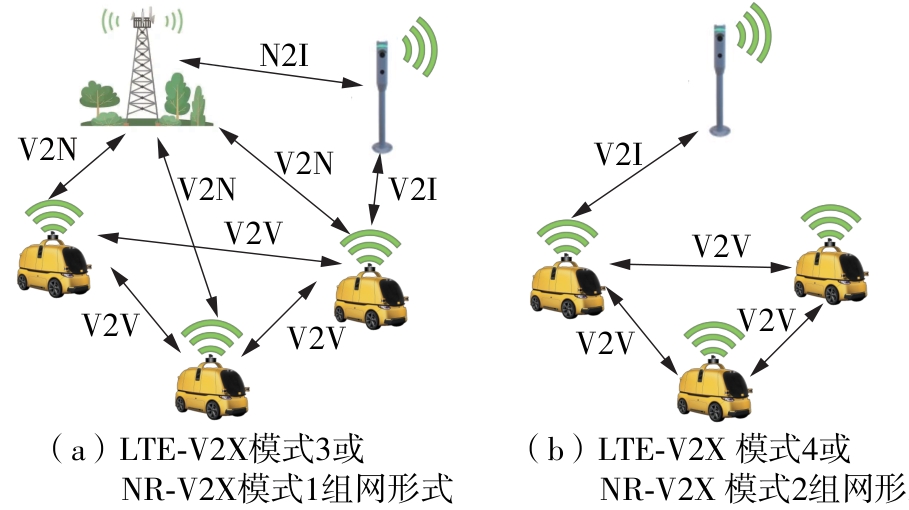
图2
几种常见的无人配送车[15,25-27]图片来自网络公开信息"
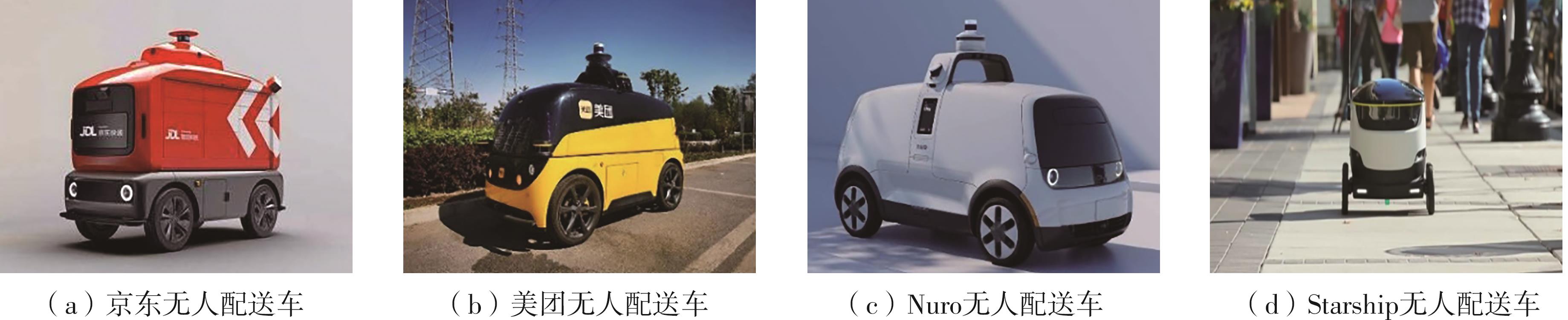

表1
几种常见的无人配送车的参数[15,25-27]"
| 车辆类型 | 车辆尺寸/(mm × mm × mm) | 承载质量/kg | 最大速度/(km·h-1) | 续航里程或电池容量 |
|---|---|---|---|---|
| 京东无人配送车 | 2 100 × 960 × 1 850 | 100 | 35 | 40 km |
| 美团“魔袋20”无人配送车 | 2 450 × 1 010 × 1 900 | 150 | 45 | 120 km |
| Nuro R2无人配送车 | 2 740 × 1 100 × 1 860 | 190 | 40 | 31 kW·h |
| Starship无人配送车 | 697 × 569 × 571 | 10 | 6 | 1.26 kW·h |
表2
中国、美国、英国无人配送车管理规范的对比"
| 名目 | 相应规定 | |||||
|---|---|---|---|---|---|---|
| 中国(北京) | 美国(宾夕法尼亚州) | 英国 | ||||
| 车辆分类管理 | 非机动车 | 个人配送设备(PDD) | 低速车 | 微型移动车辆 | ||
| 行驶范围 | 非机动车道 | 人行道、路肩、路堤 | 机动车道 | 机动车道 | ||
| 管理规范 | 行业规范 | 各州PDD法规 + 许可证制度 | 机动车法规+许可证制度 | 依据机动车法规管理 | ||
| 装载质量/kg | ≤ 600 | ≤ 36 | ≤ 190 | ≤ 10 | ||
| 整车尺寸/(m × m × m) | ≤ 3.0 × 1.2 × 1.9 | ≤ 1.06 × 8.12 × 1.82 | ≤ 2.74 × 1.1 × 1.86 | — | ||
| 最高车速/(km·h-1) | ≤ 15 | ≤ 11 | ≤ 40 | ≤ 25 | ||
| 行驶监管 | 现场或远程操作人员时刻监管 | 前期为现场监管,后期为操作员持驾驶执照远程监控和操作 | 前期为现场监管,后期为操作员持驾驶执照远程监控和操作 | |||
| 事故判定 | 交管部门判定 | 车辆购买保险 | 运营方 | |||
| 信息安全 | 符合现行国家和行业标准 | 数据及摄像头记录保护个人身份信息(白名单) | — | |||
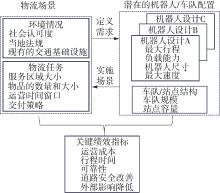
图3
无人配送车的服务运行规划[29]"
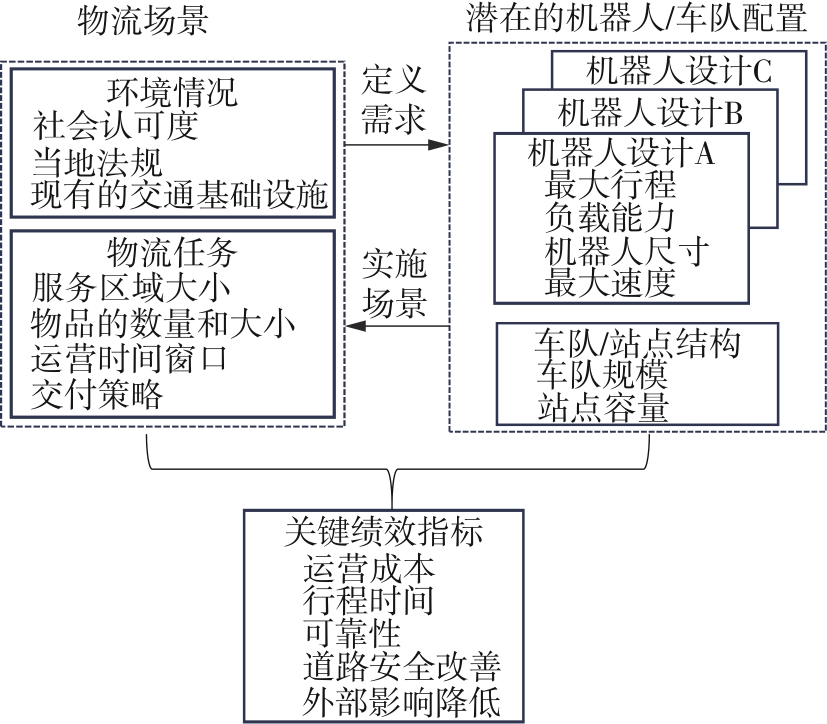
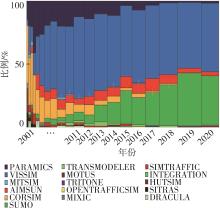
图4
有关微观仿真软件的出版物份额统计[35]"
表3
VISSIM中无人配送车重要参数的标定"
| 参数标定内容 | VISSIM内部参数借鉴对象 | 无人配送车自定义参数 |
|---|---|---|
| 车辆类型 | 小汽车 | 无人配送车 |
| 车辆模型 | 小汽车 | 长度、车轴、前离合器、前车轴、后车轴、后离合器 |
| 期望速度分布 | — | 无人配送车期望速度 |
| 车辆加/减速函数 | — | 最大加速度、期望加速度、最大减速度、期望减速度 |
| 质量分布曲线 | — | 空载质量、满载质量 |
| 功率分布 | — | 无人配送车功率分布 |
| 颜色分布 | — | 无人配送车颜色 |
| 驾驶行为参数 | 跟驰模型 | CC0——停车间距 |
| CC1——车头时距 | ||
| CC2——跟车变量 | ||
| CC3——进入跟车状态的阈值 | ||
| CC4——跟车状态的阈值1 | ||
| CC5——跟车状态的阈值2 | ||
| CC6——车速振动 | ||
| CC7——加速度波动幅度 | ||
| CC8——停车的加速度 | ||
| CC9——80 km/h时的加速度 | ||
| 前视距离 | ||
| 后视距离 | ||
| 观察到的车辆数 | ||
| 换道参数 | 最大减速度,本车 | |
| 最大减速度,后车 | ||
| 可接受减速度,本车 | ||
| 可接受减速度,后车 | ||
| 消失的等待时间 | ||
| 最小车头间距 | ||
| 安全距离折减系数 | ||
| 协同刹车的最大减速度 |
表4
无人配送车的运营影响因素[37]"
| 因素类别 | 因素名称 |
|---|---|
| 路段 | 路段长度 |
| 道路宽度 | |
| 非机动车/机动车流量 | |
| 隔离类型 | |
| 车辆组成比例 | |
| 交叉口 | 交叉口尺寸 |
| 有效绿灯时间 | |
| 右转比例 | |
| 车辆启动损失时间 | |
| 道路宽度 | |
| 饱和车头时距 |
表5
国内外道路服务水平评价研究统计[41]"
| 评价方法 | 评价角度 | 文献 | 车道 | 评级指标 | 等级 |
|---|---|---|---|---|---|
| 实测法 | 用户感知 | 美国《公路能力手册》,2010年版 | 机动车道 | 平均运行速度、负荷度、平均延误 | 六级 |
| 自行车道 | 超越事件数、车道宽度 | ||||
| 人行道 | 行人占有空间、平均速度、行人流率、负荷度 | ||||
| 交通流 | CJJ 37—2012《城市道路工程设计规范》 | 自行车道 | 骑行速度、占道面积、负荷度 | 四级 | |
| 仿真法 | 交通流 | 张晋等[ | 自行车道 | 密度、平均速度 | 五级 |
| 用户感知 | Liang等[ | 自动车道 | 速度状态熵、密度 | 五级 | |
| 用户感知和交通流 | 李玉清[ | 自行车道 | 反应空间障碍物密度、剩余感知空间障碍物密度、负荷度、平均速度、车流密度 | 五级 |
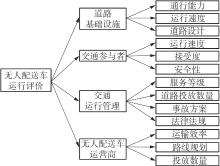
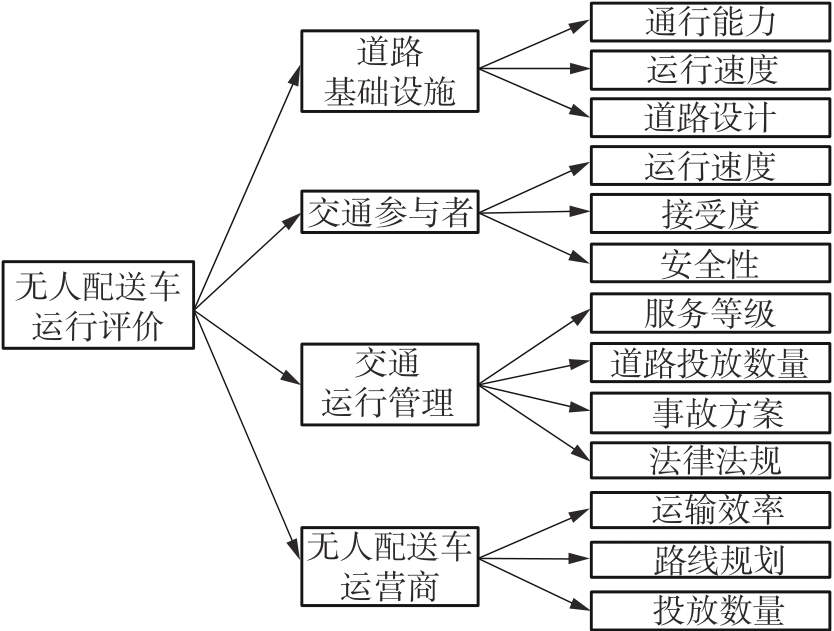
图5
无人配送车运行评价指标体系"
| [1] | 车百智库,中国电动汽车百人会 .无人配送在国内商业化的现状、挑战及建议[J].智能网联汽车,2020 (2):60-67. |
| China EV 100 Think Tank,China EV100.Current status, challenges and recommendations for commercialization of autonomous delivery in China[J].Intelligent Connected Vehicle,2020(2):60-67. | |
| [2] | BOYSEN N, FEDTKE S, SCHWERDFEGER S .Last-mile delivery concepts:a survey from an operational research perspective[J].OR Spectrum,2021,43(1):1-58. |
| [3] | PENG Z, SUN J, LU Q .China’s public transportation:problems,policies,and prospective of sustainability[J].ITE Journal-Institute of Transportation Engineers,2012,82(5):36-40. |
| [4] | LIU N, WANG Y, BAI Q,et al .Road life-cycle carbon dioxide emissions and emission reduction technologies:a review[J].Journal of Traffic and Transportation Engineering (English Edition),2022,9(4):532-555. |
| [5] | GARUS A, ALONSO B, RAPOSO M A,et al .Last-mile delivery by automated droids. Sustainability assessment on a real-world case study[J].Sustainable Cities and Society,2022,79(2):103728/1-15. |
| [6] | PAREKH D, PODDAR N, RAJPURKAR A,et al .A review on autonomous vehicles:progress,methods and challenges[J].Electronics,2022,11(14):2162/1-18. |
| [7] | SHADRIN S S, IVANOVA A A .Analytical review of standard SAE J3016“taxonomy and definitions for terms related to driving automation systems for on-road motor vehicles”with latest updates[J].Avtomobil’ Doroga Infrastruktura,2019,3(21):10-20. |
| [8] | AHMED H U, HUANG Y, LU P,et al .Technology developments and impacts of connected and autonomous vehicles:an overview[J].Smart Cities,2022,5(1):382-404. |
| [9] | KAPSER S, ABDELRAHMAN M, BERNECKER T .Autonomous delivery vehicles to fight the spread of Covid-19—How do men and women differ in their acceptance?[J].Transportation Research Part A:Policy and Practice,2021,148:183-198. |
| [10] | MARSDEN N, BERNECKER T, ZÖLLNER R,et al .BUGA:log—a real-world laboratory approach to designing an automated transport system for goods in urban areas[C]∥Proceedings of 2018 IEEE International Conference on Engineering,Technology and Innovation.Stuttgart:IEEE,2018:1-9. |
| [11] | DE ARAÚJO F A, DOS REIS J G M, CRUZ C P F DA .The role of last-mile delivery in the future of e-commerce[C]∥Proceedings of IFIP International Conference on Advances in Production Management Systems.Novi Sad:Springer,2020:307-314. |
| [12] | SRINIVAS S .Autonomous robot-driven deliveries:a review of recent developments and future directions[J].Transportation Research Part E:Logistics and Transportation Review,2022,165:102834/1-16. |
| [13] | KAPSER S, ABDELRAHMAN M .Acceptance of autonomous delivery vehicles for last-mile delivery in Germany—Extending UTAUT2 with risk perceptions[J].Transportation Research Part C:Emerging Technologies,2020,111:210-225. |
| [14] | FIGLIOZZI M, JENNINGS D .Autonomous delivery robots and their potential impacts on urban freight energy consumption and emissions[J].Transportation Research Procedia,2020,46:21-28. |
| [15] | Nuro .Safety_Nuro[EB/OL].. |
| [16] | BAI J, CAI J, ZHOU T,et al .Research on Key technologies of meal delivery robot based on the fusion of lidar and machine vision[C]∥Proceedings of 2021 7th International Conference on Big Data and Information Analytics.Chongqing:IEEE,2021:236-242. |
| [17] | LEE D, KANG G, KIM B,et al .Assistive delivery robot application for real-world postal services[J].IEEE Access,2021,9:141981-141998. |
| [18] | PROTASOV S, KARPYSHEV P, KALINOV I,et al .CNN-based omnidirectional object detection for hermesBot autonomous delivery robot with preliminary frame classification[C]∥Proceedings of 2021 20th International Conference on Advanced Robotics.Ljubljana:IEEE,2021:517-522. |
| [19] | CHENG S, WANG Z, YANG B,et al .Convolutional neural network-based intelligent decision-making for automated vehicles[J].IFAC-PapersOnLine,2022,55(27):509-514. |
| [20] | 李克强,戴一凡,李升波,等 .智能网联汽车(ICV)技术的发展现状及趋势[J].汽车安全与节能学报,2017,8(1):1-14. |
| LI Keqiang, DAI Yifan, LI Shengbo,et al .State-of-the-art and technical trends of intelligent and connected vehicles[J].Automotive Safety and Energy,2017,8(1):1-14. | |
| [21] | KAMTAM S B, LU Q, BOUALI F,et al .Network latency in teleoperation of connected and autonomous vehicles:a review of trends,challenges,and mitigation strategies[J].Sensors,2024,24(12):3957/1-37. |
| [22] | ZHENG G, NI Q, NAVAIE K,et al .A distributed learning architecture for semantic communication in autonomous driving networks for task offloading[J].IEEE Communications Magazine,2023,61(11):64-68. |
| [23] | ZHOU X, XING X, QIN H,et al .Communication-performance trade-off formation control for NAUVs:an interleaved event-triggered strategy[J].Nonlinear Dynamics,2025,13(8):8713-8739. |
| [24] | 陆淼嘉,尹钦仪 .“最后一公里”无人车配送发展现状及应用前景[J].综合运输,2021,43(1):117-121. |
| LU Miaojia, YIN Qinyi .The development and applications of last-mile autonomous delivery vehicle[J].China Transportation Review,2021,43(1):117-121. | |
| [25] | 京东物流 .京东无人配送车[EB/OL].. |
| [26] | 美团网 .美团无人配送车[EB/OL].. |
| [27] | STARSHIP .Starship technologies:autonomous robot delivery vehicle[EB/OL].. |
| [28] | HOFFMANN T, PRAUSE G .On the regulatory framework for last-mile delivery robots[J].Machines,2018,6(3):33/1-16. |
| [29] | PLANK M, LEMARDELÉ C, ASSMANN T,et al .Ready for robots?Assessment of autonomous delivery robot operative accessibility in German cities[J].Journal of Urban Mobility,2022,2:100036/1-15. |
| [30] | LI H, ZHANG J, SUN X,et al .A survey of vehicle group behaviors simulation under a connected vehicle environment[J].Physica A:Statistical Mechanics and its Applications,2022,603:127816/1-22. |
| [31] | TIAN Z, SHI W .Design and implement an enhanced simulator for autonomous delivery robot[C]∥Proceedings of 2022 5th International Conference on Connected and Autonomous Driving.Detroit:IEEE,2022:21-29. |
| [32] | VONGBUNYONG S, TRIPATHI S P, THAMRONGAPHI-CHARTKUL K,et al .Simulation of autonomous mobile robot system for food delivery in in-patient ward with unity[C]∥Proceedings of 2020 15th International Joint Symposium on Artificial Intelligence and Natural Language Processing.Bangkok:IEEE,2020:1-6. |
| [33] | LIU Y, NOVOTNY G, SMIRNOV N,et al .Mobile delivery robots:mixed reality-based simulation relying on ROS and unity 3D[C]∥Proceedings of 2020 IEEE Intelligent Vehicles Symposium.Online:IEEE,2020:15-20. |
| [34] | LIAQAT A, HUTABARAT W, TIWARI D,et al .Autonomous mobile robots in manufacturing:highway code development,simulation,and testing[J].The International Journal of Advanced Manufacturing Technology,2019,104:4617-4628. |
| [35] | RAJU N, FARAH H .Evolution of traffic microsimulation and its use for modeling connected and automated vehicles[J].Journal of Advanced Transportation,2021,2021(1):1-29. |
| [36] | HE S, GUO X, DING F, et al .Freeway traffic speed estimation of mixed traffic using data from connected and autonomous vehicles with a low penetration rate[J].Journal of Advanced Transportation,2020,2020(1):1-13. |
| [37] | 李宇轩 .城市低速无人配送车行为仿真与投放策略研究[D].北京:北京工业大学,2023. |
| [38] | 李海舰,吴丽君,陈娜,等 .面向车联网的交通-通信联合仿真平台研究综述[J].交通工程,2024,24(5):9-18. |
| LI Haijian, WU Lijun, CHEN Na,et al .Review of joint simulation platform research for transportation and communication in vehicular networks[J].Journal of Transportation Engineering,2024,24(5):9-18. | |
| [39] | RONDINONE M, MANEROS J, KRAJZEWICZ D,et al .iTETRIS:a modular simulation platform for the large scale evaluation of cooperative ITS applications[J].Simulation Modelling Practice and Theory,2013,34:99-125. |
| [40] | PIORKOWSKI M, RAYA M, LUGO A L,et al .TraNS:realistic joint traffic and network simulator for VANETs[J].ACM SIGMOBILE Mobile Computing and Communications Review,2008,12(1):31-33. |
| [41] | 张晋,王慧,李平 .基于元胞自动机(CA)的自行车流建模及仿真[J].公路交通科技,2006(1):125-129,134. |
| ZHANG Jin, WANG Hui, LI Ping .Modeling and simulation of bicycle flow based on cellular automata (CA)[J].Highway Transportation Technology,2006(1):125-129,134. | |
| [42] | LIANG X, XIE M, JIA X .Use of entropy to analyze level of service of dedicated bike lanes in China[J].Advances in Mechanical Engineering,2017,9(6):1-12. |
| [43] | 李玉清 .基于仿真的自行车道服务水平和设计参数确定方法[D].长沙:长沙理工大学,2019. |
| [44] | 韩慧 .混行非机动车道服务水平评价方法研究[J].交通与运输(学术版),2014(2):125-129. |
| HAN Hui .Studies about Level of service of mixed non-motorized lane[J].Traffic & Transportation,2014(2):125-129. | |
| [45] | 李海航 .城市非机动车道通行能力研究[D].石家庄:石家庄铁道大学,2015. |
| [1] | 张锐, 葛郁晗. 考虑同群效应的大学生出行方式选择行为研究[J]. 华南理工大学学报(自然科学版), 2026, 54(3): 114-126. |
| [2] | 许航, 李欣, 袁昀. 共享单车与需求响应公交耦合优化研究[J]. 华南理工大学学报(自然科学版), 2025, 53(8): 20-28. |
| [3] | 谢坤, 邢馨元, 董宏辉, 董春娇, 陈元朵. 轨迹数据驱动的职住地识别及出行活动特征分类方法[J]. 华南理工大学学报(自然科学版), 2025, 53(6): 131-139. |
| [4] | 龙雪琴, 翟曼溶, 王远泽, 毛健旭. 考虑乘客时间-价格弹性的网约车合乘匹配方法[J]. 华南理工大学学报(自然科学版), 2025, 53(6): 119-130. |
| [5] | 胡宝雨, 齐月, 贾佃精, 程国柱. 环线电动公交车辆调度与司机排班的联合优化[J]. 华南理工大学学报(自然科学版), 2025, 53(6): 91-103. |
| [6] | 何庆龄, 裴玉龙, 董春彤, 等. 基于混合策略改进ASO-LSSVM的风险驾驶行为分类识别[J]. 华南理工大学学报(自然科学版), 2024, 52(9): 131-141. |
| [7] | 翁剑成, 吴明珠, 魏瑞聪, 等. 多因素协同的大型活动场馆周边路段速度预测[J]. 华南理工大学学报(自然科学版), 2024, 52(8): 34-44. |
| [8] | 苏跃江, 温惠英, 袁敏贤, 等. 基于居民属性数据的出行碳排放预测模型[J]. 华南理工大学学报(自然科学版), 2024, 52(8): 23-33. |
| [9] | 杨亚璪, 翁唐政. 时空约束对运动出行的影响[J]. 华南理工大学学报(自然科学版), 2024, 52(2): 113-123. |
| [10] | 唐进君, 任茂昕, 李志涛, 等. 基于代理模型辅助NSGA-Ⅱ算法的地铁接驳公交优化[J]. 华南理工大学学报(自然科学版), 2024, 52(11): 95-105. |
| [11] | 庄焱, 董春娇, 米雪玉, 等. 基于改进网络核密度和负二项回归的事故黑点鉴别[J]. 华南理工大学学报(自然科学版), 2024, 52(1): 119-126. |
| [12] | 赵小梅, 郝郭宇, 牛晓婧, 等. 不同降雨量下基于宏观基本图的边界控制策略[J]. 华南理工大学学报(自然科学版), 2024, 52(1): 72-82. |
| [13] | 陈小鸿, 田田甜, 张华. 城市居民活动韧性——新冠肺炎疫情期间轨道客流恢复的实证[J]. 华南理工大学学报(自然科学版), 2023, 51(7): 109-119. |
| [14] | 胡兴华, 陈兴辉, 汪然, 等. 随机特性下考虑碳排放的公交优先控制优化模型[J]. 华南理工大学学报(自然科学版), 2023, 51(10): 160-170. |
| [15] | 许伦辉, 余佳芯, 裴明阳, 等. 基于几何路网结构和强化学习的车辆重定位策略[J]. 华南理工大学学报(自然科学版), 2023, 51(10): 99-109. |
| 阅读次数 | ||||||
|
全文 |
|
|||||
|
摘要 |
|
|||||