华南理工大学学报(自然科学版) ›› 2026, Vol. 54 ›› Issue (3): 114-126.doi: 10.12141/j.issn.1000-565X.250067
考虑同群效应的大学生出行方式选择行为研究
张锐1,2, 葛郁晗1
- 1.长安大学 运输工程学院,陕西 西安 710064
2.北京交通大学 综合交通运输大数据应用技术交通运输行业重点实验室,北京 100044
-
收稿日期:2025-03-13出版日期:2026-03-25发布日期:2025-08-22 -
作者简介:张锐(1991—),女,博士,讲师,主要从事多方式条件下出行者出行行为分析、交通规划等研究。E-mail: zhangrui@chd.edu.cn -
基金资助:国家自然科学基金项目(72371035);综合交通运输大数据应用技术交通运输行业重点实验室(北京交通大学)开放基金项目(ZHJTDSJ202203)
Research on College Students' Travel Mode Choice Behavior Considering Peer Effect
ZHANG Rui1,2, GE Yuhan1
- 1.School of Transportation Engineering,Chang’an University,Xi’an 710064,Shaanxi,China
2.Key Laboratory of Transport Industry of Big Data Application Technologies for Comprehensive Transport,Beijing Jiaotong University,Beijing 100044,China
-
Received:2025-03-13Online:2026-03-25Published:2025-08-22 -
About author:张锐(1991—),女,博士,讲师,主要从事多方式条件下出行者出行行为分析、交通规划等研究。E-mail: zhangrui@chd.edu.cn -
Supported by:the National Natural Science Foundation of China(72371035)

摘要:
研究在校大学生的校外出行方式选择行为,对于改善高校学生的校外出行环境、提高社会参与度、促进其身心健康发展具有重要意义。已有研究忽视了同伴群体对个体出行方式选择的影响。该文针对缺乏统一标准确定大学生有效群组的不足,通过室友关系质量量表界定有效群组,基于问卷调查获得不同出行场景下在校大学生的校外出行偏好数据;为补充同群效应在出行行为决策中的作用机制研究,从关系质量与心理特性出发,引入关系强度调节的同伴矩阵并构建多个同群效应的网络经济学线性模型,结合固定效应和两阶段最小二乘法解决潜在的内生性问题,通过模型评估确定识别和测度同群效应的最佳模型;基于模型标定结果分析宿舍群体对在校大学生个体校外出行方式选择的影响和潜在作用机制。结果表明:相较于广义计量模型和局部聚集模型,考虑关系强度的局部平均模型在识别和测度同群效应时具有更好的稳健性;随着出行距离的增加以及出行时间约束的放松,在校大学生个体出行方式选择行为受同伴相关行为的影响程度(即内生同群效应)降低;同伴的月生活费、家庭成员人数、有无驾照、开放性及环保意识等因素对在校大学生个体出行方式选择具有显著的外生同群效应;外向型个体相较于内向型个体具有更为显著的从众性同群效应,休闲娱乐场景下开放型个体比保守型个体的从众性同群效应更显著。该研究拓展了相关理论边界,可为高校低碳出行的精细化引导与分群体干预提供实证依据。
中图分类号:
引用本文
张锐, 葛郁晗. 考虑同群效应的大学生出行方式选择行为研究[J]. 华南理工大学学报(自然科学版), 2026, 54(3): 114-126.
ZHANG Rui, GE Yuhan. Research on College Students' Travel Mode Choice Behavior Considering Peer Effect[J]. Journal of South China University of Technology(Natural Science Edition), 2026, 54(3): 114-126.

表1
受访者基本信息和室友关系质量信息"
| 变量 | 类别 | 比例/% | |
|---|---|---|---|
| 个人属性 | 性别 | 男 | 69.9 |
| 女 | 30.1 | ||
| 专业科类 | 理工 | 92.1 | |
| 文史 | 6.3 | ||
| 艺体 | 1.6 | ||
| 年级 | 大一 | 24.9 | |
| 大二 | 24.7 | ||
| 大三 | 23.8 | ||
| 大四 | 26.6 | ||
| 月生活费/元 | <1 000 | 7.9 | |
| [1 000,2 000) | 77.5 | ||
| [2 000,3 000) | 12.2 | ||
| ≥3 000 | 2.4 | ||
| 是否恋爱 | 是 | 31.7 | |
| 否 | 68.3 | ||
| 有无驾照 | 有 | 49.9 | |
| 无 | 50.1 | ||
| 同宿舍受访人数 | 4 | 20.6 | |
| 3 | 46.3 | ||
| 2 | 33.1 | ||
| 家庭属性 | 家庭规模 | ≤3 | 43.1 |
| [ | 50.4 | ||
| ≥6 | 6.5 | ||
家庭私家车 保有量/辆 | 0 | 27.4 | |
| 1 | 56.9 | ||
| ≥2 | 15.7 | ||
| 综合心理特质变量 | 外向性 | [0,3.5] | 34.4 |
| (3.5,7] | 65.6 | ||
| 开放性 | [0,3.5] | 26.8 | |
| (3.5,7] | 73.2 | ||
| 健康情况 | [0,3.5] | 24.9 | |
| (3.5,7] | 75.1 | ||
| 环保意识 | [0,3.5] | 9.0 | |
| (3.5,7] | 91.0 | ||
| 室友关系质量 | 良好 | [3,4) | 3.5 |
| 非常良好 | [4,5) | 9.7 | |
| 较为融洽 | [5,6) | 41.9 | |
| 融洽 | [6,7) | 44.4 | |
| 非常融洽 | 7 | 0.5 | |
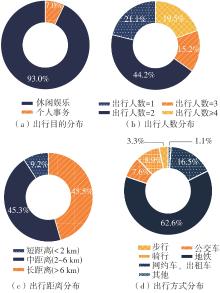
图1
校外出行特征分布"
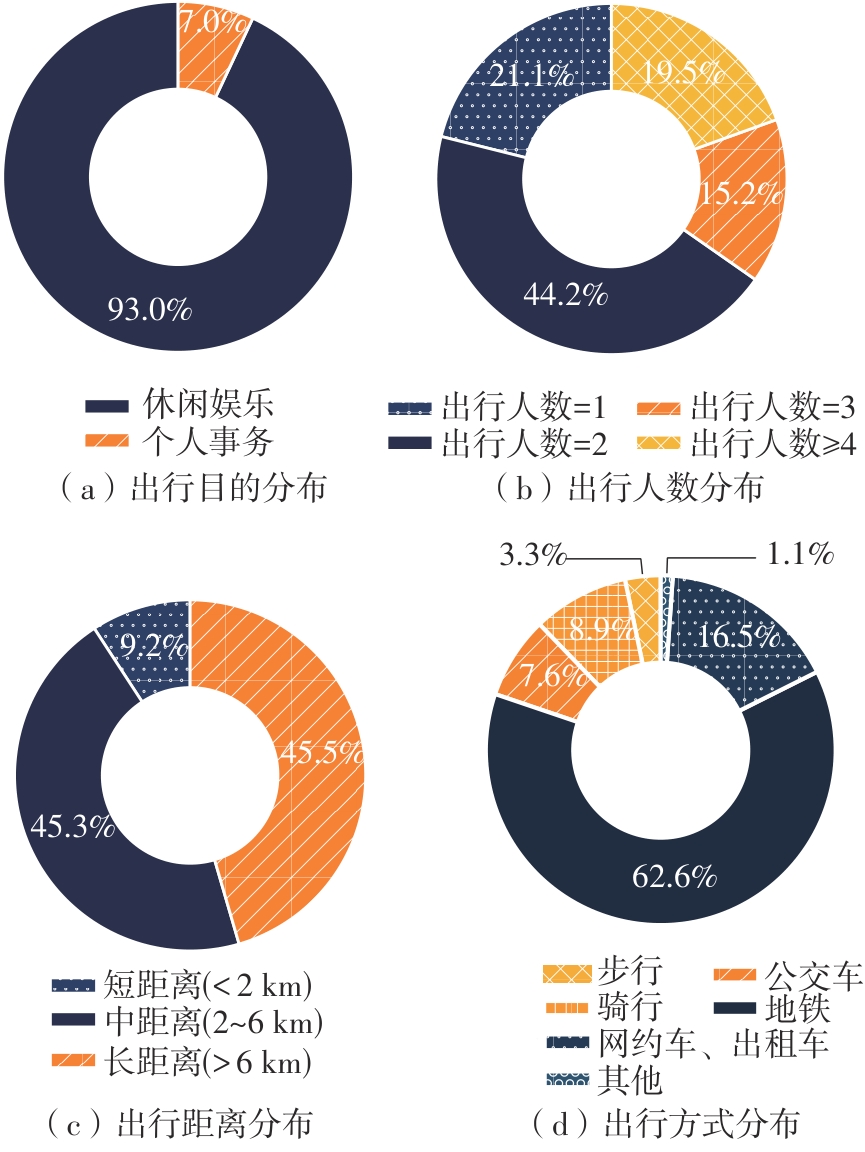
表2
量表数据信度和效度检验结果"
| 潜变量 | 观测变量 | Cronbach’ s Alpha | KMO值 | P值 |
|---|---|---|---|---|
| 宿舍关系 | 沟通频率 | 0.781 | 0.701 | 0.000 |
| 情感支持 | ||||
| 矛盾冲突 | ||||
| 彼此尊重 | ||||
| 共同责任感 | ||||
| 外向性 | 性格外向、精力充沛 | 0.850 | ||
| 性格内向、安静 | ||||
| 开放性 | 易接受新事物、常有新想法 | 0.720 | ||
| 遵循常规、不爱创新 | ||||
| 健康情况 | 睡眠习惯良好 | 0.777 | ||
| 饮食均衡健康 | ||||
| 喜欢参加各种体育活动 |
表3
模型评估结果1)"
| 检验类别 | 模型 | 短距离 | 中距离 | 长距离 | |||
|---|---|---|---|---|---|---|---|
| 休闲娱乐 | 个人事务 | 休闲娱乐 | 个人事务 | 休闲娱乐 | 个人事务 | ||
| J检验 | — | — | — | — | — | — | |
| *** | — | ** | — | — | * | ||
弱工具变量 检验 | Y&N | Y&N | Y&Y | Y&N | Y&Y | Y&N | |
| N | N | Y | N | Y | N | ||
| Y | Y | Y | Y | Y | Y | ||
| 过度识别约束检验 | — | — | — | — | — | — | |
| ** | — | — | * | — | — | ||
| — | — | — | — | — | — | ||
Wu-Hausman 检验 | — | *** | *** | *** | *** | ** | |
| — | ** | — | *** | ** | — | ||
| *** | *** | *** | *** | ** | — | ||
表4
局部平均模型参数标定结果(个体效应)1)"
| 变量 | 短距离 | 中距离 | 长距离 | |||
|---|---|---|---|---|---|---|
休闲 娱乐 | 个人 事务 | 休闲 娱乐 | 个人 事务 | 休闲 娱乐 | 个人 事务 | |
| 同群效应 | 0.839 *** | 0.788 *** | 0.849 *** | 0.923 *** | 0.449 * | 0.419 ** |
| 性别/男 | — | — | — | — | — | — |
| 月生活费/[1 000,2 000) | — | -0.442 *** | — | — | — | — |
| 月生活费/[2 000,3 000) | -0.240 ** | -0.505 *** | -0.292 *** | -0.236 * | — | -0.238 ** |
| 月生活费/≥3 000 | — | -0.522 ** | -0.617 *** | -0.381 * | — | -0.365 ** |
| 家庭规模 | — | — | 0.073 * | 0.098 ** | — | — |
| 家庭私家车保有量 | 0.086 ** | — | -0.092 *** | — | — | — |
| 是否恋爱 | — | — | — | — | — | — |
| 有无驾照 | — | — | — | — | — | — |
| 外向性 | — | — | -0.027 * | -0.051 ** | — | — |
| 开放性 | — | — | — | — | — | — |
| 健康情况 | — | — | — | — | — | — |
| 环保意识 | — | — | — | — | — | — |
| 年级固定效应 | 控制 | 控制 | 控制 | 控制 | 控制 | 控制 |
| 样本量 | 369 | 369 | 369 | 369 | 369 | 369 |
| R2 | 0.232 | 0.035 | 0.054 | -0.119 | 0.048 | 0.135 |
表5
局部平均模型参数标定结果(情景效应)1)"
| 变量 | 短距离 | 中距离 | 长距离 | |||
|---|---|---|---|---|---|---|
休闲 娱乐 | 个人 事务 | 休闲 娱乐 | 个人 事务 | 休闲 娱乐 | 个人 事务 | |
| 性别/男 | — | — | — | — | — | — |
| 月生活费/[1 000,2 000) | — | 0.366 ** | — | — | -0.110 * | -0.171 * |
| 月生活费/[2 000,3 000) | — | — | — | — | — | — |
| 月生活费/≥3 000 | — | 0.572 ** | 0.496 ** | — | — | — |
| 家庭规模 | — | — | -0.078 * | — | — | — |
| 家庭私家车保有量 | — | — | — | — | — | — |
| 是否恋爱 | — | — | — | — | — | — |
| 有无驾照 | — | — | — | — | — | -0.116 ** |
| 外向性 | — | — | — | — | — | — |
| 开放性 | — | — | — | — | 0.034 ** | — |
| 健康情况 | — | — | — | — | — | — |
| 环保意识 | — | — | — | — | — | -0.047 ** |
表6
不同组别群体同群效应参数标定结果1)"
| 变量 | 短距离 | 中距离 | 长距离 | 样本量 | |||
|---|---|---|---|---|---|---|---|
休闲 娱乐 | 个人 事务 | 休闲 娱乐 | 个人 事务 | 休闲 娱乐 | 个人 事务 | ||
| 外向型 | 0.901*** | — | 0.542* | 1.096*** | — | 0.939*** | 242 |
| 内向型 | 0.704*** | — | 0.500* | — | — | — | 127 |
| 开放型 | 0.899*** | — | 0.727** | 0.730** | — | 0.620** | 270 |
| 保守型 | 0.326* | — | — | 0.862*** | — | 0.942*** | 99 |
表7
不同组别群体局部平均模型检验结果1)"
| 变量 | 短距离 | 中距离 | 长距离 | 检验 统计量 | |||
|---|---|---|---|---|---|---|---|
休闲 娱乐 | 个人 事务 | 休闲 娱乐 | 个人 事务 | 休闲 娱乐 | 个人 事务 | ||
| 外向型 | ** | — | *** | *** | ** | *** | Wu-Hausman 检验 |
| 内向型 | — | — | — | — | — | — | |
| 开放型 | * | — | — | *** | *** | ** | |
| 保守型 | — | — | — | ** | — | ** | |
| 外向型 | Y | Y | Y | Y | Y | Y | 弱工具变量检验 |
| 内向型 | Y | Y | Y | Y | Y | Y | |
| 开放型 | Y | Y | Y | Y | Y | Y | |
| 保守型 | Y | Y | Y | Y | Y | Y | |
| 外向型 | — | — | — | — | — | — | 过度识别 约束检验 |
| 内向型 | ** | ** | — | — | — | — | |
| 开放型 | — | — | — | — | — | — | |
| 保守型 | * | — | — | — | * | — | |
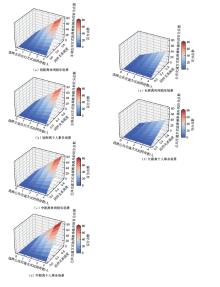
图2
同伴选择情况与同伴关系强度的敏感性"
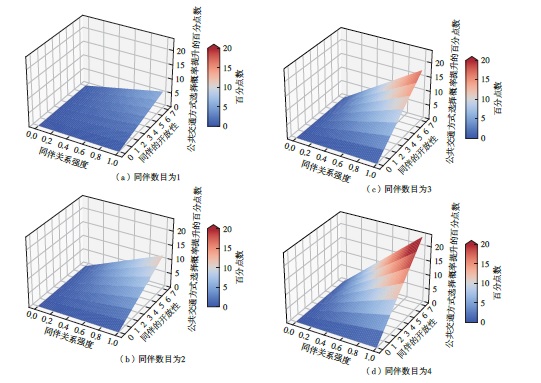
图3
不同同伴数目下同伴开放性与同伴关系强度的敏感性"
| [1] | 矫怡程 .规模扩张对不同类型高校本科生源质量的影响效应研究——基于国家大学生学情调查研究数据库(NCSS)的分析[J].华东师范大学学报(教育科学版),2023,41(8):22-33. |
| JIAO Yicheng .The impact of higher education expansion on undergraduate enrollment quality in China:based on the data of NCSS[J].Journal of East China Normal University (Educational Sciences),2023,41(8):22-33. | |
| [2] | 国家统计局 .中国统计年鉴2024[R/OL].(2024-09-01)[2025-01-16].. |
| [3] | HURLEY E C, WILLIAMS I R, TOMYN A J,et al .Social media use among Australian university students:understanding links with stress and mental healths[J].Computers in Human Behavior Reports,2024(14):100398/1-8. |
| [4] | 王玉涛,王松,段梦然 .中国企业绿色投资同群效应研究[J].系统工程理论与实践,2024,44(3):874-892. |
| WANG Yutao, WANG Song, DUAN Mengran .The peer effect of green investment activities of China’s listed firms[J].Systems Engineering—Theory & Practice,2024,44(3):874-892. | |
| [5] | POWELL L M, TAURAS J A, ROSS H .Peer effects,tobacco control policies,and youth smoking behavior[J].ImpacTeen Research Paper Series,2003(24):1-26. |
| [6] | LAVY V, SILVA O, WEINHARDT F .The good,the bad,and the average:evidence on ability peer effects in schools[J].Journal of Labor Economics,2012,30(2):367-414. |
| [7] | KAUSTIA M, KNÜPFER S .Peer performance and stock market entry[J].Journal of Financial Econo-mics,2012,104(2):321-338. |
| [8] | 赵颖 .中国上市公司高管薪酬的同群效应分析[J].中国工业经济,2016(2):114-129. |
| ZHAO Ying .Analysis of CEOs’ compensations’ peer effects from China listed companies[J].China Industrial Economics,2016(2):114-129. | |
| [9] | LAVY V, SCHLOSSER A .Mechanisms and impacts of gender peer effects at school[J].American Economic Journal:Applied Economics,2011,3(2):1-33. |
| [10] | BUECHEL B, MECHTENBERG L, PETERSEN J .If I can do it,so can you! peer effects on perseverance[J].Journal of Economic Behavior & Organization,2018,155:301-314. |
| [11] | 程利娜,梁芳 .同群效应对大学生学习投入影响的追踪研究——基于学习行为投入[J].大学教育,2022(8):5-10. |
| CHENG Lina, LIANG Fang .A follow-up study on the influence of peer effect on college students’ learning engagement:based on learning behavior engagement [J].University Education,2022(8):5-10. | |
| [12] | 崔静,冯玲 .同群效应研究述评与未来展望[J].商业经济研究,2017(10):101-103. |
| CUI Jing, FENG Ling .A review and future prospects of peer effect research[J].Journal of Commercial Economics,2017(10):101-103. | |
| [13] | POLDIN O, VALEEVA D, YUDKEVICH M. Which peers matter:how social ties affect peer-group effects[J].Research in Higher Education,2016(57):448-468. |
| [14] | EISENBERG D, GOLBERSTEIN E, WHITLOCK J L .Peer effects on risky behaviors:new evidence from college roommate assignments[J].Journal of Health Economics,2014,33:126-138. |
| [15] | 王欣涛,金鑫,石婷婷 .大学本科生社交状况调查研究——以北京大学城市与环境学院为例[J].北京教育(德育),2013(628):73-75. |
| WANG Xintao, JIN Xin, SHI Tingting .A study on the social status of undergraduate students:a case study of the college of urban and environmental sciences at Peking University[J].Beijing Education (Moral Education),2013(628):73-75. | |
| [16] | 俞宁,庞文哲,李斌,等 .大学生消费的同群效应——基于宿舍社交网络的视角[J].世界经济文汇,2023(2):1-13. |
| YU Ning, PANG Wenzhe, LI Bin,et al .The peer effect of college students’consumption:based on the perspective of dormitory social network[J].World Economic Papers,2023(2):1-13. | |
| [17] | MANSKI C F .Identification of endogenous social effects:the reflection problem[J].The Review of Economic Studies,1993,60(3):531-542. |
| [18] | LEARY M T, ROBERTS M R .Do peer firms affect corporate financial policy?[J].The Journal of Finance,2014,69(1):139-178. |
| [19] | BOOIJ A S, LEUVEN E, OOSTERBEEK H .Ability peer effects in university:evidence from a randomized experiment[J].Review of Economic Studies,2017,84(2):547-578. |
| [20] | 张川川,朱涵宇 .新型农村社会养老保险参与决策中的同群效应[J].金融研究,2021,495(9):111-130. |
| ZHANG Chuanchuan, ZHU Hanyu .The influence of the peer effect on participation in China’ s new rural pension scheme[J].Journal of Financial Research,2021,495(9):111-130. | |
| [21] | JAVID M A,ALI N, ABDULLAH M,et al .Analysis of students’ travel mode choice behaviour:a case study in oman[C]∥ Proceedings of 3rd International Conference on Advances in Civil and Environmental Engineering (ICACEE-2024).Taxila:University of Engineering & Technology Taxila,2024:441-451. |
| [22] | NASRIN S .Private university students’ mode choice behaviour for travel to university:analysis in the context of Dhaka city[C]∥ Proceedings of Transportation Research:Proceedings of CTRG 2017.Singapore:Springer,2020:299-310. |
| [23] | LIU C, BARDAKA E, PASCHALIDIS E .Sustainable transport choices in public transit access:travel behavior differences between university students and other young adults[J].International Journal of Sustainable Transportation,2023,17(6):679-695. |
| [24] | MONIRUZZAMAN M, FARBER S .What drives sustainable student travel? Mode choice determinants in the Greater Toronto Area[J].International journal of sustainable transportation,2018,12(5):367-379. |
| [25] | PARK J, JIN I H, JEON M .How social networks influence human behavior:an integrated latent space approach for differential social influence[J].Psychometrika,2023,88(4):1529-1555. |
| [26] | SUSILO Y O, LIU C .The influence of parents’ travel patterns,perceptions and residential self-selectivity to their children travel mode shares[J].Transportation,2016,43(2):357-378. |
| [27] | GOSLING S D, RENTFROW P J, SWANN J R W B .A very brief measure of the big-five personality domains[J].Journal of Research in Personality,2003,37(6):504-528. |
| [28] | HU A, LI X, SONG H .The influence of big five personality traits on college students’ key competencies:the mediating effect of psychological capital[J].Frontiers in Psychology,2023,14:1242557/1-15. |
| [29] | CAREY J C, STANLEY D L A, WERRING C J,et al .Development of a short form of the roommate rapport scale[J].Measurement and Evaluation in Counseling and Development,1988,20(4):175-180. |
| [30] | KURTZ J E, SHERKER J L .Relationship quality,trait similarity,and self‐other agreement on personality ratings in college roommates[J].Journal of Persona-lity,2003,71(1):21-48. |
| [31] | WILTZ J .Measuring relationship strength in roommates with MR/DD:the development of the Roommate Friendship Scale (RFS)[J].Research in Developmental Disabilities,2003,24(5):359-367. |
| [32] | 杨雪花,陈万明 .大学生人际交往能力对宿舍人际关系及幸福感的影响[J].中国学校卫生,2016,37(2):300-303. |
| YANG Xuehua, CHEN Wanming .Influence of college students’interpersonal communication ability on dormitory interpersonal relationship and sense of happiness [J].Chinese Journal of School Health,2016,37(2):300-303. | |
| [33] | 徐婷 .辩证行为疗法团体心理辅导对大学生宿舍人际关系、情绪调节及睡眠质量的影响[J].心理月刊,2022,17(18):26-28. |
| XU Ting .Effect of dialectical behavior therapy group psychological counseling on interpersonal relationship,emotion regulation and sleep quality in college dormitory[J].Psychologies Magazine,2022,17(18):26-28. | |
| [34] | 毛小玲,李宏翰,张建梅 .大学生宿舍人际关系的特点[J].中国心理卫生杂志,2005,19(7):473-475. |
| MAO Xiao-ling, LI Hong-han, ZHANG Jian-mei .Dormitory interpersonal relationship of college students [J].Chinese Mental Health Journal,2005,19(7):473-475. | |
| [35] | 许传新 .大学生宿舍人际关系质量研究[J].当代青年研究,2005(4):6-9. |
| XU Chuanxin .Study on the quality of college students’ dormitory interpersonal relationship[J].Contemporary Youth Research,2005(4):6-9. | |
| [36] | 刘宇峰,安韬,钱一之,等 .不同规模城市居民出行方式影响因素分析[J].中国公路学报,2022,35(4):286-297. |
| LIU Yu-feng, AN Tao,STEVEN I-JY Chien,et al .Exploring influence factors for travel mode choice in ci-ties with different scales[J].China Journal of Highway and Transport,2022,35(4):286-297. | |
| [37] | LAMBOTTE M, MATHY S, RISCH A,et al .Disentangling peer effects in transportation mode choice:the example of active commuting[J].Journal of Environmental Economics and Management,2023,121:102868/1-17. |
| [38] | AKERLOF G A .Social distance and social decisions[J].Econometrica,1997,65(5):1005-1027. |
| [39] | LIU X, PATACCHINI E, ZENOU Y .Endogenous peer effects:local aggregate or local average?[J].Journal of Economic Behavior & Organization,2014,103:39-59. |
| [40] | STAIGER D, STOCK J .Instrumental variables regression with weak instruments[J].Econometrica,1997,65(3):557-586. |
| [41] | SARGAN J D .The estimation of economic relationships using instrumental variables[J].Econometrica:Journal of the Econometric Society,1958,26(3):393-415. |
| [42] | HAUSMAN J A .Specification tests in econometrics[J].Econometrica,1978,46(6):1251-1271. |
| [43] | VIDERAS J, OWEN A L, CONOVER E,et al .The influence of social relationships on pro-environment behaviors[J].Journal of Environmental Economics and Management,2012,63(1):35-50. |
| [1] | 许航, 李欣, 袁昀. 共享单车与需求响应公交耦合优化研究[J]. 华南理工大学学报(自然科学版), 2025, 53(8): 20-28. |
| [2] | 谢坤, 邢馨元, 董宏辉, 董春娇, 陈元朵. 轨迹数据驱动的职住地识别及出行活动特征分类方法[J]. 华南理工大学学报(自然科学版), 2025, 53(6): 131-139. |
| [3] | 龙雪琴, 翟曼溶, 王远泽, 毛健旭. 考虑乘客时间-价格弹性的网约车合乘匹配方法[J]. 华南理工大学学报(自然科学版), 2025, 53(6): 119-130. |
| [4] | 胡宝雨, 齐月, 贾佃精, 程国柱. 环线电动公交车辆调度与司机排班的联合优化[J]. 华南理工大学学报(自然科学版), 2025, 53(6): 91-103. |
| [5] | 李海舰, 李宇轩, 王威杰, 童盛军, 高景伯, 李同飞, 陈娜. 城市无人配送车的运行管理、仿真与评价研究综述[J]. 华南理工大学学报(自然科学版), 2025, 53(11): 90-100. |
| [6] | 何庆龄, 裴玉龙, 董春彤, 等. 基于混合策略改进ASO-LSSVM的风险驾驶行为分类识别[J]. 华南理工大学学报(自然科学版), 2024, 52(9): 131-141. |
| [7] | 翁剑成, 吴明珠, 魏瑞聪, 等. 多因素协同的大型活动场馆周边路段速度预测[J]. 华南理工大学学报(自然科学版), 2024, 52(8): 34-44. |
| [8] | 苏跃江, 温惠英, 袁敏贤, 等. 基于居民属性数据的出行碳排放预测模型[J]. 华南理工大学学报(自然科学版), 2024, 52(8): 23-33. |
| [9] | 杨亚璪, 翁唐政. 时空约束对运动出行的影响[J]. 华南理工大学学报(自然科学版), 2024, 52(2): 113-123. |
| [10] | 唐进君, 任茂昕, 李志涛, 等. 基于代理模型辅助NSGA-Ⅱ算法的地铁接驳公交优化[J]. 华南理工大学学报(自然科学版), 2024, 52(11): 95-105. |
| [11] | 庄焱, 董春娇, 米雪玉, 等. 基于改进网络核密度和负二项回归的事故黑点鉴别[J]. 华南理工大学学报(自然科学版), 2024, 52(1): 119-126. |
| [12] | 赵小梅, 郝郭宇, 牛晓婧, 等. 不同降雨量下基于宏观基本图的边界控制策略[J]. 华南理工大学学报(自然科学版), 2024, 52(1): 72-82. |
| [13] | 陈小鸿, 田田甜, 张华. 城市居民活动韧性——新冠肺炎疫情期间轨道客流恢复的实证[J]. 华南理工大学学报(自然科学版), 2023, 51(7): 109-119. |
| [14] | 胡兴华, 陈兴辉, 汪然, 等. 随机特性下考虑碳排放的公交优先控制优化模型[J]. 华南理工大学学报(自然科学版), 2023, 51(10): 160-170. |
| [15] | 许伦辉, 余佳芯, 裴明阳, 等. 基于几何路网结构和强化学习的车辆重定位策略[J]. 华南理工大学学报(自然科学版), 2023, 51(10): 99-109. |
| 阅读次数 | ||||||
|
全文 |
|
|||||
|
摘要 |
|
|||||