华南理工大学学报(自然科学版) ›› 2026, Vol. 54 ›› Issue (3): 148-159.doi: 10.12141/j.issn.1000-565X.250372
3D打印降噪混凝土材料研究进展
陈宇, 罗楚钰, 张亚梅
- 东南大学 材料科学与工程学院/重大基础设施工程材料全国重点实验室,江苏 南京 211189
-
收稿日期:2025-10-10出版日期:2026-03-25发布日期:2025-11-14 -
通信作者:张亚梅 E-mail:ymzhang@seu.edu.cn -
作者简介:陈宇(1990—),男,博士,教授,主要从事增材制造、建筑功能材料及低碳材料研究。E-mail: y_chen@seu.edu.cn -
基金资助:国家重点研发计划项目(2024YFB4610000)
Research Progress in 3D-Printed Noise-Reducing Concrete Materials
CHEN Yu, LUO Chuyu, ZHANG Yamei
- School of Materials Science and Engineering/State Key Laboratory of Engineering Materials for Major Infrastructure,Southeast University,Nanjing 211189,Jiangsu,China
-
Received:2025-10-10Online:2026-03-25Published:2025-11-14 -
Contact:ZHANG Yamei E-mail:ymzhang@seu.edu.cn -
About author:陈宇(1990—),男,博士,教授,主要从事增材制造、建筑功能材料及低碳材料研究。E-mail: y_chen@seu.edu.cn -
Supported by:the National Key R & D Program of China(2024YFB4610000)

摘要:
随着环境噪声污染问题日益加剧,混凝土声屏障因其优良的耐久性和经济性,被广泛应用于噪声控制领域。然而,传统混凝土声屏障在吸声与隔声性能方面仍存在不足,难以同时满足轻质化、功能化与绿色化的发展需求。已有研究通过在水泥基体系中引入发泡剂、多孔轻质骨料等组分,调控材料密度、孔隙率及孔隙连通性,以优化孔隙结构与声波能量耗散机制,从材料层面提升混凝土的降噪性能。在此基础上,3D打印技术为降噪构件的复杂几何设计、轻量化制造及结构个性化提供了新的实现途径。打印过程中形成的定向连通孔隙网络及独特的层间界面特征,可有效延长声波传播路径并增强能量耗散,从而在结构层面实现声学性能优化。该文系统概述了影响混凝土降噪性能的关键因素及其调控策略,重点分析了3D打印工艺对孔隙分布、层间界面及表面纹理的调控机制,并总结了相关工程应用实例。现有研究表明,合理设计的3D打印混凝土结构在中低频吸声方面具有显著优势,且通过构件几何形态与表面纹理的协同调控,可进一步实现声学性能的定向优化。此外,3D打印降噪混凝土在道路声屏障及建筑声学领域展现出良好的应用前景,但仍面临材料打印适应性、层间界面强度及长期服役性能等技术挑战。未来研究可围绕绿色低碳原料利用、多尺度结构设计及耐久性评价等方向展开,以推动3D打印降噪混凝土的高性能化与工程化应用。
中图分类号:
引用本文
陈宇, 罗楚钰, 张亚梅. 3D打印降噪混凝土材料研究进展[J]. 华南理工大学学报(自然科学版), 2026, 54(3): 148-159.
CHEN Yu, LUO Chuyu, ZHANG Yamei. Research Progress in 3D-Printed Noise-Reducing Concrete Materials[J]. Journal of South China University of Technology(Natural Science Edition), 2026, 54(3): 148-159.
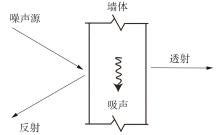
图1
隔声原理示意图[24]"
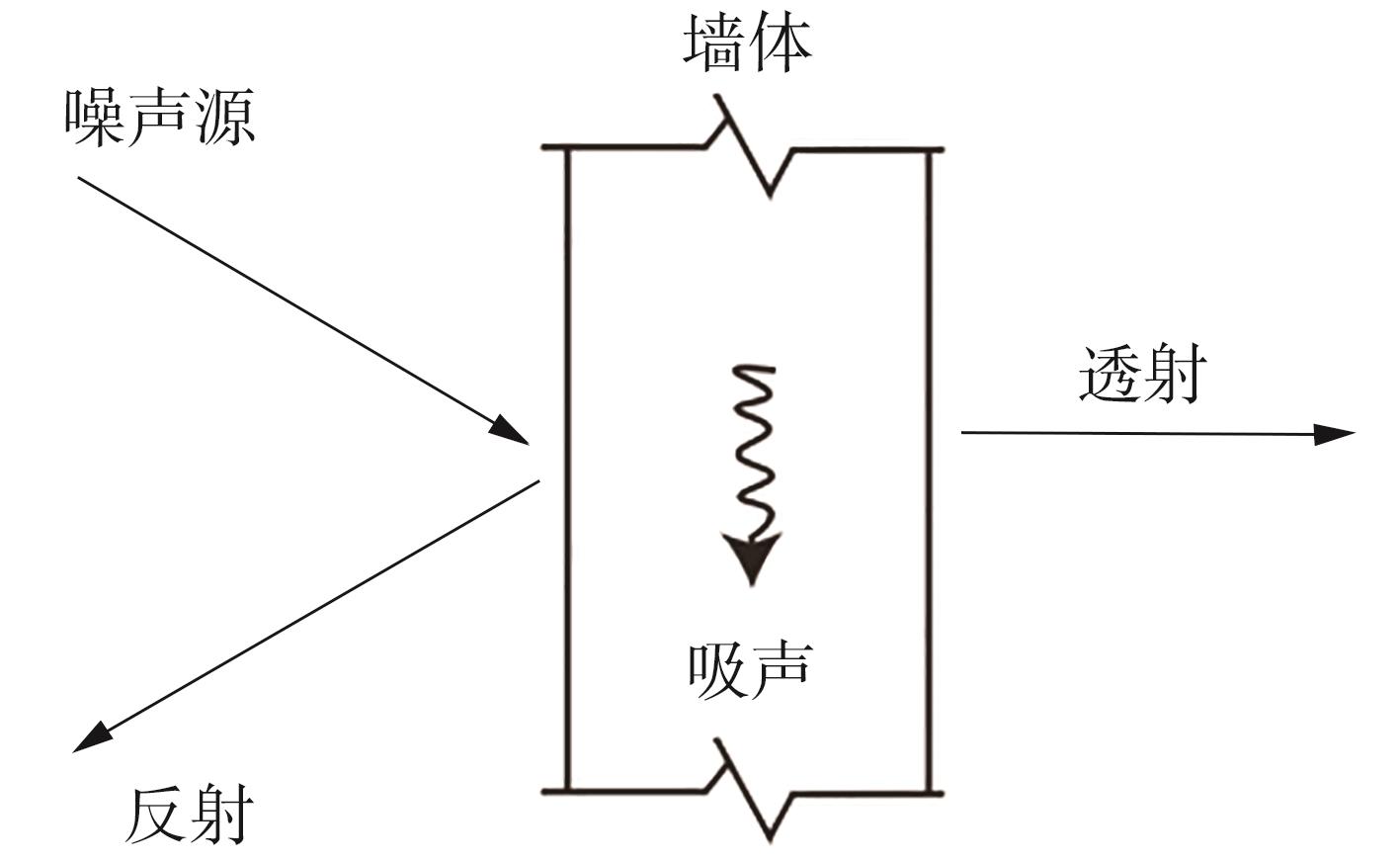
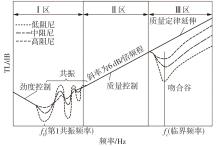
图2
典型传声损失曲线[20]"
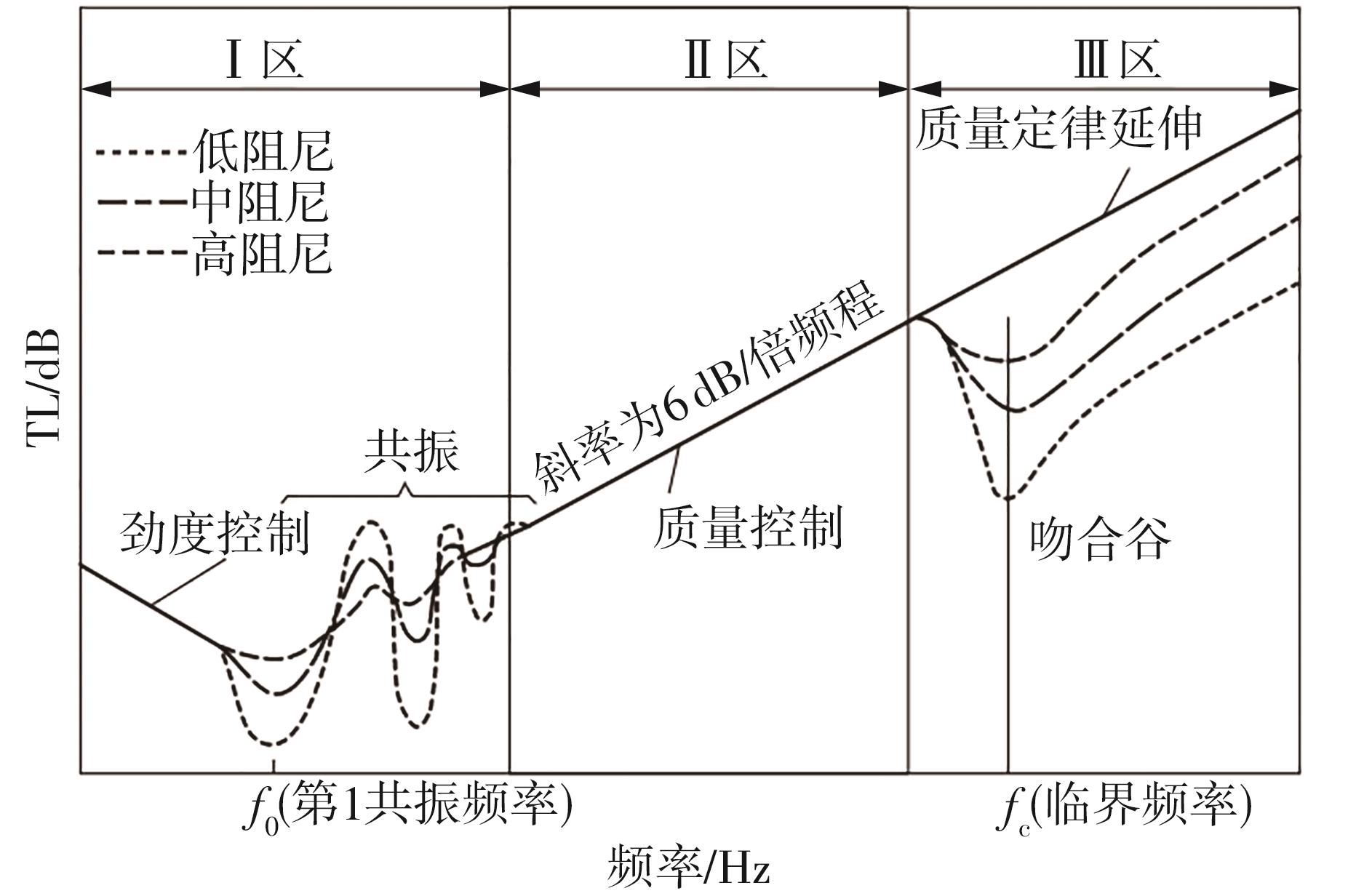
图3
吸声材料的声能损失机理图[27]"
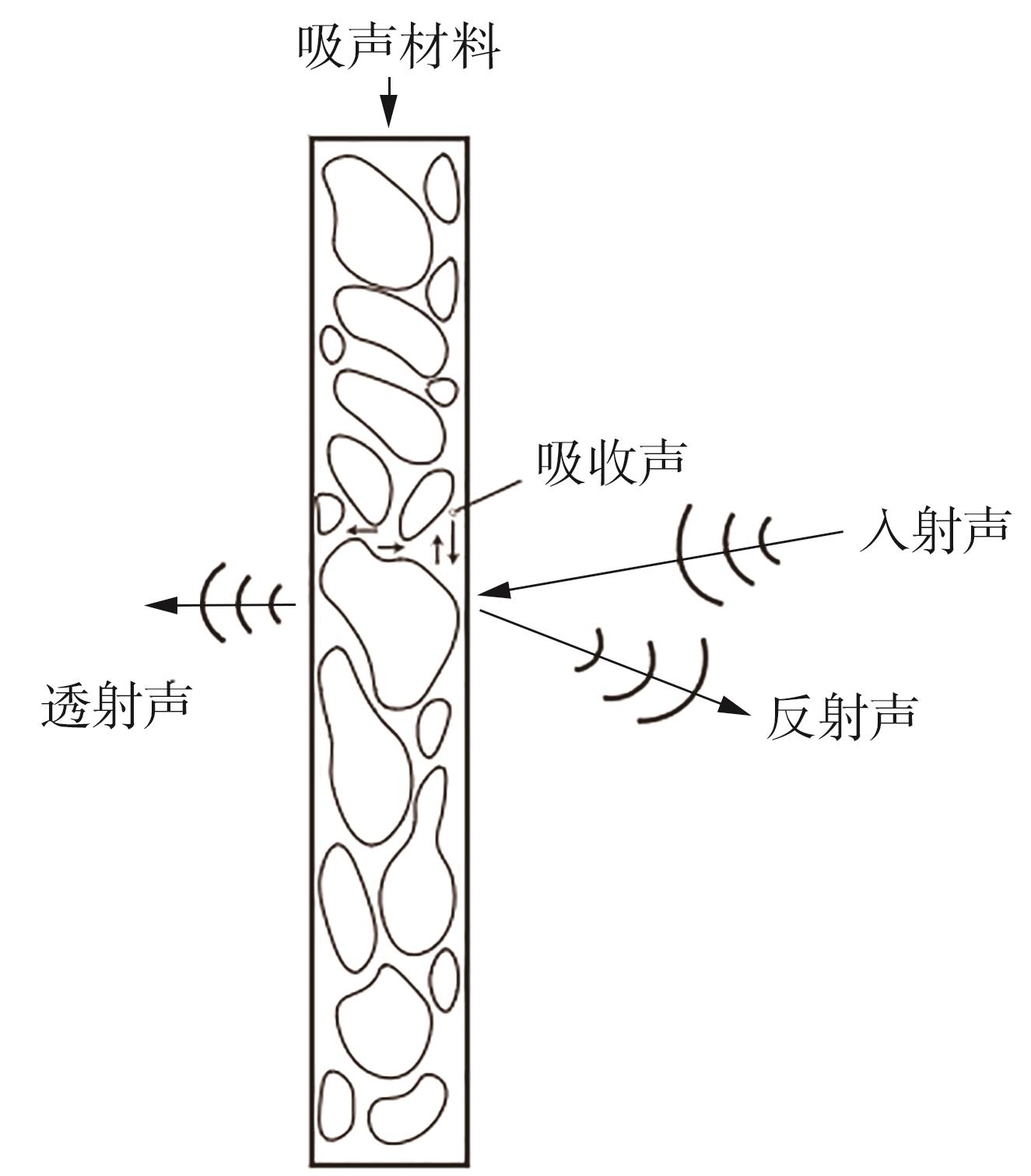
图4
两种常见的共振吸声器示意图[26]"
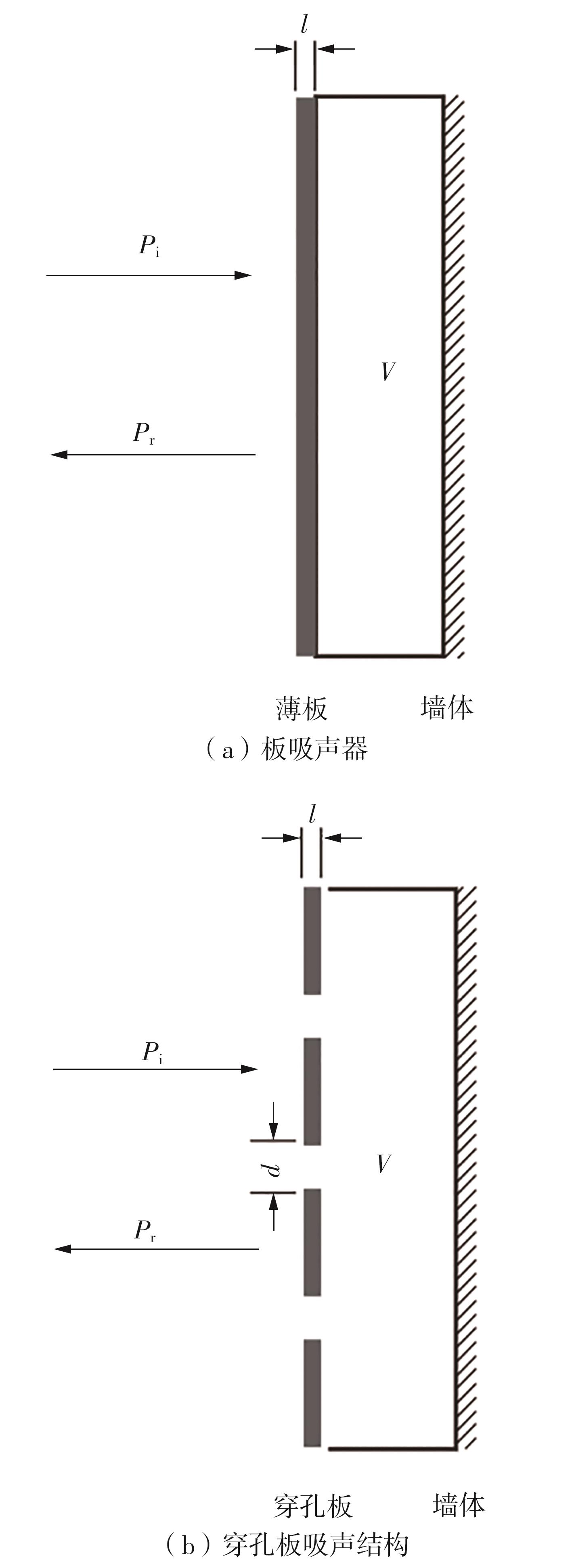

表1
发泡剂类型与用量对混凝土吸声性能的影响"
| 相关研究 | 发泡剂类型和用量 | 材料体系 | 吸声性能指标 |
|---|---|---|---|
| Rommel等[ | 表面活性剂类发泡剂;用量1%~4% | 泡沫混凝土 | 吸声系数从0.67提升至0.89 |
| Mastali等[ | 蛋白质水解物发泡剂;用量10%~35% | 纤维增强碱激发矿渣泡沫混凝土 | 中高频吸声系数达0.8~1.0 |
| Galzerano等[ | 植物表面活性剂类发泡剂;用量0.05%、12.00% | 地聚物泡沫 | 最大吸声系数为0.47(300 Hz) |
| Zhang等[ | 稀释水性表面活性剂类发泡剂;用量5%~16% | 地聚物泡沫混凝土 | 吸声系数达0.7~1.0(40~150 Hz) |
图5
多种降噪混凝土材料声学性能图谱[34,57-60,63-65]"
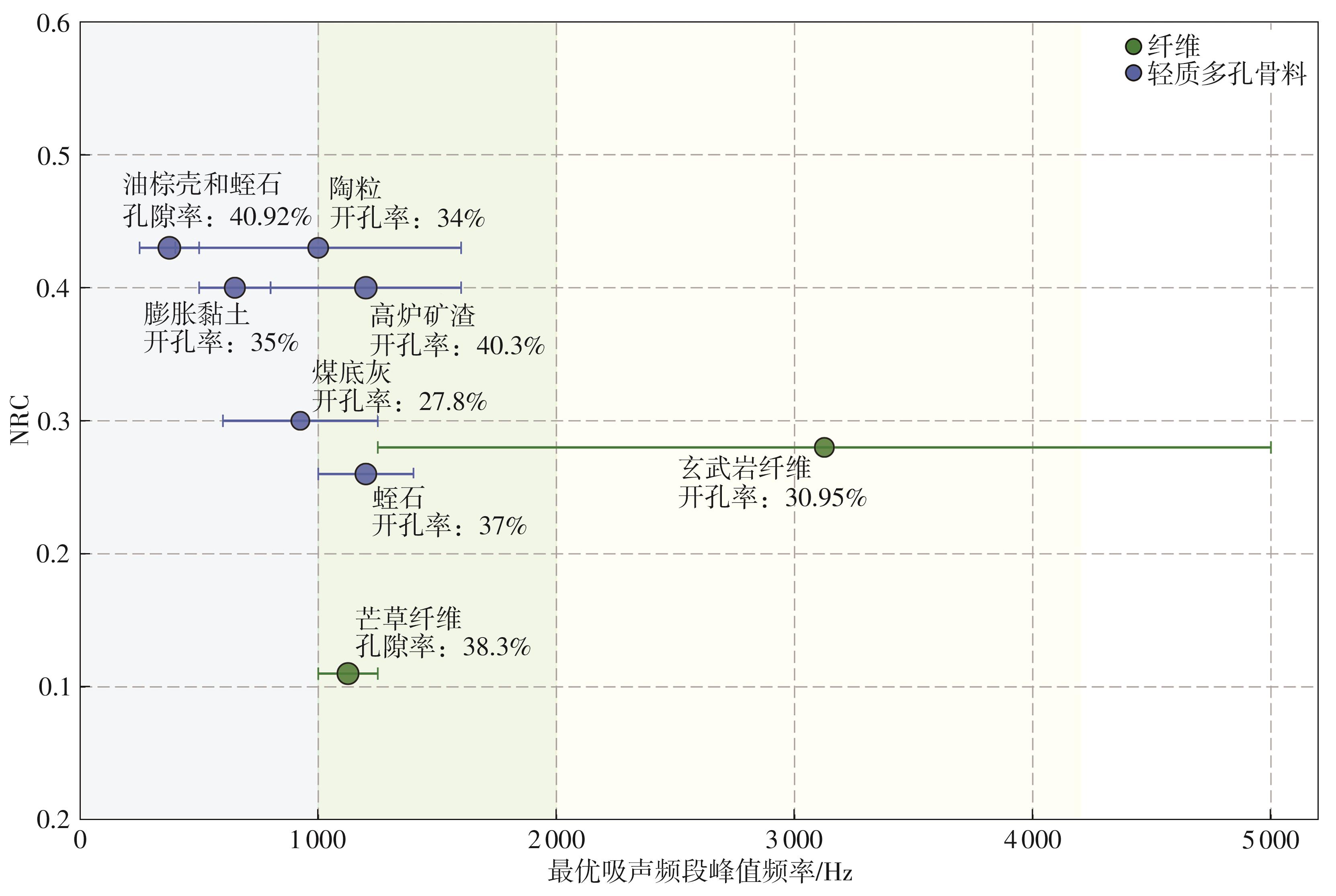
图6
苏州绕城高速S58沪常线3D打印声屏障[18]"
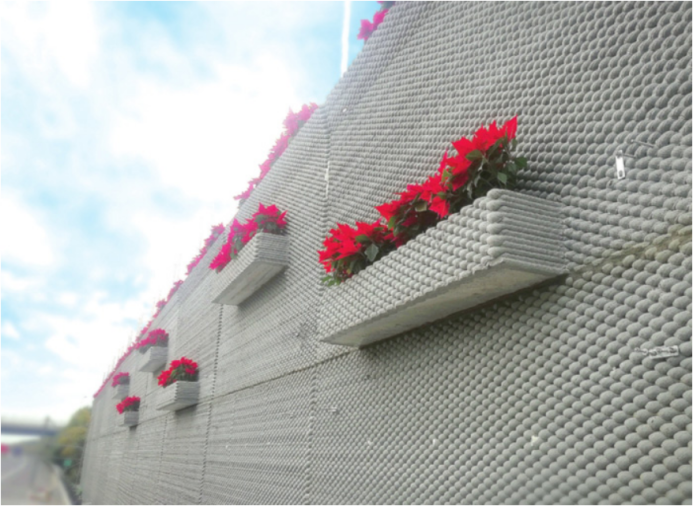
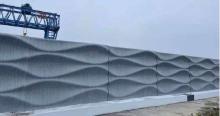
图7
上海金山高速公路3D打印声屏障[19]"
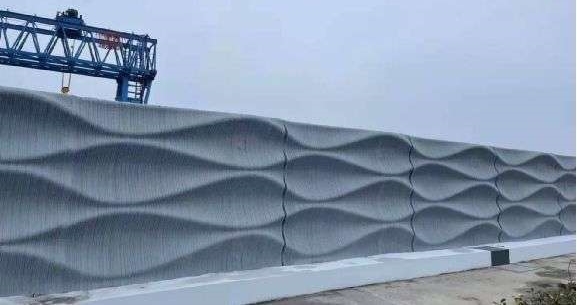
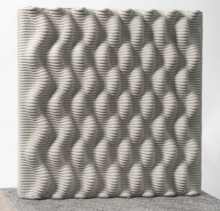
图8
3D打印声学立面[78]"
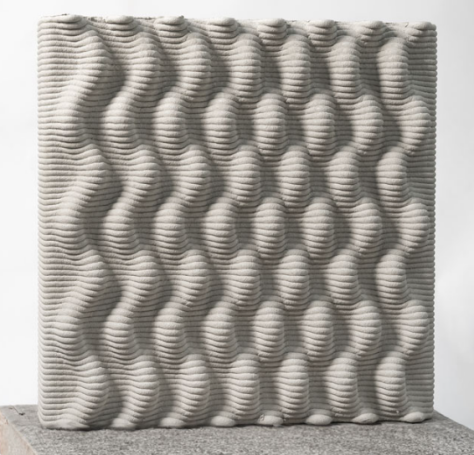
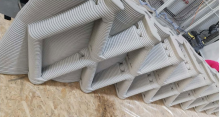
图9
3D打印声学楼板[79]"
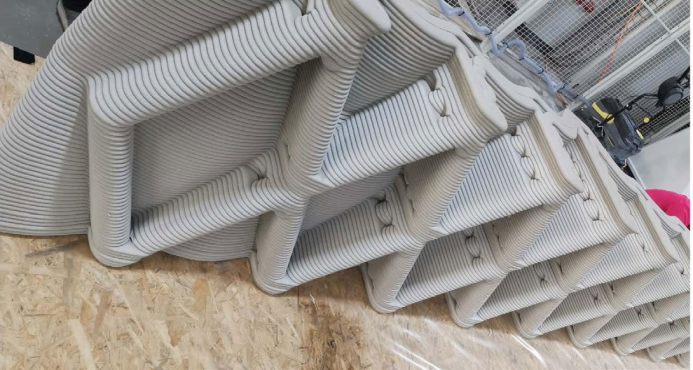
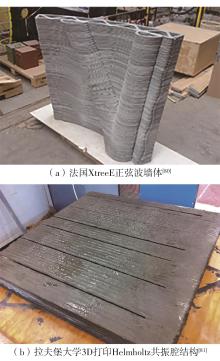
图10
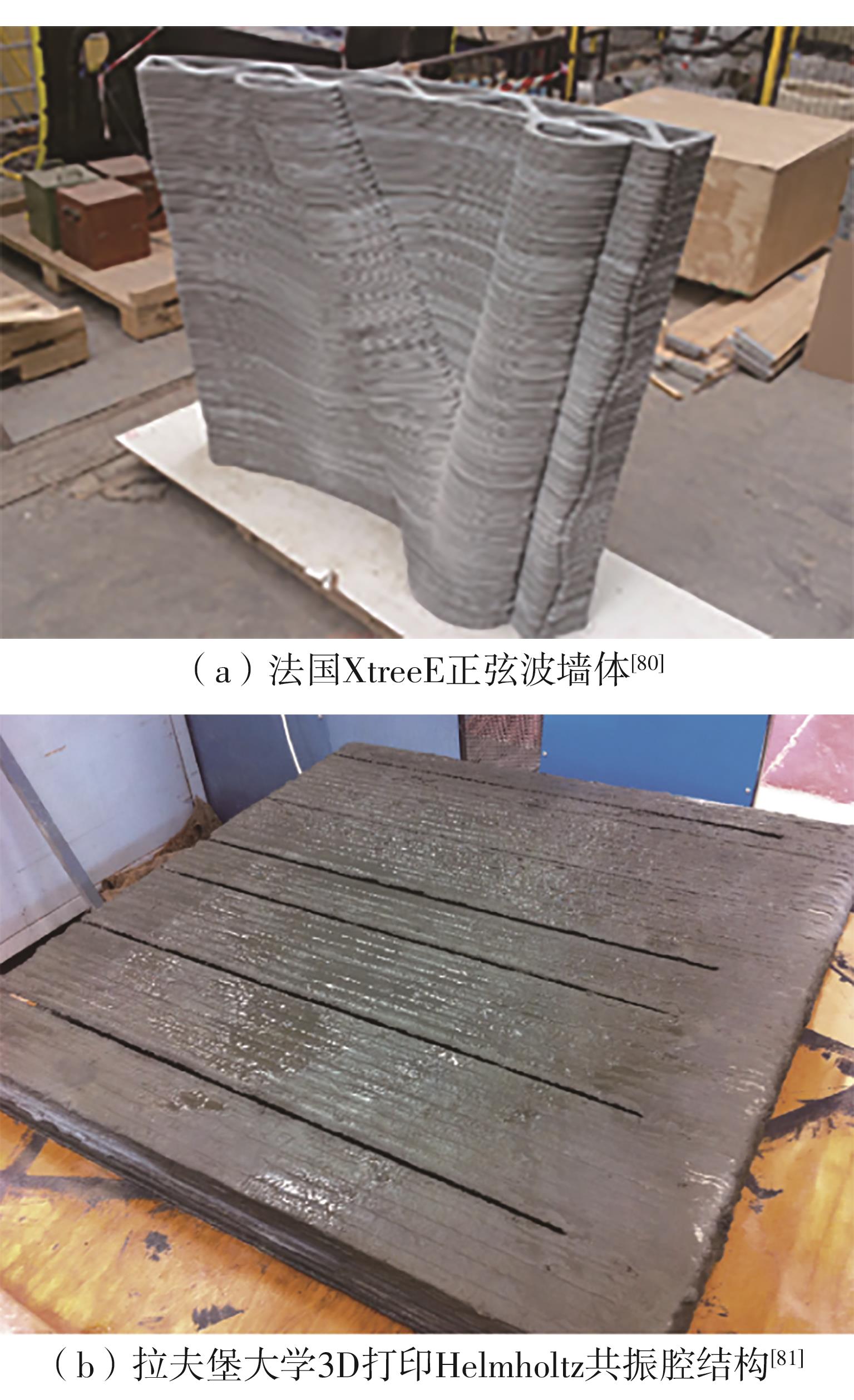
现有3D打印混凝土结构"
| [1] | 余海燕 .水泥-木梗纤维复合吸声材料的组成、性能及吸声模型研究[D].北京:中国建筑材料科学研究总院,2006. |
| [2] | 肖沙沙 .高速公路交通噪声预测方法对比研究与工程应用[D].西安:长安大学,2014. |
| [3] | 中华人民共和国生态环境部 .中国噪声污染防治报告(2024年)[J].环境保护,2024,52(16):53-67. |
| Ministry of Ecology and Environment of the People’ s Republic of China .Annual report on prevention and control of noise pollution in China(2024)[J].Environmental Protection,2024,52(16):53-67. | |
| [4] | 陈志刚 .城市综合体建筑设备噪声控制研究与应用[D].杭州:浙江大学,2023. |
| [5] | 罗帅 .吸声型再生骨料泡沫混凝土性能研究[D].邯郸:河北工程大学,2024. |
| [6] | 王俊凯 .分层多孔水泥基吸声材料的制备及性能[D].南京:东南大学,2023. |
| [7] | 廖陈畅 .发泡混凝土声屏障声学与力学性能试验研究[D].南京:东南大学,2022. |
| [8] | RAMAMURTHY K, KUNHANANDAN NAMBIAR E K, INDU SIVA RANJANI G .A classification of studies on properties of foam concrete[J].Cement and Concrete Composites,2009,31(6):388-396. |
| [9] | ZHOU G, SU R K L .A review on serviceability of foam concrete[J].Proceedings of the Institution of Civil Engineers-Construction Materials,2024,177(6):381-392. |
| [10] | ZHANG B, POON C S .Sound insulation properties of rubberized lightweight aggregate concrete[J].Journal of Cleaner Production,2018,172:3176-3185. |
| [11] | LAHOUIOUI M, ARFI R BEN, FOIS M,et al .Investigation of fiber surface treatment effect on thermal,mechanical and acoustical properties of date palm fiber-reinforced cementitious composites[J].Waste and Biomass Valorization,2020,11(8):4441-4455. |
| [12] | CHEN L, CHEN Z, XIE Z,et al .Recent developments on natural fiber concrete:a review of properties,sustainability,applications,barriers,and opportunities[J].Developments in the Built Environment,2023,16:100255/1-17. |
| [13] | WIJESINGHE K A P, GUNASEKARA C, LAW D W,et al .Thermal and acoustic performance in textile fibre-reinforced concrete: an analytical review[J].Construction and Building Materials,2024,412:134879/1-17. |
| [14] | AMRAN M, FEDIUK R, MURALI G,et al .Sound-absorbing acoustic concretes:a review[J].Sustainability,2021,13(19):10712/1-3. |
| [15] | CAI X, GUO Q, HU G,et al .Ultrathin low-frequency sound absorbing panels based on coplanar spiral tubes or coplanar Helmholtz resonators[J].Applied Physics Letters,2014,105(12):121901/1- 4. |
| [16] | LI Y, ASSOUAR B M .Acoustic metasurface-based perfect absorber with deep subwavelength thickness[J].Applied Physics Letters,2016,108(6):063502 /1- 4. |
| [17] | 谭普,付涛,李成斐,等 .三周期极小曲面声学超材料的低频宽带吸声性能[J].复合材料学报,2025,42(5):2928-2941. |
| TAN Pu, FU Tao, LI Chengfei,et al .Low-frequency broadband acoustic absorption properties of triply perio-dic minimal surface acoustic metamaterials[J].Acta Materiae Compositae Sinica,2025,42(5):2928-2941. | |
| [18] | 今日头条 .苏州高速用上3D打印声屏障,隔音降噪效果杠杠滴[EB/OL].(2019-12-07) [2025-09-19].. |
| [19] | 中国基建报 .钢渣有妙用!钢渣3D打印声屏障落地上海金山高速公路[EB/OL].(2022-01-13) [2025-09-19].. |
| [20] | 康玉成 .建筑隔声设计:空气声隔声技术[M].北京:中国建筑工业出版社,2004. |
| [21] | 张玮玮 .轻质高隔声复合隔墙研究[D].南京:东南大学,2018. |
| [22] | 戈禧芸 .基于固废资源化的新型声屏障性能研究[D].重庆:重庆大学,2021. |
| [23] | 张群义 .新型道路声屏障设计及仿真[D].长沙:湖南大学,2018. |
| [24] | FEDIUK R, AMRAN M, VATIN N,et al .Acoustic properties of innovative concretes:a review[J].Materials,2021,14(2):398. |
| [25] | 赵毅 .多孔材料吸声性能仿真分析与优化[D].重庆:重庆大学,2018. |
| [26] | 张春春 .纤维基复合吸声体的结构设计及中低频降噪性能调控研究[D].天津:天津工业大学,2021. |
| [27] | TIE T S, MO K H, PUTRA A,et al .Sound absorption performance of modified concrete:a review[J].Journal of Building Engineering,2020,30:101219/1-10. |
| [28] | TSAY Y S, LIN J Y, MA F .Development of a panel membrane resonant absorber[J].Applied Sciences,2021,11(4):1893/1-14. |
| [29] | 钟祥璋 .建筑吸声材料与隔声材料[M].2版.北京:化学工业出版社,2012. |
| [30] | 声屏障声学设计和测量规范: [S]. |
| [31] | 建筑吸声产品的吸声性能分级: [S]. |
| [32] | JIANG W, SHA A, XIAO J .Experimental study on relationships among composition, microscopic void features,and performance of porous asphalt concrete[J].Journal of Materials in Civil Engineering,2015,27(11):4015028/1-10. |
| [33] | CHAGAS RODRIGUES P, DE SALES BRAGA N T, SANTOS ARRUDA JUNIOR E,et al .Effect of pore characteristics on the sound absorption of pervious concretes[J].Case Studies in Construction Materials,2022,17:e01302/1-16. |
| [34] | PEREIRA M, CARBAJO J, GODINHO L,et al .Acoustic behavior of porous concrete.characterization by experimental and inversion methods[J].Materiales de Construcción,2019,69(336):e202/1-13. |
| [35] | WARNOCK A C C .Factors affecting sound transmission loss[J].Canadian Building Digest,1985,CBD-239. |
| [36] | Federal Highway Administration .Noise barrier design handbook:3. Acoustical considerations[R].Washington,DC:FHWA,U.S. Department of Transportation,2017. |
| [37] | LI F, CHEN Y, ZHU D .Revealing the sound transmission loss capacities of sandwich metamaterials with re-entrant negative poisson’s ratio configuration[J].Materials,2023,16(17):5928/1-21. |
| [38] | WARNOCK A C C .Sound transmission loss measurements through 190 mm and 140 mm blocks with added drywall and through cavity block walls[R].Ottawa:Institute for Research in Construction,National Research Council Canada,1990. |
| [39] | EVEREST F A, POHLMANN K C .Master handbook of acoustics[M].New York:McGraw-Hill,2009. |
| [40] | GALIP N S, HARON Z, MOHAMED R N,et al .Sound absorption properties of porous concrete layers for noise barrier[J].Journal of Physics:Conference Series,2024,2721(1):012012/1-19. |
| [41] | NEITHALATH N, WEISS J, OLEK J .Characterizing enhanced porosity concrete using electrical impedance to predict acoustic and hydraulic performance[J].Cement and Concrete Research,2006,36(11):2074-2085. |
| [42] | NEITHALATH N, MAROLF A, WEISS J,et al .Modeling the influence of pore structure on the acoustic absorption of enhanced porosity concrete[J].Journal of Advanced Concrete Technology,2005,3(1):29-40. |
| [43] | ZHANG Y, LI H, ABDELHADY A,et al .Effect of different factors on sound absorption property of porous concrete[J].Transportation Research Part D:Transport and Environment,2020,87:102532/1-17. |
| [44] | ZHANG Y, LI H, ABDELHADY A,et al .Laboratorial investigation on sound absorption property of porous concrete with different mixtures[J].Construction and Building Materials,2020,259:120414/1-11. |
| [45] | LAUKAITIS A, FIKS B .Acoustical properties of aera-ted autoclaved concrete[J].Applied Acoustics,2006,67(3):284-296. |
| [46] | ROMMEL E, PRASETYOL L, RUSDIANTO Y,et al .The insulation properties of foam concrete with the use of foam-agent and fly-ash[C]∥ Proceedings of IOP Conference Series:Materials Science and Engineering.Sorong:IOP Publishing,2020,821(1):012013/1-8. |
| [47] | 王卫东 .水泥多孔吸声材料性能的研究[J].工程建设,2025,57(5):22-27. |
| WANG Weidong .Study on properties of cement porous sound absorbing materials[J].Engineering Construction,2025,57(5):22-27. | |
| [48] | LIU Y, ZHAO Z, AMIN M N,et al .Foam concrete for lightweight construction applications:a comprehensive review of the research development and material characteristics[J].Reviews on Advanced Materials Science,2024,63(1):20240022/1-26. |
| [49] | SHAWNIM P, MOHAMMAD F .Porosity,permeabi-lity and microstructure of foamed concrete through SEM images[J].Journal of Civil Engineering,Science and Technology,2019,10(1):22-33. |
| [50] | AMRAN M, FEDIUK R, VATIN N,et al .Fibre-reinforced foamed concretes:a review[J].Materials,2020,13(19):4323/1-36. |
| [51] | 王稷良,杨宁,辛懿涛,等 .泡沫混凝土气泡性能研究进展[J].低温建筑技术,2025,47(4):109-113. |
| WANG Jiliang, YANG Ning, XIN Yitao,et al .Research progress on bubble properties of foamed concrete[J].Low Temperature Architecture Technology,2025,47(4):109-113. | |
| [52] | MASTALI M, KINNUNEN P, ISOMOISIO H,et al .Mechanical and acoustic properties of fiber-reinforced alkali-activated slag foam concretes containing lightweight structural aggregates[J].Construction and Building Materials,2018,187:371-381. |
| [53] | GALZERANO B, CAPASSO I, VERDOLOTTI L,et al .Design of sustainable porous materials based on 3D-structured silica exoskeletons,diatomite:chemico-physical and functional properties[J].Materials & Design,2018,145:196-204. |
| [54] | ZHANG Z, PROVIS J L, REID A,et al .Mechanical,thermal insulation, thermal resistance and acoustic absorption properties of geopolymer foam concrete[J].Cement and Concrete Composites,2015,62:97-105. |
| [55] | LEIVA C, VILCHES L F, ARENAS C,et al .Potential recycling of bottom and fly ashes in acoustic mortars and concretes[J].Materials Journal,2012,109(5):529-536. |
| [56] | TIWARI V, SHUKLA A, BOSE A .Acoustic pro-perties of cenosphere reinforced cement and asphalt concrete[J].Applied Acoustics,2004,65(3):263-275. |
| [57] | WANG C, REN X, DIAO Q,et al .Sound absorption performance of a triple-hole structure in green ceramsite concrete for high-speed-railway sound barriers:experiments and neural network modeling[J].Case Studies in Construction Materials,2023,18:e01980/1-15. |
| [58] | JAHYA Z, HARON Z, YAHYA K,et al .Acoustical properties of porous concrete containing oil palm shell and vermiculite[C]∥ Mohamed Nazri F.Proceedings of AICCE’ 19.Cham:Springer International Publishing,2020:905-917. |
| [59] | CHEN Y, YU Q L, BROUWERS H J H .Acoustic performance and microstructural analysis of bio-based lightweight concrete containing miscanthus[J].Construction and Building Materials,2017,157:839-851. |
| [60] | BOZKURT T S .Acoustic analyses of mortars prepared with recycled aggregates[J].Applied Acoustics,2023,205:109273/1-28. |
| [61] | ALYOUSEF R .Enhanced acoustic properties of concrete composites comprising modified waste sheep wool fibers[J].Journal of Building Engineering,2022,56:104815/1-13. |
| [62] | ALYOUSEF R, MOHAMMADHOSSEINI H, EBID A A K,et al .Enhanced acoustic properties of a novel prepacked aggregates concrete reinforced with waste polypropylene fibers[J].Materials,2022,15(3):1173/1-17. |
| [63] | CARBAJO J, ESQUERDO LLORET T V, RAMIS J,et al .Acoustic properties of porous concrete made from arlite and vermiculite lightweight aggregates[J].Materiales de Construcción,2015,65(320):e072/1-11. |
| [64] | RIOS J, ARENAS C, CIFUENTES H,et al .Porous structure by X-ray computed tomography and sound absorption in pervious concretes with air cooled blast furnace slag as coarse aggregate[J].Acoustics Australia,2019,47(3),271-276. |
| [65] | ARENAS C, LEIVA C, VILCHES L F,et al .Use of co-combustion bottom ash to design an acoustic absorbing material for highway noise barriers[J].Waste Management,2013,33(11):2316-2321. |
| [66] | NGO T H, LI S, HUYNH T,et al .3D printable hemp concrete:rheological,mechanical,and microstructural properties[J].Journal of Building Engineering,2025,114:114467/1-18. |
| [67] | RUDZIEWICZ M, MAROSZEK M, HUTYRA A,et al .Influence of foaming agents and stabilizers on porosity in 3D printed foamed concrete[J].Processes,2025,13(2):403/1-31. |
| [68] | WENG Y, LI M, LIU Z,et al .Printability and fire performance of a developed 3D printable fibre reinforced cementitious composites under elevated temperatures[J].Virtual and Physical Prototyping,2019,14(3):284-292. |
| [69] | KRUGER J, du PLESSIS A, van ZIJL G .An investigation into the porosity of extrusion-based 3D printed concrete[J].Additive Manufacturing,2021,37:101740/1-13. |
| [70] | WANG X, DU L, LIU Z,et al .3D cementitious composites printing with pretreated recycled crumb rubber:mechanical and acoustic insulation properties[J].Virtual and Physical Prototyping,2024,19(1):e2399787/1-25. |
| [71] | CICIONE A, KRUGER J, WALLS R S,et al .An experimental study of the behavior of 3D printed concrete at elevated temperatures[J].Fire Safety Journal,2021,120:103075/1-10. |
| [72] | van den HEEVER M, du PLESSIS A, KRUGER J,et al .Evaluating the effects of porosity on the mechanical properties of extrusion-based 3D printed concrete[J].Cement and Concrete Research,2022,153:106695/1-17. |
| [73] | MOGES K A, DALILA N, PLASKOTA P,et al .Evaluation methods,testing standards,and simulation techniques of sound absorption capabilities of cementitious materials:a review[J].Journal of Building Engineering,2024,96:110468/1-28. |
| [74] | MOGES K A, PARK S,PYO S .Sound absorption characteristics of surface perforated mortar with micro-sized pores[J].Applied Acoustics,2022,195:108811/1-12. |
| [75] | PEREIRA C M, VIEIRA H, GONCALVES N P F,et al .Innovative waste-containing 3D-printed geopolymer structures for enhanced acoustic comfort in built environments[J].Journal of Cleaner Production,2025,517:145857/1-14. |
| [76] | SHENG W, WANG Y .Traffic noise mitigation through texture-induced quiet pavement:analytical modeling and field test[J].Transportation Research Part D:Transport and Environment,2024,137:104485/1-16. |
| [77] | 王玎君 .3D打印声屏障在改建高速公路的设计及应用[J].价值工程,2023,42(17):74-76. |
| WANG Dingjun .Design and application of 3D printing sound barrier in reconstruction of highways[J].Value Engineering,2023,42(17):74-76. | |
| [78] | VERTICO .Hybrid 3D concrete printing & milling for acoustic façades[EB/OL].(2024-05-06)[2025-09-19].. |
| [79] | AZIZ S, APELLÁNIZ D, WEBER M,et al .Towards a multifunctional 3DCP slab system[C]∥ Proceedings of the IASS Annual Symposium 2020/21 and the 7th International Conference on Spatial Structures 2020/21.Guilford:University of Surrey,2021:1-12. |
| [80] | GOSSELIN C, DUBALLET R, ROUX PH,et al .Large-scale 3D printing of ultra-high performance concrete—a new processing route for architects and buil-ders[J].Materials & Design,2016,100:102-109. |
| [81] | BUSWELL R A, LEAL de SILVA W R, JONES S Z,et al .3D printing using concrete extrusion:a roadmap for research[J].Cement and Concrete Research,2018,112:37-49. |
| [1] | 周捷航, 杜龙雨, 赖建中, 尹雪祥, 杨明宇. 3D打印混凝土抗侵彻仿真模型[J]. 华南理工大学学报(自然科学版), 2025, 53(8): 137-148. |
| [2] | 张海燕, 马金一, 吴波, 等. 再生细骨料和砖粉双掺对3D打印混凝土性能的影响[J]. 华南理工大学学报(自然科学版), 2024, 52(3): 18-27. |
| [3] | 王红卫, 张光耀, 沈涛, 等. 近场声全息重建参数对隔声测量精度的影响[J]. 华南理工大学学报(自然科学版), 2024, 52(11): 1-8. |
| [4] | 熊威, 王红卫, 张光耀, 等. 近场声全息隔声测量技术重建参数的选取[J]. 华南理工大学学报(自然科学版), 2022, 50(5): 109-117. |
| [5] | 张刚 董江涛 贺利芳. 无信号间干扰的多载波降噪差分混沌移位键控方案[J]. 华南理工大学学报(自然科学版), 2022, 50(4): 100-109. |
| [6] | 邱志斌, 卢祖文, 王海祥, 等. 基于Mel频谱图和CNN的电网涉鸟故障鸟声识别[J]. 华南理工大学学报(自然科学版), 2022, 50(2): 129-136. |
| [7] | 王红卫 高艺帆 於秀. 基于三维声强法的吸声系数测量研究[J]. 华南理工大学学报(自然科学版), 2020, 48(7): 134-142. |
| [8] | 黄险峰 刘君. 利用双层墙构造减弱吻合效应影响的方法 [J]. 华南理工大学学报(自然科学版), 2018, 46(4): 105-111. |
| [9] | 彭健新 唐云飞. 谱减法与维纳滤波法相结合的睡眠鼾声降噪处理 [J]. 华南理工大学学报(自然科学版), 2018, 46(3): 103-107. |
| [10] | 孙海涛 赵越喆 吴硕贤. 厅堂1:10声学缩尺模型材料吸声系数测定[J]. 华南理工大学学报(自然科学版), 2014, 42(11): 85-91. |
| [11] | 蒋贤海 谢存禧 邹焱飚. 一种强噪声下的监护信息降噪方法[J]. 华南理工大学学报(自然科学版), 2011, 39(4): 66-69. |
| [12] | 金雪莉 曾令可 李萍 侯来广. 聚丙烯纤维对吸声性能的影响及其神经网络模拟[J]. 华南理工大学学报(自然科学版), 2007, 35(12): 97-101. |
| [13] | 梁基照 蒋兴华. 聚合物/无机粒子复合材料的隔声理论模型[J]. 华南理工大学学报(自然科学版), 2004, 32(10): 6-9. |
| 阅读次数 | ||||||
|
全文 |
|
|||||
|
摘要 |
|
|||||