Journal of South China University of Technology(Natural Science Edition) ›› 2025, Vol. 53 ›› Issue (10): 86-96.doi: 10.12141/j.issn.1000-565X.240593
Special Issue: 2025年土木建筑工程
• Architecture & Civil Engineering • Previous Articles Next Articles
Strength-Deformation Behavior and Engineering Applications of Residual Soil Under Drying-Wetting Cycles and Construction Vibration
CHEN Dongxia1, TANG Jiarun1, WANG Dongdong1, CHEN Bo2, ZHANG Jingyi1
- 1.School of Architecture and Civil Engineering/Fujian Key Laboratory of Digital Simulations for Coastal Civil Engineering,Xiamen University,Xiamen 361005,Fujian,China
2.China Railway Southern Investment Group Co. ,Ltd. ,Shenzhen 518000,Guangdong,China
-
Received:2024-12-20Online:2025-10-25Published:2025-05-26 -
About author:陈东霞(1976 —),女,博士,助理教授,主要从事残积土工程特性、基坑工程、边坡工程及地基处理研究。E-mail: dongxiachen@xmu.edu.cn -
Supported by:the Natural Science Foundation of Fujian Province(2021J01010)

CLC Number:
Cite this article
CHEN Dongxia, TANG Jiarun, WANG Dongdong, CHEN Bo, ZHANG Jingyi. Strength-Deformation Behavior and Engineering Applications of Residual Soil Under Drying-Wetting Cycles and Construction Vibration[J]. Journal of South China University of Technology(Natural Science Edition), 2025, 53(10): 86-96.
share this article
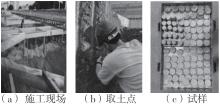
Fig.1
Sample taken on site and made"
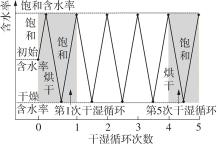
Fig.2
Sample drying-wetting cycle path"
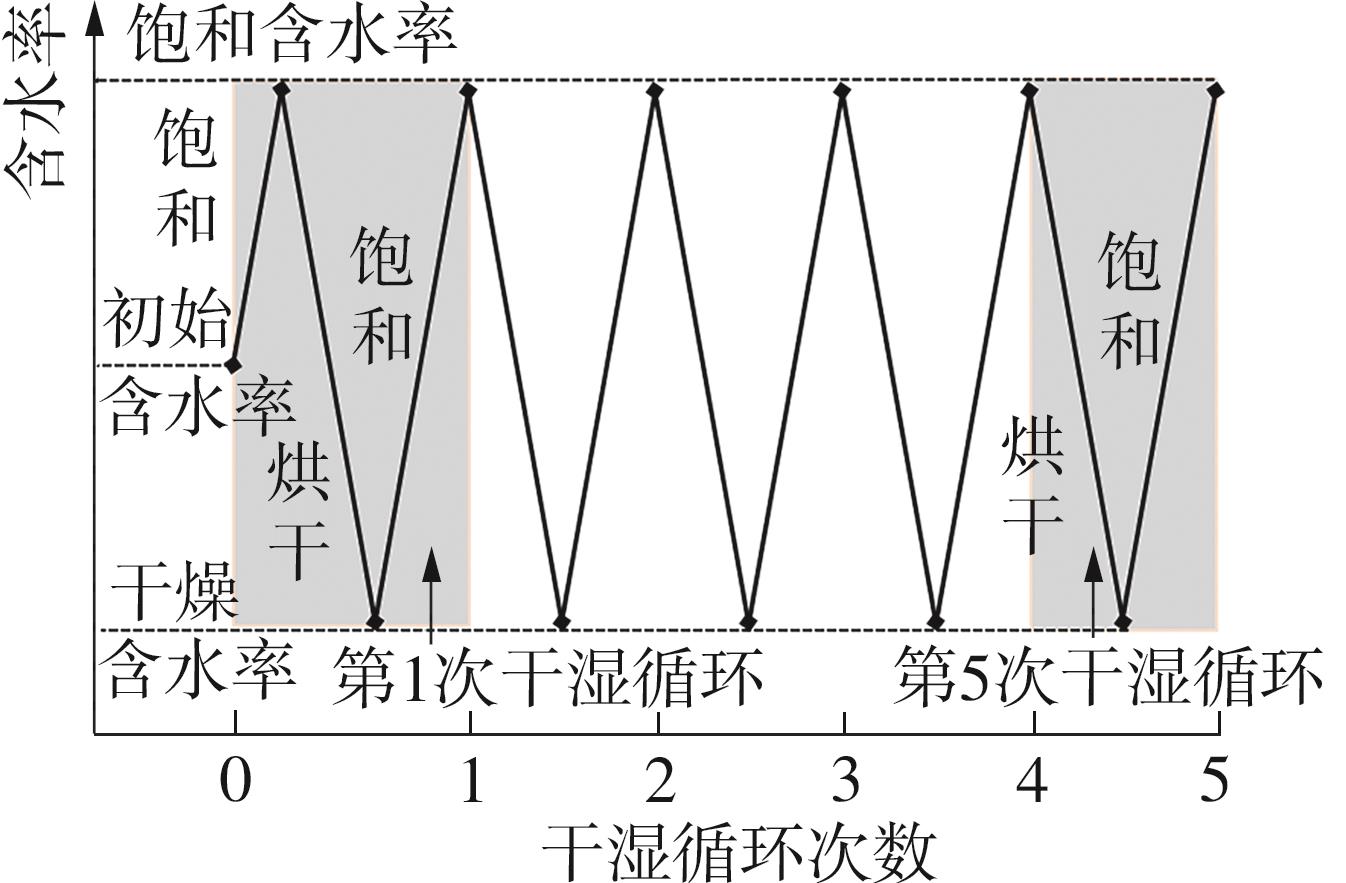
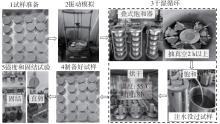
Fig.3
Test flowchart"
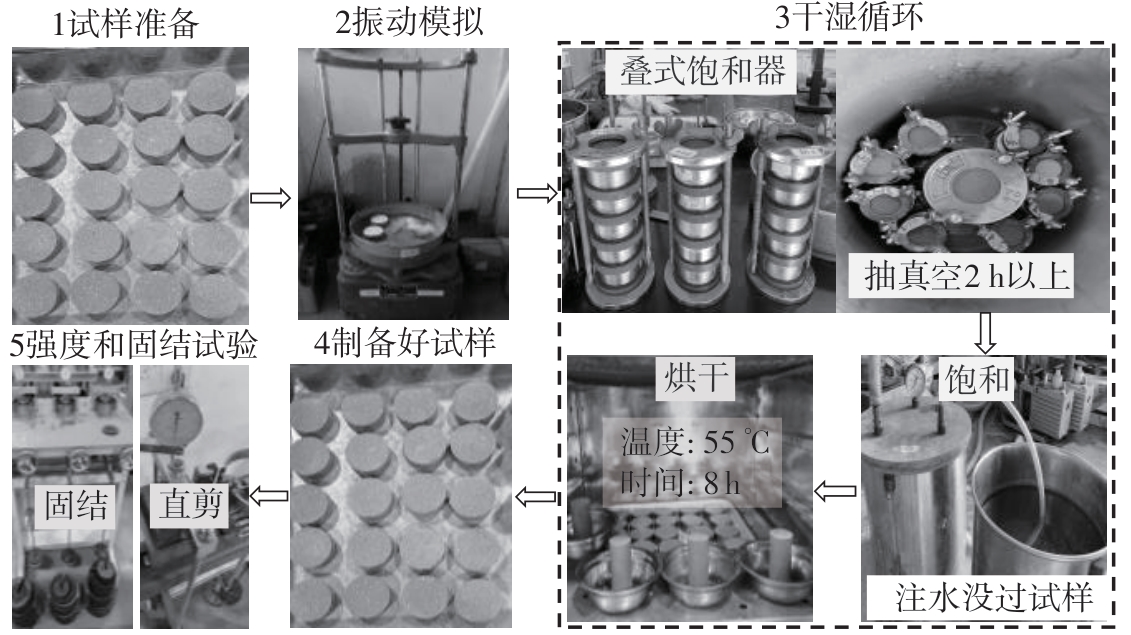

Table 1
Test program for residual soil"
| 试验名称 | 振动时长/min | 干湿循环次数 | 垂直压力/kPa | 试样数 |
|---|---|---|---|---|
| 直剪 | 0, 15, 30, 45 | 0~5 | 100, 200, 300, 400 | 192 |
| 固结 | 0, 15, 30, 45 | 0~5 | 25, 50, 100, 200, 300, 400, 800 | 48 |
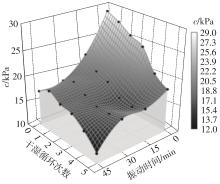
Fig.4
Change graph of cohesion c"
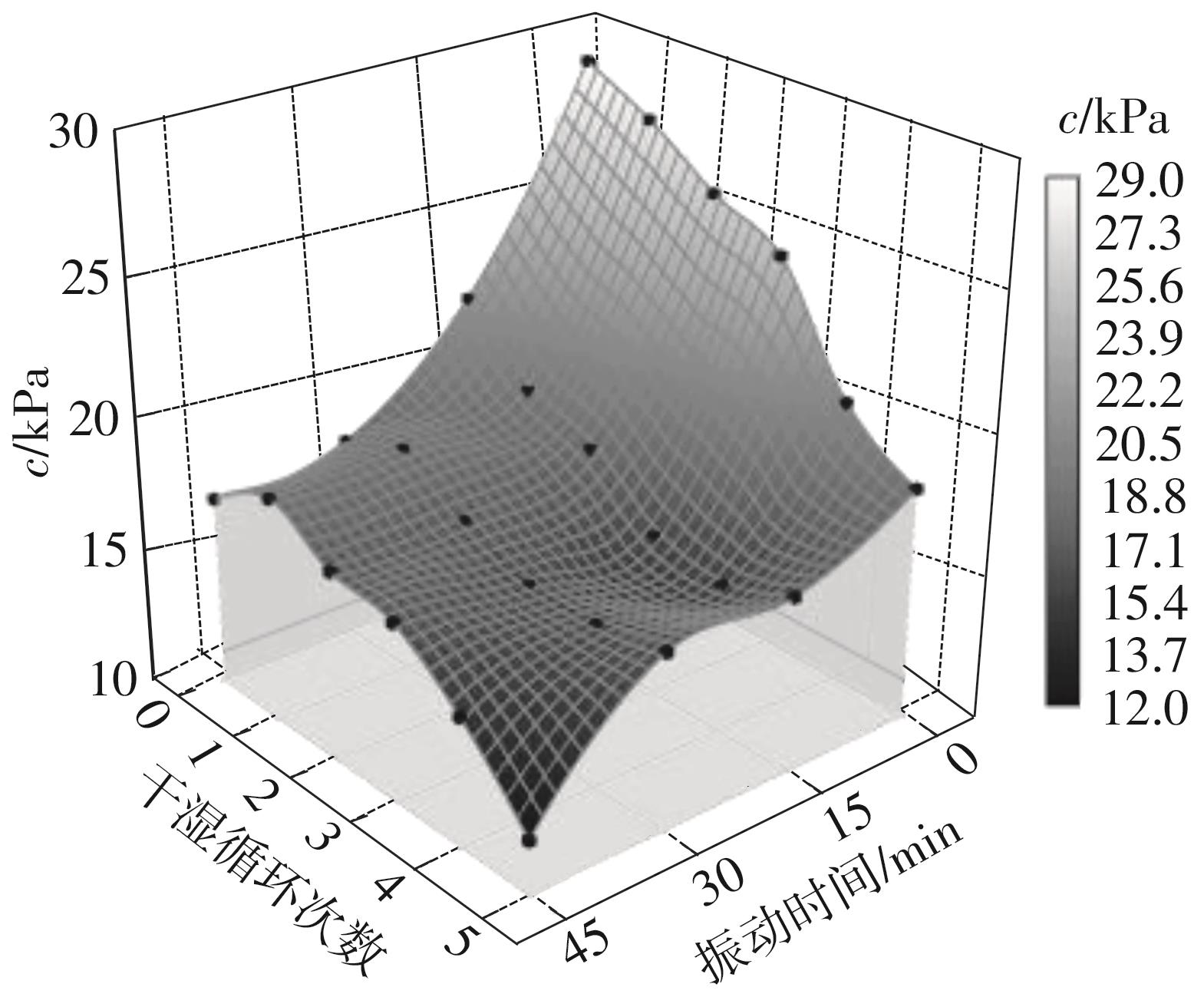
Table 2
Cohesion deterioration under drying-wetting cycle and vibration"
| 振动时长/min | ||||||
|---|---|---|---|---|---|---|
| n = 0 | n = 1 | n = 2 | n = 3 | n = 4 | n = 5 | |
| 0 | 0.0 | 4.5 | 10.5 | 14.8 | 30.3 | 35.9 |
| 15 | 26.2 | 33.1 | 37.9 | 40.3 | 38.8 | 42.6 |
| 30 | 39.7 | 36.6 | 40.6 | 44.8 | 44.8 | 43.1 |
| 45 | 41.4 | 36.9 | 41.4 | 42.8 | 49.1 | 58.6 |
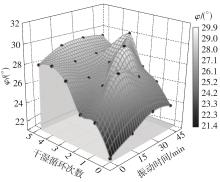
Fig.5
Variation diagram of internal friction angle φ"
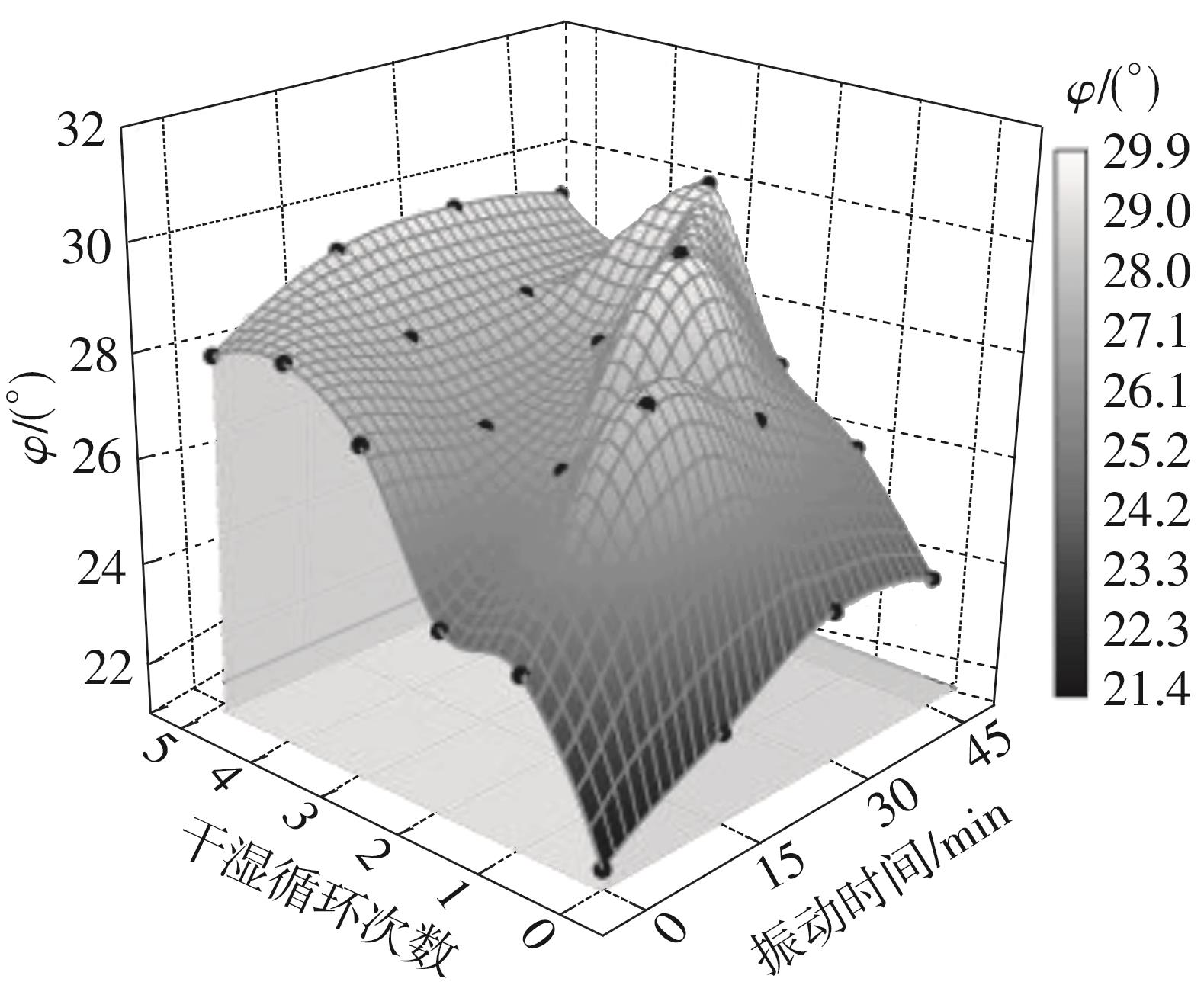
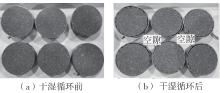
Fig.6
Specimen volume shrinkage diagram"
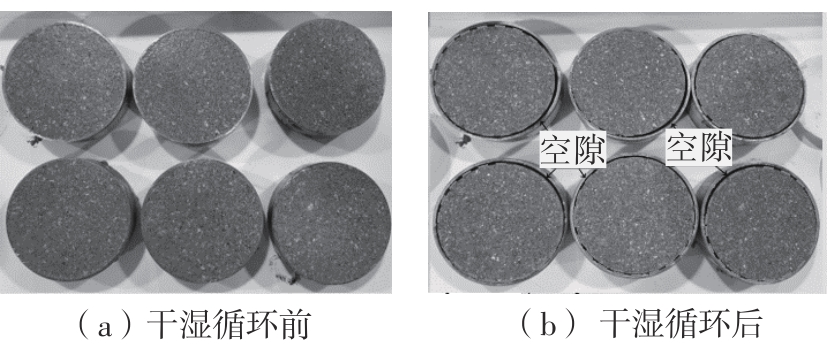
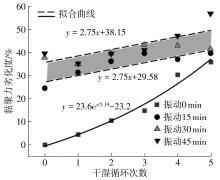
Fig.7
Fitting of cohesion deterioration with drying-wetting cycles"
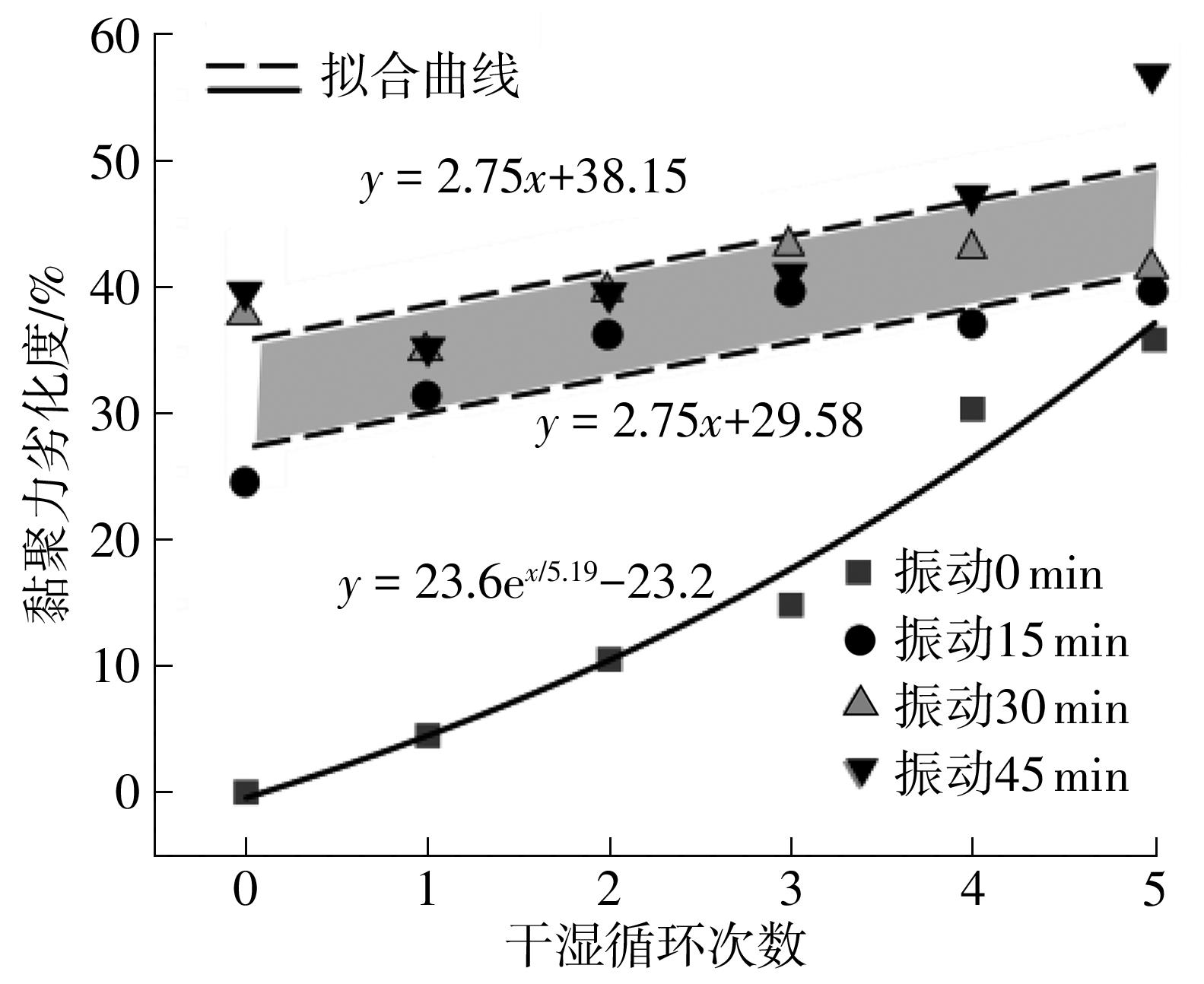
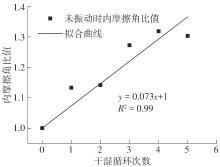
Fig.8
Fitting of ratio of internal friction angle with drying-wetting cycles"
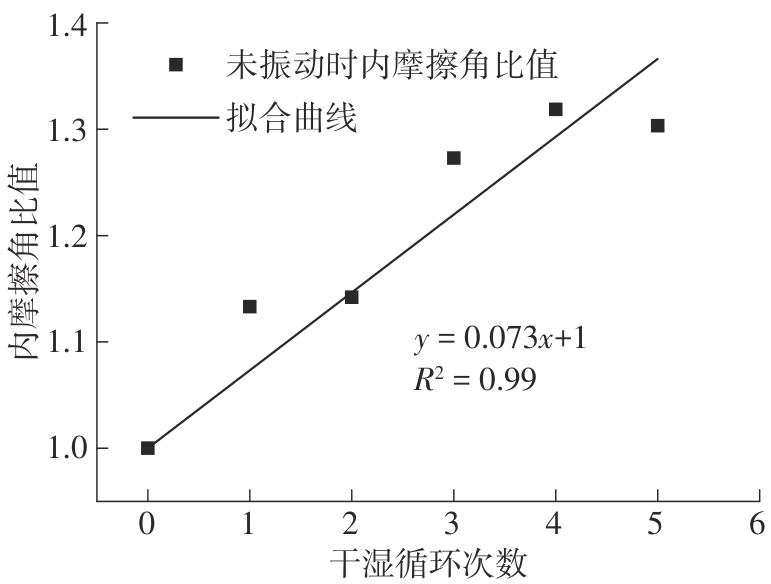
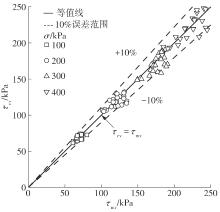
Fig.9
Comparison of measured and calculated values of shear strength"
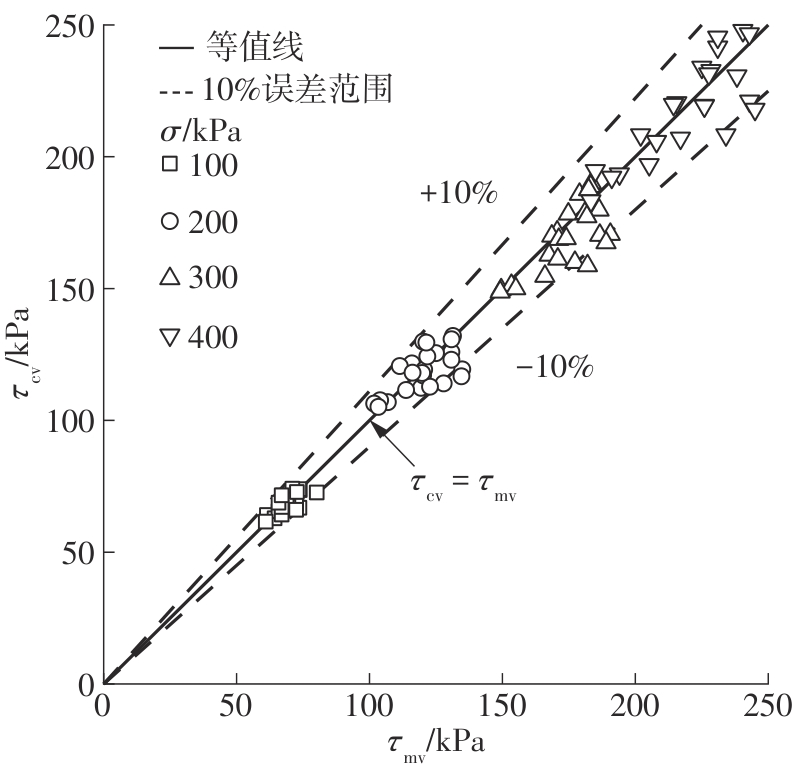
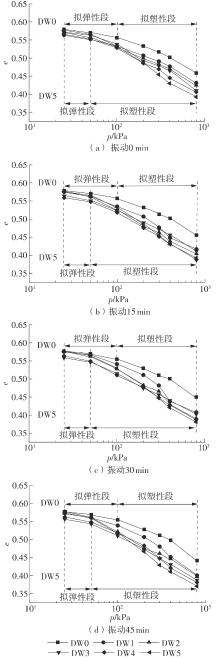
Fig.10
e-lg p curves of residual soil under drying-wetting cycle and vibration"
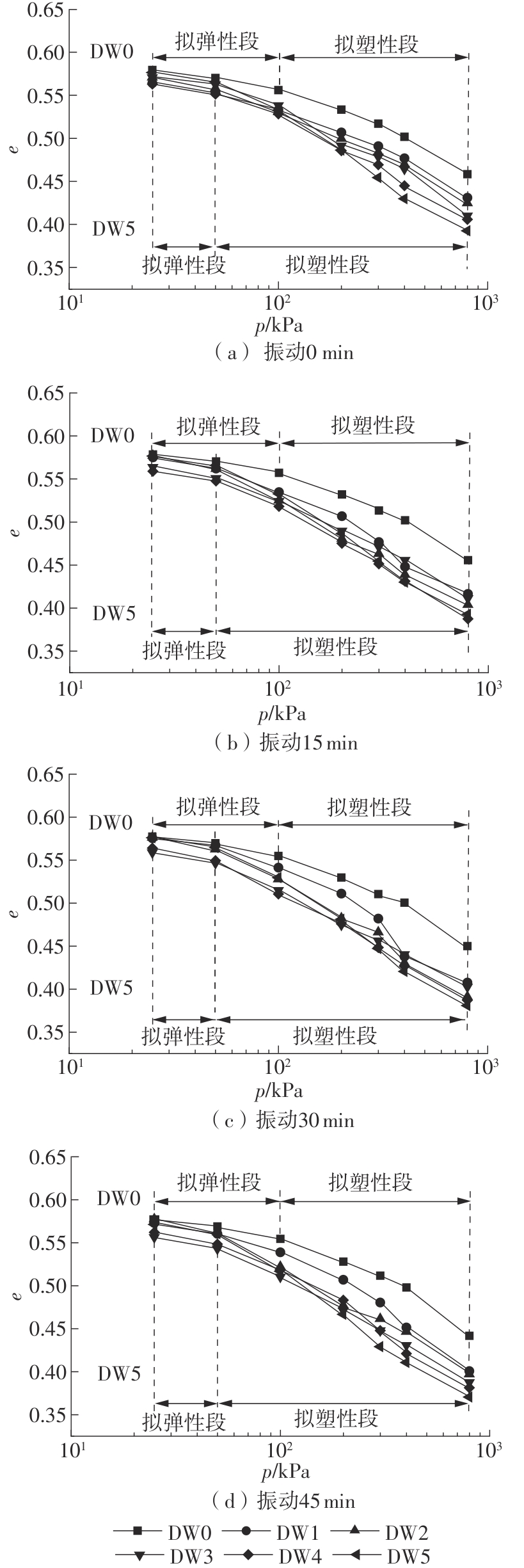
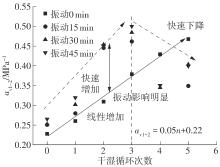
Fig.11
Compression coefficient under drying-wetting cycle and vibration"
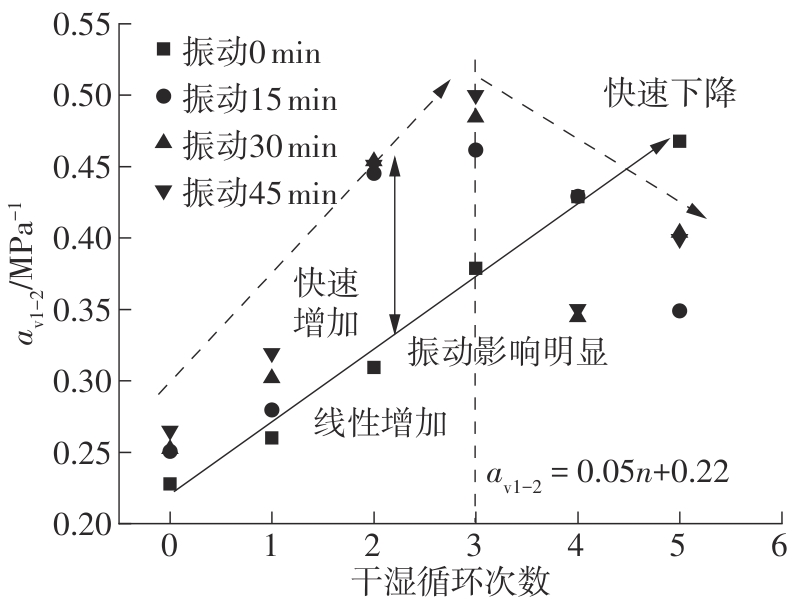
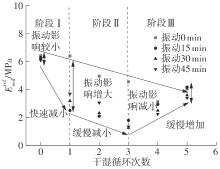
Fig.12
Eoedref under drying-wetting cycle and vibration"
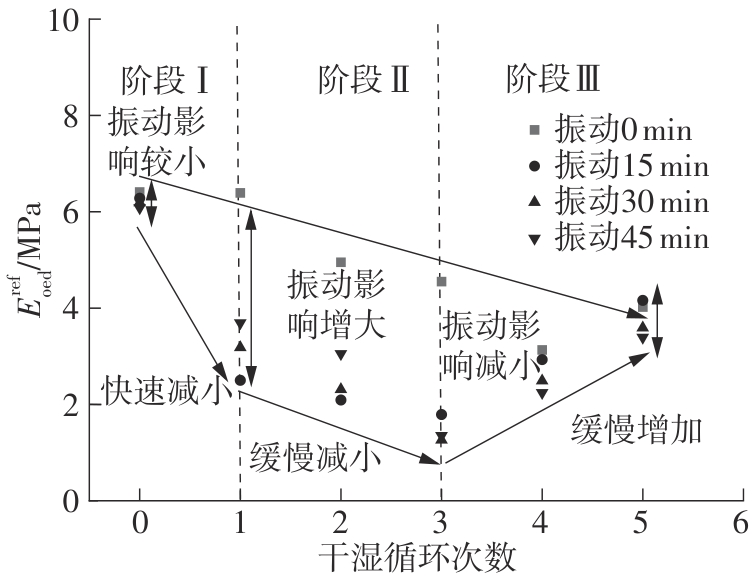
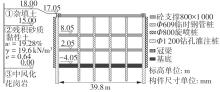
Fig.13
Typical cross-section of station foundation excavation"
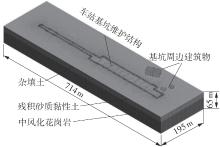
Fig.14
Finite element model of an excavation"
Table 3
Physical and mechanical parameters of soil"
| 参数 | 单位 | 杂填土 | 残积砂质黏性土 | 中风化花岗岩 |
|---|---|---|---|---|
| γ | kN/m3 | 17 | 21 | 18.5 |
| kN/m2 | 4 500 | 10 256 | 35 000 | |
| kN/m2 | 4 500 | 6 410 | 35 000 | |
| kN/m2 | 13 500 | 46 793 | 75 000 | |
| c΄ | kN/m2 | 10 | 29 | 30 |
| φ΄ | ° | 23 | 21.4 | 22 |
| pref | kPa | 100 | 100 | 100 |
Table 4
Component parameters and simulation form"
| 构件 | 模拟形式 | γ/(kN·m-3) | 泊松比 | 弹性模E/GPa |
|---|---|---|---|---|
| 地下连续墙 | 2D板单元 | 24 | 0.17 | 30.0 |
混凝土支撑 及腰梁 | 1D梁单元 | 25 | 0.20 | 31.5 |
| 建筑物梁 | 1D梁单元 | 25 | 0.25 | 30.0 |
| 建筑物板 | 2D板单元 | 25 | 0.25 | 30.0 |
| 建筑物柱 | 1D梁单元 | 25 | 0.25 | 30.0 |
| 建筑物桩 | 植入式梁单元 | 25 | 0.25 | 30.0 |
Table 5
Construction stage simulation table"
| 阶段编号 | 模拟内容 |
|---|---|
| 1、2 | 初始渗流场及初始应力场分析 |
| 3、4 | 建筑物施工、地下连续墙施工 |
| 5 | 第1次降水 |
| 6 | 第1层支护及开挖 |
| 7 | 第2次降水 |
| 9 | 第2层支护及开挖 |
| 10 | 第3次降水 |
| 12 | 第3层支护及开挖 |
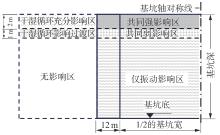
Fig.15
Schematic diagram of considering the division of areas affected by drying-wetting cycle and vibration"
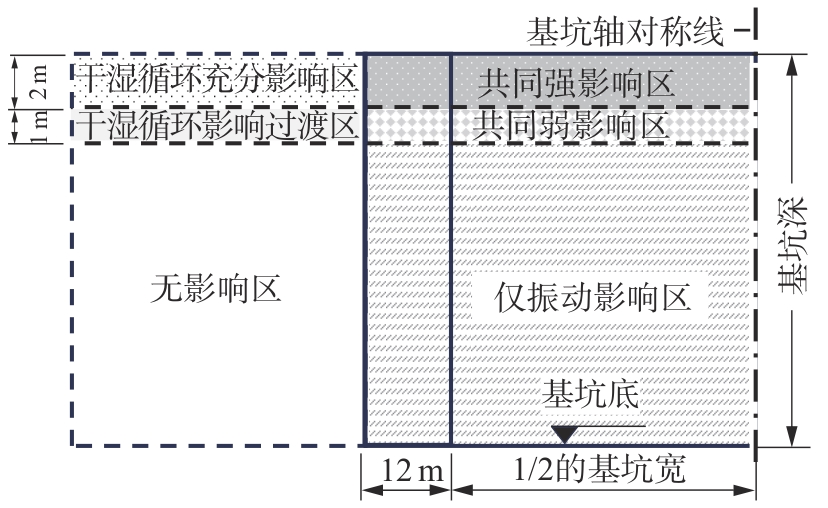
Table 6
Relationship between impact zoning, drying-wetting cycles, and vibration time"
| 影响区域 | 干湿循环次数 | 振动时间/min |
|---|---|---|
| 干湿循环充分影响区 | 5 | 0 |
| 干湿循环影响过渡区 | 1 | 0 |
| 共同强影响区 | 5 | 45 |
| 共同弱影响区 | 1 | 15 |
| 仅振动影响区 | 0 | 45 |
| 无影响区 | 0 | 0 |
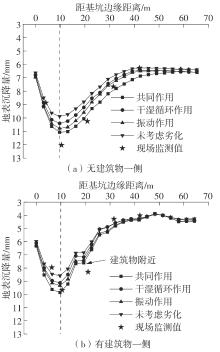
Fig.16
Surface settlement under different influencing factors and on-site monitoring"
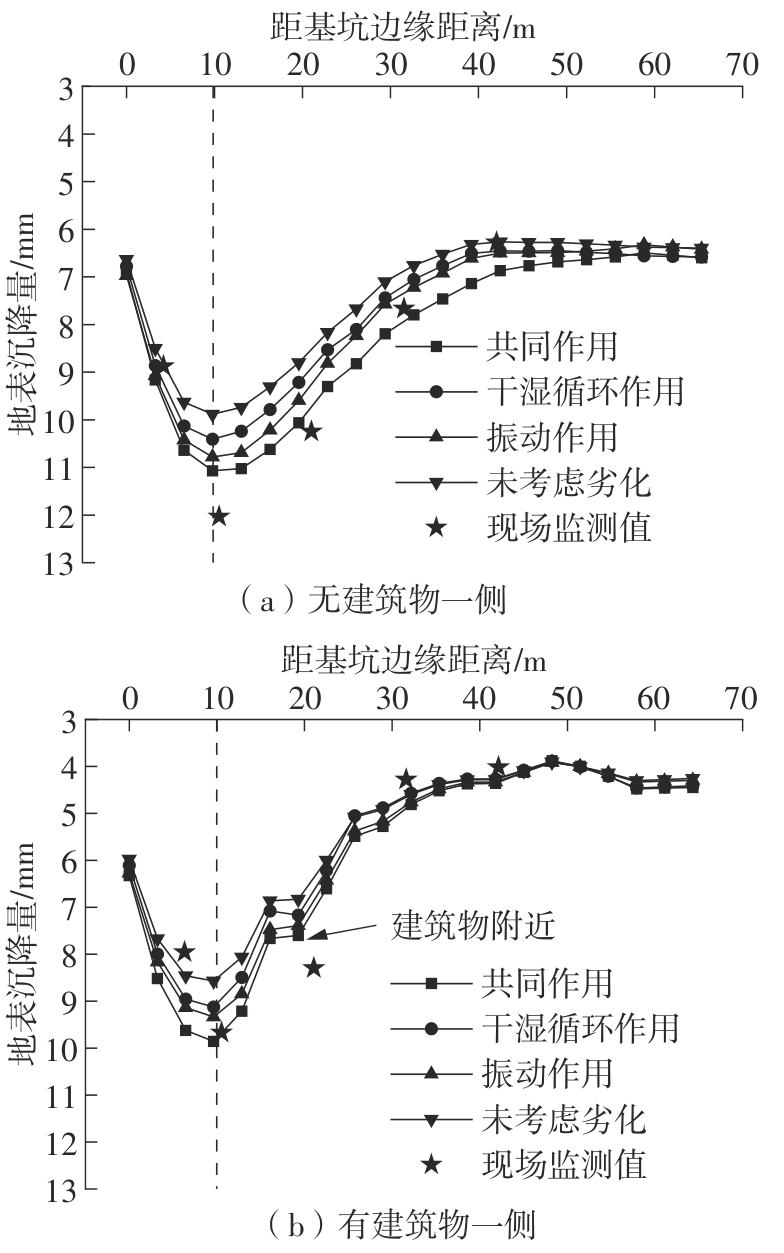
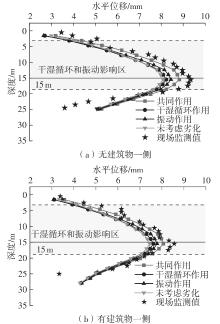
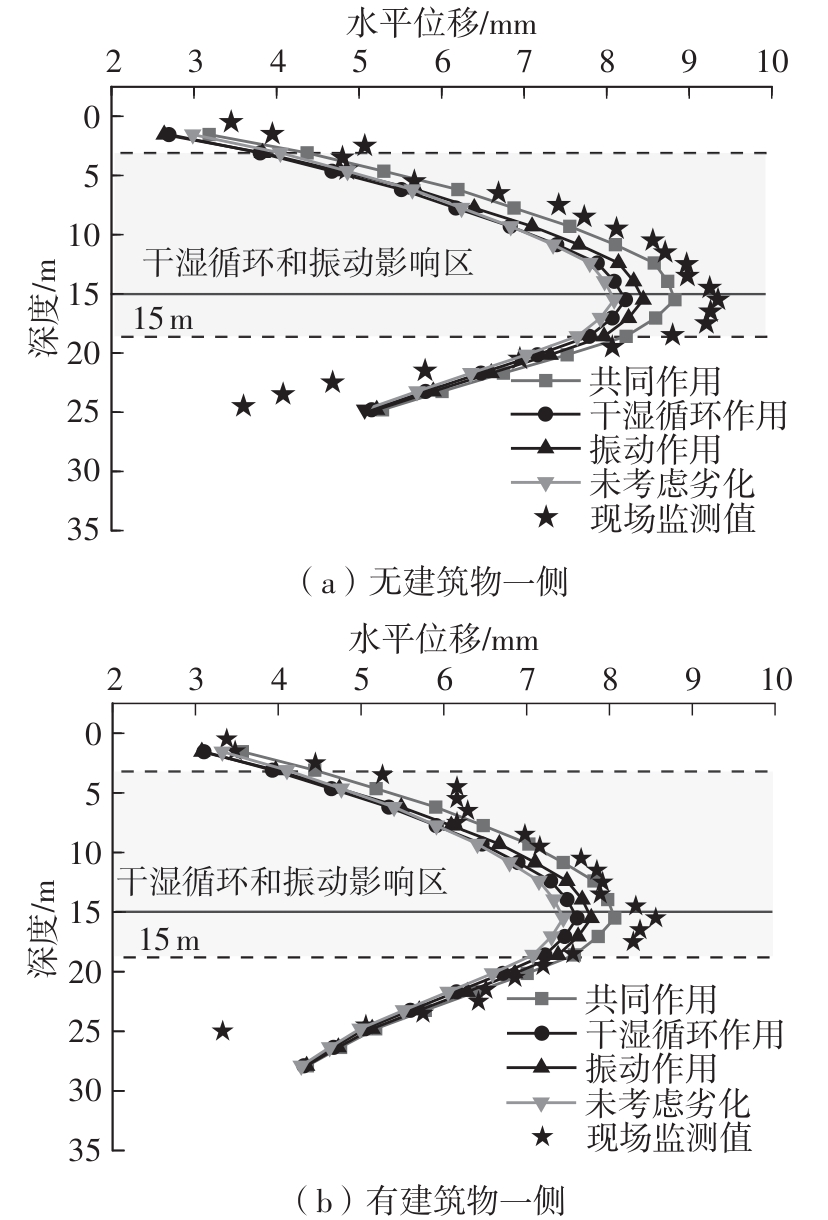
Fig.17
Displacement of diaphragm wall under different influencing factors and on-site monitoring"
| [1] | AN R, ZHANG X W, KONG L W,et al .Drying-wetting impacts on granite residual soil:a multi-scale study from macroscopic to microscopic investigations[J].Bulletin of Engineering Geology and the Environment,2022,81(10):447/1-14. |
| [2] | MEHRDAD K, KAMARUDIN A .Effect of matric suction and density on yield stress,compression index and collapse potential of unsaturated granite soil[J].KSCE Journal of Civil Engineering,2021,25(8):2847-2854. |
| [3] | 简文彬,胡海瑞,罗阳华,等 .干湿循环下花岗岩残积土强度衰减试验研究[J].工程地质学报,2017,25(3):592-597. |
| JIAN Wenbin, HU Hairui, LUO Yanghua,et al .Experimental study on deterioration of granitic residual soil strength in wetting-drying cycles[J].Journal of Engineering Geology,2017,25(3):592-597. | |
| [4] | XU X T, CHEN X L, CAI Y Q,et al .Microstructure and macro-mechanical properties of residual soil subjected to repeated hygroscopic cycles[J].Frontiers in Earth Science,2025,13:1528098/1-13. |
| [5] | LIU P, CHEN R P, WU K,et al .Effects of drying-wetting cycles on the mechanical behavior of reconstituted granite-residual soils[J].Journal of Materials in Civil Engineering,2020,32(8):04020199/1-11. |
| [6] | KANG X, ZHAO S C, LIU P .Effects of drying-wetting cycles and free iron oxides on the mechanical behaviors of a partially decomposed granite residual soils[J].Bulletin of Engineering Geology and the Environment,2023,82(12):466/1-18. |
| [7] | 安然,孔令伟,张先伟,等 .基于原位孔内剪切试验的残积土强度指标及风化程度影响评价[J].应用基础与工程科学学报,2022,30(5):1275-1286. |
| AN Ran, KONG Lingwei, ZHANG Xianwei,et al .Weathering degree effects on strength indexes of residual soil based on in-situ borehole shear tests[J].Journal of Basic Science and Engineering,2022,30(5):1275-1286. | |
| [8] | 邵嘉波,宋常军,徐凤银,等 .花岗岩残积土的室内外剪切特性对比[J].公路交通科技,2023,40(S1):192-198. |
| SHAO Jia-bo, SONG Chang-jun, XU Feng-yin,et al .Shear property of granite residual soil based on laboratory and in-situ direct shear test[J].Journal of Highway and Transportation Research and Development,2023,40(S1):192-198. | |
| [9] | 邓永锋,刘松玉 .扰动对软土强度影响规律研究[J].岩石力学与工程学报,2007,26(9):1940-1944. |
| DENG Yongfeng, LIU Songyu .Effect of sample disturbance on soft soil strength[J].Chinese Journal of Rock Mechanics and Engineering,2007,26(9):1940-1944. | |
| [10] | 刘娟娟,曾国红,孟令帅,等 .扰动对粉土触变强度恢复影响规律研究[J].地下空间与工程学报,2016,12(5):1294-1299. |
| LIU Juanjuan, ZENG Guohong, Meng Lingshuai,et al .Study on the effect of disturbance on the thixotropic strength increasing of silt[J].Chinese Journal of Underground Space and Engineering,2016,12(5):1294-1299. | |
| [11] | 刘建民,邱月,郭婷婷,等 .饱和粉质黏土静剪强度与振动后静剪强度对比研究[J].岩土力学,2020,41(3):773-780. |
| LIU Jian-min, QIU Yue, GUO Ting-ting,et al .Comparative experimental study on static shear strength and postcyclic strength of saturated silty clay[J].Rock and Soil Mechanics,2020,41(3):773-780. | |
| [12] | 王卫东 .软土深基坑变形及环境影响分析方法与控制技术[J].岩土工程学报,2024,46(1):1-25. |
| WANG Weidong. Analytical methods and controlling techniques for deformation and environmental influence of deep excavations in soft soils [J].Chinese Journal of Geotechnical Engineering,2024,46(1):1-25. | |
| [13] | 杨兰强,周立波,夏雯,等 .宁波软土地区基坑数值计算中HS模型参数试验研究[J].隧道建设(中英文),2018,38(6):954-962. |
| YANG Lanqiang, ZHOU Libo, XIA Wen,et al .Experimental study of parameters of HS model for numerical analysis of foundation pits in Ningbo soft soil area[J].Tunnel Construction,2018,38(6):954-962. | |
| [14] | 白时雨,王文军,谢新宇,等 .考虑扰动影响的土体小应变硬化模型参数试验研究及其在基坑工程中的应用[J].岩土力学,2023,44(1):206-216. |
| BAI Shi-yu, WANG Wen-jun, XIE Xin-yu,et al .Experimental study on HS-small model parameters of soil considering disturbance and its application in foundation pit engineering[J].Rock and Soil Mechanics,2023,44(1):206-216. | |
| [15] | 土工试验方法标准: [S]. |
| [16] | 建筑地基基础技术规范: [S]. |
| [17] | 余雷,崔俊杰 .高速铁路地基土压缩性分类及中低压缩性土变形特性研究[J].铁道标准设计,2023,67(7):7-11,56. |
| YU Lei, CUI Junjie .Research on the compressible classification of high-speed railway foundation soil and deformation characteristics of medium-low compressible soil[J].Railway Standard Design,2023,67(7):7-11,56. | |
| [18] | 林乔宇 .厦门花岗岩残积土HSS模型参数的研究及工程应用[D].泉州:华侨大学,2019. |
| [19] | 许旭堂,简文彬,吴能森,等 .降雨诱发残积土坡失稳的模型试验[J].中国公路学报,2018,31(2):270-279. |
| XU Xu-tang, JIAN Wen-bin, WU Neng-sen,et al .Model test of rainfall-induced residual soil slope failure[J].China Journal of Highway and Transport,2018,31(2):270-279. | |
| [20] | 刘越,陈东霞,王晖,等 .干湿循环下考虑裂隙发育的残积土边坡响应分析[J].岩土力学,2021,42(7):1933-1943,1982. |
| LIU Yue, CHEN Dong-xia, WANG Hui,et al .Response analysis of residual soil slope considering crack development under drying-wetting cycles[J].Rock and Soil Mechanics,2021,42(7):1933-1943,1982. |
| [1] | LIU Dingping, WU Chaochao, PAN Shuhuan. Numerical Simulation of Lean Coal Combustion Based on Staged Plasma Ignition [J]. Journal of South China University of Technology(Natural Science Edition), 2026, 54(3): 1-9. |
| [2] | LIU Dingping, PAN Shuhuan, WU Chaochao. Numerical Simulation on Characteristics of Coaxial Dual-Chamber Plasma Generator [J]. Journal of South China University of Technology(Natural Science Edition), 2026, 54(1): 10-18. |
| [3] | QIU Zhicheng, LI Meng, LI Min. Vibration Control of Three-Flexible Beam Coupling System Based on Fuzzy Algorithm [J]. Journal of South China University of Technology(Natural Science Edition), 2026, 54(1): 104-114. |
| [4] | CHEN Zhong, LIU Qi, WU Hongbing, XIAO Jiafeng, XU Yang, ZHAN Xiaoyu, SHEN Shuang. Brake Noise Reduction of Elevator Traction Machine Based on Particle Dampers [J]. Journal of South China University of Technology(Natural Science Edition), 2026, 54(1): 115-123. |
| [5] | GAN Yunhua, CHEN Kui, CHEN Ningguang, CHENG Jing, XU Yan. Study on Low Nitrogen Combustion Characteristics of Metal Fiber Burner in Limited Space [J]. Journal of South China University of Technology(Natural Science Edition), 2026, 54(1): 1-9. |
| [6] | ZHOU Jiehang, DU Longyu, LAI Jianzhong, YIN Xuexiang, YANG Mingyu. A Simulation Model of 3D Printed Concrete for Penetration Resistance [J]. Journal of South China University of Technology(Natural Science Edition), 2025, 53(8): 137-148. |
| [7] | LI Tao, HE Zhengbo, WEI Guozheng, CAO Hongyou. Study on Axial Compression Performance of UHPC Fully Encased Q690 High-Strength Steel Composite Stub Columns [J]. Journal of South China University of Technology(Natural Science Edition), 2025, 53(8): 87-99. |
| [8] | CAO Yang, SHI Hao, LI Jiaofeng, TAO Jing. Evolution Analysis of Vibration Source Intensity of Subway Station Under the Influence of Closely-Spaced Undercrossing [J]. Journal of South China University of Technology(Natural Science Edition), 2025, 53(7): 149-158. |
| [9] | KANG Lan, LI Rongwen, SU Jingyu, FENG Lei. Influence of Laser Remelting Treatment on Fatigue Performance of Steel Structure Welded Joints [J]. Journal of South China University of Technology(Natural Science Edition), 2025, 53(6): 1-11. |
| [10] | ZHANG Jinxi, PING Xinying, GUO Wangda, ZHANG Yuxuan. Prediction Accuracy and Its Comparison of Road Surface Roughness Based on Different Intelligent Devices [J]. Journal of South China University of Technology(Natural Science Edition), 2025, 53(6): 140-150. |
| [11] | LIU Guoyong, GAO Shize, ZHU Dongmei. Analysis of Extrusion Law of Large-Scale and Small-Scale Aluminum Profiles with Hollow Thin Wall for Rails [J]. Journal of South China University of Technology(Natural Science Edition), 2025, 53(5): 45-55. |
| [12] | WANG Suguo, QIU Wei, CHEANG I, FAN Binghui. Modified Calculation of Axial Compressive Bearing Capacity of Ultra-High-Strength Concrete Precast Column Considering Constraint Effect of Stirrup [J]. Journal of South China University of Technology(Natural Science Edition), 2025, 53(4): 50-60. |
| [13] | ZHANG Chi, GUO Tingyu, HU Ruilai, GAO Yanyang, ZHOU Yuming. Research on Average Longitudinal Slope Length of Expressway Based on Braking Behavior [J]. Journal of South China University of Technology(Natural Science Edition), 2025, 53(2): 12-26. |
| [14] | LI Ping, WANG Hongbo, CHEN Chaohe. Research on the Structural Strength of Floating Offshore Wind Turbine Platform Based on Long and Short Term Design Waves [J]. Journal of South China University of Technology(Natural Science Edition), 2025, 53(2): 92-106. |
| [15] | ZHANG Haiyan, CHEN Haibiao, WU Bo, LI Mengyuan. Flexural Performance of Two-Way Slabs Strengthened with Textile Reinforced Geopolymer Mortar [J]. Journal of South China University of Technology(Natural Science Edition), 2025, 53(2): 115-123. |
| Viewed | ||||||
|
Full text |
|
|||||
|
Abstract |
|
|||||