Journal of South China University of Technology(Natural Science Edition) ›› 2026, Vol. 54 ›› Issue (1): 30-41.doi: 10.12141/j.issn.1000-565X.250233
• Energy,Power & Electrical Engineering • Previous Articles Next Articles
Performance Analysis of FCI-DCSK-NR over Power Line Channel
CHENG Guixian1, LING Qin1, ZHENG Cai1, CHEN Fang2, ZHANG Quanling1, CHEN Pingping3
- 1.School of Physics and Electronic Science,Guizhou Normal University,Guiyang 550025,Guizhou,China
2.Huizhou Power Supply Bureau of Guangdong Power Grid Co. ,Ltd. ,Huizhou 516003,Guangdong,China
3.National-Local Joint Engineering Research Center for Intelligent Technology of Digital Television,Fuzhou University,Fuzhou 350108,Fujian,China
-
Received:2025-07-15Online:2026-01-25Published:2025-09-01 -
Contact:凌琴(1996—),女,硕士生,主要从事无线通信、电力线通信等研究。 E-mail:14786136422@163.com -
About author:程桂仙(1986—),女,博士,副教授,主要从事人工智能、无线传感网络、电力线通信等研究。E-mail: chgx86@126.com -
Supported by:the National Natural Science Foundation of China(62361012)

CLC Number:
Cite this article
CHENG Guixian, LING Qin, ZHENG Cai, CHEN Fang, ZHANG Quanling, CHEN Pingping. Performance Analysis of FCI-DCSK-NR over Power Line Channel[J]. Journal of South China University of Technology(Natural Science Edition), 2026, 54(1): 30-41.
share this article
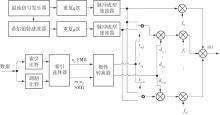
Fig.1
Transmitter of FCI-DCSK-NR scheme"
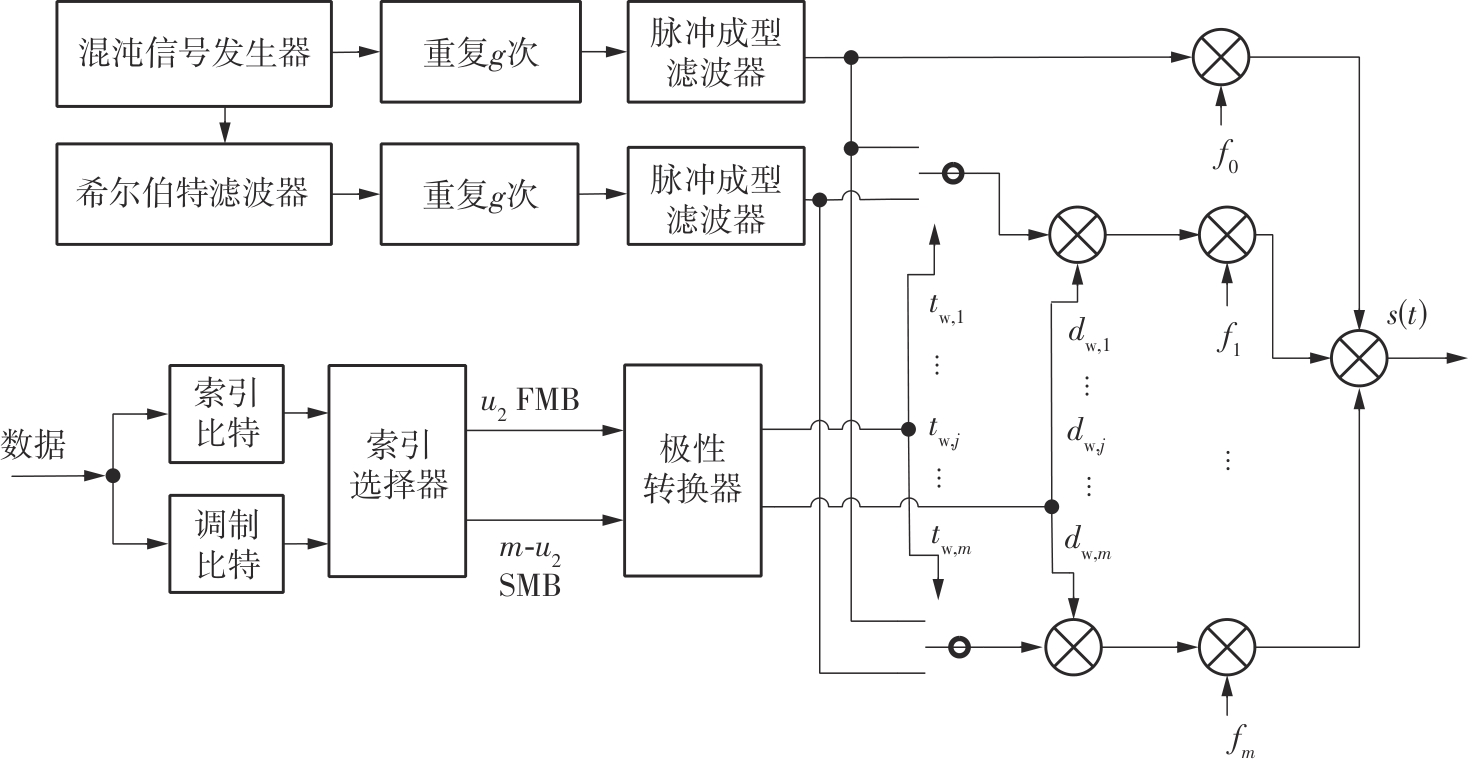
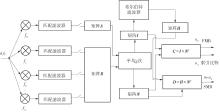
Fig.2
Receiver of FCI-DCSK-NR scheme"
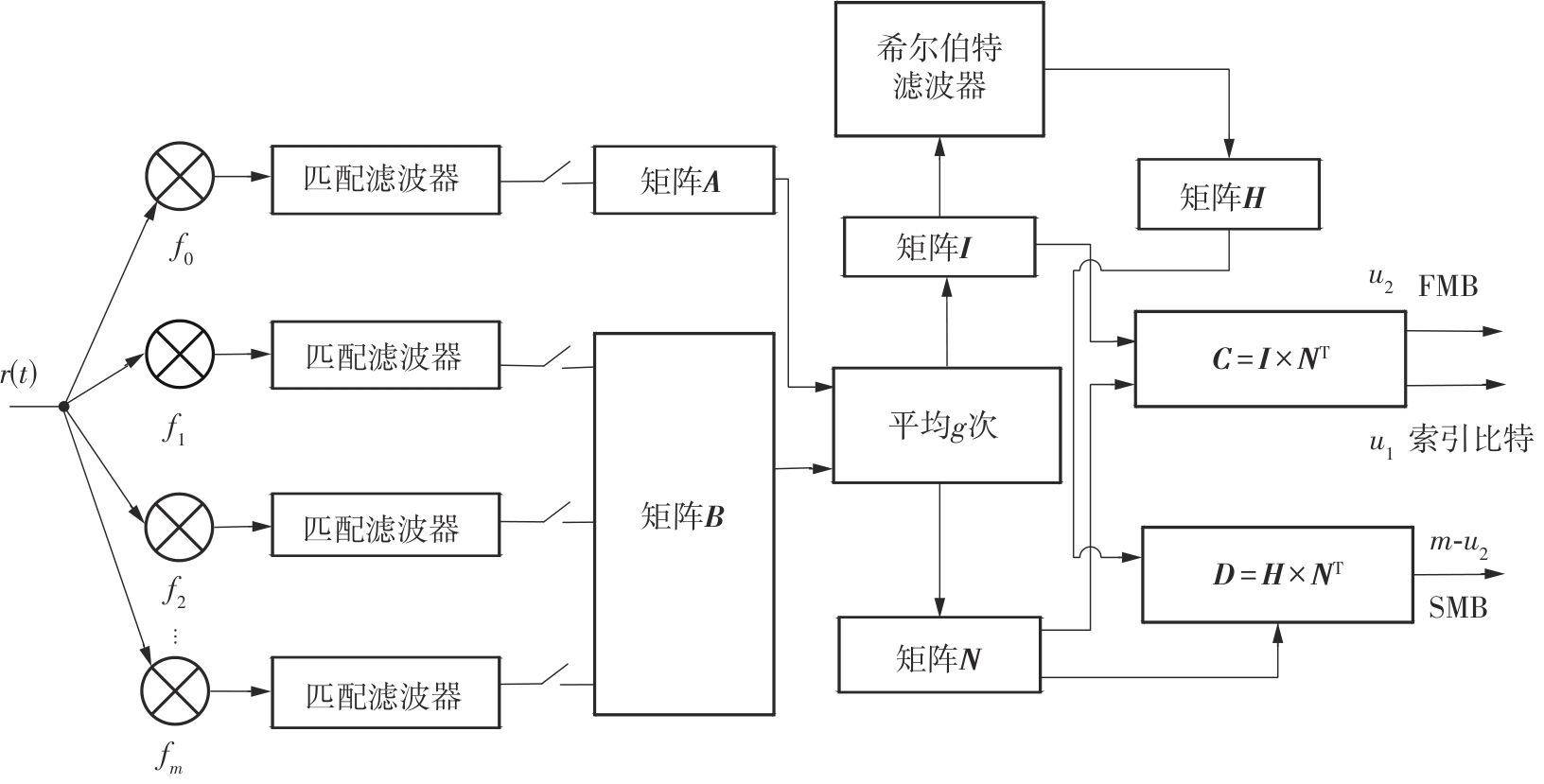

Table 1
Symbols and their meanings"
| 包含背景噪声和脉冲噪声的符号 | 含义 | 仅包含背景噪声的符号 | 含义 | ||
|---|---|---|---|---|---|
| 传输比特的总误码率 | 传输比特的总误码率 | ||||
| 索引比特的误码率 | 索引比特的误码率 | ||||
| 调制比特的误码率 | 调制比特的误码率 | ||||
| 索引比特的符号错误率 | 索引比特的符号错误率 | ||||
| 第1类调制比特的误码率 | 第1类调制比特的误码率 | ||||
| 第2类调制比特的误码率 | 第2类调制比特的误码率 | ||||
Table 2
Comparison of transmitter hardware complexity"
| 方案 | 加法器数量 | 乘法器数量 | 脉冲成形滤波器数量 | 希尔伯特滤波器数量 | 调制器 | 其他模块 |
|---|---|---|---|---|---|---|
| FCI-DCSK-NR | 2 | 1 | DCSK调制器 | 混沌信号生成器、噪声平均器、全载波索引选择器 | ||
| GCI-DCSK | 1 | 1 | 0 | DCSK调制器 | 混沌信号生成器、索引选择器 | |
| NR-DCSK | 0 | 1 | 1 | 0 | DCSK调制器 | 混沌信号生成器、时延复制器 |
| DCSK | 1 | 1 | 1 | 0 | DCSK调制器 |
Table 3
Comparison of receiver hardware complexity"
| 方案 | 乘法器数量 | 匹配滤波器数量 | 希尔伯特滤波器数量 | 解调器 | 其他模块 |
|---|---|---|---|---|---|
| FCI-DCSK-NR | 1 | DCSK解调器 | 全载波索引检测器、噪声平均器 | ||
| GCI-DCSK | 0 | DCSK解调器 | 索引检测器 | ||
| NR-DCSK | 1 | 1 | 0 | DCSK解调器 | 移动平均器 |
| DCSK | 1 | 1 | 0 | DCSK解调器 |
Table 4
Comparison of spectral efficiency, energy efficiency and data rate"
| 方案 | 频谱效率 | 能量效率 | 数据速率 |
|---|---|---|---|
| DCSK | |||
| FM-DCSK | |||
| CS-DCSK | |||
| GCI-DCSK | |||
| FCI-DCSK-NR |
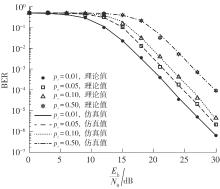
Fig.3
Simulated and theoretical BER of FCI-DCSK-NR over power line channel with different values of pr"
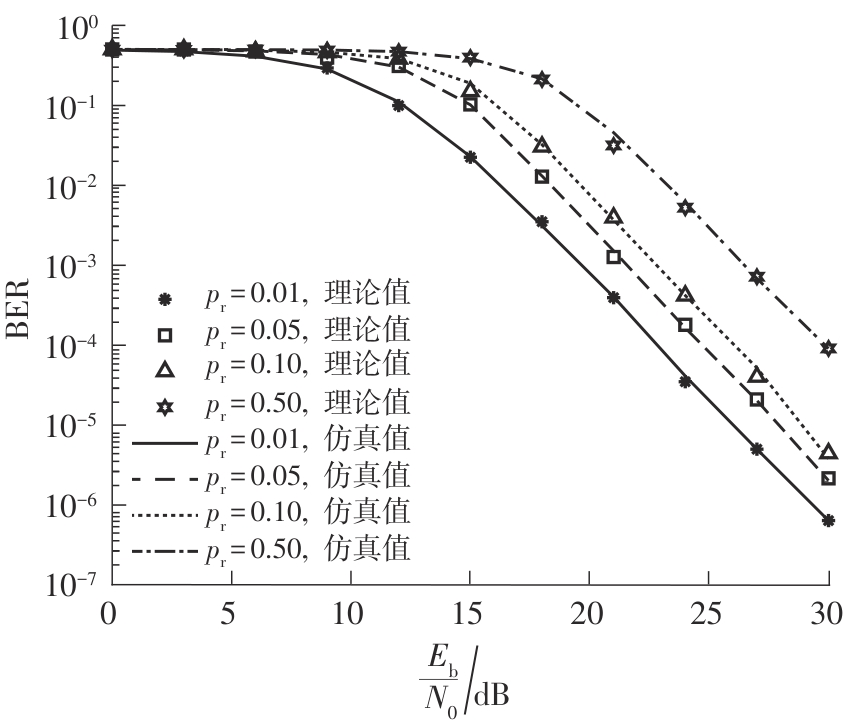
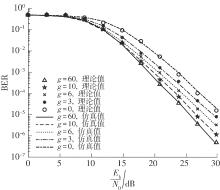
Fig.4
Simulated and theoretical BER of FCI-DCSK-NR over power line channel with different values of g"
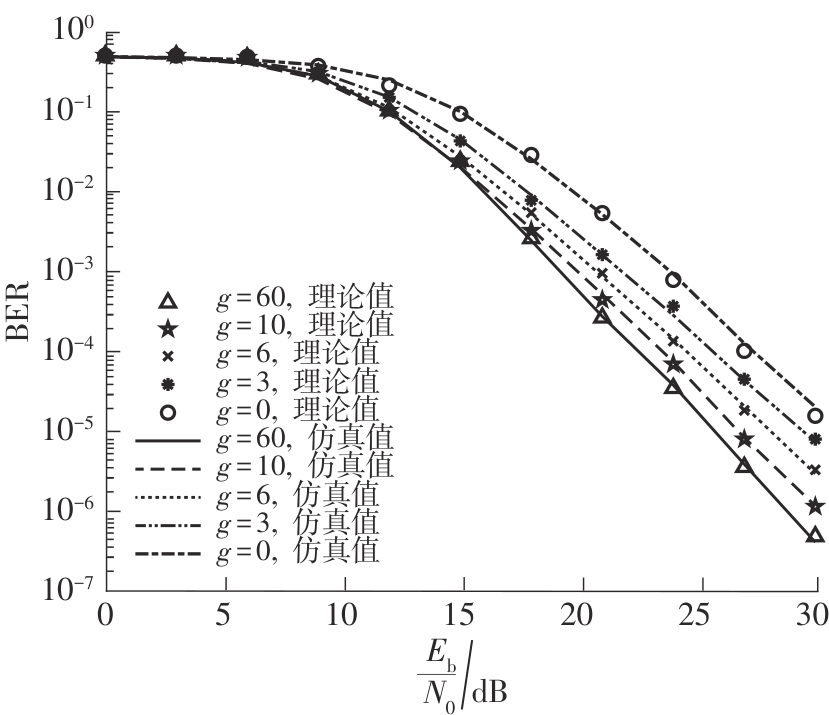
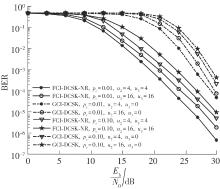
Fig.5
BER comparison between FCI-DCSK-NR and GCI-DCSK over power line channel"
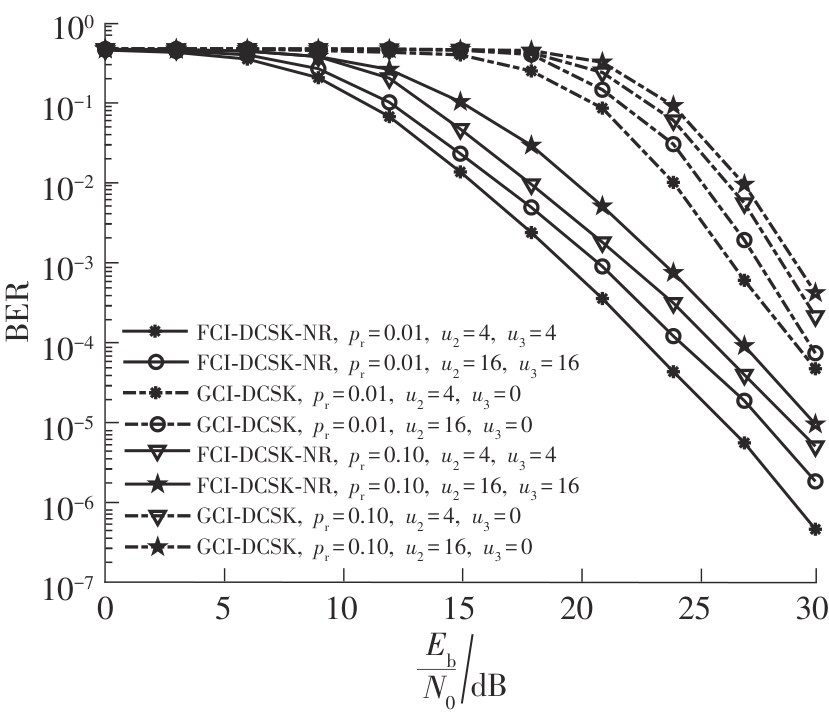
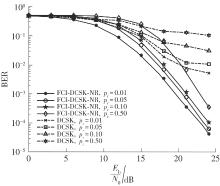
Fig.6
BER comparison between FCI-DCSK-NR and DCSK over power line channel"
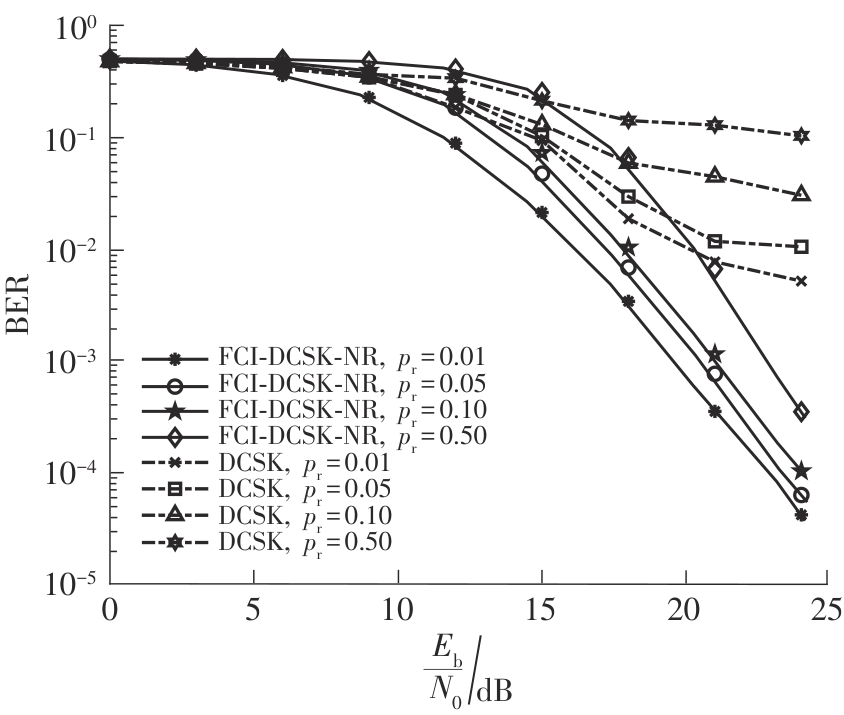
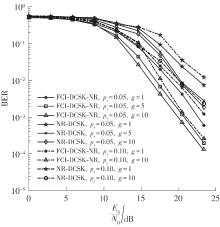
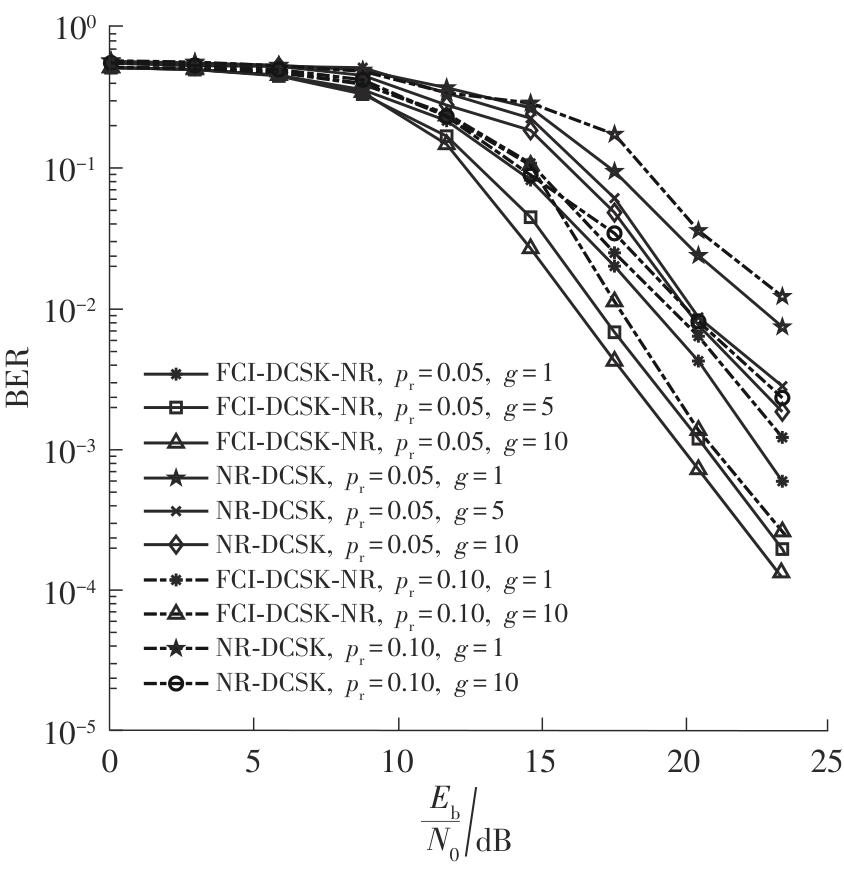
Fig.7
BER comparison between FCI-DCSK-NR and NR-DCSK over power line channel"
| [1] | 陈智雄,詹学滋,左嘉烁 .基于深度强化学习的电力线与无线双模通信MAC层接入算法[J]. 智能系统学报,2025,20(2):344-354. |
| CHEN Zhixiong, ZHAN Xuezi, ZUO Jiashuo .Adaptive MAC layer access algorithm for power line and wireless dual mode communication based on deep reinforcement learning [J].Cogent Engineering,2025,20(2):344-354. | |
| [2] | 代洲,张全玲,凌琴,等 .面向电力线通信融合双模态索引和时间分集的差分混沌移位方案[J].电力系统保护与控制,2025,53(15):135-145. |
| DAI Zhou, ZHANG Quanling, LING Qin,et al .Dual mode index and time diversity based DCSK for power line communications[J].Power System Protection and Control,2025,53(15):135-145. | |
| [3] | BHUYAN J, DASH S P .Performance analysis of a receive diversity PLC system with imperfect CSI in Nakagami-m noise environment[J].IEEE Communications Letters,2021,25(6):1839-1843. |
| [4] | REDDY B R, DASH S P .Optimal QPSK constellation for a PLC system in Nakagami-m noise environment[J].IEEE Communications Letters,2020,24(6):1206-1210. |
| [5] | BAI T, ZHANG H M, WANG J J,et al .Fifty years of noise modeling and mitigation in power-line communications[J].IEEE Communications Surveys & Tutorials,2021,23(1):41-69. |
| [6] | FADAEI TEHRANI A, YEH H G, KWON S C .BER performance of space-time parallel ICI cancellation of OFDM in MIMO power line communications[J].IEEE Systems Journal,2021,15(2):1742-1752. |
| [7] | 王光平,白智全,代健,等 .双模三维OFDM索引调制方案设计与低复杂度检测[J/OL].系统工程与电子技术.. |
| WANG Guangping, BAI Zhiquan, DAI Jian,et al .Design of dual-mode 3D OFDM-IM scheme and low Complexity detection[J/OL].Systems Engineering and Electroncs.. | |
| [8] | 李超,许泽宁 .基于MIMO-OFDM双模的下一代电力线通信技术分析[J].电子技术,2024,53(10):254-255. |
| LI Chao, XU Zening .Analysis of next generation power line communication technology based on MIMO-OFDM dual mode[J].Electronic Technology,2024,53(10):254-255. | |
| [9] | KOLUMBÁN G, KIS G, KENNEDY M P, et al .FM-DCSK: a new and robust solution to chaos communications[C]∥Proceedings of the International Symposium.Nonlinear Theory Applications. Hawaii,HI: IEICE,1997:117-120. |
| [10] | XU W K, WANG L, KOLUMBÁN G .A novel diffe-rential chaos shift keying modulation scheme[J].International Journal of Bifurcation and Chaos,2011,21(3):799-814. |
| [11] | Al-ASKERY A J, AL-ALI A K H, HASAN F S .Performance analysis of NR-DCSK based copper cable model for G.fast communication[J].Telecom, 2025,6(1): 5/1-14. |
| [12] | 尚丽,刘淑芬 .2DPSK调制与解调系统的仿真设计与分析[J].智能建筑与智慧城市,2023(1):29-31. |
| SHANG Li, LIU Shu-fen .Simulation design and analysis of 2DPSK modulation and demodulation system [J].Intelligent Building and Smart City,2023(1):29-31. | |
| [13] | LIN Z, XU W, SUN H,et al .A hybrid DCSK scheme combining cyclic shift keying and code index modulation[J].IEEE Communications Letters,2023,27(9):2303-2307. |
| [14] | KADDOUM G, TADAYON N .Differential chaos shift keying:a robust modulation scheme for power-line communications[J].IEEE Transactions on Circuits and Systems Ⅱ:Express Briefs,2017,64(1):31-35. |
| [15] | MIAO M, WANG L, CHEN G,et al .Design and analysis of replica piecewise M-ary DCSK scheme for power line communications with asynchronous impulsive noise[J].IEEE Transactions on Circuits and Systems I:Regular Papers,2020,67(12):5443-5453. |
| [16] | CAI X, XU W, WANG L,et al .Design of joint position and constellation mapping assisted DCSK scheme subject to Laplacian impulsive noise[J].IEEE Communications Letters,2022,26(2):463-467. |
| [17] | DONG H, WANG K, YANG G,et al .A 0.4-to-30 GHz CMOS low-noise amplifier with input-referred noise reduction and coupled-inductive-peaking technique[J].IEEE Microwave and Wireless Technology Letters,2023,33(6):859-862. |
| [18] | SERIZAWA I, KUGA N .System residual noise reduction for non-contact passive intermodulation measurements of array antennas using multiple testers[J].IEICE Communications Express,2024,13(8):335-338. |
| [19] | IMAJUKU W, AOKI D, YAMAGA Y,et al .Time-domain single carrier index modulation for elastic optical access links[J].Journal of Lightwave Technology,2024,42(6):1853-1860. |
| [20] | 赵耿,刘阿龙,马英杰 .直接序列扩频非正交分组码索引调制技术研究[J].计算机仿真,2023,40(7):249-253,266. |
| ZHAO Geng, LIU A-long, MA Ying-jie .Research on direct sequence spread spectrum nonorthogonal grou-ping code index modulation technology[J].Computer Simulation,2023,40(7):249-253,266. | |
| [21] | MA Y H, SO P L . GUNAWAN E .Performance analysis of OFDM systems for broadband power line communications under impulsive noise and multipath effects[J].IEEE Transactions on Power Delivery,2005,20(2):674-682. |
| [22] | ANTONIALI M, VERSOLATTO F, TONELLO A M .An experimental characterization of the PLC noise at the source[J].IEEE Transactions on Power Delivery,2016,31(3):1068-1075. |
| [23] | CAI X, XU W, HONG S,et al .Dual-mode differential chaos shift keying with index modulation[J].IEEE Transactions on Communications,2019,67(9):6099-6111. |
| [24] | CHENG G, CHEN X, LIU W,et al .GCI-DCSK:generalized carrier index differential chaos shift keying modulation[J].IEEE Communications Letters,2019,23(11):2012-2016. |
| [25] | CAI X, XU W, WANG L,et al .Towards high-data-rate noncoherent chaotic communication:a multiple-mode differential chaos shift keying system[J].IEEE Tran-sactions on Wireless Communications,2021,20(8):4888-4901. |
| [26] | CAI X, XU W, HONG S,et al .General carrier index aided dual-mode differential chaos shift keying with full mapping:design and optimization[J].IEEE Transactions on Vehicular Technology,2021,70(11):11665-11677. |
| [27] | TAO Y, FANG Y, MA H,et al .Multi-carrier DCSK with hybrid index modulation:a new perspective on frequency-index-aided chaotic communication[J].IEEE Transactions on Communications,2022,70(6):3760-3773. |
| [28] | BAŞAR E, AYGŐLŰ Ü, PANAYŀRCŀ E,et al .Orthogonal frequency division multiplexing with index modulation[J].IEEE Transactions on Signal Proce-ssing,2013,61(22):5536-5549. |
| [29] | GHOSH M .Analysis of the effect of impulse noise on multicarrier and single carrier QAM systems[J].IEEE Transactions on Communications,1996,44(2):145-147. |
| [30] | OUYANG S, LIU G, HUANG T,et al .Impulsive noise suppression network for power line communication[J].IEEE Communications Letters,2024,28(11):2628-2632. |
| [31] | KATAYAMA M, YAMAZATO T, OKADA H .A mathematical model of noise in narrowband power line communication systems[J].IEEE Journal on Selected Areas in Communications,2006,24(7):1267-1276. |
| [32] | 姜培华,刘文震,张小敏 .极端次序统计量在均匀分布统计推断中的应用[J].高师理科学刊,2025,45(6):100-107. |
| JIANG Peihua, LIU Wenzhen, ZHANG Xiaomin .Application of extreme order statistics in uniform distribution statistical inference[J].Journal of Science of Teachers’ College and University,2025,45(6):100-107. | |
| [33] | 陈光曙 .最大最小次序统计量的联合分布[J].大学数学,2006,22(5):134-137. |
| CHEN Guangshu .Joint distribution of maximum and minimal order statistics[J].College Mathematics,2006,22(5):134-137. |
| [1] | LIU Jiaojiao, CHEN Ayue, MA Biyun. Simulation Study on BER Performance of DS-UsWB Intrabody Communication [J]. Journal of South China University of Technology(Natural Science Edition), 2023, 51(11): 10-17. |
| [2] | ZHANG Gang DONG Jiangtao HE Lifang. Multicarrier Noise Reduction DCSK Scheme with No Intra-signal Interference [J]. Journal of South China University of Technology(Natural Science Edition), 2022, 50(4): 100-109. |
| [3] | Li Ju-hu Nie Juan . Effect of Carrier Frequency Offsets on Performance of OFDM AF Relay System [J]. Journal of South China University of Technology (Natural Science Edition), 2015, 43(9): 39-46. |
| [4] | Li Ju-hu Zhang Hai-yan. Performance Analysis of Multi-Antenna UHF RFID System [J]. Journal of South China University of Technology (Natural Science Edition), 2015, 43(5): 22-29. |
| [5] | Guo Li-li Zhou Bin Yang Peng Sun Zhi-guo. Memory-Based Symmetric Raised-Cosine Keying Modulation Method [J]. Journal of South China University of Technology(Natural Science Edition), 2012, 40(9): 110-115. |
| [6] | Jiang Xiao-fei Guo Li-li Qi Lin Zhao Bing. Time-Hopping Multiple Access Performance of Ultra-Wideband System Based on Parallel Combinatory Spread Spectrum [J]. Journal of South China University of Technology (Natural Science Edition), 2011, 39(9): 115-119. |
| [7] | Meng Fan-yuu Gu Xue-mai Yang Ming-chuan Guo Qing. Multiple Access Technology Based on Bivariate Chirp Modulation [J]. Journal of South China University of Technology (Natural Science Edition), 2011, 39(7): 70-76,114. |
| [8] | Qiu Xin Sha Xue-jun Ning Xiao-yan. Multiple Access Scheme of Ultra-Wideband System in Fractional Fourier Transform Domain [J]. Journal of South China University of Technology (Natural Science Edition), 2010, 38(9): 20-24. |
| [9] | Han Chun-lei Ge Jian-hua Wang Yong Gao Ming. A Novel Cooperative Scheme for Multiple-Access Relay Channel [J]. Journal of South China University of Technology (Natural Science Edition), 2010, 38(1): 31-37. |
| [10] | Liu Xin Tan Xue-zhi. Anti-Jamming System for Cognitive Radio Based on Fractional Fourier Transform [J]. Journal of South China University of Technology (Natural Science Edition), 2010, 38(1): 44-48. |
| [11] | Liu Xue-fang Fu Feng-lin Lu Zhao-yang. Effects of Imperfect Channel State Information on Performance of Multiuser-MIMO System [J]. Journal of South China University of Technology (Natural Science Edition), 2009, 37(10): 30-33. |
| Viewed | ||||||
|
Full text |
|
|||||
|
Abstract |
|
|||||