Journal of South China University of Technology(Natural Science Edition) ›› 2025, Vol. 53 ›› Issue (12): 126-139.doi: 10.12141/j.issn.1000-565X.250068
Previous Articles Next Articles
Monitoring and Simulation Analysis of Prestressing Effect During Construction of Wet Joints of Simply-Supported-to-Continuous T-Beam Bridge
SHEN Lei1, YU Zhiping2, HUANG Fangyuan2, XU Chen1, WAN Peng2
- 1.School of Civil Engineering,Tongji University,Shanghai 200092,China
2.Fuzhou Donglin Ring City Expressway Co. ,Ltd. ,Fuzhou 344000,Jiangxi,China
-
Received:2025-03-13Online:2025-12-25Published:2025-07-04 -
Contact:徐晨(1982—),男,副教授,博士生导师,主要从事钢与组合结构桥梁以及功能复合材料的开发与应用研究。 E-mail:xuchenprc@tongji.edu.cn -
About author:沈磊(2002—),男,博士生,主要从事钢与组合结构桥梁等研究。E-mail: 2410468@tongji.edu.cn -
Supported by:the National Natural Science Foundation of China(52478197);the Science and Technology Project of Jiangxi Provincial Department of Transportation(2024ZG026);the Shanghai Municipal Natural Science Foundation(24ZR1471100)

CLC Number:
Cite this article
SHEN Lei, YU Zhiping, HUANG Fangyuan, XU Chen, WAN Peng. Monitoring and Simulation Analysis of Prestressing Effect During Construction of Wet Joints of Simply-Supported-to-Continuous T-Beam Bridge[J]. Journal of South China University of Technology(Natural Science Edition), 2025, 53(12): 126-139.
share this article
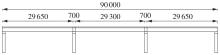
Fig.1
Span arrangement (Unit:mm)"
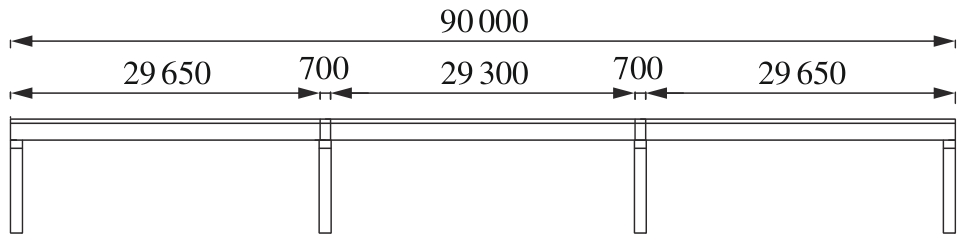
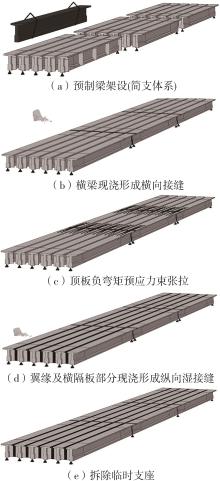
Fig.2
Schematic diagram of construction process"
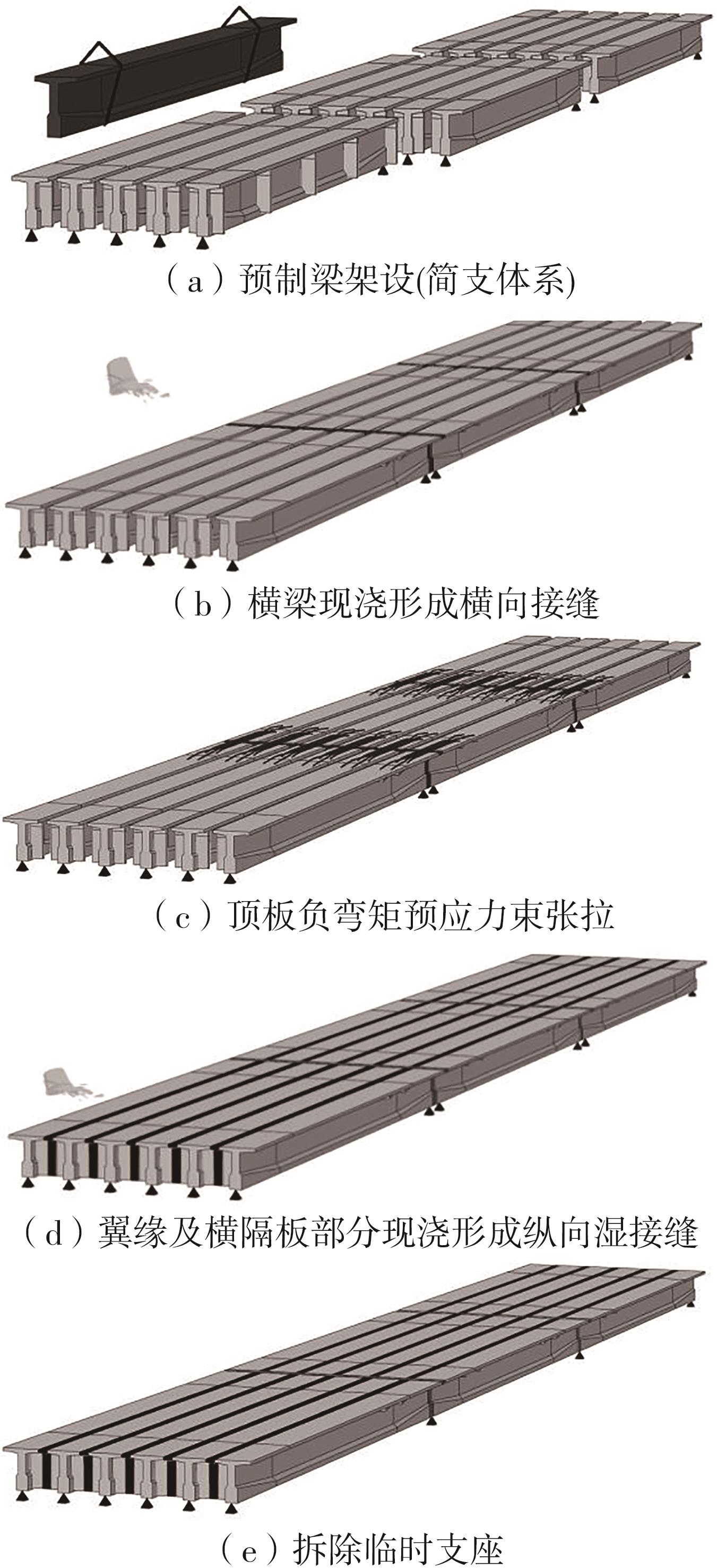
Fig.3
Bridge section (Unit:mm)"
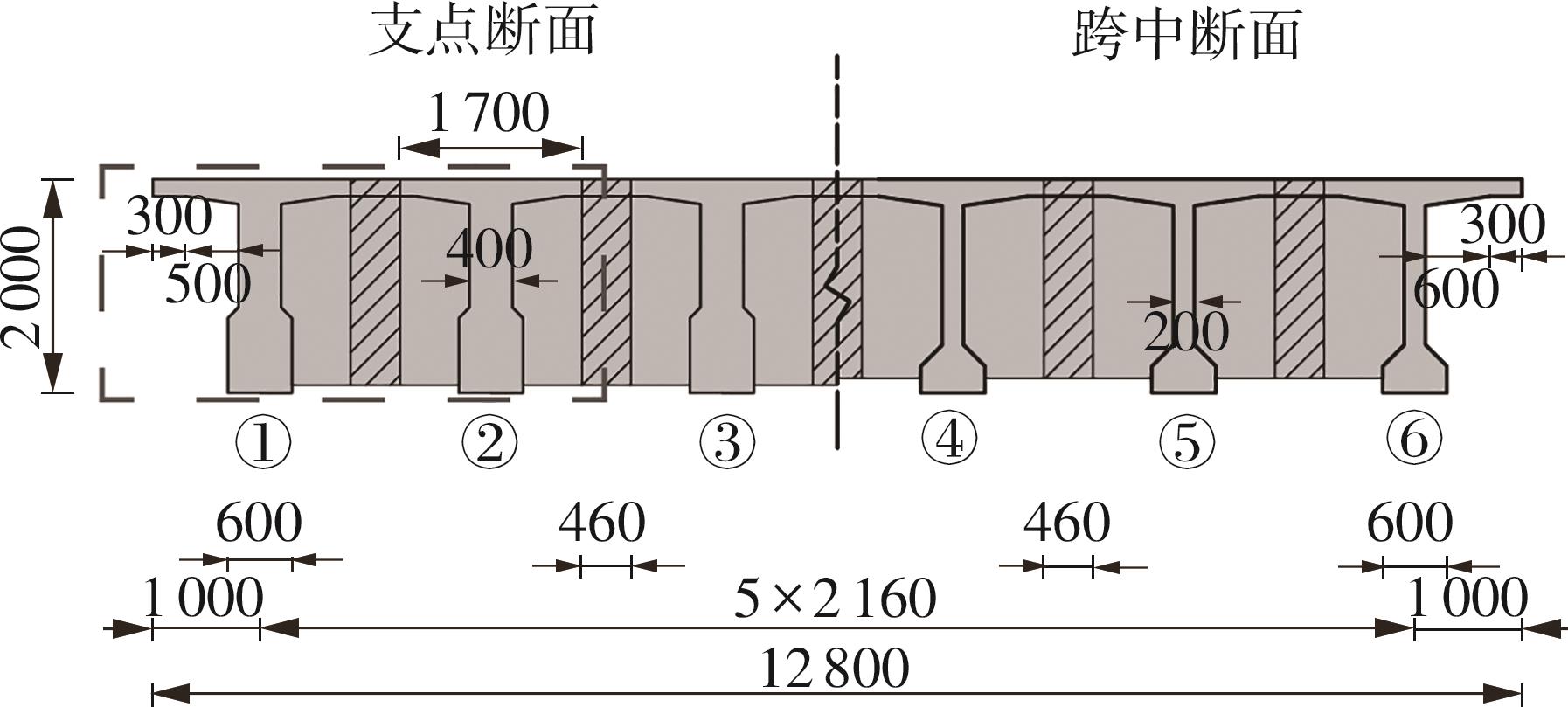
Fig.4
Single-span bridge design plan (Unit:mm)"
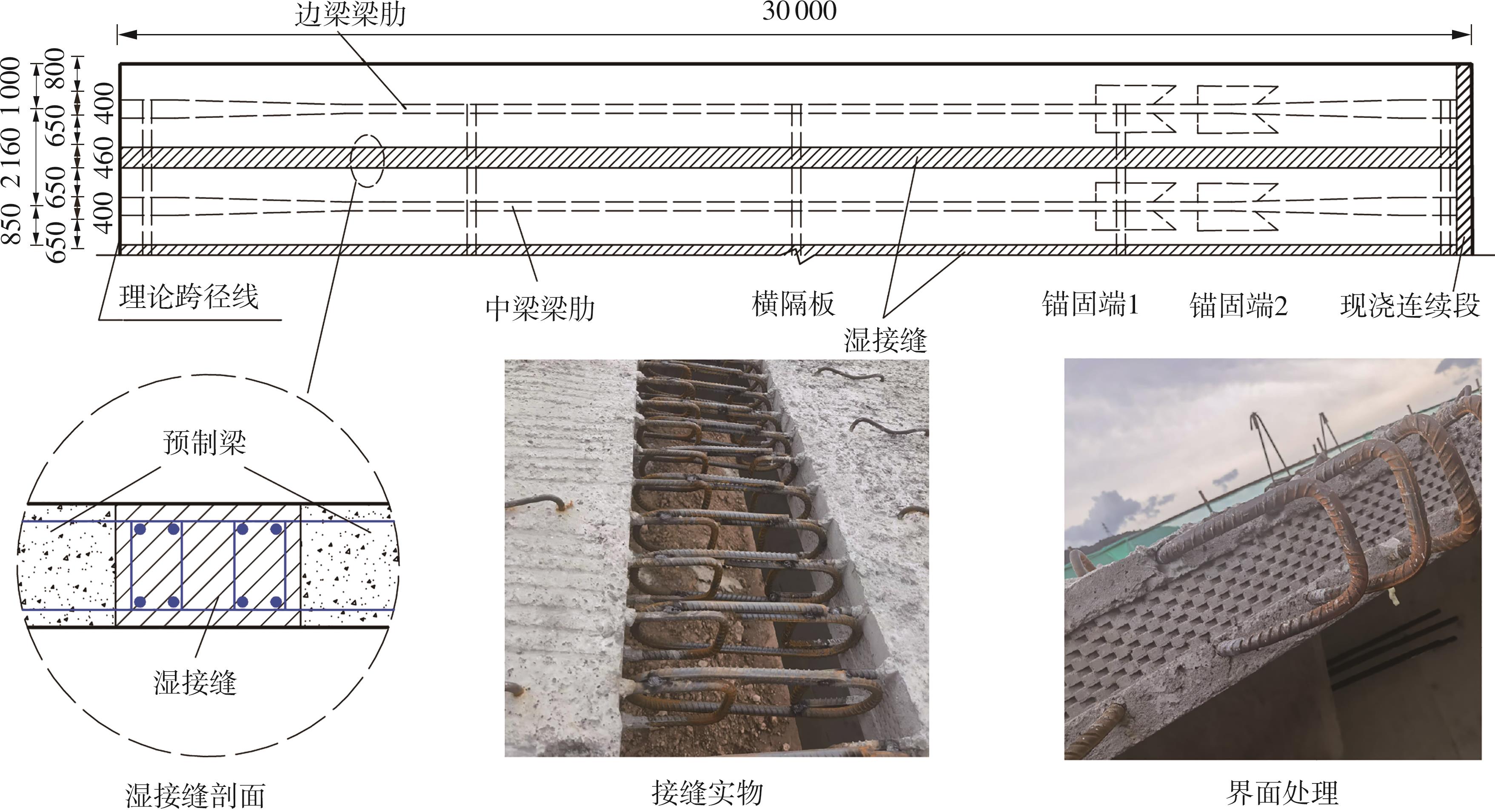
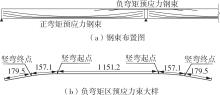
Fig.5
Schematic layout of prestressing steel bundles (Unit:mm)"
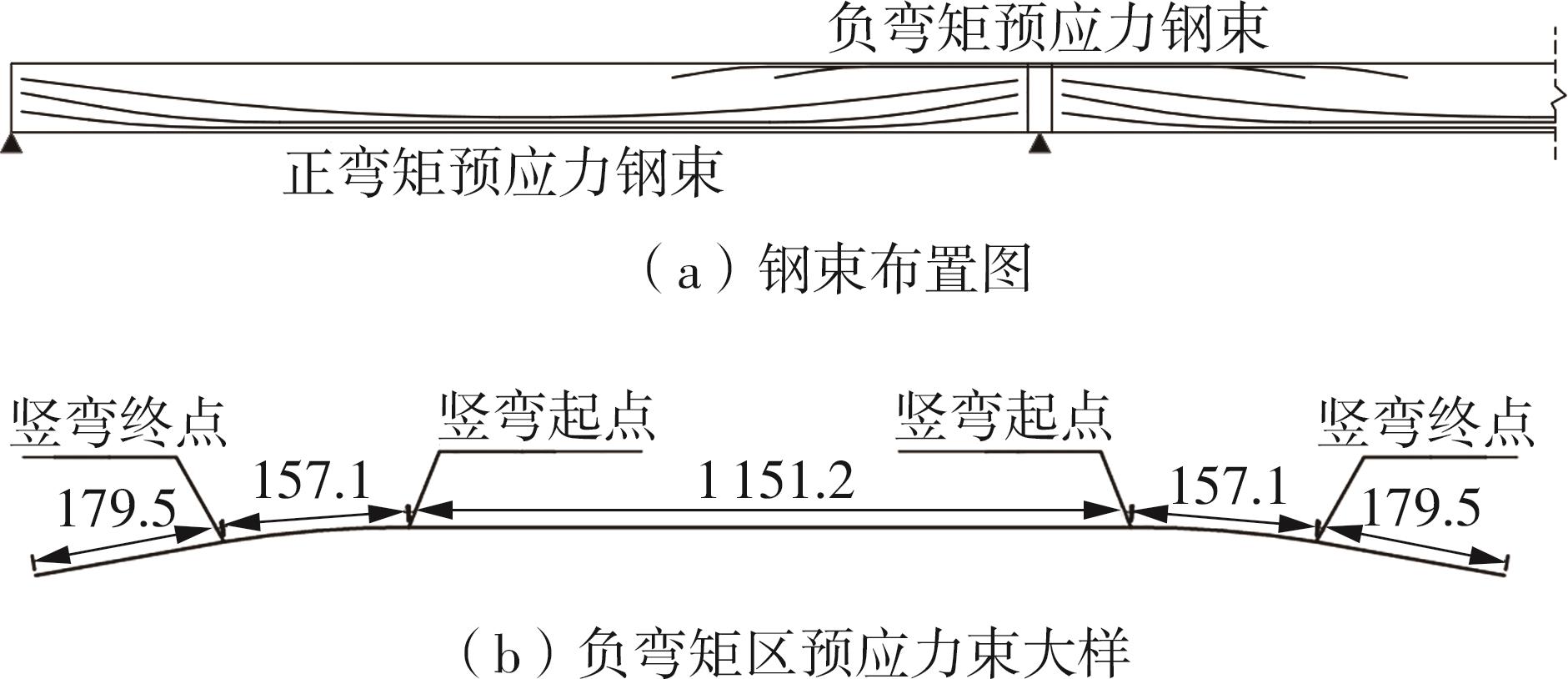
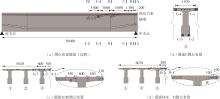
Fig.6
Schematic layout of measurement points (Unit:mm)"
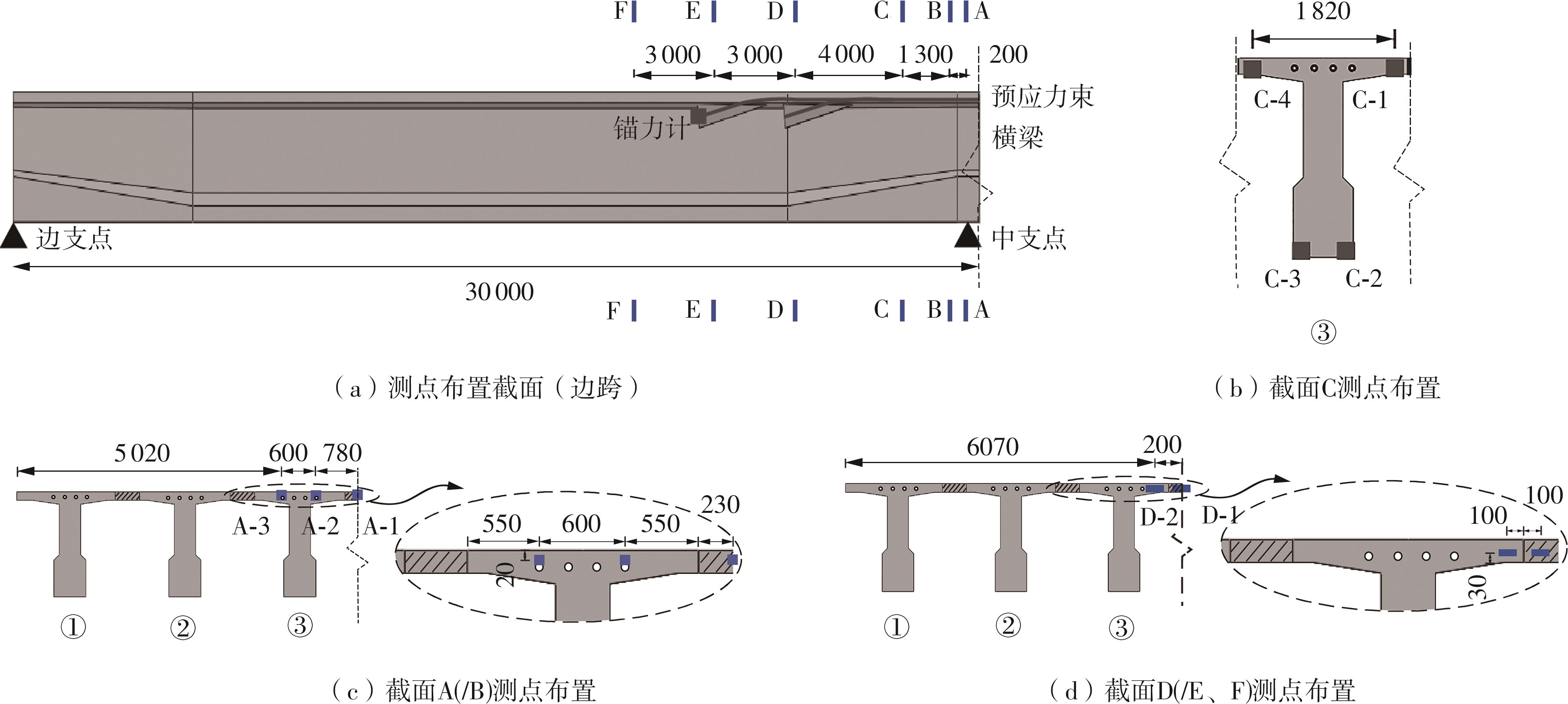
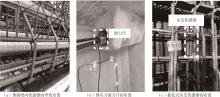
Fig.7
Schematic diagram of physical and deployment of sensors"
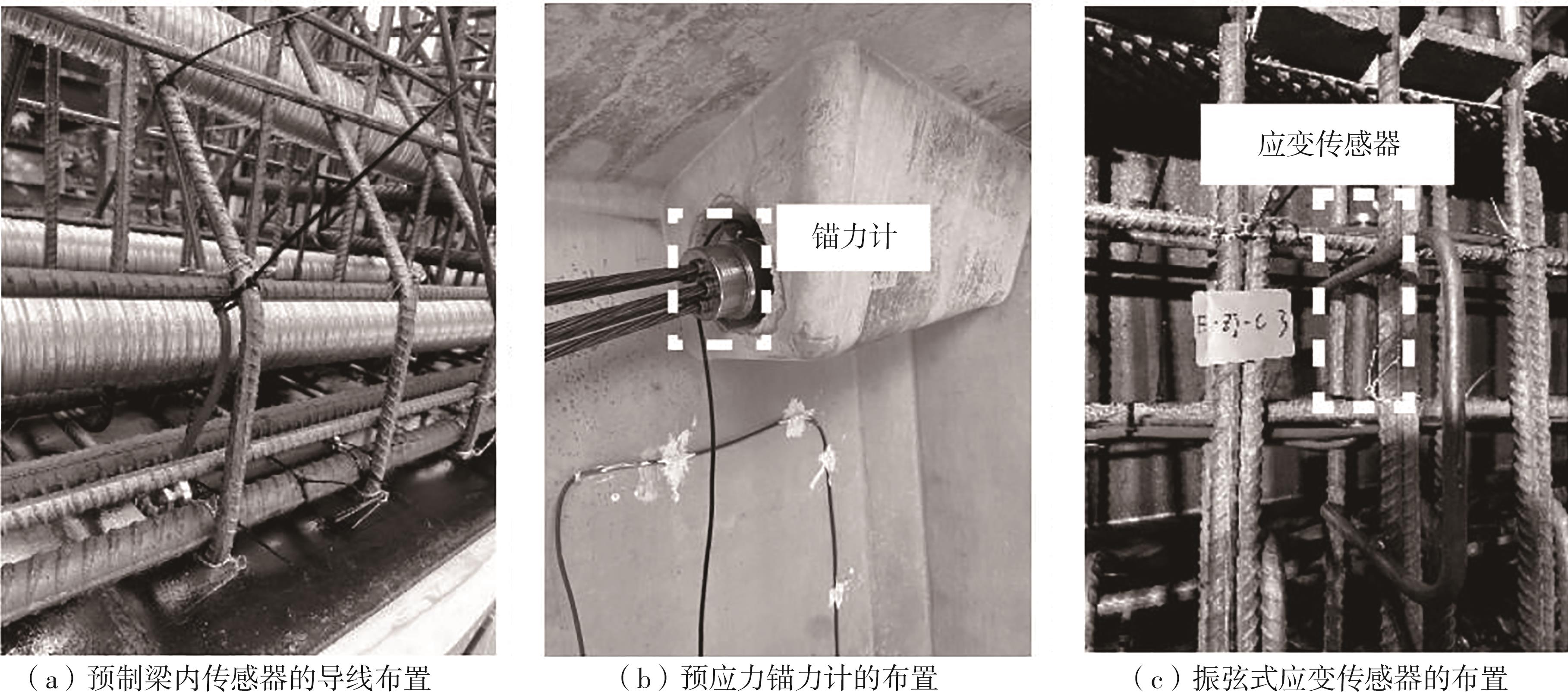
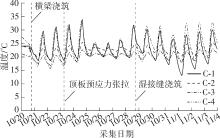
Fig.8
Temperature variation with time at each measurement point at section C"
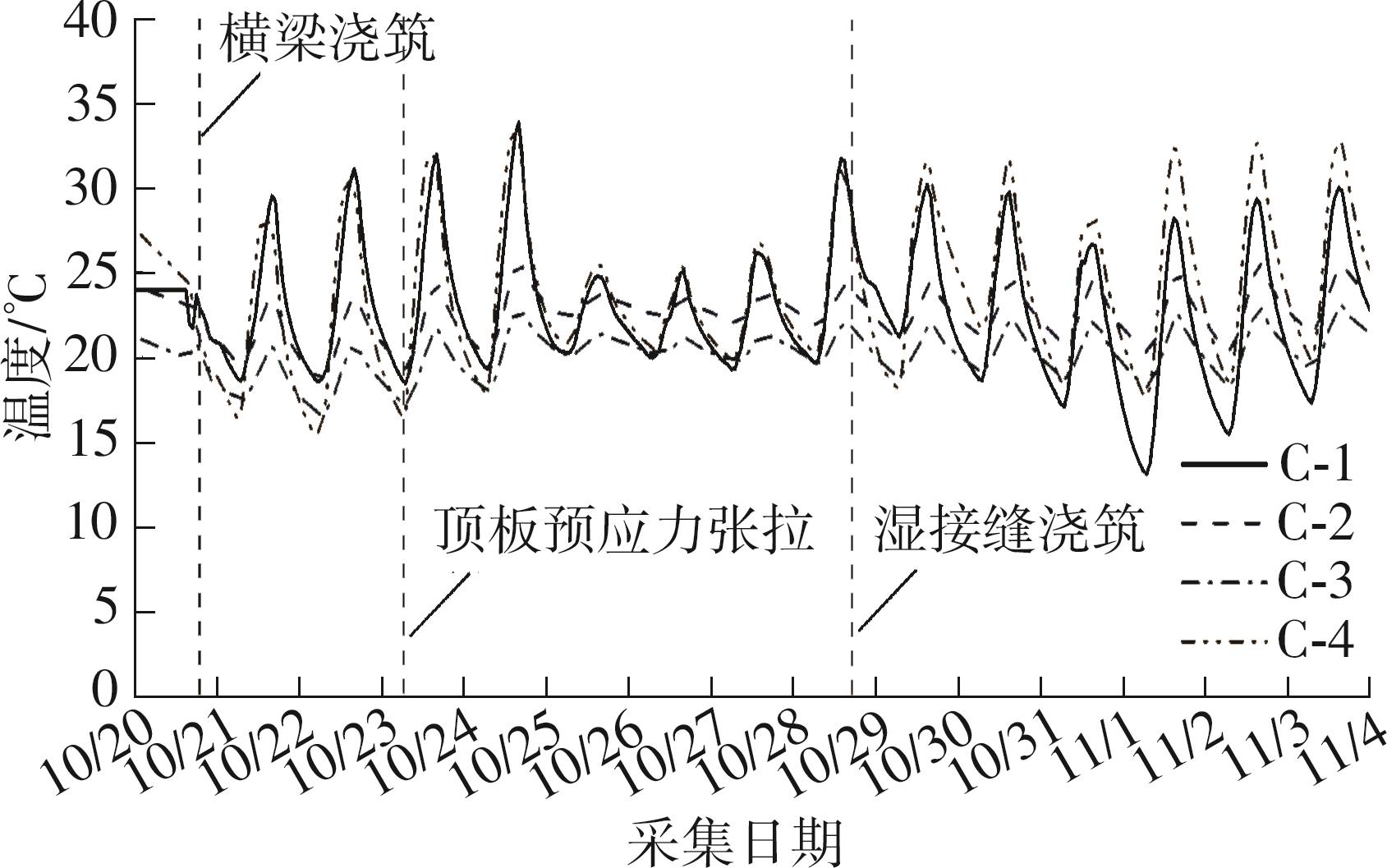
Fig.9
Monitoring results of prestressing level of pre-slab stress bundle in negative moment zone of girder No.3"
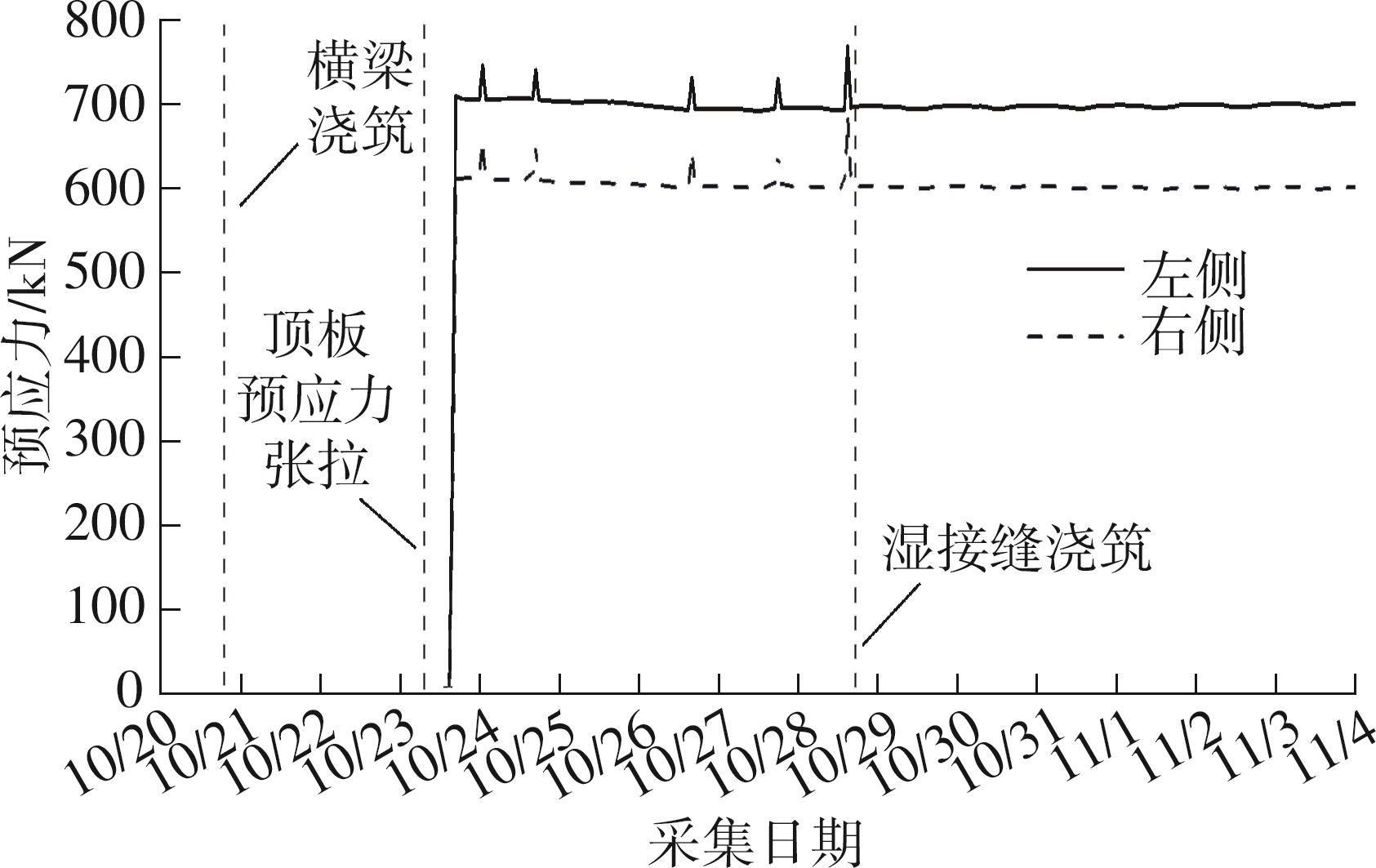
Fig.10
Comparison of strain development at measurement points D-1, E-1 and F-1"
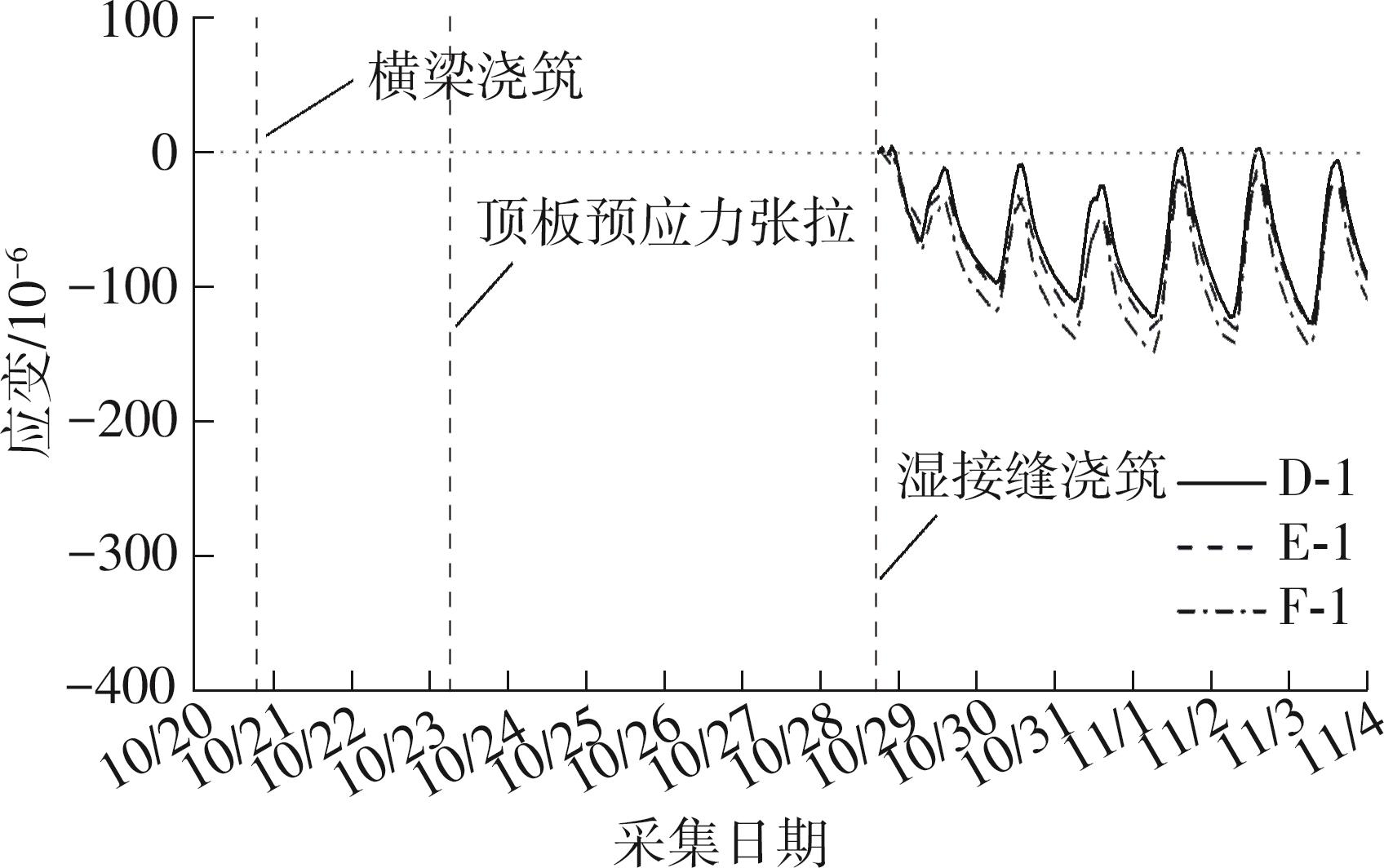
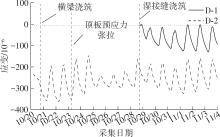
Fig.11
Comparison of strain development at measurement points D-1 and D-2"
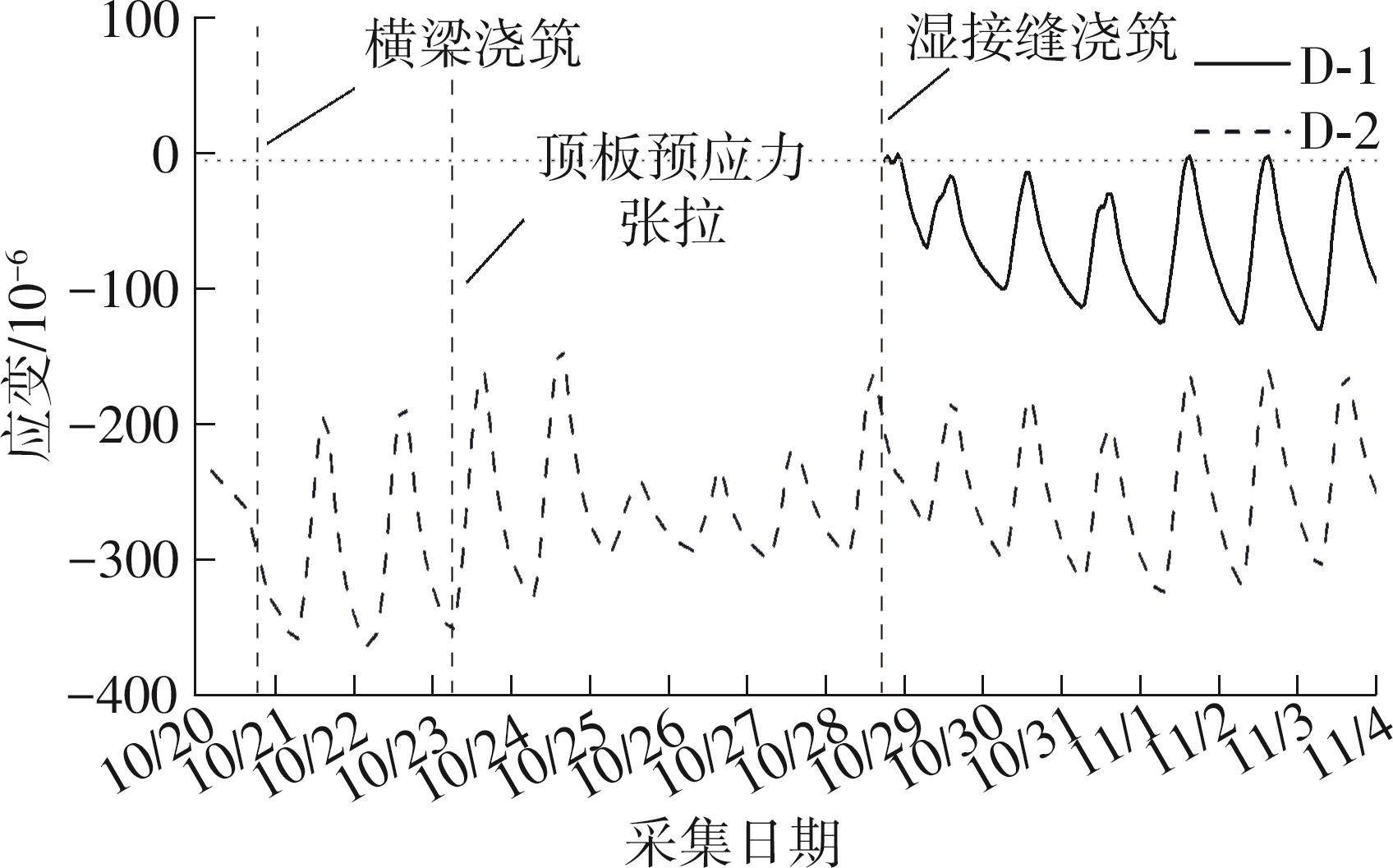

Table 1
Comparison of maximum and minimum values of transverse strains at measurement points on both sides of the wet joint with one week after pouring"
| 测点编号 | 10月29日 | 10月30日 | 10月31日 | 11月1日 | 11月2日 | 11月3日 | 11月4日 | |||||||
|---|---|---|---|---|---|---|---|---|---|---|---|---|---|---|
| Max | Min | Max | Min | Max | Min | Max | Min | Max | Min | Max | Min | Max | Min | |
| D-1 | -11 | -76 | -9 | -96 | -25 | -110 | 3 | -121 | 3 | -121 | -6 | -125 | -29 | -115 |
| D-2 | -178 | -273 | -177 | -298 | -200 | -313 | -160 | -325 | -157 | -316 | -160 | -304 | -180 | -279 |
| E-1 | -13 | -79 | -34 | -102 | -46 | -122 | -11 | -132 | -11 | -131 | -19 | -129 | -40 | -117 |
| E-2 | -187 | -314 | -180 | -279 | -207 | -302 | -174 | -312 | -177 | -307 | -179 | -300 | -193 | -278 |
| F-1 | -17 | -99 | -31 | -117 | -50 | -136 | -17 | -148 | -18 | -144 | -24 | -143 | -41 | -130 |
| F-2 | -185 | -279 | -180 | -300 | -199 | -310 | -171 | -318 | -171 | -311 | -172 | -301 | -189 | -280 |
Fig.13
Comparison of strain development at measurement points A-2, A-3, B-2 and B-3"
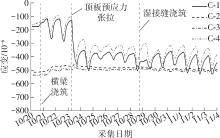
Fig.14
Variation of strain with time at each measurement point at section C"
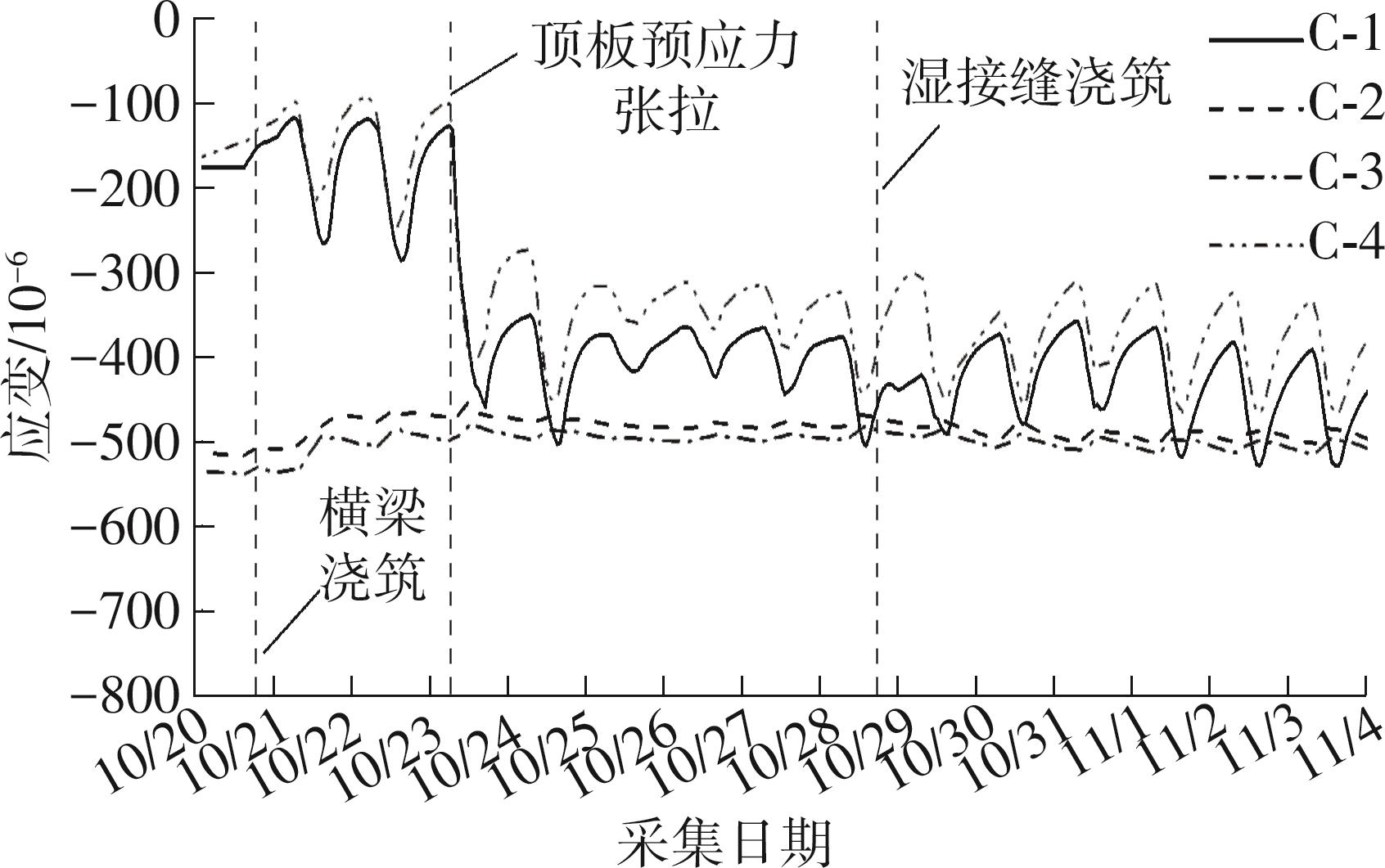
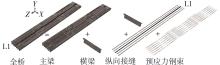
Fig.15
Overall schematic of finite element model"
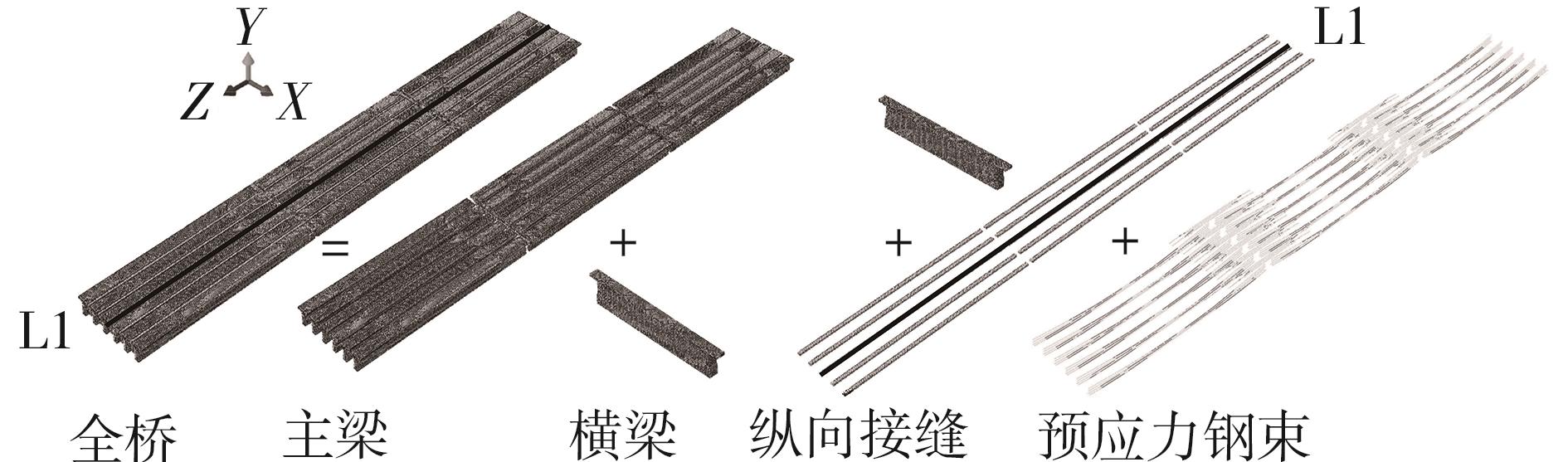
Fig.16
Vertical deformation of mid-span cross-section before and after activation of life-death unit"
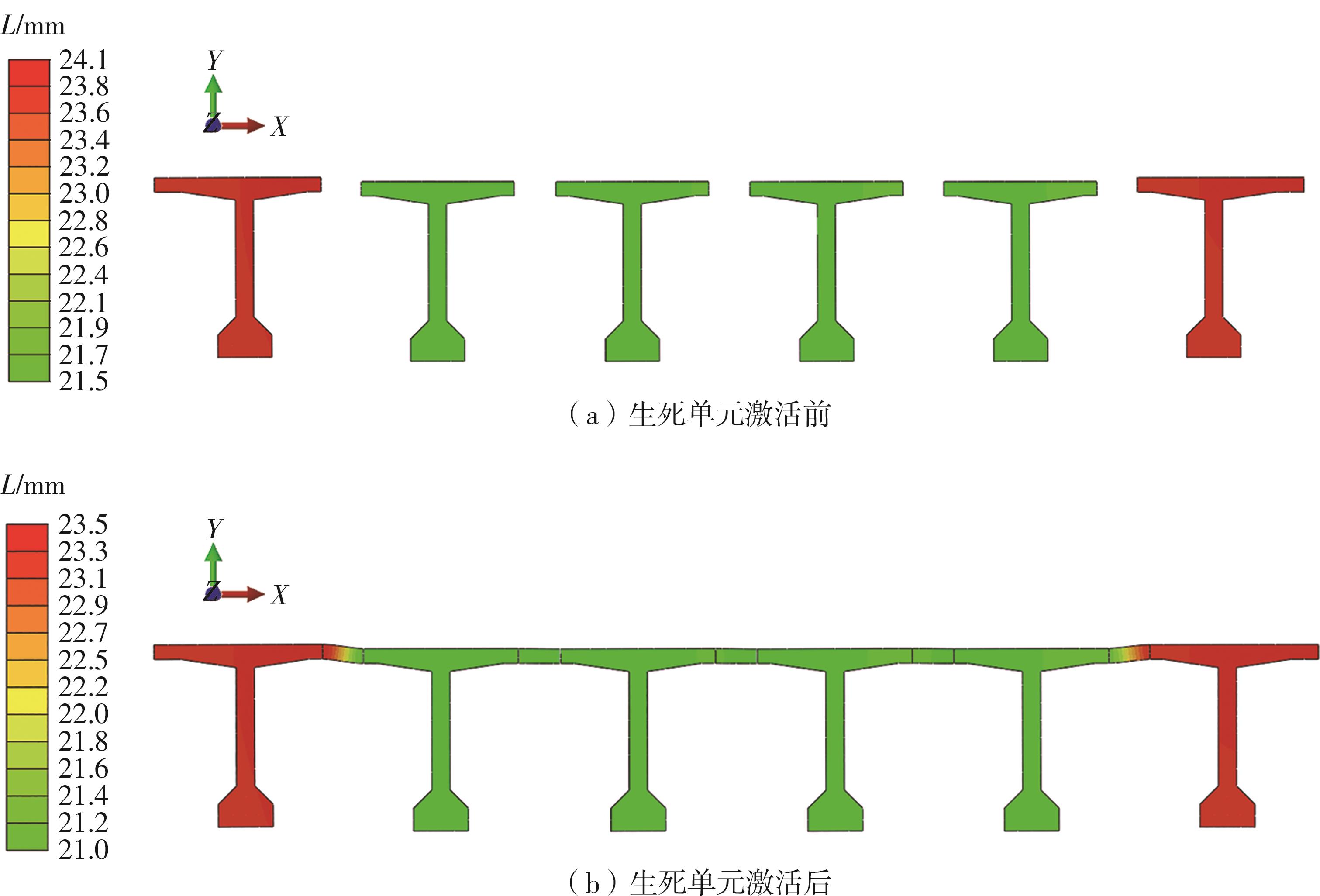
Fig.17
Comparison of measured strain values at measurement points with finite element simulation (PJ) results"
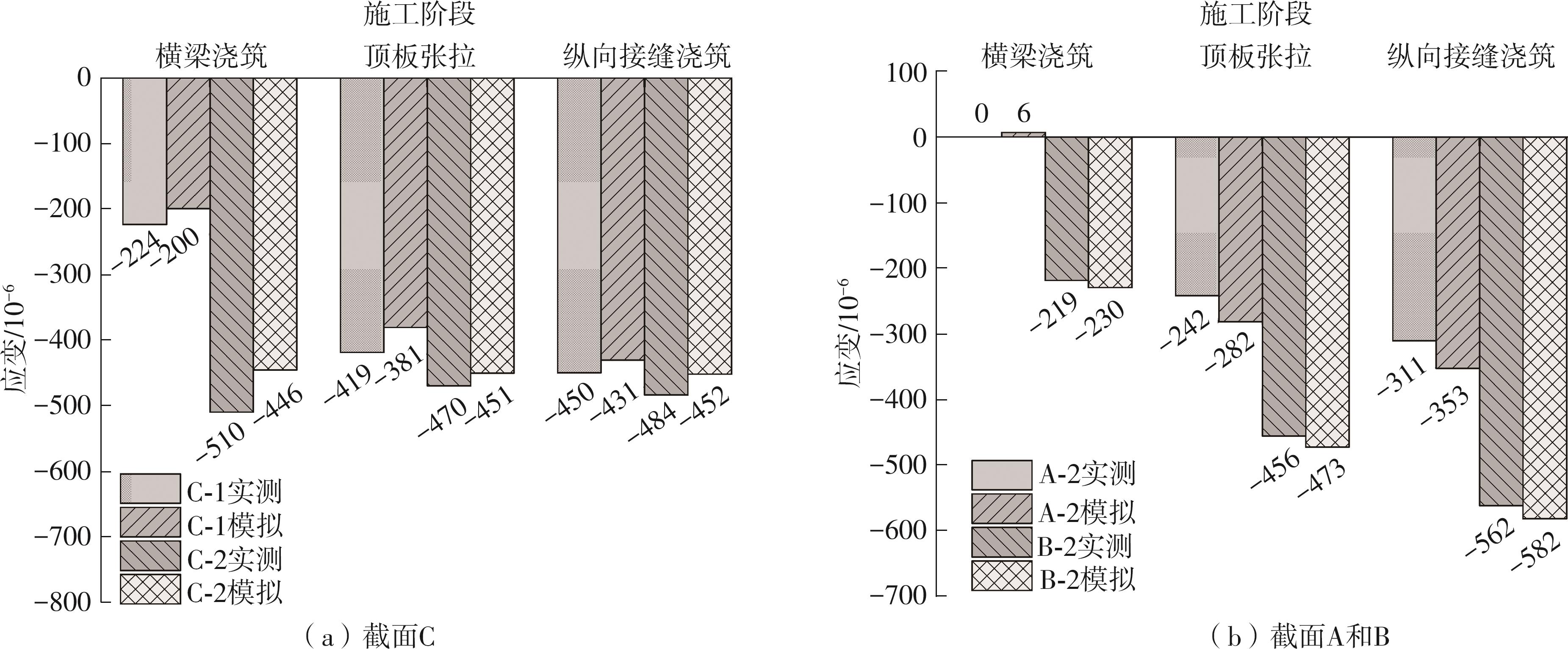
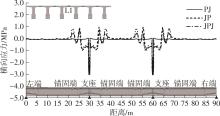
Fig.18
Horizontal distribution of transverse stress at L1 for each model under dead load"
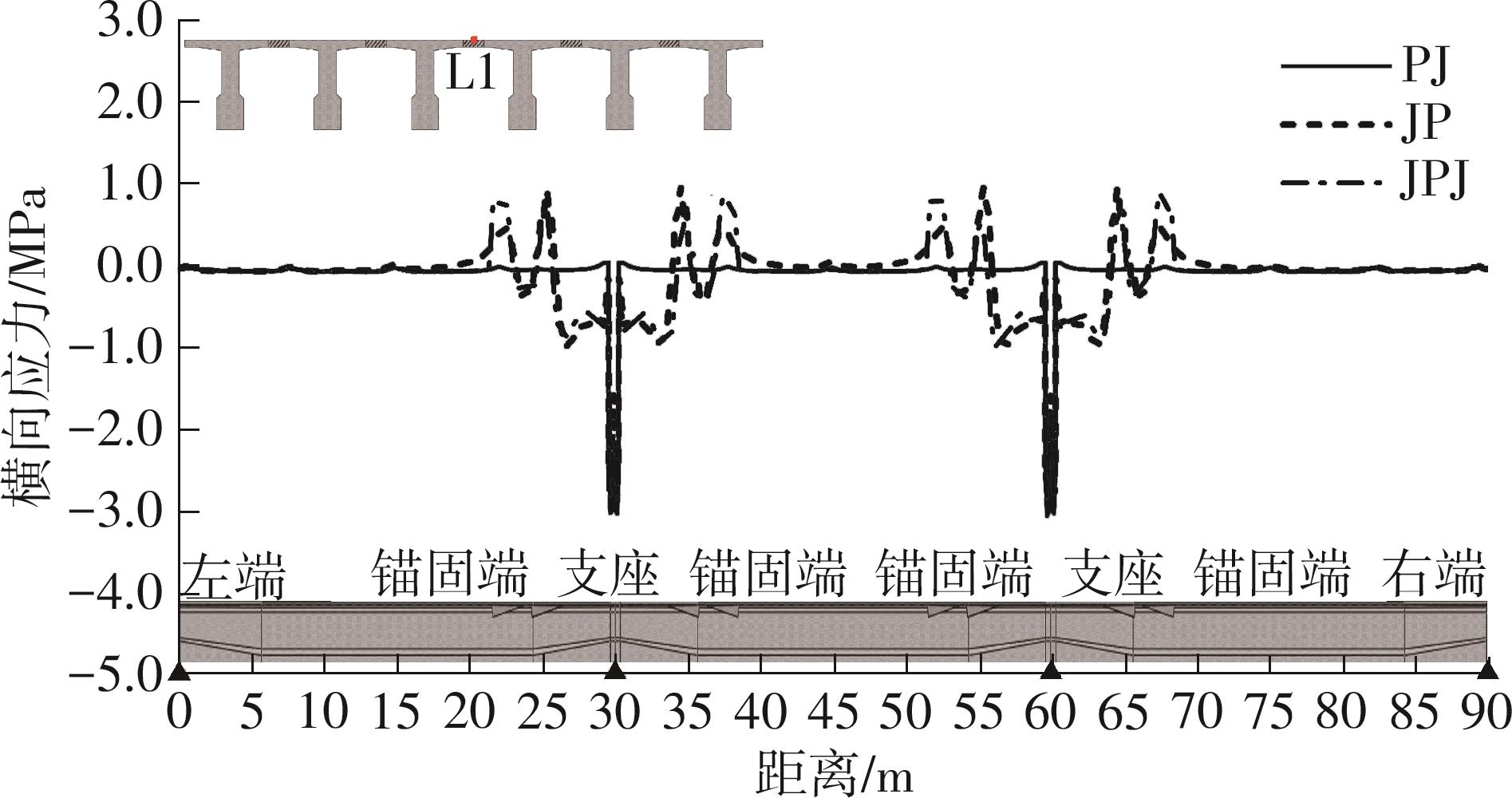
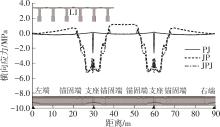
Fig.19
Horizontal distribution of positive stress at L1 under dead load for each model"
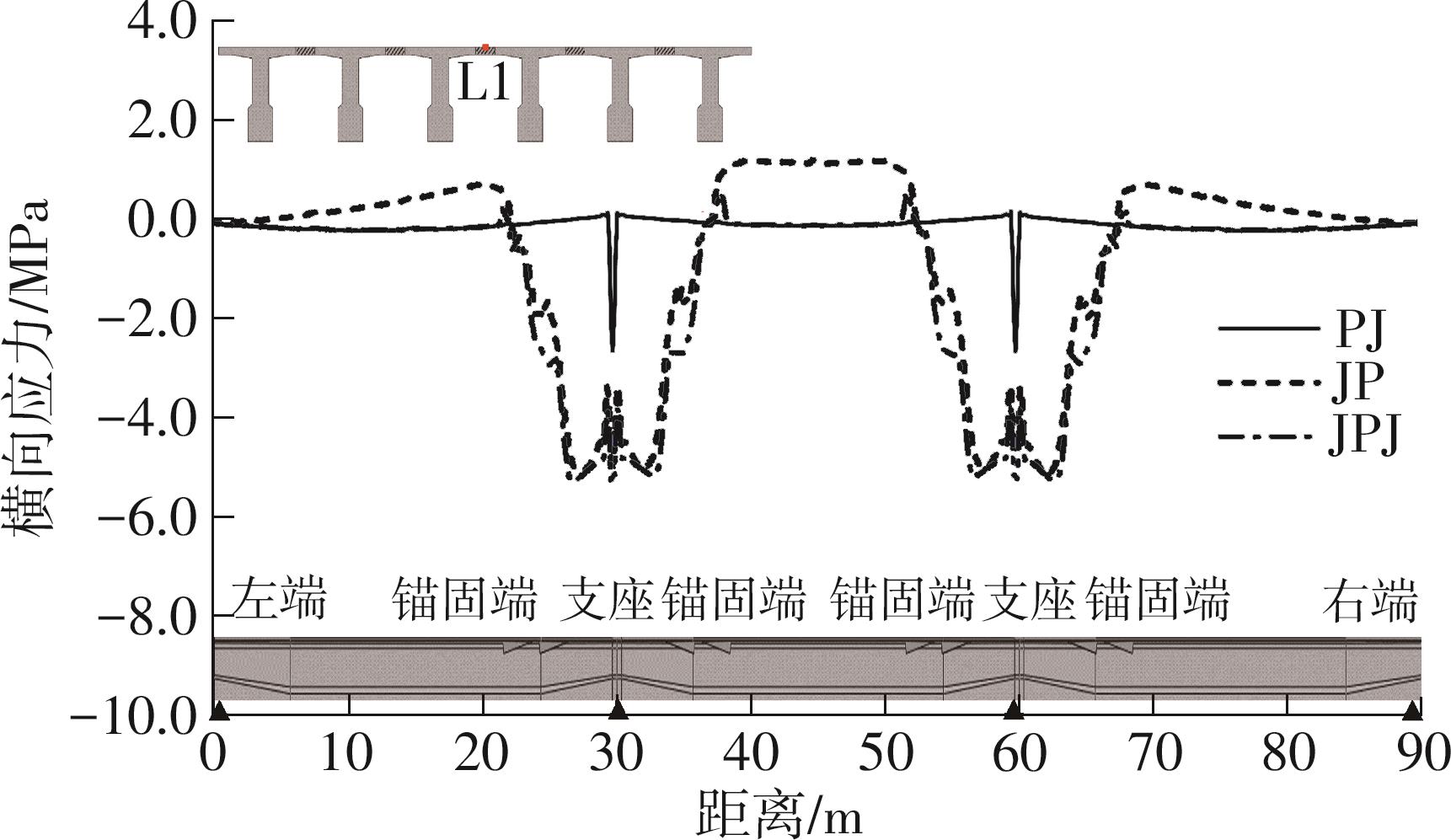
Table 2
Distribution of main tensile stresses at critical locations on joint L1 under constant load"
| 模型 | 左端 | 边跨跨中 | 锚固端 | 支座 | 中跨跨中 |
|---|---|---|---|---|---|
| PJ | 0.0 | 0.0 | 0.1 | 0.3 | 0.0 |
| JP | 0.0 | 0.6 | 0.9 | 0.0 | 1.5 |
| JPJ | 0.0 | 0.0 | 0.9 | 0.2 | 0.0 |
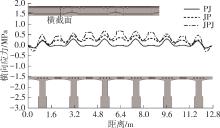
Fig.20
Horizontal distribution of transverse stress at the top edge of the cross-section at the anchorage end for each model under dead load"
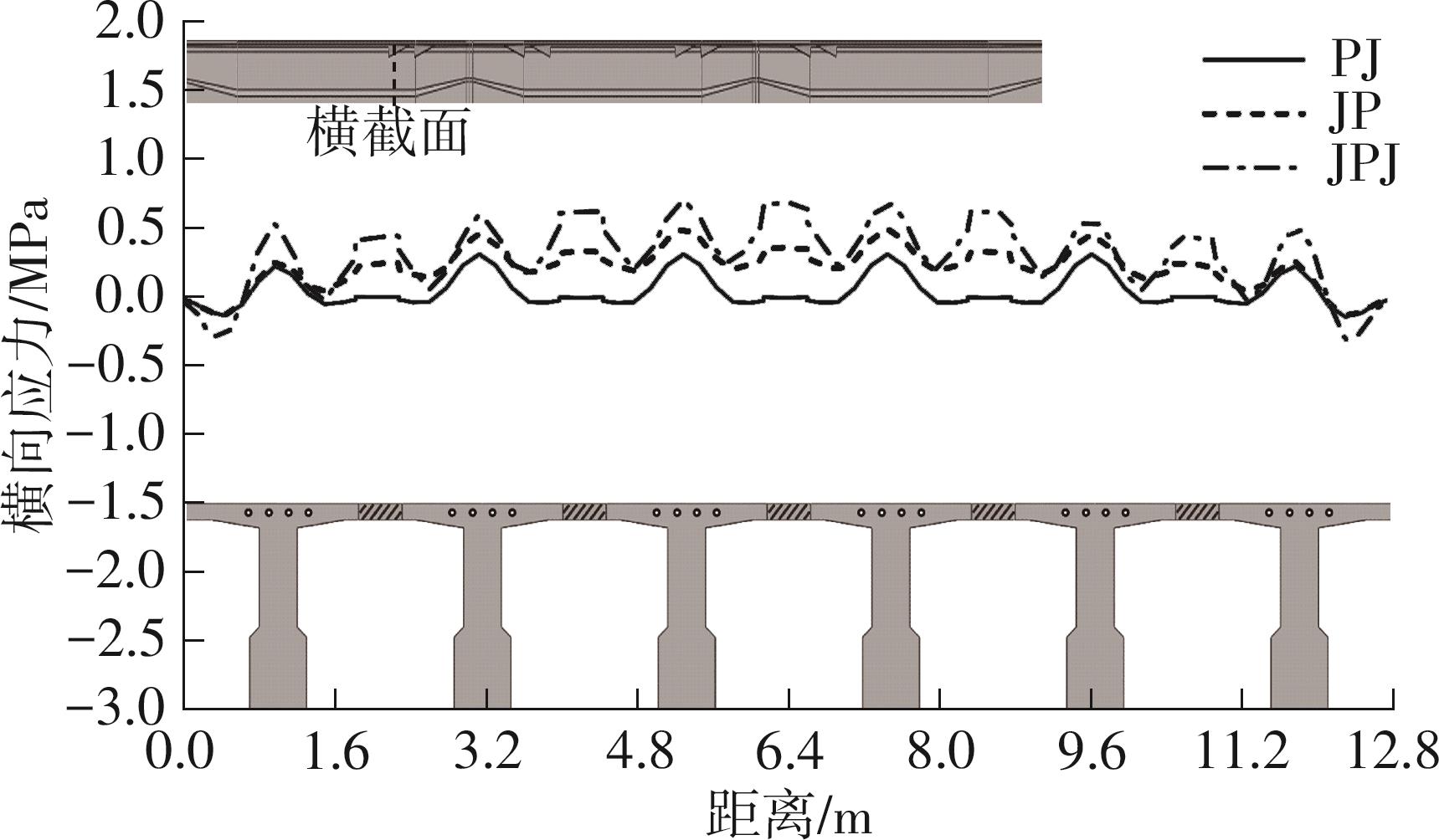
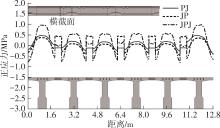
Fig.21
Horizontal distribution of positive stress at the top edge of the cross-section at the anchorage end for each model under dead load"
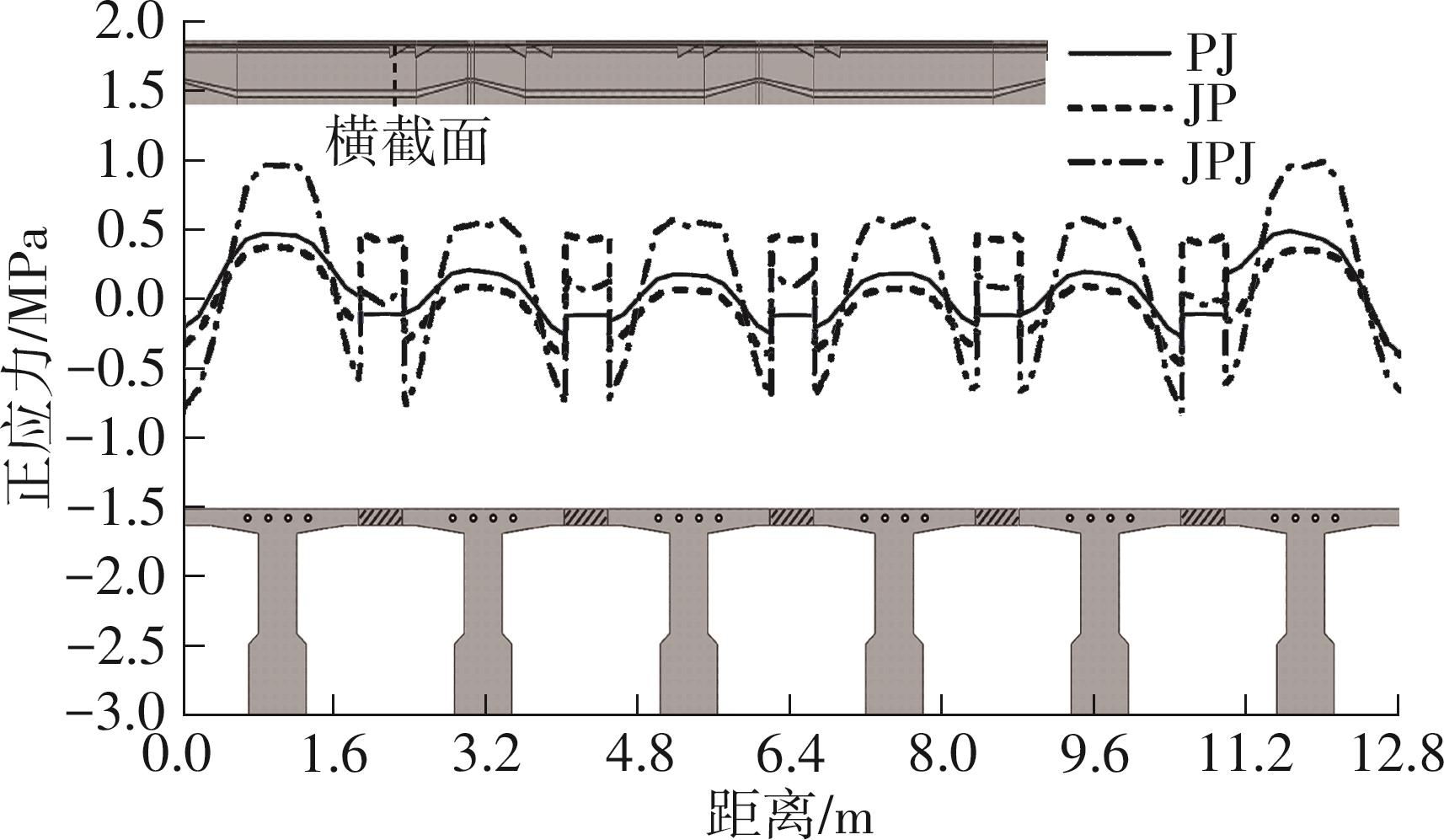
Fig.22
Comparison of transverse stresses in wet joints under dead load and superimposed dead load in three models"
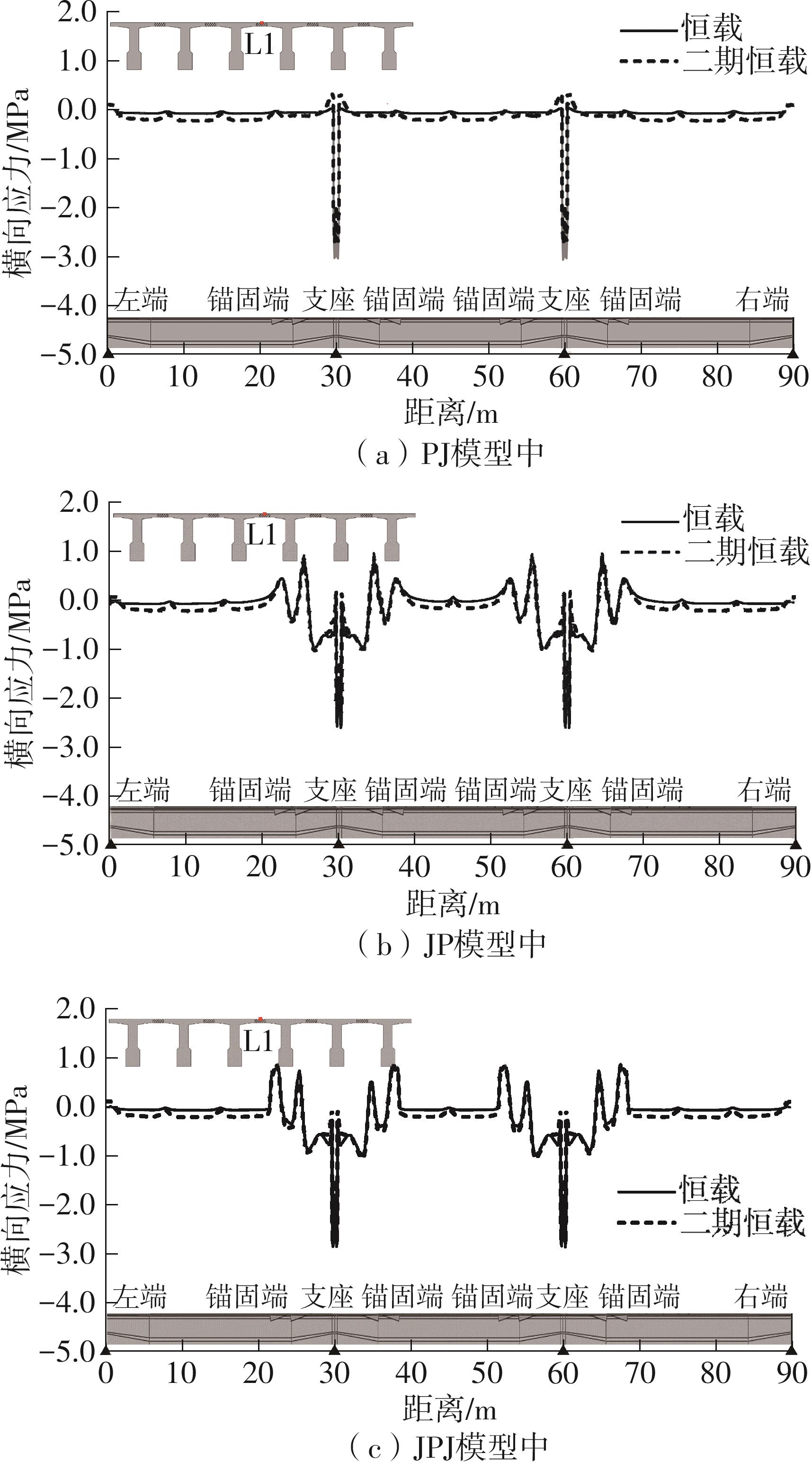
Fig.23
Comparison of positive stresses in wet joints under dead load and superimposed dead load in three models"
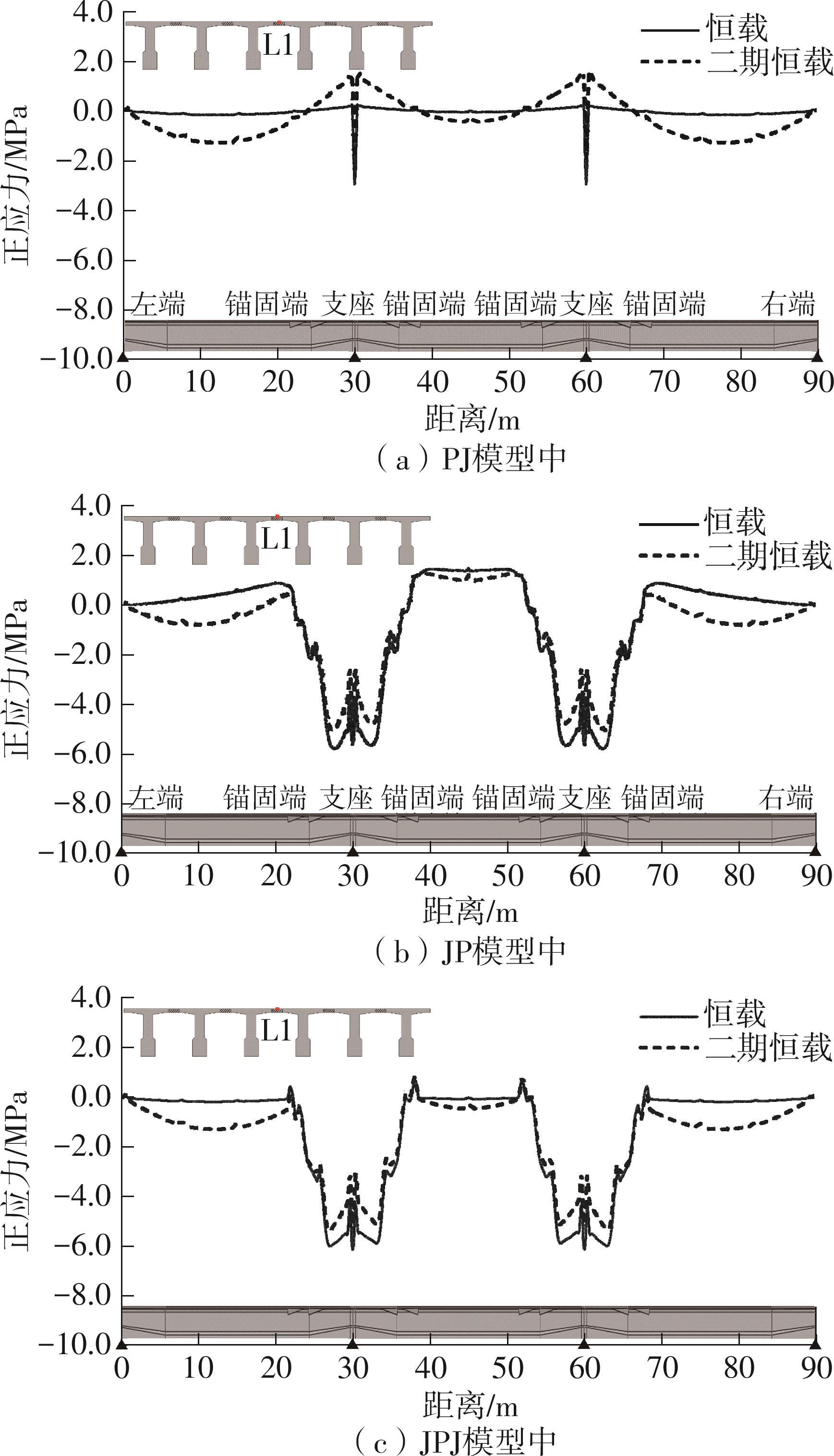
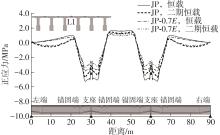
Fig.24
Comparison of positive stresses in wet joints between JP model and JP-0.7E model under dead load and superimposed dead loads"
Table 3
Comparison of stress richness in wet joints between models"
| 模型 | 恒载作用 | 累加二期恒载作用 |
|---|---|---|
| PJ | 0.84 | 0.19 |
| JP | 0.19 | 0.30 |
| JPJ | 0.51 | 0.57 |
| [1] | 申雁鹏,郭文龙,韩之江,等 .混凝土桥面板湿接缝纯弯破坏行为试验研究[J].桥梁建设,2019,49(3):34-39. |
| SHEN Yan-peng, GUO Wen-long, HAN Zhi-jiang,et al .Experimental study on pure bending failure behaviour of wet joint of concrete bridge deck[J].Bridge Construction,2019,49(3):34-39. | |
| [2] | 苏庆田,胡一鸣,田乐,等 .用于组合梁桥面板湿接缝的弧形钢筋连接构造[J].中国公路学报,2017,30(9):86-92. |
| SU Qing-tian, HU Yi-ming, TIAN Le,et al .Curved bar connection configuration used for wet joints of deck of composite girder[J].China Journal of Highway and Transport,2017,30(9):86-92. | |
| [3] | 张菊辉,黄帅,管仲国 .预制小箱梁纵向U筋交错搭接接缝静载试验[J].中国公路学报,2018,31(12):115-123. |
| ZHANG Ju-hui, HUANG Shuai, GUAN Zhong-guo,et al .Static loading test of longitudinal joint details using staggered U-bars in precast multibox girder bridges[J].China Journal of Highway and Transport,2018,31(12):115-123. | |
| [4] | 曹洪亮,刘帅,殷涛,等 .节段预制拼装箱梁桥抗剪性能试验研究[J].结构工程师,2024,40(1):107-114. |
| CAO Hongliang, LIU Shuai, YIN Tao,et al .Experimental study on shear resistance of segmental prefabricated assembled box girder bridge[J].Structure Engineers,2024,40(1):107-114. | |
| [5] | 陈德宝,曾明根,苏庆田,等 .钢-UHPC组合桥面板湿接缝界面处理方式[J].中国公路学报,2018,31(12):154-162. |
| CHEN De-bao, ZENG Ming-gen, SU Qing-tian,et al .Interfacial treatment measures of wet joints in composite bridge deck composed of steel and UHPC layer[J].China Journal of Highway and Transport,2018,31(12):154-162. | |
| [6] | 龙佩恒,杜小节,韩扬,等 .预制拼装板UHPC湿接缝抗弯性能分析[J].建筑结构,2021,51(S2):1209-1215. |
| LONG Peiheng, DU Xiaojie, HAN Yang,et al .Analysis on flexural performance of prefabricated assembly panels with UHPC wet joints[J].Building Structure,2021,51(S2):1209-1215. | |
| [7] | 高立强,王敏,王康宁 .预制NC拼装梁粗骨料UHPC湿接缝抗弯性能研究[J].桥梁建设,2022,52(2):82-88. |
| GAO Li-qiang, WANG Min, WANG Kang-ning .Research on flexural performance of precast NC beam with in-situ coarse aggregate UHPC stitches[J].Bridge Construction,2022,52(2):82-88. | |
| [8] | 邹宇,俞承序,徐栋,等 .接缝处纵筋连续预制节段梁弯剪受力机理试验研究[J].同济大学学报(自然科学版),2024,52(11):1670-1680,1698. |
| ZOU Yu, YU Chengxu, XU Dong,et al .Experimental study on bending shear force mechanism of precast segmental girder with continuous longitudinal reinforcement across joints[J].Journal of Tongji University(Natural Science),2024,52(11):1670-1680,1698. | |
| [9] | 朱劲松,佟欣瑶,刘晓旭 .装配式小箱梁桥超高性能混凝土免支模湿接缝抗弯性能[J].吉林大学学报(工学版),2024,54(9):2568-2580. |
| ZHU Jin-song, TONG Xin-yao, LIU Xiao-xu .Flexural behavior of ultra-high performance concrete joint without formwork in prefabricated small box girder bridges[J].Journal of Jilin University(Engineering and Technology Edition),2024,54(9):2568-2580. | |
| [10] | 邵旭东,孔小璇,邱明红,等 .先简支后连续混凝土梁负弯矩区UHPC“T形”湿接缝试验研究[J].湖南大学学报(自然科学版),2021,48(3):1-13. |
| SHAO Xudong, KONG Xiaoxuan, QIU Minghong,et al .Experimental study on UHPC“T-shaped”wet joints in the negative moment zone of continuous concrete beams after simple support[J].Journal of Hunan University(Natural Sciences),2021,48(3):1-13. | |
| [11] | ZHAO C H, WANG K K, ZHOU Q F, et al .Full-scale test and simulation on flexural behavior of dovetail-shaped reactive powder-concrete wet joint in a compo-site deck system[J].Journal of Bridge Engineering,2018,23(8):04018051/1-10. |
| [12] | 盖珂瑜,龙勇,陈露一,等 .矿物掺合料复掺对超高性能湿接缝混凝土性能的影响[J].硅酸盐通报,2024,43(3):948-955. |
| GE Keyu, LONG Yong, CHEN Luyi,et al .Effects of mixing mineral admixtures on properties of ultra high performance wet-joints concrete[J].Bulletin of the Chinese Ceramic Society,2024,43(3):948-955. | |
| [13] | 黄方林,孟宪冬,冯帆,等 .预制桥面板方台形剪力键湿接缝受力性能分析[J].铁道科学与工程学报,2023,20(6):2151-2164. |
| HUANG Fanglin, MENG Xiandong, FENG Fan,et al .Analysis of the mechanical behavior of precast deck slab with square platform shear key wet joint[J].Journal of Railway Science and Engineering,2023,20(6):2151-2164. | |
| [14] | 王贤林,李怀峰,刘玉擎 .预制桥面板齿槽-U筋湿接缝受力机理分析[J].结构工程师,2023,39(1):1-7. |
| WANG Xianlin, LI Huaifeng, LIU Yuqing .Analysis on load transfer mechanism of tooth-U bar wet joints[J].Structure Engineers,2023,39(1):1-7. | |
| [15] | 中华人民共和国住房和城乡建设部 . 混凝土结构设计规范: [S]. |
| [1] | CHEN Zhong, LIU Qi, WU Hongbing, XIAO Jiafeng, XU Yang, ZHAN Xiaoyu, SHEN Shuang. Brake Noise Reduction of Elevator Traction Machine Based on Particle Dampers [J]. Journal of South China University of Technology(Natural Science Edition), 2026, 54(1): 115-123. |
| [2] | JIANG Zuqian, XIAO Rucheng, SONG Chaolin, SUN Bin, WANG Yeteng, JIANG Haixi. Stability Analysis of the Network Arch Bridge Considering Nonlinear Effects [J]. Journal of South China University of Technology(Natural Science Edition), 2025, 53(8): 111-122. |
| [3] | CAO Yang, SHI Hao, LI Jiaofeng, TAO Jing. Evolution Analysis of Vibration Source Intensity of Subway Station Under the Influence of Closely-Spaced Undercrossing [J]. Journal of South China University of Technology(Natural Science Edition), 2025, 53(7): 149-158. |
| [4] | WANG Ronghui, LIU Xiyue, ZHAO Yonglin, ZHEN Xiaoxia, ZHANG Zhuojie. Bending Characteristics of 2-Layer Spiral Strand Under Typical Contact Conditions [J]. Journal of South China University of Technology(Natural Science Edition), 2025, 53(6): 12-24. |
| [5] | JIN Qichao, LI Jun, WANG Liangliang, TAN Haibing, LI Fulin, FU Rui, MENG Lingchao, GUO Lei. Mechanism of Saw Tooth-Shaped Chip Formation in Cast & Wrought High-Temperature Alloy GH4198 [J]. Journal of South China University of Technology(Natural Science Edition), 2025, 53(5): 32-44. |
| [6] | FAN Xueming, ZHOU Xiaopeng, YE Xiaohang, ZHAO Kun. Cost-Performance Analysis of Thin-Layer UHPC Encased I-Beam Shear Resistance [J]. Journal of South China University of Technology(Natural Science Edition), 2025, 53(4): 40-49. |
| [7] | CHENG Jin, SUN Kedi, YUAN Yi. Deflection Reliability Assessment Method of Long-Span Suspension Bridge Based on Random Field [J]. Journal of South China University of Technology(Natural Science Edition), 2025, 53(4): 13-21. |
| [8] | LIU Wenshuo, LI Ang, WANG Hailong, LUO Qiong, LI Jianquan. Model Test Study on Steel-Concrete Joint Segment of Arch Foot of A Long-Span Flat Arch Bridge [J]. Journal of South China University of Technology(Natural Science Edition), 2025, 53(12): 117-125. |
| [9] | XIE Zhengchao, LIU Jincan, LI Shuang, LI Wenfeng, ZHAO Jing. Time Series Prediction of Vehicle Crash Based on Process Parameters Analysis of Friction Stir Welding [J]. Journal of South China University of Technology(Natural Science Edition), 2025, 53(11): 132-140. |
| [10] | ZHANG Dawei, YE Juntao, XIE Zhiyu. Skid Resistance of Cement Concrete Grooved Pavements Based on a Longitudinal Friction Testing Model [J]. Journal of South China University of Technology(Natural Science Edition), 2025, 53(10): 52-59. |
| [11] | XIA Qinxiang, PENG Chong, LIU Meihua, et al. Research on Material Flow Behavior of Gear Blank with Deep Spoke During Multi Station Close Die Forging [J]. Journal of South China University of Technology(Natural Science Edition), 2024, 52(9): 35-41. |
| [12] | JIANG Xu, LÜ Zhilin, QIANG Xuhong, et al. Fatigue Cracking Characteristics of Butt Welds in U-Rib Embedded Section of Steel Bridge Decks [J]. Journal of South China University of Technology(Natural Science Edition), 2024, 52(5): 92-100. |
| [13] | LI Min, YAO Qishui. Calculation of Fatigue Life of Rubber Vibration Isolators Under Random Vibration Loads [J]. Journal of South China University of Technology(Natural Science Edition), 2024, 52(12): 14-21. |
| [14] | CHEN Zhong, QIU Yuliang, ZHANG Xianmin. Optimization Design and Experiment of XY Compliant Platform with Local Resonance Damping [J]. Journal of South China University of Technology(Natural Science Edition), 2024, 52(12): 1-13. |
| [15] | LIU Yan, CHEN Yixian, WANG Xin, et al. Analysis of the Ultimate Bearing Capacity of the Π-Joint of Welded Square Tube Under Axial Load [J]. Journal of South China University of Technology(Natural Science Edition), 2024, 52(11): 32-42. |
| Viewed | ||||||
|
Full text |
|
|||||
|
Abstract |
|
|||||