Journal of South China University of Technology(Natural Science Edition) ›› 2025, Vol. 53 ›› Issue (12): 117-125.doi: 10.12141/j.issn.1000-565X.250078
Previous Articles Next Articles
Model Test Study on Steel-Concrete Joint Segment of Arch Foot of A Long-Span Flat Arch Bridge
LIU Wenshuo1, LI Ang1, WANG Hailong1, LUO Qiong1, LI Jianquan2
- 1.School of Civil Engineering,Central South University,Changsha 410075,Hunan,China
2.Huicheng District Transportation Service Center of Huizhou City,Huizhou 516000,Guangdong,China
-
Received:2025-03-21Online:2025-12-25Published:2025-06-05 -
About author:刘文硕(1985—),女,博士,副教授,主要从事高速铁路大跨度桥梁研究。E-mail: liuwenshuo@csu.edu.cn -
Supported by:the National Natural Science Foundation of China(52278234);the Natural Science Foundation of Hunan Province(2022JJ30728)

CLC Number:
Cite this article
LIU Wenshuo, LI Ang, WANG Hailong, LUO Qiong, LI Jianquan. Model Test Study on Steel-Concrete Joint Segment of Arch Foot of A Long-Span Flat Arch Bridge[J]. Journal of South China University of Technology(Natural Science Edition), 2025, 53(12): 117-125.
share this article
Fig.1
General arrangement drawing of bridge(Unit: cm)"
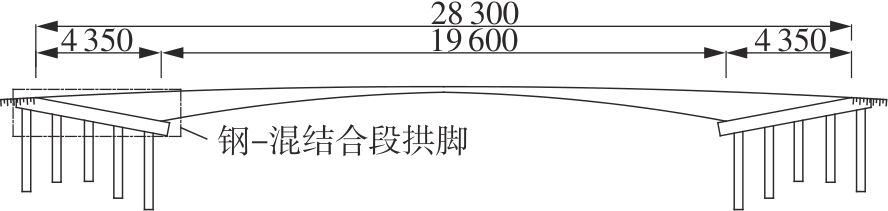
Fig.2
Elevation drawing of steel-concrete composite arch abutment(Unit: mm)"
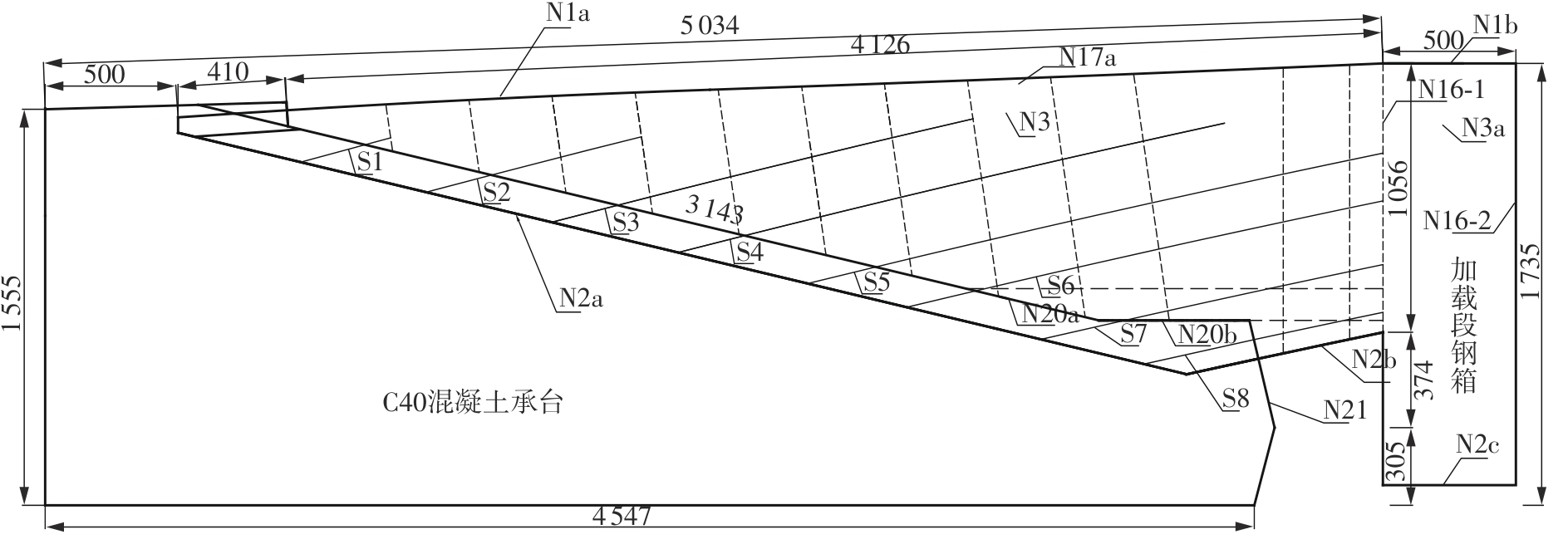
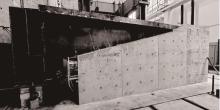
Fig.3
Model elevation drawing"
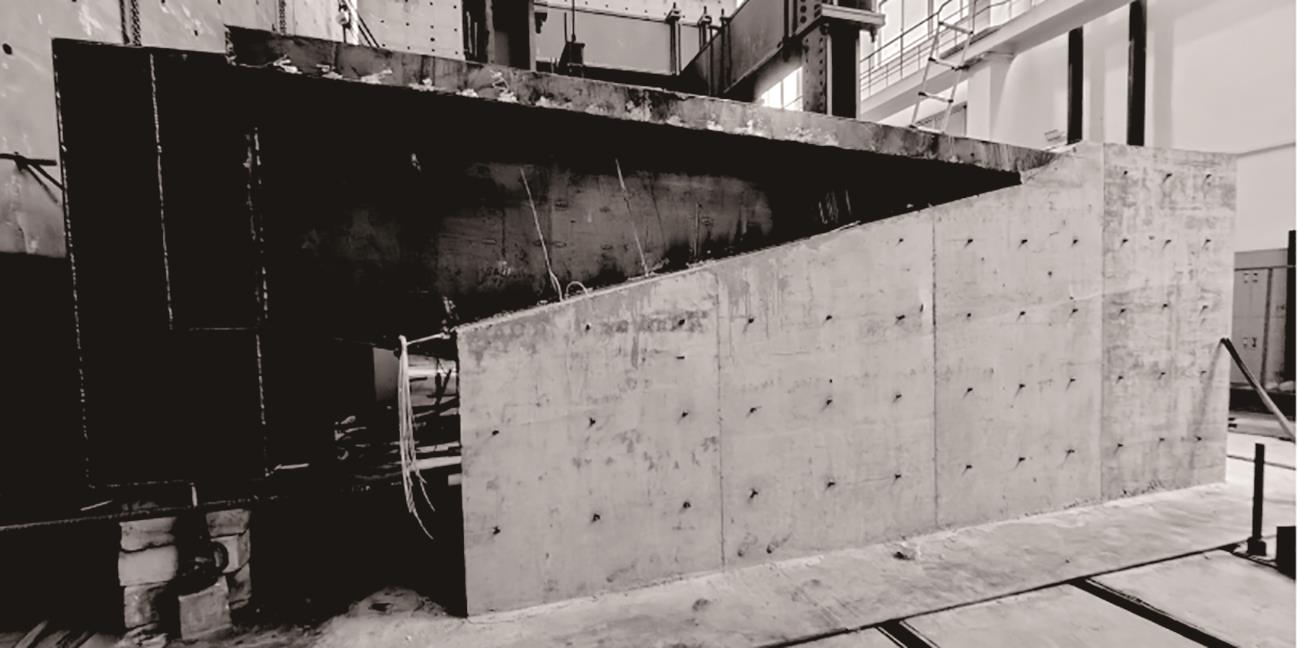
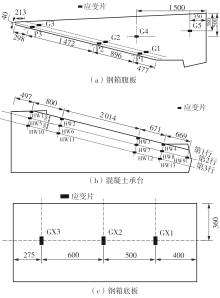
Fig.4
Arrangement of main measuring points on the test model (Unit: mm)"
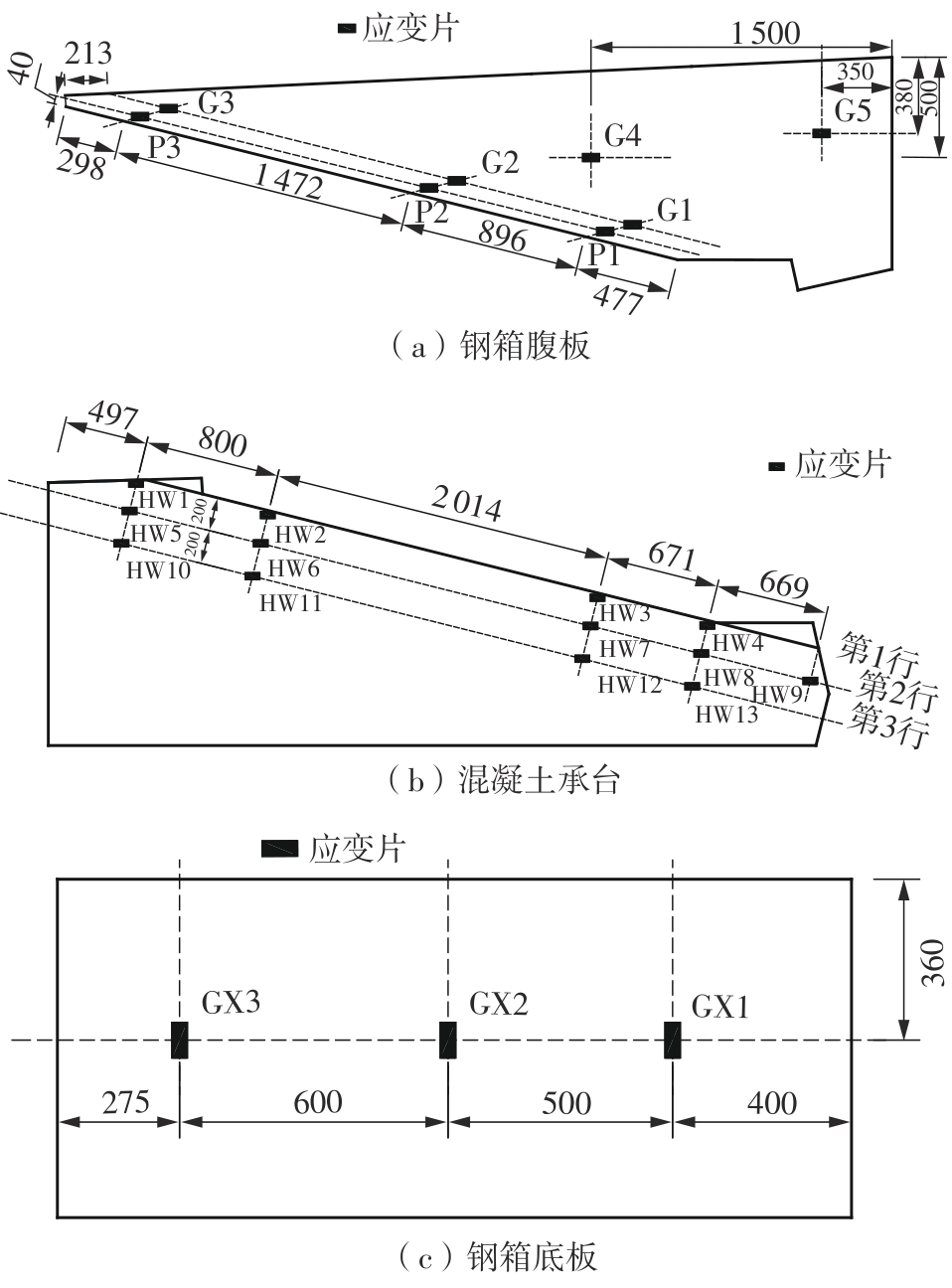

Table 1
Load values for loading conditions"
| 工况 | 轴向力/kN | 弯矩/(kN·m) | 偏心距/m |
|---|---|---|---|
| 工况1 | -1 715 | -429 | 0.25 |
| 工况2 | -1 607 | -741 | 0.46 |
| 工况3 | -2 377 | -487 | 0.21 |
| 工况4 | -567 | -1 519 | 2.68 |
| 工况5 | -651 | -1 610 | 2.48 |
| 工况6 | -626 | -2 145 | 3.42 |
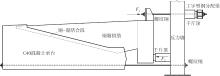
Fig.5
Schematic diagram of model loading device"
Table 2
Summary table of model testing and loading instruments"
| 项目 | 数量 | |
|---|---|---|
| 测试元件 | 电阻应变片 | 103 |
| 指针式位移计 | 4 | |
| 加载设备 | YDC千斤顶 | 5 |
| 力传感器 | 3 | |
| 数据采集系统 | 动态应变采集仪 | 7 |
| HBM数据采集系统 | 1 | |
| 微力特斯IMTS材料性能测试仪 | 1 | |
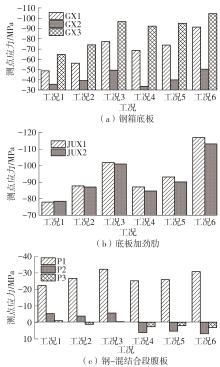
Fig.6
Stress distribution of measurement points under various working conditions"
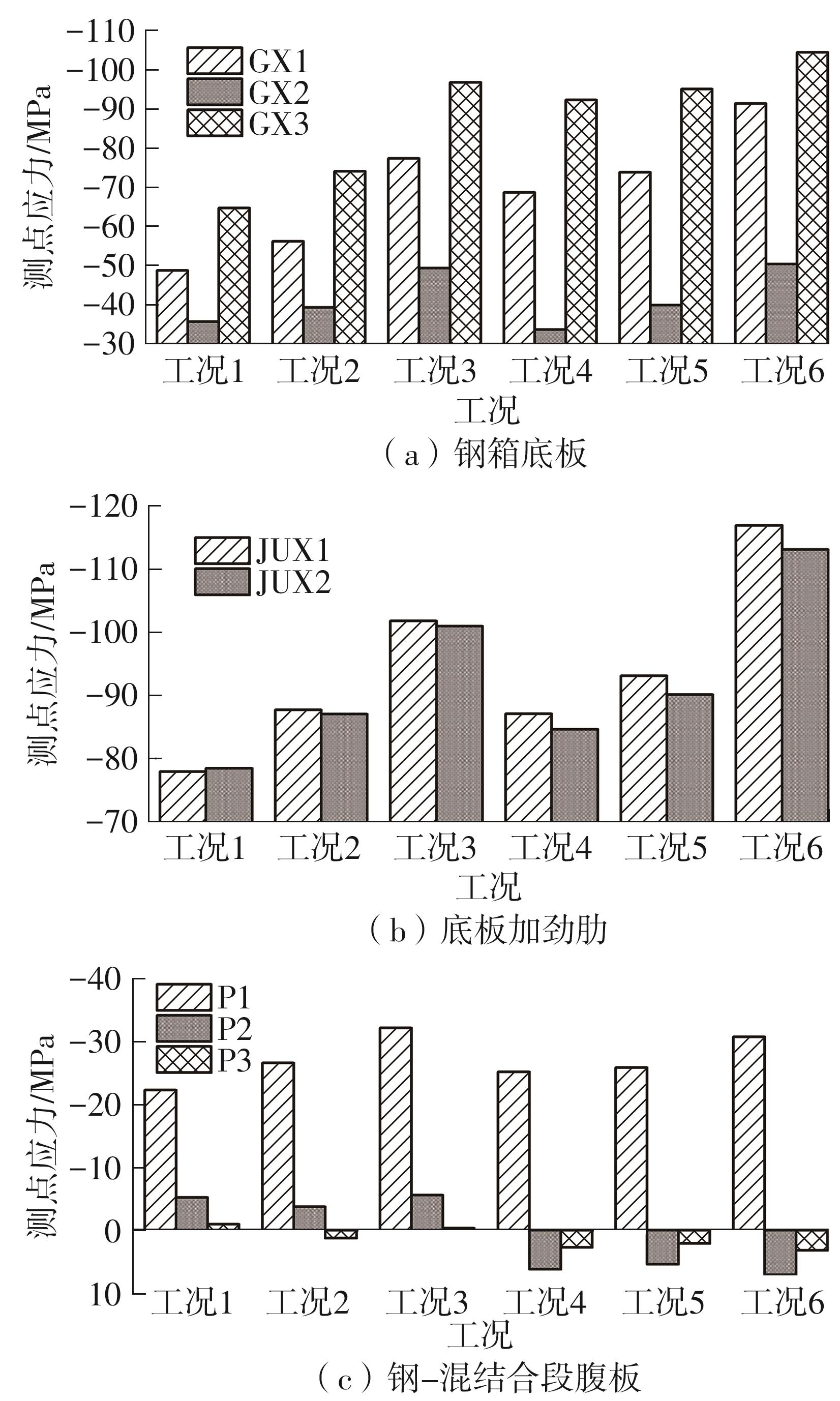
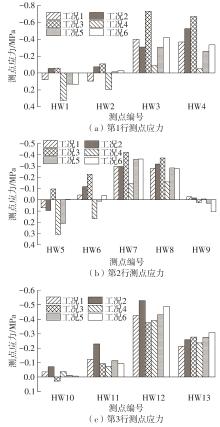
Fig.7
Stress results at measurement points on concrete pile cap under various working conditions"
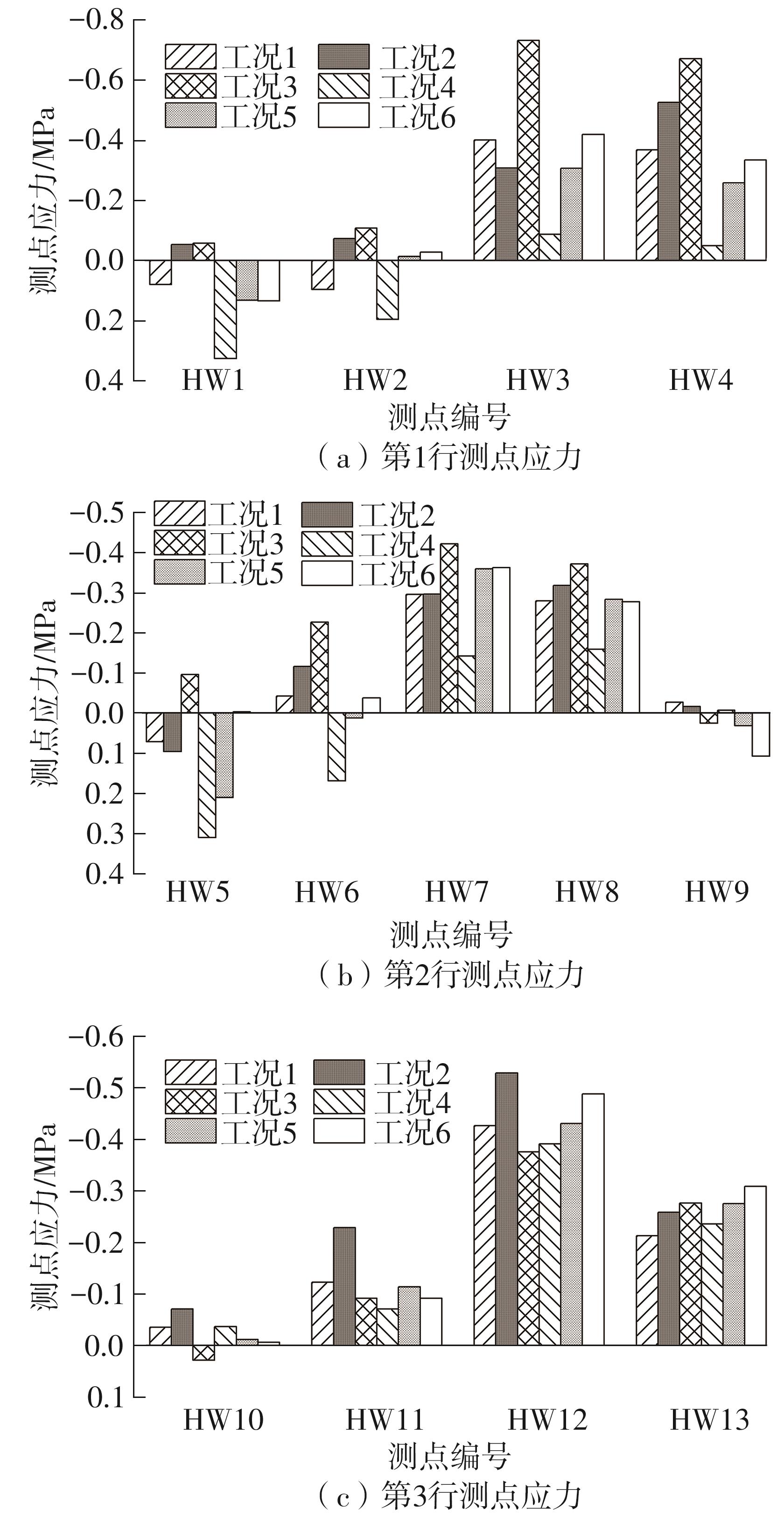
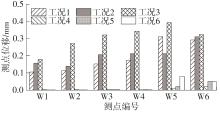
Fig.8
Displacement results at measurement points under va-rious working conditions"
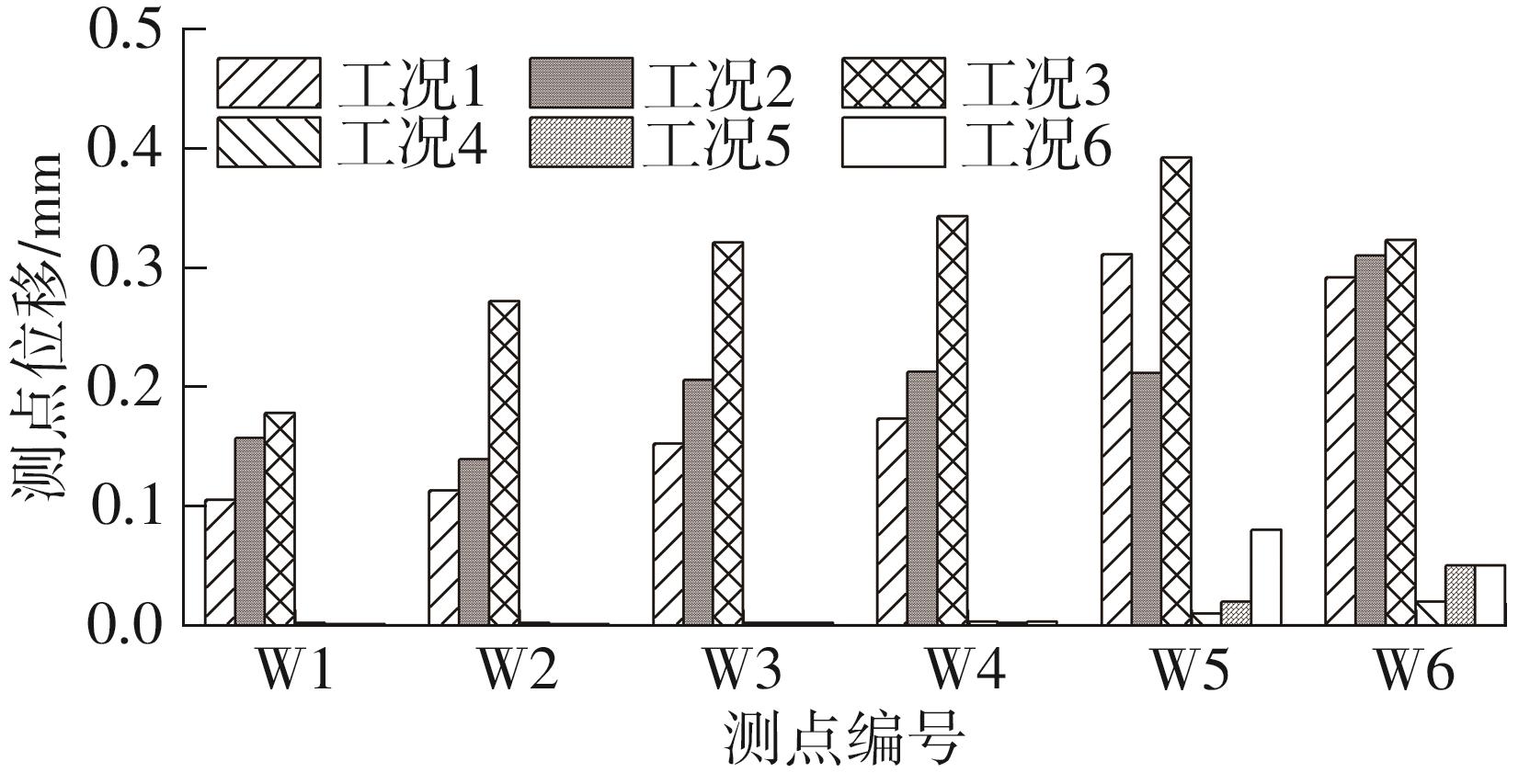
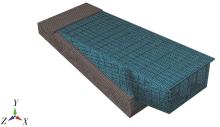
Fig.9
Finite element scaled model"
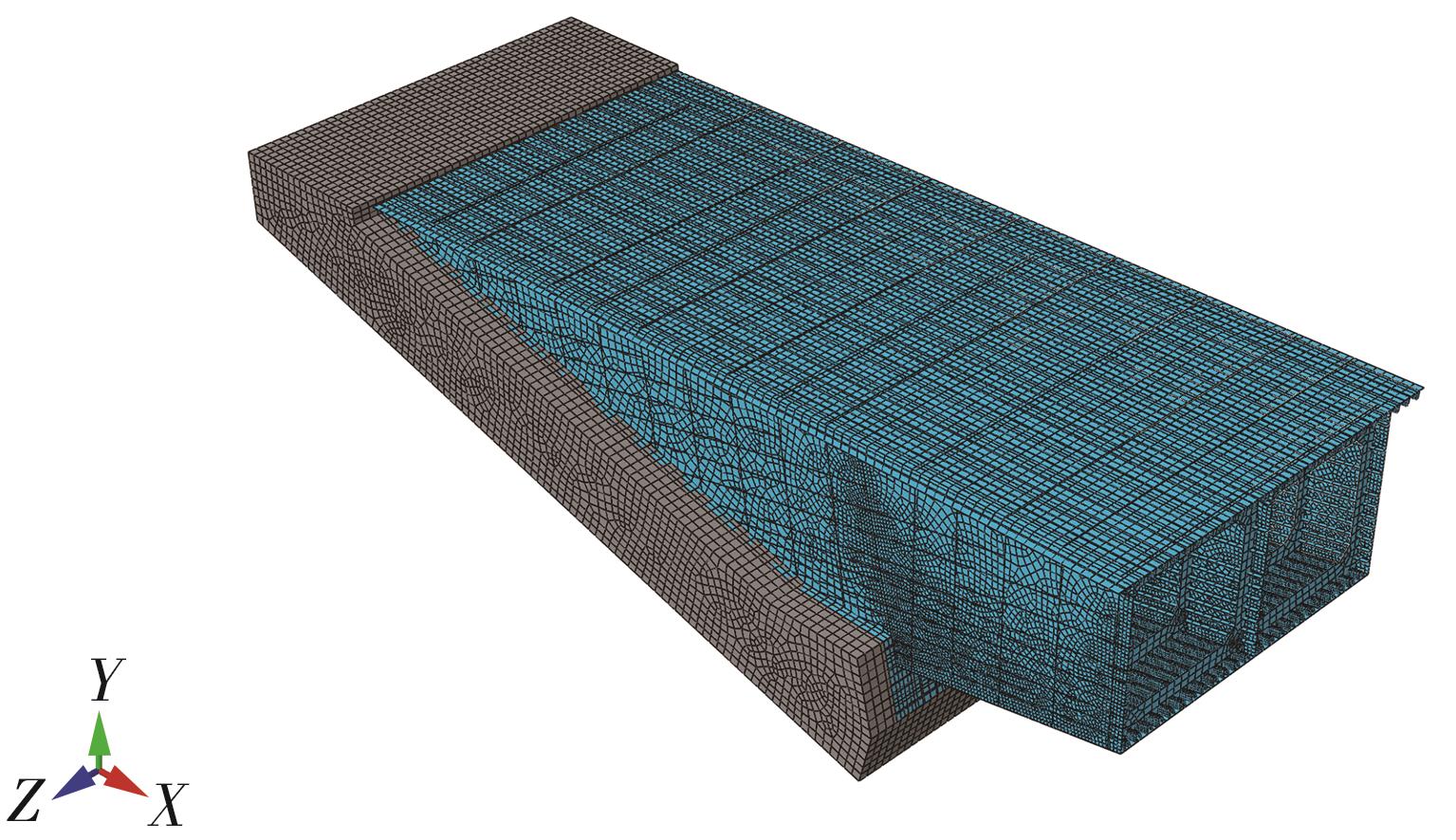
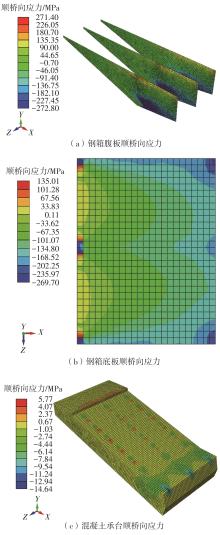
Fig.10
Stress contour plot in the web, bottom flange of steel box girder and concrete pile cap under working condition 6"
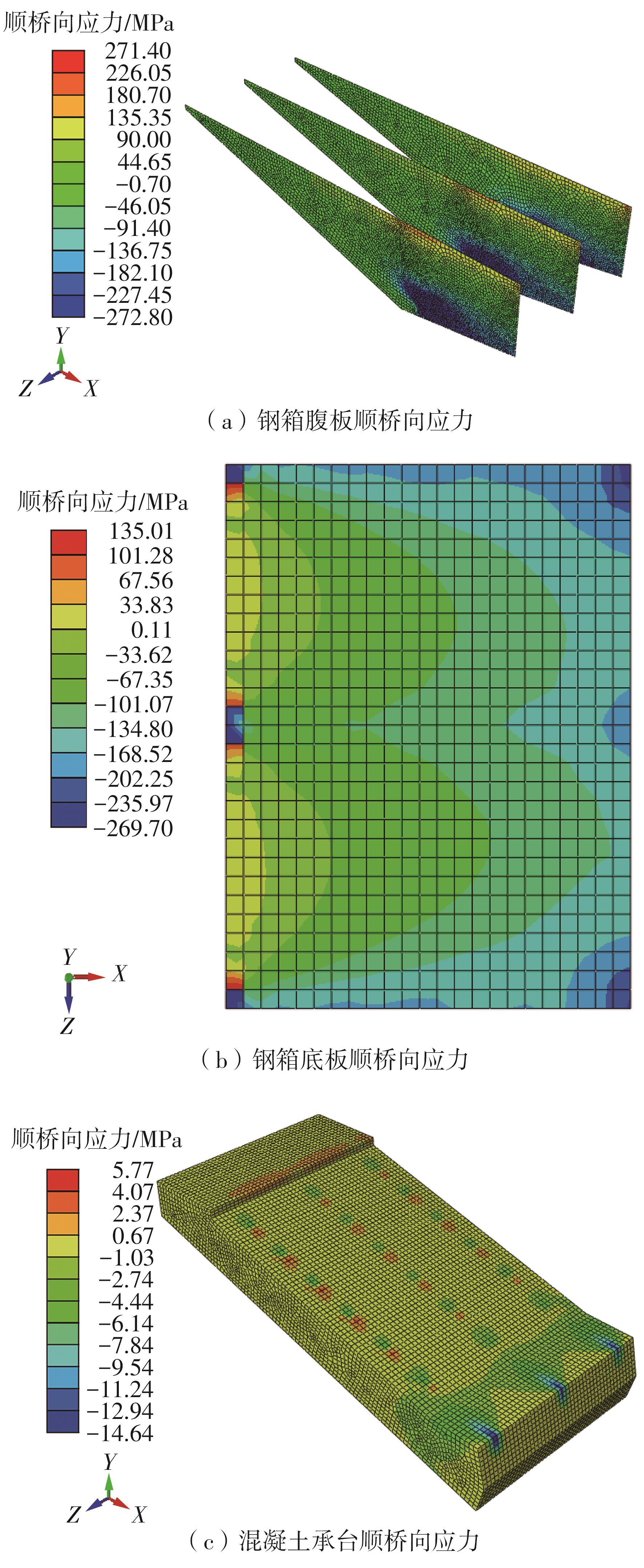
Table 3
Stress comparison at measurement points under wor-king condition 3"
| 测点 | 理论值/MPa | 实测值/MPa | 绝对误差/MPa | 容许误差/MPa |
|---|---|---|---|---|
| GX1 | -73.32 | -77.31 | 4.00 | 16.72 |
| GX2 | -46.97 | -49.24 | 2.27 | 11.45 |
| GX3 | -93.27 | -96.78 | 3.51 | 20.71 |
| G1 | -25.10 | -24.71 | 0.39 | 7.08 |
| G2 | -4.98 | -4.04 | 0.93 | 3.06 |
| G3 | -4.18 | -3.14 | 1.04 | 2.90 |
| G4 | -18.64 | -17.18 | 1.46 | 5.79 |
| G5 | -15.06 | -15.80 | 0.75 | 5.07 |
| P1 | -32.44 | -32.16 | 0.28 | 8.55 |
| P2 | -5.33 | -5.55 | 0.22 | 3.13 |
| P3 | -0.87 | -0.30 | 0.57 | 2.23 |
Table 4
Stress comparison at measurement points under wor-king condition 6"
| 测点 | 理论值/MPa | 实测值/MPa | 绝对误差/MPa | 容许误差/MPa |
|---|---|---|---|---|
| GX1 | -90.08 | -91.33 | 1.25 | 20.08 |
| GX2 | -50.13 | -50.27 | 0.14 | 12.09 |
| GX3 | -105.04 | -104.40 | 0.64 | 23.07 |
| G1 | -16.67 | -15.97 | 0.70 | 5.39 |
| G2 | -3.18 | -2.67 | 0.51 | 2.70 |
| G3 | -2.96 | -2.46 | 0.50 | 2.65 |
| G4 | 8.87 | 8.18 | 0.69 | 3.83 |
| G5 | 10.99 | 11.38 | 0.38 | 4.26 |
| P1 | -28.52 | -30.74 | 2.22 | 7.76 |
| P2 | 8.96 | 7.11 | 1.85 | 3.85 |
| P3 | 3.62 | 3.24 | 0.38 | 2.78 |
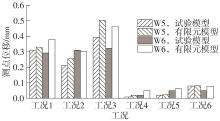
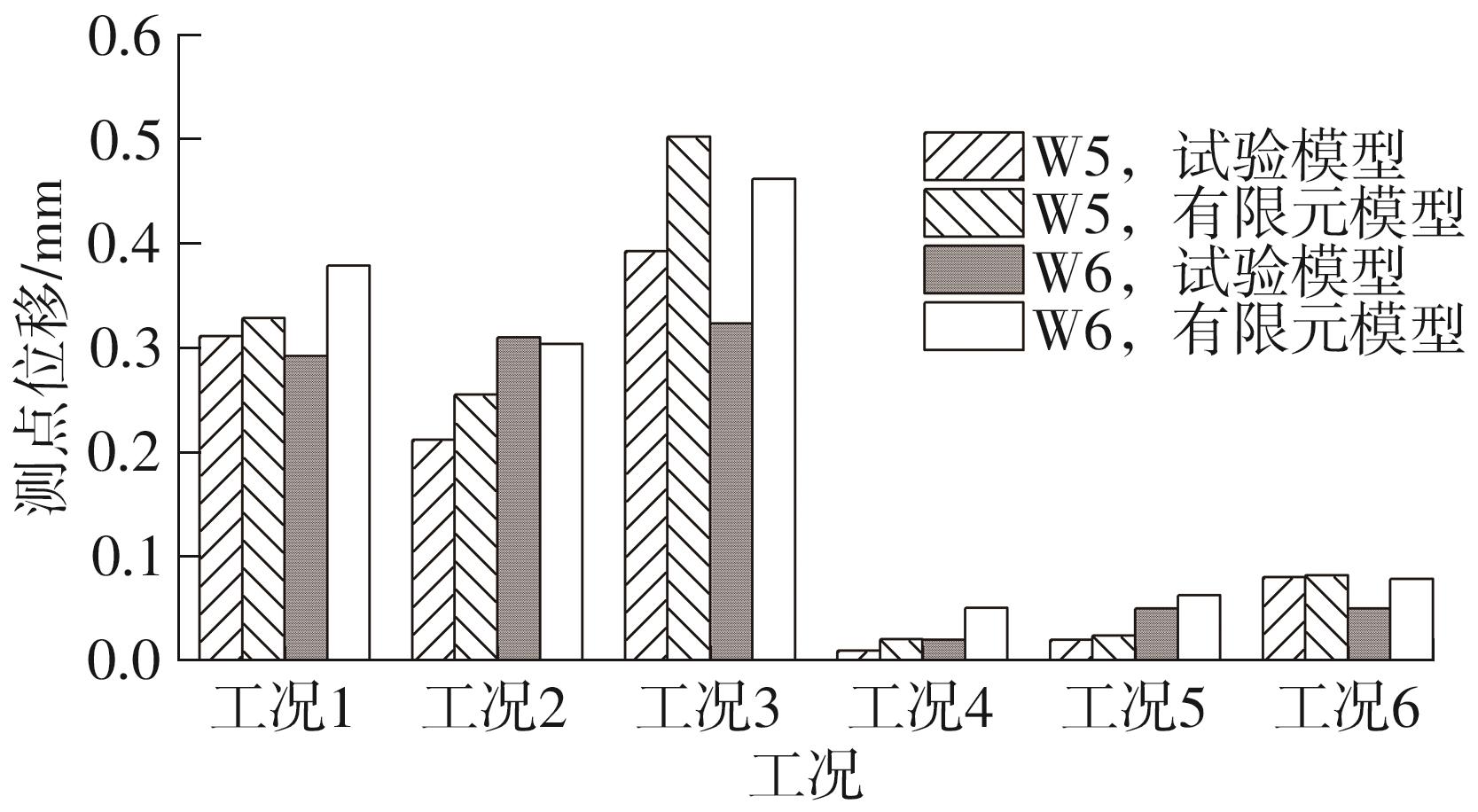
Fig.11
Comparison of displacement results at measurement points under different working conditions"
| [1] | 杨清华,柴生波,王秀兰,等 .大跨度钢箱系杆拱桥主拱钢-混结合段受力分析[J].公路工程,2023,48(4):31-36,51. |
| YANG Qinghua, CHAI Shengbo, WANG Xiulan,et al .Force analysis of steel and concrete combined segment of main arch for large-span steel box tied arch bridge[J].Highway Engineering,2023,48(4):31-36,51. | |
| [2] | 刘世明,李振豪,张颖达 .连续梁边跨混合梁结合部力学性能有限元分析[J].公路,2020,65(10):122-126. |
| LIU Shi-ming, LI Zhen-hao, ZHANG Ying-da .Mechanical behavior analysis on steel-concrete connection part of continuous bridge with side span hybrid beam[J].Highway,2020,65(10):122-126. | |
| [3] | 许世展,怀臣子,杨纪,等 .自锚式悬索桥钢-混结合段局部受力分析[J].公路工程,2019,44(5):1-3,30. |
| XU Shizhan, HUAI Chenzi, YANG Ji,et al .Local stress analysis of steel and concrete joint section of self-anchored suspension bridge[J].Highway Engineering,2019,44(5):1-3,30. | |
| [4] | 史灼 .某铁路槽型梁拱桥拱脚局部应力分析[J].工程建设与设计,2021(14):66-68. |
| SHI Zhuo .Local stress analysis of the arch foot of a railway trough beam arch bridge[J].Construction & Design for Engineering,2021(14):66-68. | |
| [5] | 邓江涛 .高速铁路槽形连续梁拱桥拱脚局部应力分析与验证[J].铁道标准设计,2019,63(7):92-96. |
| DENG Jiang-tao .Local stress analysis and verification of arch foot of high-speed railway continuous channel-beam arch bridge[J].Railway Standard Design,2019,63(7):92-96. | |
| [6] | 崔凤坤,朱谊彪,杜朋,等 .钢管混凝土系杆拱桥拱脚一致多尺度建模及分析[J].江苏大学学报(自然科学版),2017,38(2):211-217. |
| CUI Fengkun, ZHU Yibiao, DU Peng,et al .Concurrent multi-scale modeling and analysis of springing joint for CFST tied-arch bridge[J].Journal of Jiangsu University (Natural Science Edition),2017,38(2):211-217. | |
| [7] | 周萌,宁晓旭,聂建国 .系杆拱桥拱脚连接结构受力性能分析的多尺度有限元建模方法[J].工程力学,2015,32(11):150-159. |
| ZHOU Meng, NING Xiao-xu, NIE Jian-guo .Multi-scale FEA modeling method for mechanical behavior analysis of arch feet on tied arch bridges[J].Enginee-ring Mechanics,2015,32(11):150-159. | |
| [8] | 刘学强 .下承式系杆拱桥拱脚区域内力分析[J].交通科技,2023(3):75-79. |
| LIU Xueqiang .Internal force analysis of arch foot area of through tied arch bridge[J].Transportation Science & Technology,2023(3):75-79. | |
| [9] | 莫家鹏 .钢-混系杆拱桥拱脚施工过程稳定性模拟分析[J].福建交通科技,2022(5):91-94. |
| MO Jiapeng .Stability simulation analysis of steel and concrete combined of tie arch bridge footing construction process[J].Transportation Technology of Fujian,2022(5):91-94. | |
| [10] | AHN J H, LEE C G, WON J H,et al .Shear resistance of the perfobond-rib shear connector depending on concrete strength and rib arrangement[J].Journal of Constructional Steel Research,2010,66(10):1295-1307. |
| [11] | 黄天贵 .混合梁斜拉桥钢-混凝土结合段受力性能研究[D].北京:清华大学,2016. |
| [12] | 萨布尼斯G M .结构模型和试验技术[M].北京:中国铁道出版社,1989. |
| [13] | 李小珍,肖林,黄玲,等 .混合梁斜拉桥钢-混结合段静力行为[J].哈尔滨工业大学学报,2013,45(6):75-82. |
| LI Xiaozhen, XIAO Lin, HUANG Ling,et al .Static mechanical behavior of steel-concrete joint section of hybrid beam cable-stayed bridges[J].Journal of Harbin Institute of Technology,2013,45(6):75-82. | |
| [14] | 陈华婷,李德旺,孙平宽,等 .自锚式悬索桥钢混结合段受力性能试验研究[J].哈尔滨工程大学学报,2023,44(5):837-846,856. |
| CHEN Huating, LI Dewang, SUN Pingkuan,et al .Experimental investigation on the structural behavior of the steel-concrete composite segments of self-anchored suspension bridges[J].Journal of Harbin Engineering University,2023,44(5):837-846,856. | |
| [15] | 金杰,张君琳,李业,等 .独塔混合梁大跨斜拉桥钢—混结合段的受力分析[J].公路,2023,68(1):111-117. |
| JIN Jie, ZHANG Junlin, LI Ye,et al .Mechanical behavior analysis of the steel-concrete composite section in a single-pylon long-span hybrid girder cable-stayed bridge[J].Highway,2023,68(1):111-117. | |
| [16] | WEI B, ZHANG R M, JIANG L Z,et al .Scale model test and numerical analysis on the anchorage zone of a cable-stayed bridge with the cross-anchor structure[J].Engineering Structures,2024,316:118614/1-17. |
| [17] | 戴公连,粟淼 .高铁槽形梁斜拉桥塔梁固接结构试验研究及数值分析[J].铁道学报,2015,37(3):85-92. |
| DAI Gong-lian, SU Miao .Experimental study and numerical analysis on pylon-girder rigid fixity structure of a trough girder cable-stayed bridge in high-speed railway[J].Journal of the China Railway Society,2015,37(3):85-92. |
| [1] | WANG Ronghui, LIU Xiyue, ZHAO Yonglin, ZHEN Xiaoxia, ZHANG Zhuojie. Bending Characteristics of 2-Layer Spiral Strand Under Typical Contact Conditions [J]. Journal of South China University of Technology(Natural Science Edition), 2025, 53(6): 12-24. |
| [2] | XIA Qinxiang, PENG Chong, LIU Meihua, et al. Research on Material Flow Behavior of Gear Blank with Deep Spoke During Multi Station Close Die Forging [J]. Journal of South China University of Technology(Natural Science Edition), 2024, 52(9): 35-41. |
| [3] | LI Xinggao, GUO Yidong, SUN Yu, et al. Pressure Loss of Pipeline Conveying Large-Size Pebbles in Slurry Discharge System of Slurry Shield [J]. Journal of South China University of Technology(Natural Science Edition), 2024, 52(7): 135-144. |
| [4] | LI Xiao, HU Zhijian, HE Yan. Anti-Cracking Property of UHPC-NC Structure in the Negative Moment Zone of PC Beam Bridge [J]. Journal of South China University of Technology(Natural Science Edition), 2022, 50(11): 35-43. |
| [5] | YANG Youfu GUO Hongxin. Axial Compression Behavior of the Stiffened Concrete-Filled Thin-Walled High-Strength Square Steel Tube Stub Columns [J]. Journal of South China University of Technology(Natural Science Edition), 2021, 49(8): 43-52. |
| [6] | XIAO Ye LUO Xiaoyong. Impact of Increasing Load of Heavy Haul Train on Structural Response of Simply Supported T-shape Beam Bridge [J]. Journal of South China University of Technology (Natural Science Edition), 2020, 48(9): 124-132. |
| [7] | LIU Gang, XU Zhifeng, WANG Pengyu, et al. Temperature Field Distribution and Ampacity Calculation of Double-Channel Four-Circuit Cables Based on Multi-Field Coupling of Electromagnetic-Thermal-Fluid [J]. Journal of South China University of Technology(Natural Science Edition), 2020, 48(12): 10-17. |
| [8] | LIU Pei ZHU Haixin LIAN Pengyu YANG Weiguo. Automatic Updating Method of Finite Element Model and Its Application Based on Ambient Vibration and Bayesian Theorem [J]. Journal of South China University of Technology(Natural Science Edition), 2019, 47(7): 49-57. |
| [9] | LI Yangbo ZHANG Jiasheng ZHU Zhihui WANG Xuan SHI Xion. Accumulative Deformation of Subgrade Under CRTS Ⅲ Slab Track [J]. Journal of South China University of Technology (Natural Science Edition), 2019, 47(3): 135-142. |
| [10] | CHEN Ji-qing LIU Chao-yang LAN Feng-chong. Development of Finite Element Model of Impact Injury to Upper Limb of Chinese Human Body [J]. Journal of South China University of Technology (Natural Science Edition), 2017, 45(8): 21-27. |
| [11] | ZHANG Xiao-qing DING Tie LONG Shu-chang YAO Xiao-hu. Dynamic response and Damage Prediction of Composite Stiffened Panel Under Hail Impact [J]. Journal of South China University of Technology (Natural Science Edition), 2017, 45(5): 120-128. |
| [12] | DAI Gong-lian SU Miao . Numerical Stimulation of Interface Delamination Failure for Prefabricated Slab Ballastless Track [J]. Journal of South China University of Technology (Natural Science Edition), 2016, 44(7): 102-107,122. |
| [13] | HAO Jian-bin MEN Yu-ming WANG Ban-qiao. Experimental Investigation into Load Bearing Features of Compression- Type Soil Anchors Under Step-Loading [J]. Journal of South China University of Technology (Natural Science Edition), 2016, 44(10): 104-109. |
| [14] | Zang Meng- yan Song Zi- lin Yang Zhong- gao. Finite Element Model of Windscreen for Pedestrian Protection [J]. Journal of South China University of Technology (Natural Science Edition), 2014, 42(4): 143-148. |
| [15] | Qiu Zhi-cheng Ling De-fang. Nonlinear Vibration Control of Piezoelectric Cantilever Plate [J]. Journal of South China University of Technology(Natural Science Edition), 2012, 40(11): 45-51. |
| Viewed | ||||||
|
Full text |
|
|||||
|
Abstract |
|
|||||