华南理工大学学报(自然科学版) ›› 2025, Vol. 53 ›› Issue (11): 132-140.doi: 10.12141/j.issn.1000-565X.240364

• 车辆工程 • 上一篇    下一篇

基于搅拌摩擦焊工艺参数分析的整车碰撞时序预测

谢正超1, 刘锦灿1, 李双1, 李文锋2, 赵晶2   

  1. 1.华南理工大学 机械与汽车工程学院,广东 广州 510640
    2.东北大学 机械工程与自动化学院,辽宁 沈阳 110819
  • 收稿日期:2024-07-15 出版日期:2025-11-25 发布日期:2025-05-30
  • 通信作者: 赵晶(1987—),男,博士,教授,主要从事整车有限元分析与整车动力学研究。 E-mail:zhaoj@mail.neu.edu.cn
  • 作者简介:谢正超(1978—),男,教授,博士生导师,主要从事有限元数值分析、车辆动力学分析与控制等研究。E-mail: zxie@scut.edu.cn
  • 基金资助:
    国家重点研发计划项目(2019YFE0110700)

Time Series Prediction of Vehicle Crash Based on Process Parameters Analysis of Friction Stir Welding

XIE Zhengchao1, LIU Jincan1, LI Shuang1, LI Wenfeng2, ZHAO Jing2   

  1. 1.School of Mechanical and Automotive Engineering,South China University of Technology,Guangzhou 510640,Guangdong,China
    2.School of Mechanical Engineering and Automation,Northeastern University,Shenyang 110819,Liaoning,China
  • Received:2024-07-15 Online:2025-11-25 Published:2025-05-30
  • Contact: 赵晶(1987—),男,博士,教授,主要从事整车有限元分析与整车动力学研究。 E-mail:zhaoj@mail.neu.edu.cn
  • About author:谢正超(1978—),男,教授,博士生导师,主要从事有限元数值分析、车辆动力学分析与控制等研究。E-mail: zxie@scut.edu.cn
  • Supported by:
    the National Key Research and Development Program of China(2019YFE0110700)

摘要:

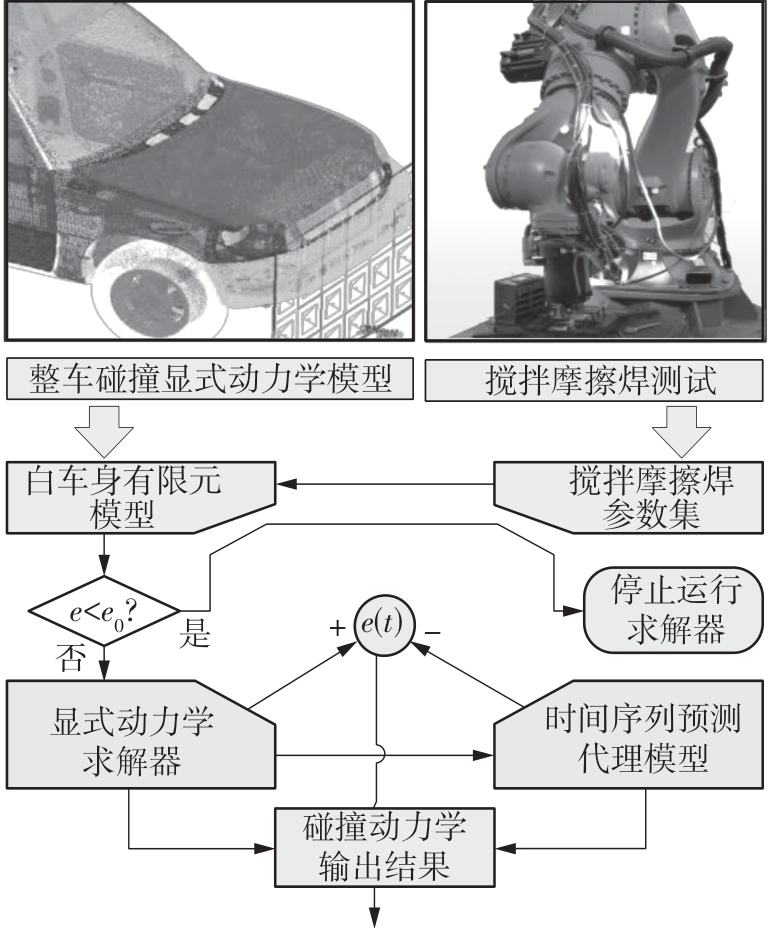
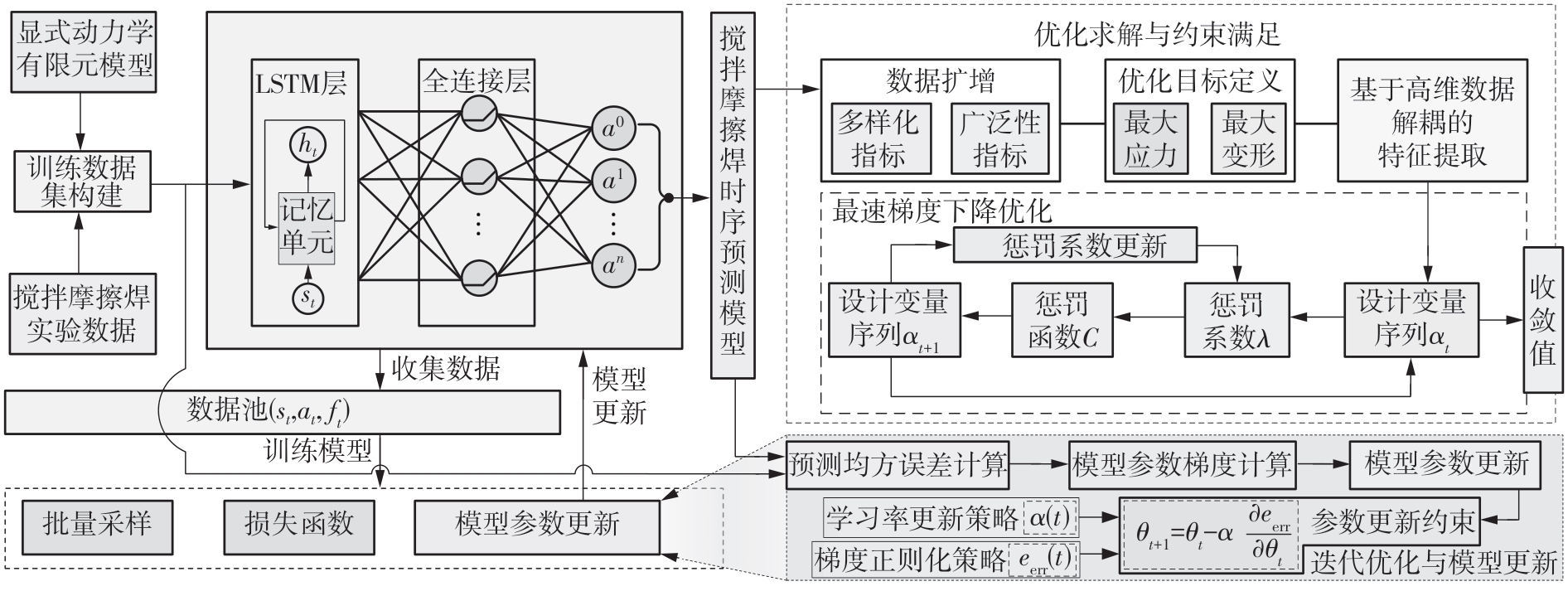
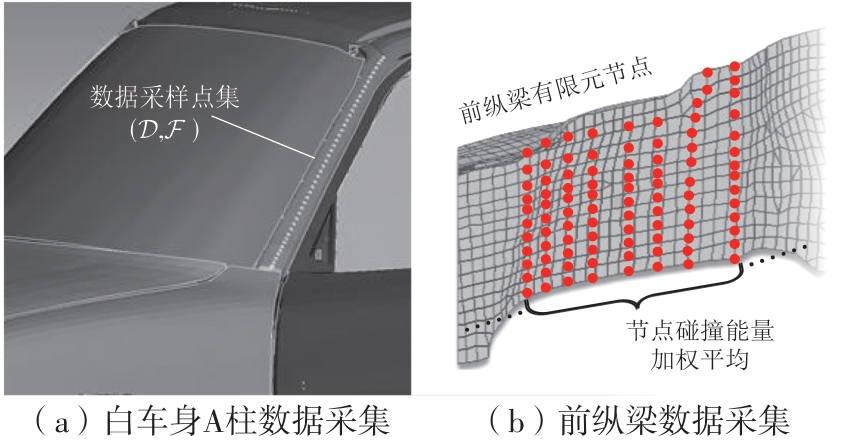
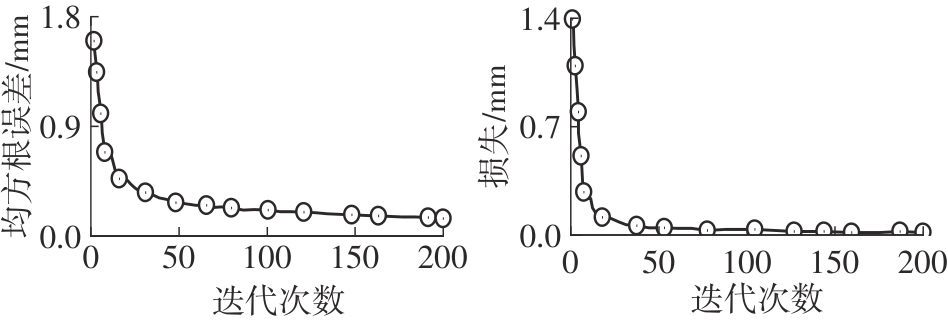
在汽车轻量化与高安全性需求下,搅拌摩擦焊成为了车身关键结构制造的核心技术,对提升碰撞能量吸收能力至关重要。但传统显式动力学模型优化搅拌摩擦焊工艺参数时,需大量重复有限元计算,存在计算耗时久、资源消耗大的问题,制约了设计效率。为此,该文提出基于搅拌摩擦焊工艺参数分析的整车碰撞时序预测方法,以兼顾优化效率与碰撞安全性。首先,归纳旋转速度、焊接速度与焊件弹性模量的映射关系,构建参数集;然后,以某白车身为对象,用混合壳单元离散白车身零部件集合,设定正碰工况,构建整车显式动力学模型;接着,设计时序预测代理模型,用显式动力学响应数据进行训练,结合高维数据解耦器与罚函数,面向观测点变形量与应变量的最小化目标,形成代理模型的更新流程。经迭代后,代理模型预测结果的均方根误差与损失趋近于零,精度可靠。相较于传统方法,所提出的方法节省了50%的计算时间。该方法实现了轻量化与高安全性的协同优化,为车身设计及搅拌摩擦焊工艺参数迭代提供了一种高效的技术手段,对缩短汽车研发周期、提升安全性能具有工程价值。

关键词: 车身设计, 车辆碰撞安全性, 搅拌摩擦焊, 工艺优化, 代理网络模型, 有限元法

Abstract:

Under the demands for vehicle lightweighting and high safety, friction stir welding has become the core technology for the manufacturing of key vehicle body structures, and it is crucial for the enhancement of collision energy absorption capacity. However, when the traditional explicit dynamic model is used to optimize the process pa-rameters of friction stir welding, a large number of repeated finite element calculations are required, thus leading to such problems as long calculation time and high resource consumption, which restricts the design efficiency. To solve these problems, this paper proposes a time series prediction method of vehicle crash based on the process parameters analysis of friction stir welding, which balances the optimization efficiency and crash safety. During the investigation, first, the mapping relationships between rotational speed, welding speed and the elastic modulus of welded parts are summarized, and a parameter set is constructed. Next, by taking a body-in-white as the object, the set of body-in-white components with mixed shell elements is discretized and the frontal crash condition is set to establish a vehicle explicit dynamic model. Then, a time series prediction surrogate model is designed, and is trained with explicit dynamic response data, with the combination of a high-dimension data decoupler and a penalty function, thus finally forming a surrogate model update process toward the goal of minimizing the deformation and strain of observation points. After iteration, the root mean square error and loss of the surrogate model’s prediction results approach zero, which means that the model accuracy is reliable. In addition, compared with the traditional method, the proposed method saves 50% of the calculation time. This method achieves the collaborative optimization of lightweighting and high safety of vehicles, provides an efficient technical means for vehicle body design and the iteration of friction stir welding process parameters, and has engineering value for shortening the research and deve-lopment cycle and improving the safety performance of vehicles.

Key words: vehicle body design, vehicle impact safety, friction stir welding, process optimization, surrogate network model, finite element method

中图分类号: