华南理工大学学报(自然科学版) ›› 2025, Vol. 53 ›› Issue (7): 139-148.doi: 10.12141/j.issn.1000-565X.240353

• 土木建筑工程 • 上一篇    下一篇

复杂环境下复合材料薄柱壳结构的双稳态特性

吴耀鹏1,2, 杨泉1, 刘莹1   

  1. 1.西安建筑科技大学 土木工程学院,陕西 西安 710055
    2.西安建筑科技大学 结构工程与抗震教育部重点实验室,陕西 西安 710055
  • 收稿日期:2024-07-02 出版日期:2025-07-25 发布日期:2025-02-28
  • 作者简介:吴耀鹏(1979 —),男,博士,副教授,主要从事复合材料结构的力学性能研究。E-mail: wyp@xauat.edu.cn
  • 基金资助:
    陕西省自然科学基础研究计划项目(2023-JC-YB435)

Bistable Behaviors of Composite Thin Cylindrical Shell in Complex Environment

WU Yaopeng1,2, YANG Quan1, LIU Ying1   

  1. 1.School of Civil Engineering,Xi’an University of Architecture and Technology,Xi’an 710055,Shaanxi,China
    2.Key Lab of Structural Engineering and Earthquake Resistance of Ministry of Education (XAUAT),Xi’an University of Architecture and Technology,Xi’an 710055,Shaanxi,China
  • Received:2024-07-02 Online:2025-07-25 Published:2025-02-28
  • About author:吴耀鹏(1979 —),男,博士,副教授,主要从事复合材料结构的力学性能研究。E-mail: wyp@xauat.edu.cn
  • Supported by:
    the Natural Science Basic Research Project of Shaanxi Province(2023-JC-YB435)

摘要:

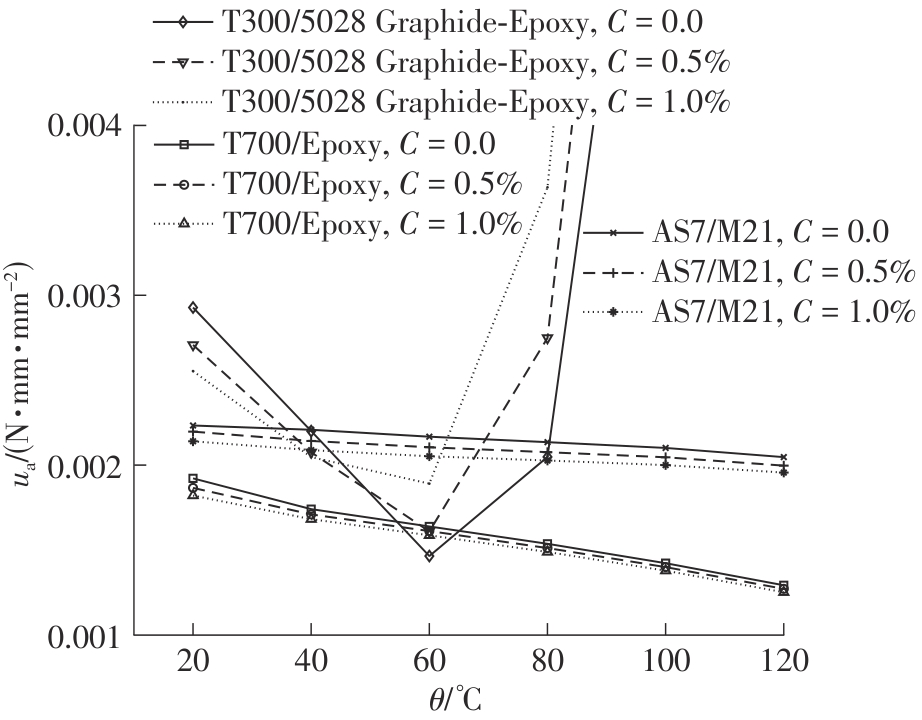
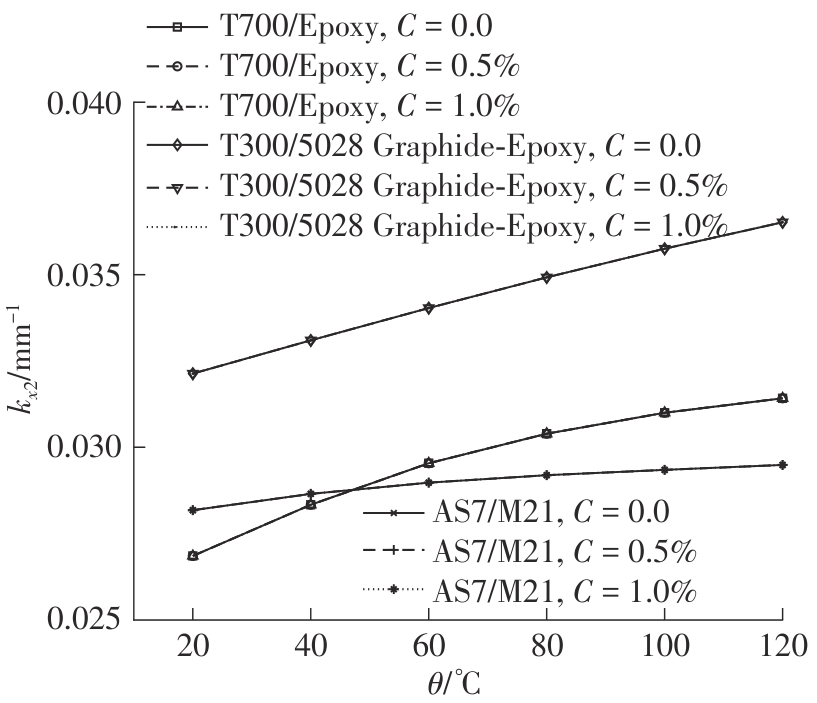
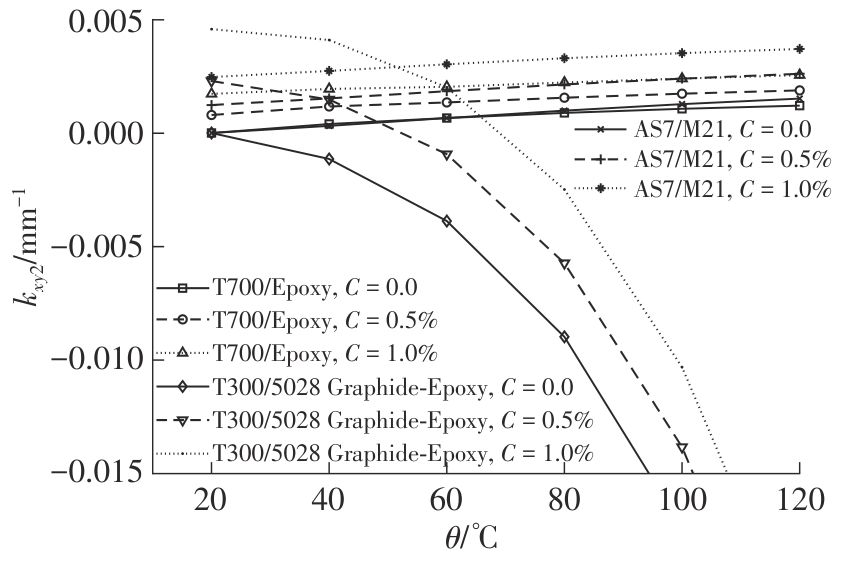
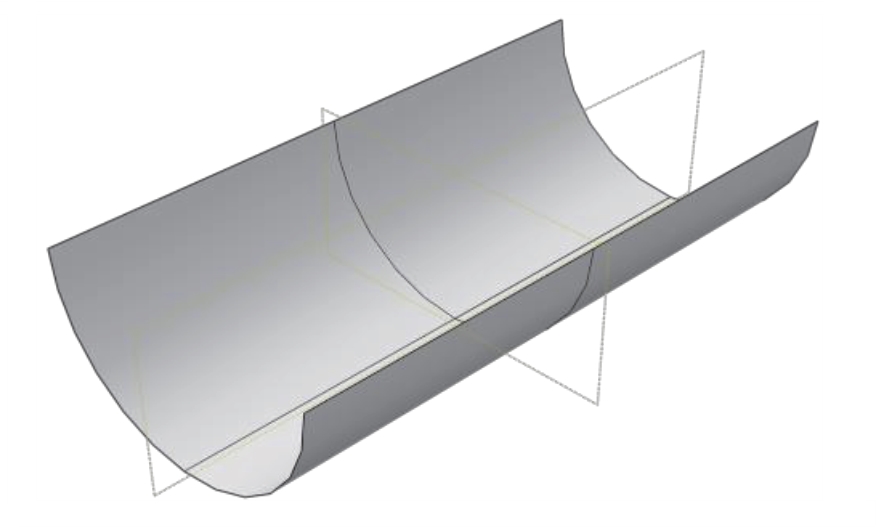
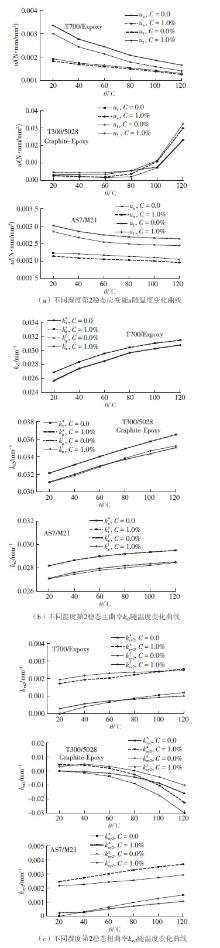
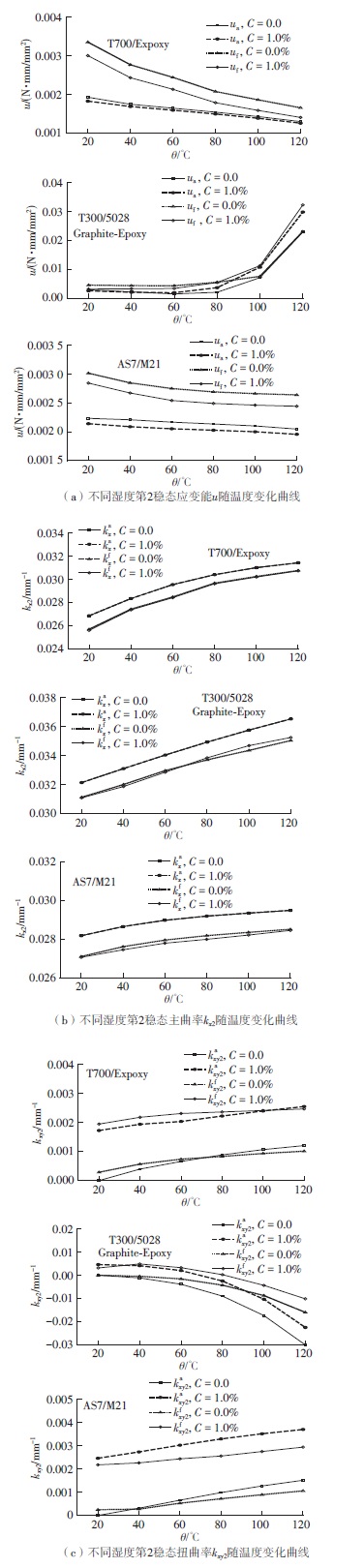
双稳态复合材料结构是一种新型可展开结构,广泛应用于多个领域。然而在复杂工作环境中,其材料性能可能发生变化,进而影响结构的双稳态特性。结合理论研究和数值研究,建立含热膨胀系数和湿膨胀系数的复合材料薄柱壳结构理论模型,推导复杂环境下薄柱壳应变能的解析表达式。基于最小势能原理,建立了温度和湿度影响的双稳态理论模型,研究预测环境参数对T700/Epoxy、T300/5028 Graphite-Epoxy和AS7/M21碳纤维/环氧树脂复合材料柱壳第2稳态应变能、主曲率和扭曲率的影响。采用ABAQUS软件建立柱壳结构的有限元模型,数值模拟柱壳的双稳态变形过程,得到不同温湿环境下第2稳态应变能、主曲率和扭曲率变化,并将数值结果与理论结果进行对比分析。结果表明:T700/Epoxy、AS7/M21在20~120 ℃以及0.0~1.0%湿度范围内,最大应变能分别最多减少32.7%和9.1%,T300/5028 Graphite-Epoxy柱壳的应变能最大增量为914.6%,T700/Epoxy与T300/5028 Graphite-Epoxy的主曲率对温度敏感性强,最大增量约为17%和14%,而AS7/M21变化不超过5%。在抗扭性能上,T700/Epoxy与T300/5028 Graphite-Epoxy在高温高湿下波动较大,AS7/M21则保持良好稳定性。结合理论研究和数值模拟,高温、高湿对复合材料结构的双稳态性能影响显著。通过定量分析不同温湿条件下复合材料的力学性能,可为双稳态结构的材料选择及应用环境优化提供科学依据,有助于提升结构设计的可靠性和耐久性。

关键词: 双稳态, 复合材料, 柱壳结构, 复杂环境, 曲率

Abstract:

Bistable composite structures are a novel type of deployable structure widely used across various fields. However, in complex service environments, changes in material properties may occur, which can in turn affect the bistable characteristics of the structure. By integrating theoretical and numerical studies, this study established a theoretical model of a composite cylindrical shell structure incorporating thermal and hygrothermal expansion coefficients. And it derived an analytical expression for the strain energy of the cylindrical shell under complex environmental conditions. Based on the principle of minimum potential energy, a bistable theoretical model considering the effects of temperature and humidity was developed. The influence of environmental parameters on the second stable-state strain energy, principal curvature, and twist curvature of cylindrical shells made from T700/Epoxy, T300/5028 Graphite-Epoxy, and AS7/M21 carbon fiber/epoxy composites was investigated. Using ABAQUS software, a finite element model of the cylindrical shell was built to numerically simulate the bistable deformation process, and the variations in second stable-state strain energy, principal curvature, and twist curvature under different temperature and humidity conditions were obtained. The numerical results were compared with the theoretical predictions. The results show that under temperature ranges of 20 ℃ to 120 ℃ and humidity levels from 0.0 to 1.0%, the maximum strain energy decreases by up to 32.7% and 9.1% for T700/Epoxy and AS7/M21, respectively, while the strain energy of T300/5028 Graphite-Epoxy increases by up to 914.6%. The principal curvatures of T700/Epoxy and T300/5028 Graphite-Epoxy show high sensitivity to temperature, with maximum increases of approximately 17% and 14%, respectively, whereas AS7/M21 exhibits variations of less than 5%. In terms of anti-twisting performance, T700/Epoxy and T300/5028 experience significant fluctuations under high temperature and humidity, while AS7/M21 maintains good stability. The combination of theoretical analysis and numerical simulation indicates that high temperature and humidity significantly affect the bistable performance of composite structures. By quantitatively analyzing the mechanical properties of composite materials under different temperature and humidity conditions, a scientific basis can be provided for material selection and environmental optimization of bistable structures, thereby contributing to improved reliability and durability in structural design.

Key words: bistable, composite, cylindrical shell structure, complex environment, curvature

中图分类号: