
Journal of South China University of Technology(Natural Science) >
Complex Scenario Construction Method for Navigation Pilot Based on Natural Driving Behaviour
Received date: 2024-07-01
Online published: 2024-09-29
Supported by
the National Key R & D Program of China(2022YFB2503404)
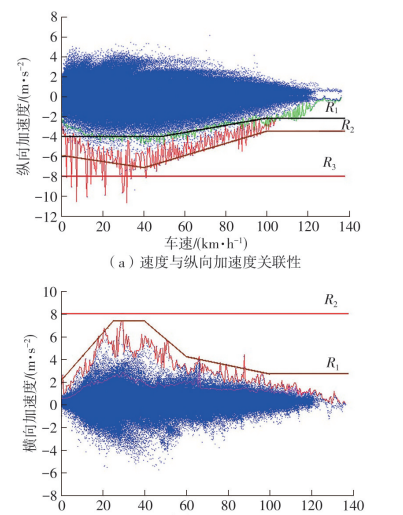
As the focus of research and development of intelligent connected vehicles, the test and evaluation of autonomous driving systems must focus on the real performance of vehicles in complex weather and complex traffic flow scenarios. This research proposed a method for constructing complex scenarios based on weather complexity and traffic complexity to meet the testing requirements of intelligent driving systems in challenging traffic environments. Using natural driving data from China’s large-scale field operational test project (China-FOT), the study analyzed vehicle dynamics parameters such as speed, longitudinal acceleration, lateral acceleration, and yaw rate. By fitting safety boundary envelopes, driving behavior risk levels were defined, and hazardous scenarios in natural driving were identified. These scenarios help clarify the fundamental scene types related to the functional safety of navigation-based intelligent driving. A traffic interaction coupling method, incorporating multiple dynamic target features, was applied to construct complex scenario types. The quantified natural weather factors were used to construct influence indicators, such as light factor, rainfall factor, fog factor, which are employed to characterize the weather complexity through the distribution of natural driving behavior characteristics. The complexity parameters, including encounter angle, relative distance, relative speed, were constructed using the Support Vector Machines and K-fold cross validation methods to characterize the traffic state of the complex scenarios. In order to ascertain the complexity of the test scenario, a closed field vehicle test was conducted, during which the real test performance evaluation parameters were employed to verify the rationality of the complex scenario construction. This research indicates the necessity to construct a test scenario that can accurately portray the real-world complex traffic environment for the navigation pilot driving functions. This will facilitate the optimization and iteration of the autonomous driving system of intelligent connected vehicles.
WU Biao , REN Hongze , ZHENG Lianqing , ZHU Xichan , MA Zhixiong . Complex Scenario Construction Method for Navigation Pilot Based on Natural Driving Behaviour[J]. Journal of South China University of Technology(Natural Science), 2025 , 53(2) : 38 -47 . DOI: 10.12141/j.issn.1000-565X.240346
| 1 | 导航智能驾驶测评规程(2020版修订版): IVISTA SMNP TPR A0—2022 [S]. |
| 2 | Intelligent transport systems-Forward vehicle collision systems-Performance requirements and test procedures: [S]. |
| 3 | Intelligent transport systems-Lane departure warning systems-Performance requirements and test procedures: [S]. |
| 4 | Intelligent transport systems-Adaptive cruise control systems-Performance requirements and test procedures: [S]. |
| 5 | Uniform provisions concerning the approval of vehicles with regard to automated lane keeping systems:UN ECE R157—2021 [S]. |
| 6 | RIEDMAIE S, PONN T, LUDWIG D,et al .Survey on scenario-based safety assessment of automated vehicles[J].IEEE Access,2020,8(4):87456-87477. |
| 7 | HAUER F, SCHMIDT T, HOLZMüLLER B,et al .Did we test all scenarios for automated and autonomous driving systems?[C]?∥ Proceeding of the 2019 IEEE Intelligent Transportation Systems Conference (ITSC).[S.l.]: IEEE,2019:2950-2955. |
| 8 | DUAN J, GAO F, HE Y,et al .Test scenario generation and optimization technology for intelligent driving systems[J].IEEE Intelligent Transportation Systems Magazine,2020,14(1):115-127. |
| 9 | GELDER E,HOF J, CATOR E,et al .Scenario para-meter generation method and scenario representativeness metric for scenario-based assessment of automated vehicles[J].IEEE Transactions on Intelligent Transportation Systems,2022,23(10):18794-18807. |
| 10 | 陈吉清,舒孝雄,兰凤崇,等 .典型危险事故特征的自动驾驶测试场景构建[J].华南理工大学学报(自然科学版),2021,49(5):1-8. |
| CHEN Jiqing, SHU Xiaoxiong, LAN Fengchong,et al .Construction of autonomous vehicles test scenarios with typical dangerous accident characteristics[J].Journal of South China University of Technology (Natural Science Edition),2021,49(5):1-8. | |
| 11 | INDAHENG F, KIM E, VISWANADHA K,et al .A scenario-based platform for testing autonomous vehicle behavior prediction models in simulation[J].arxiv preprint arxiv:2110.14870,2021. |
| 12 | STADLER C, MONTANARI F, BARON W,et al .A credibility assessment approach for scenario-based virtual testing of automated driving functions[J].IEEE Open Journal of Intelligent Transportation Systems,2022,3(2):45-60. |
| 13 | 李平飞,金思雨,胡文浩,等 .用于自动驾驶仿真测试的车——车事故场景复杂度评价[J].汽车安全与节能学报,2022,13(4):697-704. |
| LI Pingfei, JIN Siyu, HU Wenhao,et al .Complexity evaluation of vehicle-vehicle accident scenarios for autonomous driving simulation tests[J].Journal of Automotive Safety and Energy,2022,13(4):697-704. | |
| 14 | 董汉,舒伟,陈超,等 .危险驾驶工况场景的复杂度评估方法研究[J].汽车工程,2020,42(6):808-814. |
| DONG Han, SHU Wei, CHEN Chao,et al .Research on complexity evaluation method of dangerous driving scenes[J].Automotive Engineering,2020,42(6): 808-814. | |
| 15 | MA B, ZHANG Z, GUO G,et al .Study on influence factors of intelligent connected vehicle (ICV) performance under complex weather conditions[C]?∥ Proceeding of the 2020 E3S Web of Conferences.[S.l.]:EDP Sciences,2020,213:02024/924-927. |
| 16 | MA B, LI W, ZHANG Z,et al .Research on weather condition influence factors on intelligent connected vehicle[C]?∥ Proceeding of Journal of Physics:Confe-rence Series.[S.l.]:IOP Publishing,2020,1550(3):032021/122-125. |
| 17 | LEBLANC D J, SAYER J, WINKLER C,et al .Road departure crash warning system field operational test:methodology and results.volume 1:technical report[R].Ann Arbor:Transportation Research Institute,University of Michigan,2006. |
| 18 | DiINGUS T A, KLAUER S, NEALE V,et al .The 100-car naturalistic driving study:phase Ⅱ-results of the 100-car field experiment[R].Washington:National Highway Traffic Safety Administration(NHTSA),United States,2006. |
| 19 | BARNARD Y, KOSKINEN S, NNAMAA S,et al .Data management and data sharing in field operational tests[C]?∥ Proceeding of 2016 Intelligent Transportation Systems.New York:CRC Press,2016:69-82. |
| 20 | HANOWSKI R J, NAKATA A, OLSON R L .Metho-dological overview of the drowsy driver warning system field operational test[J].SAE Transactions,2004,4(5):610-615. |
| 21 | OLSON R L, HANOWSKI R J, HICKMAN J S,et al .Driver distraction in commercial vehicle operations[R].Washington:Department of Transportation,Federal Motor Carrier Safety Administration,United States,2009. |
| 22 | ANTIN J, LEE S, HANKEY J,et al .Design of the in-vehicle driving behavior and crash risk study:in support of the SHRP 2 naturalistic driving study[R].Washington:Transportation Research Board of the National Academies,United States,2011. |
| 23 | ZHANG X, TAO J, TAN K,et al . Finding critical scenarios for automated driving systems:a systematic literature review[J].arXiv Preprint arXiv:2110.08664,2021. |
| 24 | 降水量等级: [S]. |
| 25 | 雾天公路通行条件预警分级: [S]. |
| 26 | YIM J B, PARK D J .Modeling evasive action to be implemented at the minimum distance for collision avoi-dance in a give-way situation[J].Ocean Engineering,2022,263:112-210. |
| 27 | ANAND K, BIANCONI G .Entropy measures for networks:toward an information theory of complex topologies[J].Physical Review E—Statistical,Nonlinear,and Soft Matter Physics,2009,80(4):45-102. |
/
| 〈 |
|
〉 |