Journal of South China University of Technology(Natural Science Edition) ›› 2025, Vol. 53 ›› Issue (12): 94-106.doi: 10.12141/j.issn.1000-565X.240596
Previous Articles Next Articles
Lateral Resistance of Multi-Storey Steel Frame with Sparse Chevron Bracings
HE Liang1, XU Zhaoyu2, SHEN Wenjie1, TONG Genshu3, LIU Zhixin1, ZHANG Lei3
- 1.Anhui Architectural Design and Research Institute Co. ,Ltd. ,Heifei 230000,Anhui,China
2.Nanxun Innovation Institute,Zhejiang University of Water Resources and Electric Power,Hangzhou 310018,Zhejiang,China
3.Institute of Advanced Engineering Structures,Zhejiang University,Hangzhou 310058,Zhejiang,China
-
Received:2024-12-25Online:2025-12-25Published:2025-07-01 -
Contact:许照宇(1993—),男,博士,讲师,主要从事钢结构稳定理论研究。 E-mail:xuzhaoyu@zju.edu.cn -
About author:何亮(1979—),男,正高级工程师,主要从事钢结构设计研究。E-mail: 5996928@qq.com -
Supported by:the Key Program of the Natural Science Foundation of Zhejiang Province(LZ22E080004)

CLC Number:
Cite this article
HE Liang, XU Zhaoyu, SHEN Wenjie, TONG Genshu, LIU Zhixin, ZHANG Lei. Lateral Resistance of Multi-Storey Steel Frame with Sparse Chevron Bracings[J]. Journal of South China University of Technology(Natural Science Edition), 2025, 53(12): 94-106.
share this article
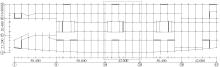
Fig.1
Standard floor plan of CXMT R&D building (Unit: m)"
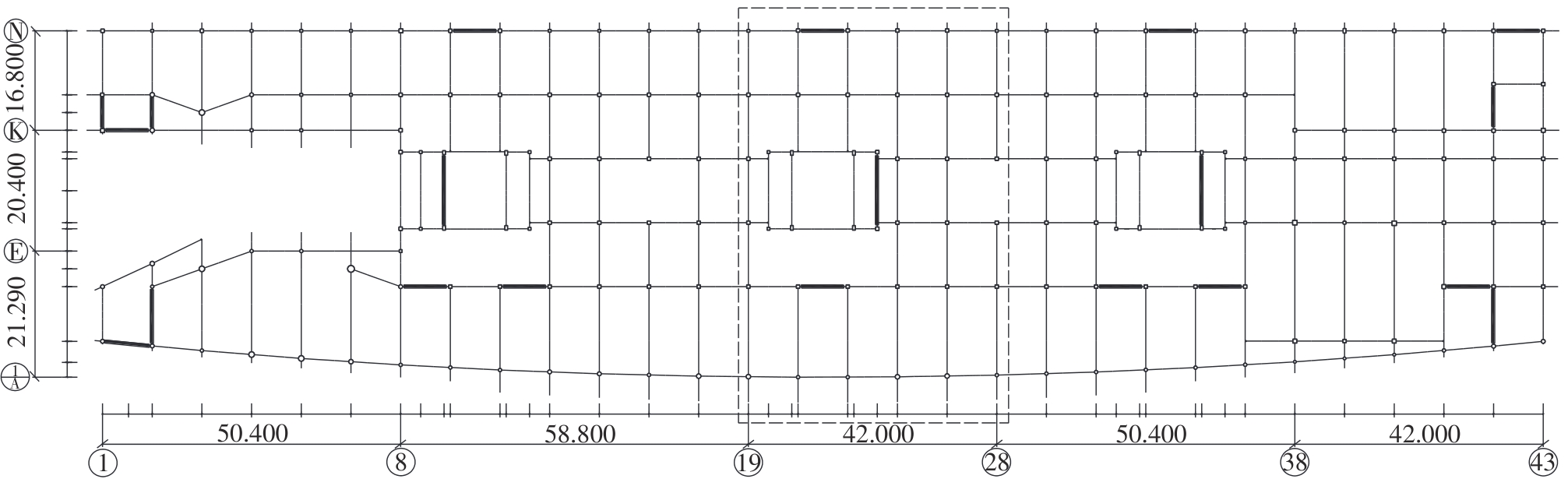
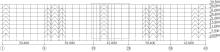
Fig.2
Elevation of CXMT R&D building (Unit: m)"
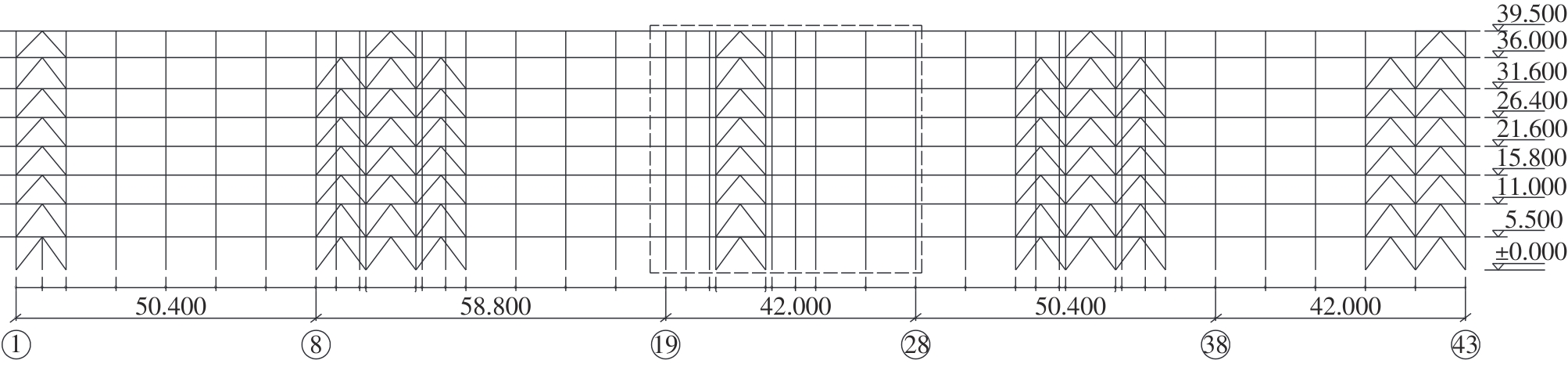
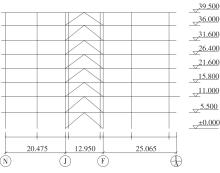
Fig.3
Section at gridlines 19-28 of CXMT R&D building(Unit: m)"
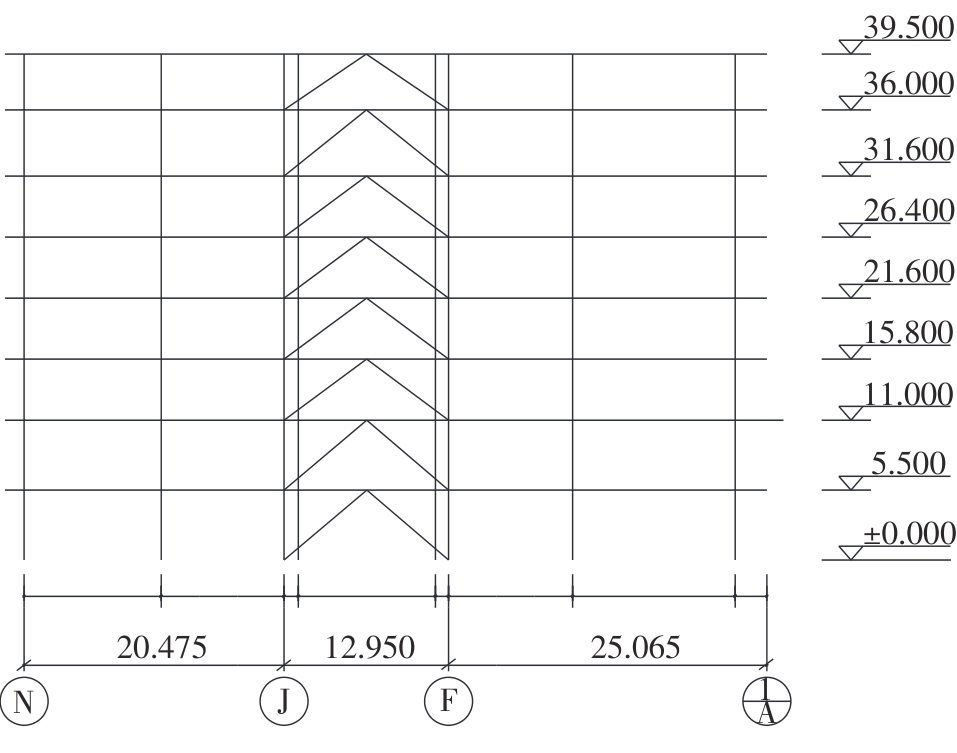

Fig.4
Front view of frame-bracing model"


Fig.5
Front view of frame model"


Table 1
Results of modal and buckling analyses"
| 结构类型 | 周期/s | 频率 | 振型 | 屈曲 因子 | 屈曲模态 |
|---|---|---|---|---|---|
| 框架-人字撑 | 2.01 | 0.50 | 横向 | 18.81 | 横向 |
| 1.71 | 0.58 | 纵向 | 26.42 | 纵向和少量扭转 | |
| 纯框架 | 3.20 | 0.31 | 横向 | 6.84 | 横向 |
| 2.79 | 0.36 | 纵向 | 9.28 | 纵向 |
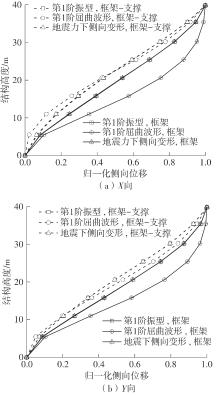
Fig.6
Comparison of structural biaxial modal shapes and buckling modes"
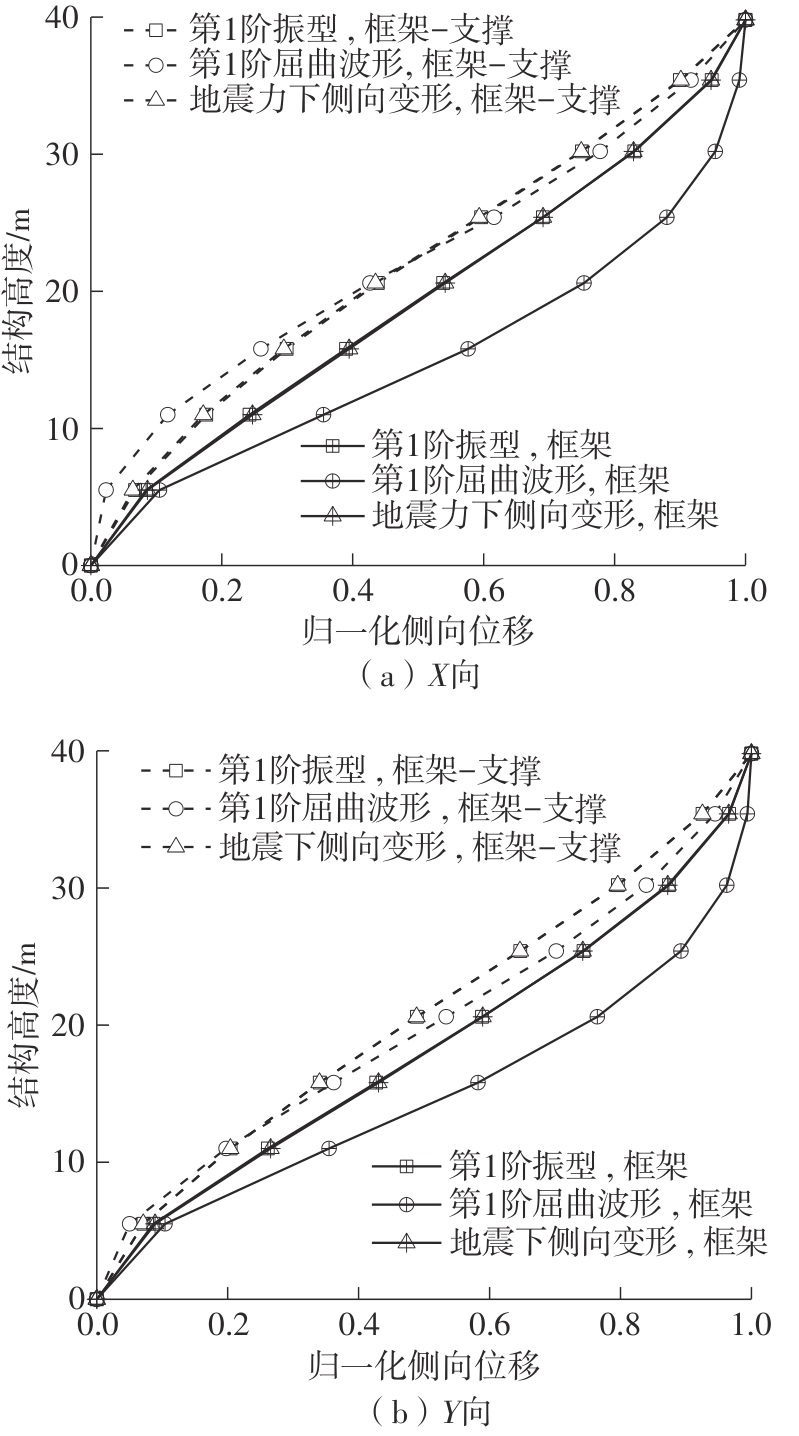
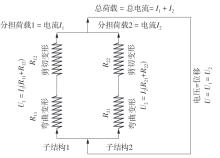
Fig.7
Series-parallel model of multi-lateral loads resistance structure"
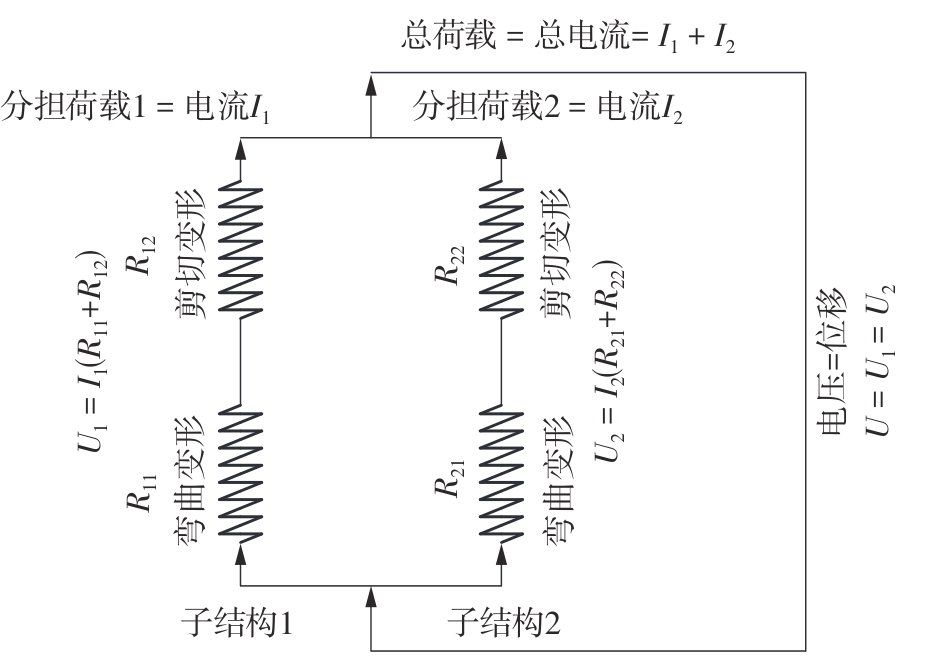
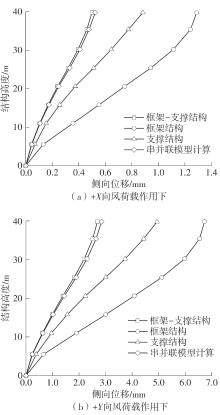
Fig.8
Lateral displacement of structure under wind loads"
Table 2
Comparison of lateral displacement of structure under wind loads"
| 高度/m | 真实值(+X)/mm | 理论值(+X)/mm | 比值(+X) | 真实值(+Y)/mm | 理论值(+Y)/mm | 比值(+Y) |
|---|---|---|---|---|---|---|
| 5.5 | 0.04 | 0.05 | 1.061 | 0.23 | 0.24 | 1.057 |
| 11.0 | 0.11 | 0.11 | 1.024 | 0.62 | 0.64 | 1.027 |
| 20.6 | 0.17 | 0.17 | 1.035 | 0.99 | 1.03 | 1.035 |
| 25.4 | 0.24 | 0.25 | 1.036 | 1.39 | 1.45 | 1.042 |
| 30.2 | 0.32 | 0.33 | 1.037 | 1.81 | 1.89 | 1.045 |
| 35.4 | 0.39 | 0.41 | 1.036 | 2.20 | 2.30 | 1.046 |
| 39.8 | 0.46 | 0.48 | 1.035 | 2.52 | 2.65 | 1.051 |
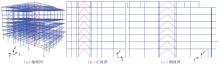
Fig.9
Model of multi-storey frame with chevron bracings"
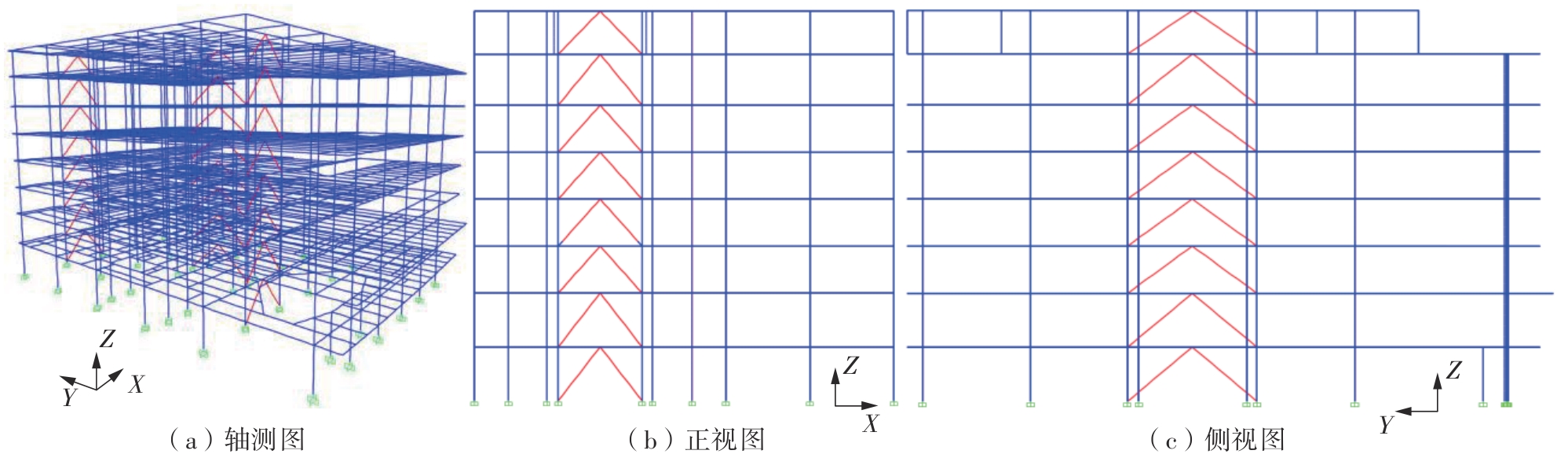
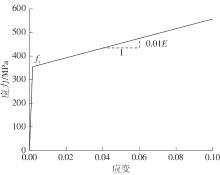
Fig.10
Bilinear constitutive relationship of steel"
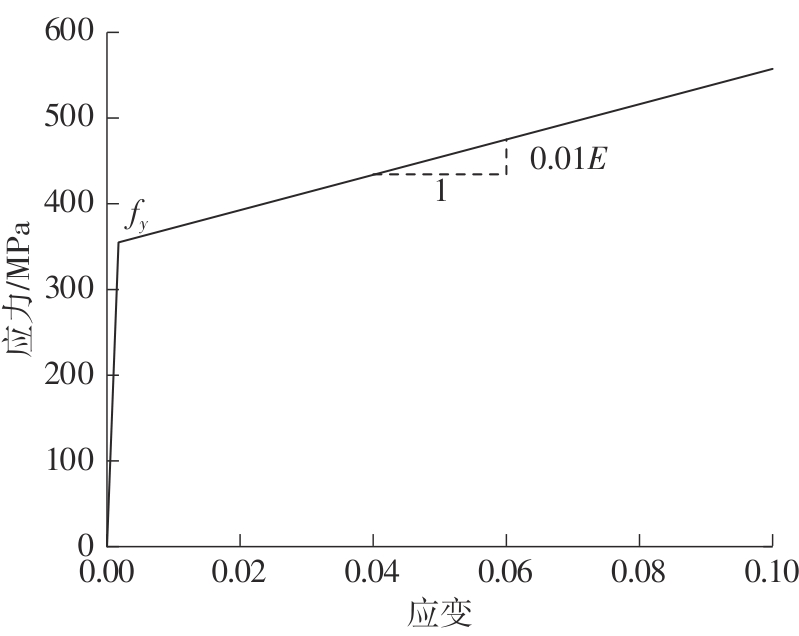
Table 3
Design parameters of chevron bracings and beams (Span 8.40 m in X direction and 12.95 m in Y direction)"
| 楼层 | 层高/m | X向 | Y向 | ||||||||||
|---|---|---|---|---|---|---|---|---|---|---|---|---|---|
支撑截面 h×b×tw×tf /(mm×mm×mm×mm) | λt | λy(1.0) | λy(0.7) | 横梁截面 h′×b′×t′w×t′f /(mm×mm×mm×mm) | Rb | 支撑截面 h×b×tw×tf /(mm×mm×mm×mm) | λt | λy (1.0) | λy (0.7) | 横梁截面 h′×b′×t′w×t′f /(mm×mm×mm×mm) | Rb | ||
| 1 | 5.5 | 400×400×18×40 | 39.9 | 65.1 | 45.6 | 800×400×14×24 | 0.33 | 380×380×18×40 | 51.3 | 85.7 | 60.0 | 800×400×14×24 | 0.31 |
| 2 | 5.5 | 400×400×18×40 | 39.9 | 65.1 | 45.6 | 800×400×14×24 | 0.33 | 380×380×18×40 | 51.3 | 85.7 | 60.0 | 800×400×14×24 | 0.31 |
| 3 | 4.8 | 350×350×15×25 | 50.6 | 70.8 | 49.6 | 800×400×14×24 | 0.60 | 350×350×15×25 | 55.3 | 89.5 | 62.6 | 800×400×14×24 | 0.43 |
| 4 | 4.8 | 350×350×15×25 | 50.6 | 70.8 | 49.6 | 800×400×14×24 | 0.60 | 350×350×15×25 | 55.3 | 89.5 | 62.6 | 800×400×14×24 | 0.43 |
| 5 | 4.8 | 330×330×15×22 | 53.6 | 76.2 | 53.3 | 600×350×14×18 | 0.34 | 330×330×15×22 | 58.4 | 95.8 | 67.1 | 600×350×14×18 | 0.22 |
| 6 | 4.8 | 330×330×15×22 | 53.6 | 76.2 | 53.3 | 600×350×14×18 | 0.34 | 330×330×15×22 | 58.4 | 95.8 | 67.1 | 600×350×14×18 | 0.22 |
| 7 | 5.2 | 350×350×15×25 | 51.6 | 74.2 | 51.9 | 600×400×12×30 | 0.47 | 350×350×15×25 | 55.8 | 91.7 | 64.2 | 600×350×14×18 | 0.18 |
| 8 | 4.4 | 280×280×15×18 | 56.2 | 87.8 | 61.4 | 600×350×14×18 | 0.35 | 330×330×15×22 | 57.9 | 93.0 | 65.1 | 600×350×14×18 | 0.24 |
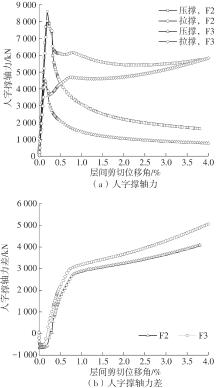
Fig.11
Variation of axial forces and axial force differences of X-direction chevron bracing with inter-story drift angle"
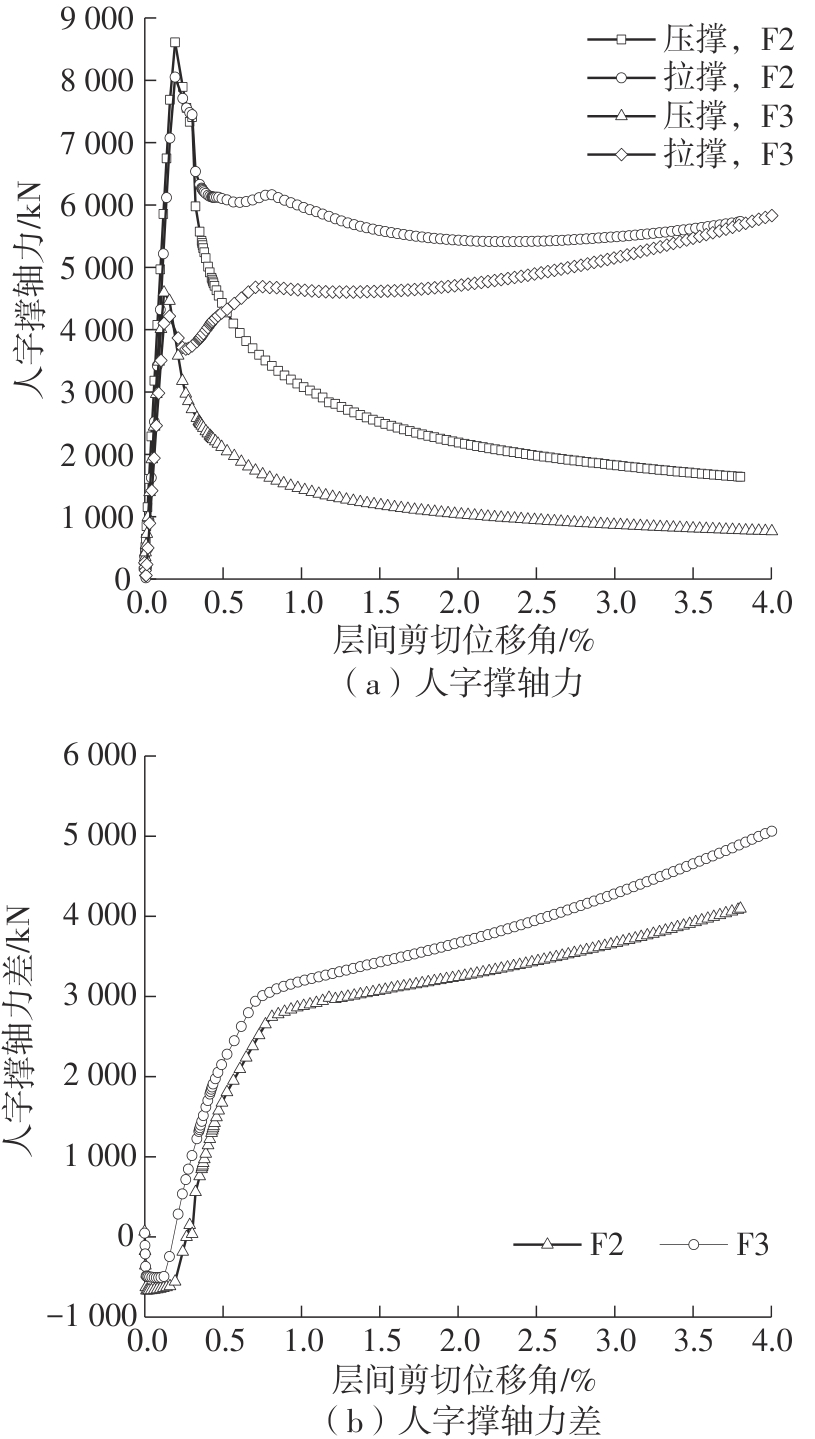
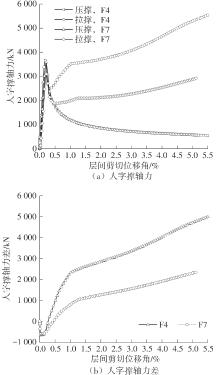
Fig.12
Variation of axial forces and axial force differences of Y-direction chevron bracing with inter-story drift angle"
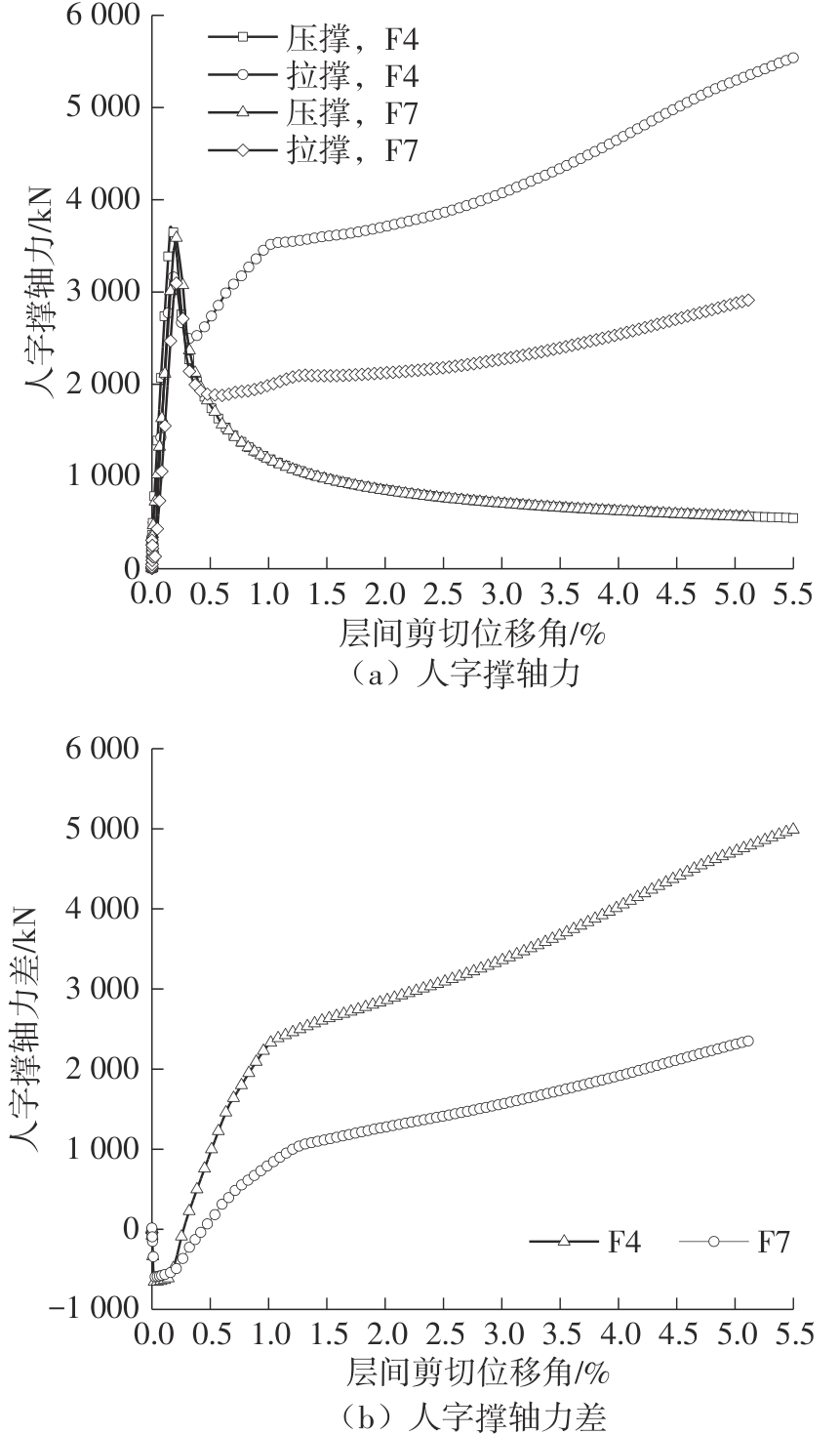
Fig.13
Schematic diagram of shear and bending drift angles"
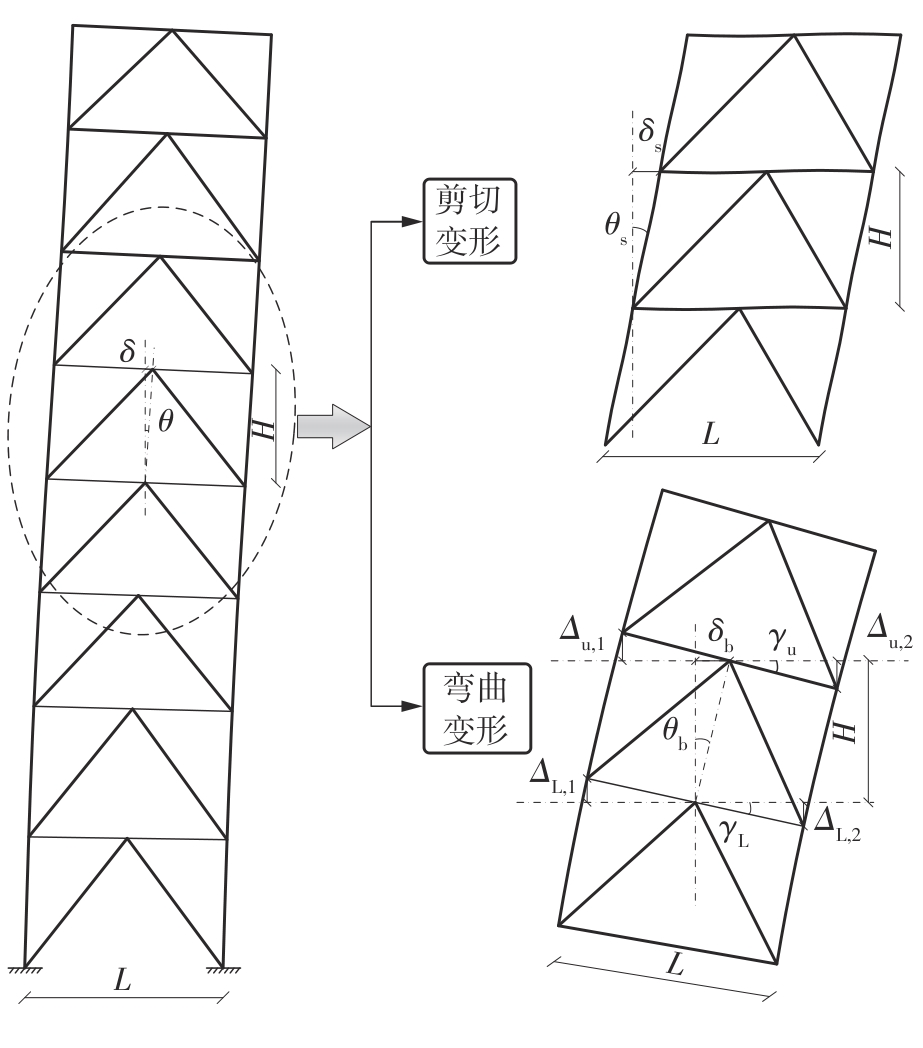
Table 4
Unbalanced vertical force Funb at the horizontal beam after the buckling of chevron bracing (X direction)"
X向 楼层 | θs=1.00% | θs=1.50% | θs=2.00% | ||||||||||||
|---|---|---|---|---|---|---|---|---|---|---|---|---|---|---|---|
| Funb/kN | 比值(规范与有限元) | 比值(式(9)与有限元) | Funb/kN | 比值(规范与有限元) | 比值(式(9)与有限元) | Funb/kN | 比值(规范与有限元) | 比值(式(9)与有限元) | |||||||
| 有限元 | 规范 | 式(9) | 有限元 | 规范 | 式(9) | 有限元 | 规范 | 式(9) | |||||||
| 1 | 2 187 | 8 486 | 2 449 | 3.9 | 1.12 | 2 258 | 8 702 | 2 449 | 3.9 | 1.08 | 2 354 | 8 826 | 2 449 | 3.7 | 1.04 |
| 2 | 2 285 | 8 486 | 2 444 | 3.7 | 1.07 | 2 441 | 8 702 | 2 447 | 3.6 | 1.00 | 2 577 | 8 826 | 2 447 | 3.4 | 0.95 |
| 3 | 2 402 | 4 747 | 2 454 | 2.0 | 1.02 | 2 580 | 4 856 | 2 445 | 1.9 | 0.95 | 2 761 | 4 920 | 2 445 | 1.8 | 0.89 |
| 4 | 2 255 | 4 747 | 2 453 | 2.1 | 1.09 | 2 433 | 4 856 | 2 442 | 2.0 | 1.00 | 2 578 | 4 920 | 2 442 | 1.9 | 0.95 |
| 5 | 1 122 | 4 112 | 1 234 | 3.7 | 1.10 | 1 227 | 4 200 | 1 218 | 3.4 | 0.99 | 1 309 | 4 250 | 1 218 | 3.2 | 0.93 |
| 6 | 1 130 | 4 112 | 1 234 | 3.6 | 1.09 | 1 244 | 4 200 | 1 216 | 3.4 | 0.98 | 1 336 | 4 250 | 1 216 | 3.2 | 0.91 |
| 7 | 1 475 | 4 949 | 2 002 | 3.4 | 1.36 | 1 906 | 5058 | 1 985 | 2.7 | 1.04 | 2 079 | 5 121 | 1 985 | 2.5 | 0.95 |
Table 5
Unbalanced vertical force Funb at the horizontal beam after the buckling of chevron bracing (Y direction)"
Y向 楼层 | θs=1.00% | θs=1.50% | θs=2.00% | ||||||||||||
|---|---|---|---|---|---|---|---|---|---|---|---|---|---|---|---|
| Funb/kN | 比值(规范与有限元) | 比值(式(9)与有限元) | Funb/kN | 比值(规范与有限元) | 比值(式(9)与有限元) | Funb/kN | 比值(规范与有限元) | 比值(式(9)与有限元) | |||||||
| 有限元 | 规范 | 式(9) | 有限元 | 规范 | 式(9) | 有限元 | 规范 | 式(9) | |||||||
| 1 | 1 249 | 5 372 | 1 476 | 4.3 | 1.18 | 1 364 | 5 469 | 1 563 | 4.0 | 1.15 | 1 435 | 5 526 | 1 563 | 3.9 | 1.09 |
| 2 | 1 375 | 5 372 | 1 473 | 3.9 | 1.07 | 1 534 | 5 469 | 1 559 | 3.6 | 1.02 | 1 654 | 5 526 | 1 559 | 3.3 | 0.94 |
| 3 | 1 448 | 3 930 | 1 475 | 2.7 | 1.02 | 1 623 | 3 996 | 1 556 | 2.5 | 0.96 | 1 781 | 4 035 | 1 556 | 2.3 | 0.87 |
| 4 | 1 371 | 3 930 | 1 475 | 2.9 | 1.08 | 1 564 | 3 996 | 1 552 | 2.6 | 0.99 | 1 700 | 4 035 | 1 552 | 2.4 | 0.91 |
| 5 | 538 | 3 420 | 688 | 6.4 | 1.28 | 699 | 3 472 | 756 | 5.0 | 1.08 | 785 | 3 502 | 756 | 4.5 | 0.96 |
| 6 | 554 | 3 420 | 688 | 6.2 | 1.24 | 718 | 3 472 | 753 | 4.8 | 1.05 | 809 | 3 502 | 753 | 4.3 | 0.93 |
| 7 | 504 | 4 172 | 686 | 8.3 | 1.36 | 706 | 4 240 | 749 | 6.0 | 1.06 | 803 | 4 280 | 749 | 5.3 | 0.93 |
Fig.14
Development of base shear forces in X and Y directions with storey drift angles"
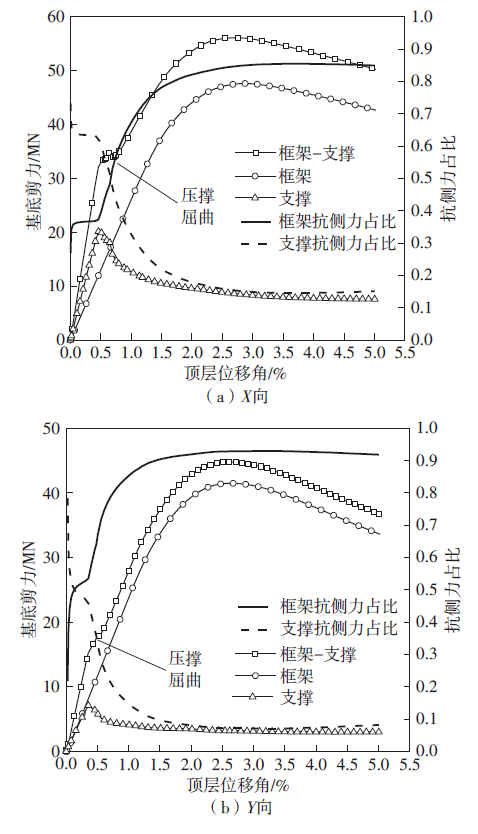
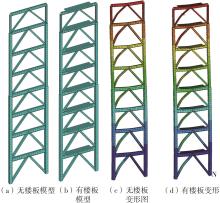
Fig.15
Finite element model of single bay"
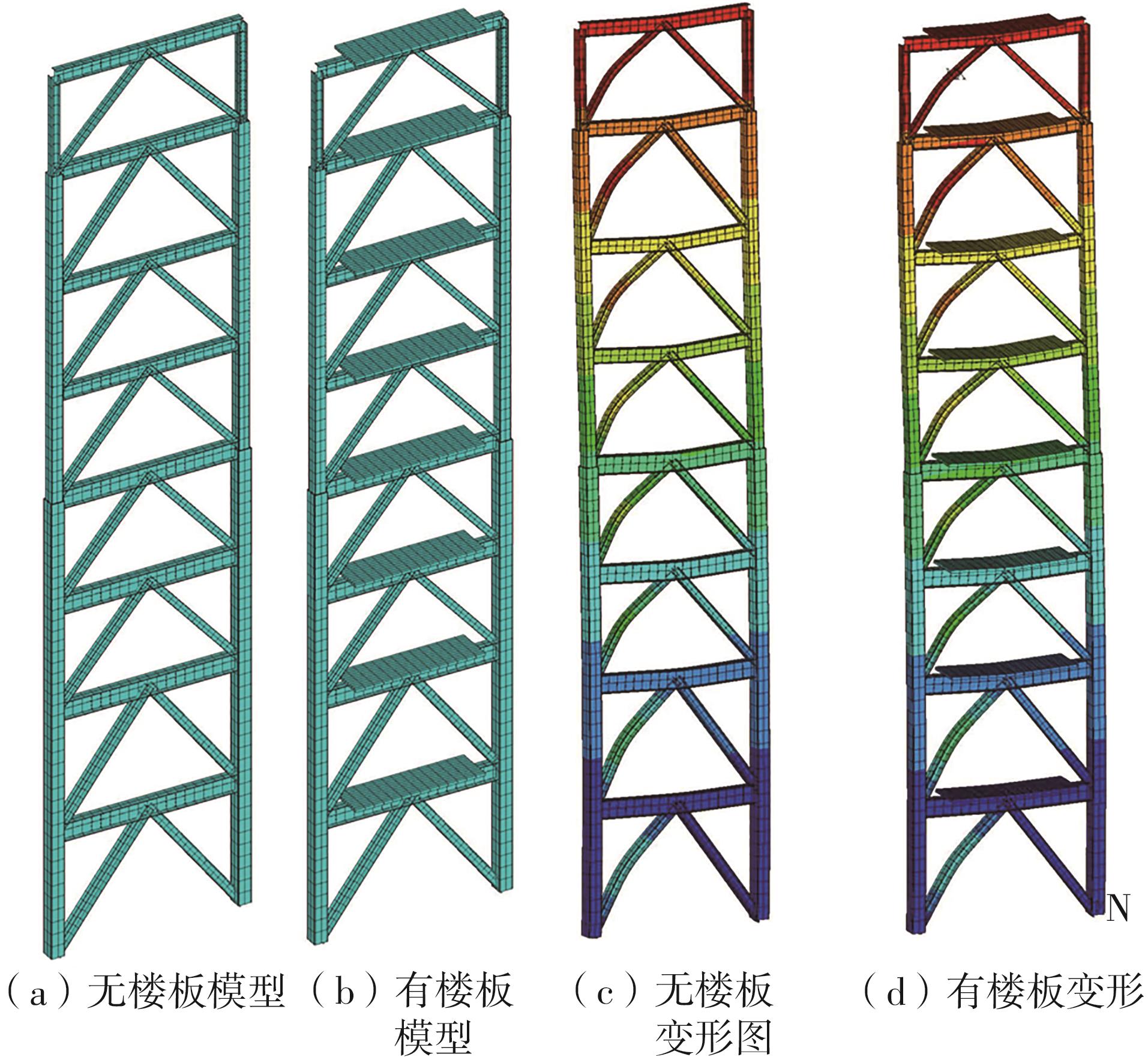
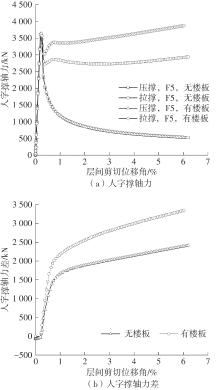
Fig.16
Comparison of internal forces of braces in the X-direction single-frame chevron bracing model"
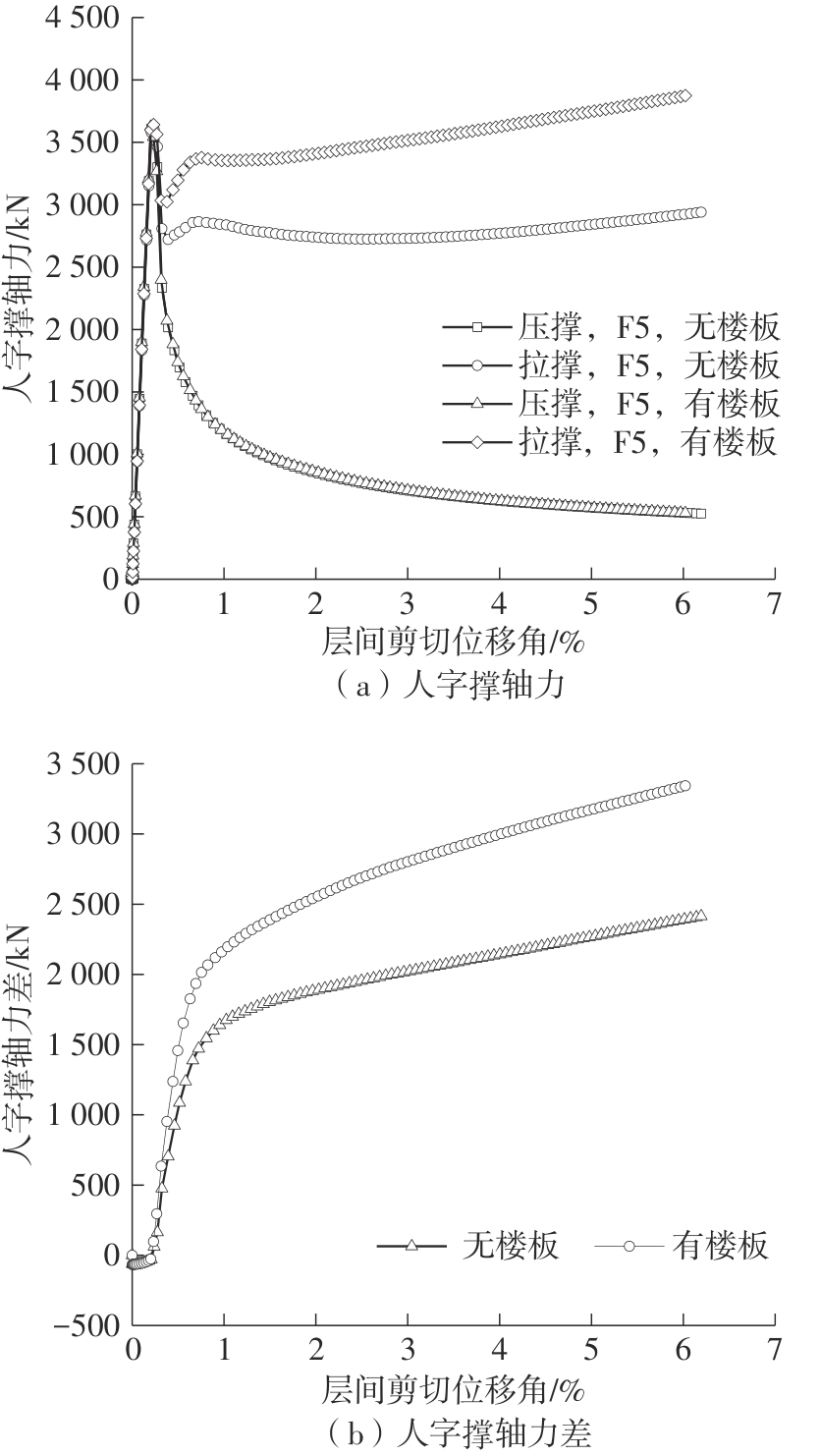
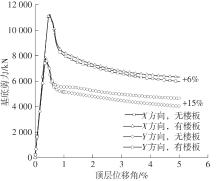
Fig.17
Comparison of base shear force variation with storey drift angle"
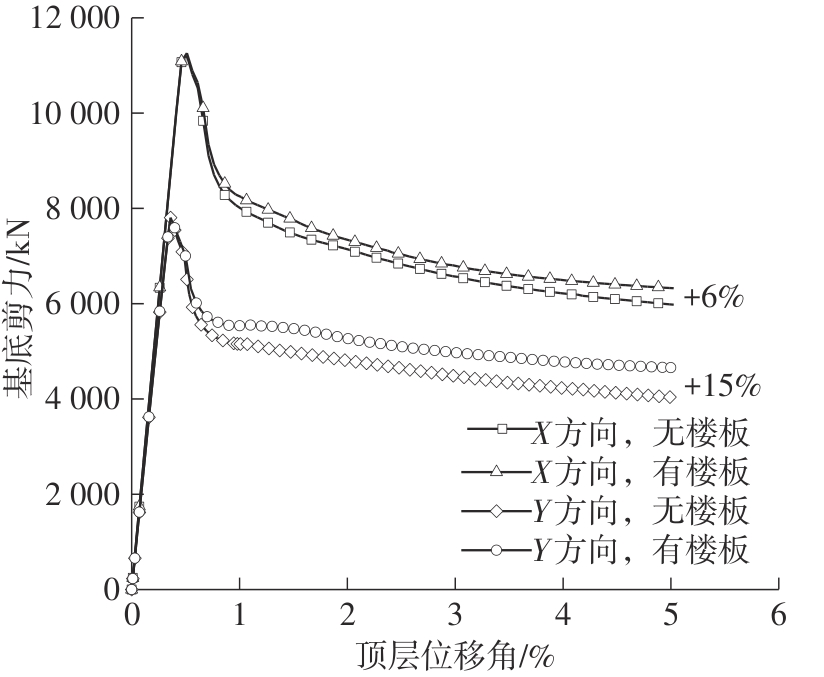
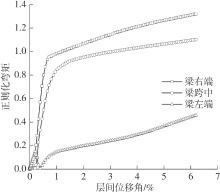
Fig.18
Relationship between bending moment of F5 steel beem and storey drift angle"
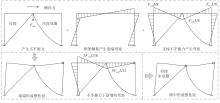
Fig.19
Failure mechanism and bending moment composition of insufficiently strengthened horizontal beam in rigid frame-chevron bracing structures"
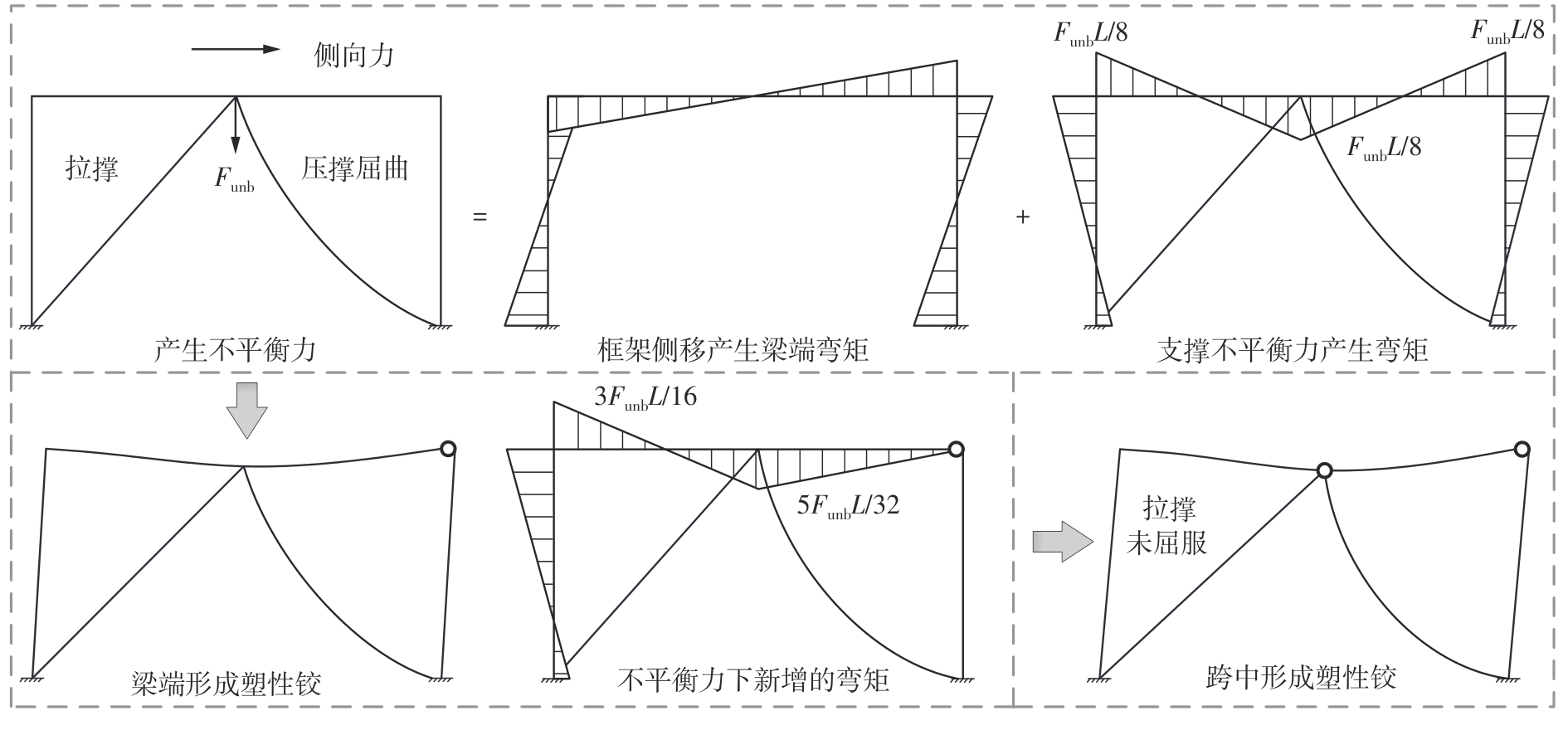
Table 6
Axial tensile force in chevron bracings with inadequately strengthened beams (without concrete slab)"
X向 楼层 | θs =1.00% | θs = 2.00% | Y向 楼层 | θs = 1.00% | θs = 2.00% | ||||||||||
|---|---|---|---|---|---|---|---|---|---|---|---|---|---|---|---|
| Nt/kN | 比值(式(8)与有限元) | Nt/kN | 比值(式(8)与有限元) | Nt /kN | 比值(式(8)与有限元) | Nt/kN | 比值(式(8)与有限元) | ||||||||
| 有限元 | 式(8) | 有限元 | 式(8) | 有限元 | 式(8) | 有限元 | 式(8) | ||||||||
| 1 | 5 809 | 5 445 | 0.94 | 5 174 | 5 018 | 0.97 | 1 | 3 286 | 3 607 | 1.10 | 2 966 | 3 503 | 1.18 | ||
| 2 | 5 969 | 5 439 | 0.91 | 5 401 | 5 015 | 0.93 | 2 | 3 517 | 3 602 | 1.02 | 3 358 | 3 498 | 1.04 | ||
| 3 | 4 508 | 4 543 | 1.01 | 4 585 | 4 301 | 0.94 | 3 | 3 381 | 3 469 | 1.03 | 3 454 | 3 426 | 0.99 | ||
| 4 | 4 747 | 4 542 | 0.96 | 4 663 | 4 298 | 0.92 | 4 | 3 442 | 3 469 | 1.01 | 3 475 | 3 420 | 0.98 | ||
| 5 | 2 843 | 2 662 | 0.94 | 2 741 | 2 457 | 0.90 | 5 | 1 880 | 1 922 | 1.02 | 1 875 | 1 897 | 1.01 | ||
| 6 | 2 774 | 2 662 | 0.96 | 2 679 | 2 454 | 0.92 | 6 | 1 889 | 1 922 | 1.02 | 1 927 | 1 891 | 0.98 | ||
| 7 | 3 682 | 3 801 | 1.03 | 3 955 | 3 560 | 0.90 | 7 | 2 049 | 2 049 | 1.00 | 2 046 | 1 978 | 0.97 | ||
Table 7
Axial tensile force in chevron bracings with inadequately strengthened beams (with concrete slab)"
X向 楼层 | θs =1.00% | θs =2.00% | Y向 楼层 | θs =1.00% | θs =2.00% | ||||||||||
|---|---|---|---|---|---|---|---|---|---|---|---|---|---|---|---|
| Nt/kN | 比值(式(8)与有限元) | Nt/kN | 比值(式(8)与有限元) | Nt/kN | 比值(式(8)与有限元) | Nt/kN | 比值(式(8)与有限元) | ||||||||
| 有限元 | 式(8) | 有限元 | 式(8) | 有限元 | 式(8) | 有限元 | 式(8) | ||||||||
| 1 | 6 515 | 6 440 | 0.99 | 6 170 | 6 013 | 0.97 | 1 | 3 999 | 4 495 | 1.12 | 3 849 | 4 392 | 1.14 | ||
| 2 | 6 799 | 6 434 | 0.95 | 6 414 | 6 010 | 0.94 | 2 | 4 239 | 4 491 | 1.06 | 4 158 | 4 387 | 1.05 | ||
| 3 | 5 412 | 5 594 | 1.03 | 5 724 | 5 352 | 0.94 | 3 | 4 182 | 4 435 | 1.06 | 4 391 | 4 392 | 1.00 | ||
| 4 | 5 605 | 5 593 | 1.00 | 5 807 | 5 349 | 0.92 | 4 | 4 250 | 4 435 | 1.04 | 4 401 | 4 387 | 1.00 | ||
| 5 | 3 356 | 3 380 | 1.01 | 3 404 | 3 176 | 0.93 | 5 | 2 425 | 2 609 | 1.08 | 2 454 | 2 584 | 1.05 | ||
| 6 | 3 263 | 3 380 | 1.04 | 3 291 | 3 173 | 0.96 | 6 | 2 339 | 2 609 | 1.12 | 2 439 | 2 578 | 1.06 | ||
| 7 | 4 365 | 4 579 | 1.05 | 4 584 | 4 337 | 0.95 | 7 | 2 455 | 2 703 | 1.10 | 2 465 | 2 632 | 1.07 | ||
| [1] | RAI D C, GOEL S C .Seismic evaluation and upgrading of chevron braced frames[J].Journal of Constructional Steel Research,2003,59:971-994. |
| [2] | 建筑抗震设计规范: [S]. |
| [3] | Design of structures for earthquake resistance Part 1:general rules,seismic actions and rules for buildings:EN1998-1-1:2004 [S]. |
| [4] | Seismic provision for structural steel buildings:ANSI/AI [S]. |
| [5] | 童根树,罗桂发,张磊 .横梁未加强型人字撑框架体系的抗侧性能[J].工程力学,2011,28(8): 89-98. |
| TONG Gen-shu, LUO Gui-fa, ZHANG Lei .Lateral resistance of chevron-braced frames with weak beams[J].Engineering Mechanics,2011,28(8):89-98. | |
| [6] | 童根树,罗桂发,张磊 .横梁加强型人字形支撑的抗侧力性能[J].工程力学,2012,29(7):201-208. |
| TONG Gen-shu, LUO Gui-fa, ZHANG Lei .Lateral resistance of chevron-braced frames with strong beams [J].Engineering Mechanics,2012,29(7):201-208. | |
| [7] | 童根树,罗桂发,张磊 .框架-横梁未充分加强型人字撑架的抗侧性能[J].哈尔滨工业大学学报,2012,44(10):128-134. |
| TONG Gen-shu, LUO Gui-fa, ZHANG Lei .Lateral resistance of moment resisting-chevron braced frames with weak beams[J].Journal of Harbin Institute of Techno-logy,2012,44(10):128-134. | |
| [8] | 张磊,罗桂发,童根树 .人字撑-钢框架弹塑性抗侧性能的精细化研究[J].浙江大学学报(工学版),2013,47(10):1815-1823,1845. |
| ZHANG Lei, LUO Gui-fa, TONG Gen-shu .Refined study on lateral-force resistance of dual structural system composed of moment-resisting frame and chevron braces [J].Journal of Zhejiang University (Engineering Science),2013,47(10):1815-1823,1845. | |
| [9] | 张磊,罗桂发,童根树 .弱横梁人字撑结构的弹塑性抗侧性能[J].工程力学,2014,31(1):104-112,159. |
| ZHANG Lei, LUO Gui-fa, TONG Gen-shu .Behaviour of chevron bracing system of weak beam in resisting la-teral force[J].Engineering Mechanics,2014,31(1):104-112,159. | |
| [10] | 童根树 .放松人字撑不平衡力的条件[J].钢结构(中英文),2023,38(12):54-57. |
| TONG Genshu .Condition for relieving unbalanced force in chevron braces[J].Steel Construction(Chinese & English),2023,38(12):54-57. | |
| [11] | ROEDER C W, SEN A D, TERPSTRA C,et al .Effect of beam yielding on chevron braced frames[J].Journal of Constructional Steel Research,2019,159:428-441. |
| [12] | ROEDER C W, SEN A D, ASADA H,et al .Inelastic behavior and seismic design of multistory chevron-braced frames with yielding beams[J].Journal of Constructional Steel Research,2020,167:105817/1-18. |
| [13] | TAN Q Y, LEHMAN D E, ROEDER C W,et al .Design-parameter study on seismic performance of chevron-configured SCBFs with yielding beams[J].Journal of Constructional Steel Research,2021,179:106561/1-22. |
| [14] | LI H W, ZHANG W Y, ZENG L J .Seismic assessment of chevron braced frames with differently designed beams[J].Structures,2023,49:1028-1043. |
| [15] | TAN Q Y, ROEDER C W, WANG C,et al .Seismic design of midspan beam connection of chevron-configured special concentrically braced frames[J].Thin-Walled Structures,2025,209:112881/1-20. |
| [16] | HOOSHANGI H, HADIANFARD M A, JOHARI A .The reliability assessment of the seismic demands of beams in chevron-braced frames and the factors affec-ting them[J].Structures,2024,66:106876/1-16. |
| [17] | 童根树 .钢结构的平面内稳定[M].北京:中国建筑工业出版社,2015:327-328. |
| [18] | 钢结构设计标准: [S]. |
| [19] | 童根树 .钢结构与钢-混凝土组合结构设计方法[M].北京:中国建筑工业出版社,2022:420-431,830-860. |
| [20] | 杨双龙 .考虑横梁与楼板组合效应的钢框架-人字撑结构抗侧性能研究[R].杭州:浙江大学,2025:60-69. |
| [21] | Computers and Structures,Inc .Composite beam design manual for etabs[EB/OL].[2025-09-19]. |
| [22] | 混凝土结构设计规范: [S]. |
| [1] | CHEN Qingjun, ZHANG Yuqi, LEI Jun, WANG Yingtao, YAO Miaojin, LI Jiancong. Analysis on Dynamic Performance of New-to-Old Concrete Interface in Prefabricated Members [J]. Journal of South China University of Technology(Natural Science Edition), 2025, 53(10): 60-73. |
| [2] | CHEN Qingjun, LEI Jun, LI Bingzhou, et al. Seismic Performance of Hoop Head Tenon Timber Joint with Added Corner Dampers [J]. Journal of South China University of Technology(Natural Science Edition), 2024, 52(7): 119-134. |
| [3] | LI Peizhen, XIAO Jiaqu, YANG Jinping, et al.. Dynamic Response of Frame Structure System Considering SSI Effect [J]. Journal of South China University of Technology(Natural Science Edition), 2023, 51(9): 139-148. |
| [4] | CHEN Qingjun, LI Bingzhou, CHEN Yinian, et al. Seismic Performance of Hoop Head Tenon Frame Structure Reinforced by Sparrow Brace Type Damper [J]. Journal of South China University of Technology(Natural Science Edition), 2023, 51(4): 9-20. |
| [5] | Wei De-min Chen Gui-tao. Self-Adaptive Subpopulations-Based Memetic Algorithm and Its Application to Displacement Performance Optimization of Concrete Frames [J]. Journal of South China University of Technology (Natural Science Edition), 2013, 41(10): 108-116. |
| [6] | Wang Zhi-jun Han Feng-xia Huang Zong-ming. Response Spectrum Method Precisely Considering Dynamic Second-Order Effects of Single-Degree-of-Freeofdom System [J]. Journal of South China University of Technology (Natural Science Edition), 2011, 39(9): 48-53. |
| [7] | Guo Zhen Yuan Ying-shu. Experimental Investigation into Seismic Behaviors of Composite Steel-Plate Shear Walls with Short-Limb Steel Frame [J]. Journal of South China University of Technology (Natural Science Edition), 2011, 39(6): 155-164. |
| [8] | . Design and Analyses of Membrane Structrue for the Dolphinarium in Shanghai Peace Park [J]. Journal of South China University of Technology(Natural Science Edition), 2003, 31(4): 85-88. |
| Viewed | ||||||
|
Full text |
|
|||||
|
Abstract |
|
|||||