
Journal of South China University of Technology(Natural Science) >
Channel Estimation Method Based on Channel Enhanced Deep Horblock Network
Received date: 2025-03-24
Online published: 2025-03-24
Supported by
the Guangdong Basic and Applied Basic Research Foundation(2022A1515011830);the National Key Research and Development Program of China(2024YFE0105400);the National Foreign Expert Project(H20241005)
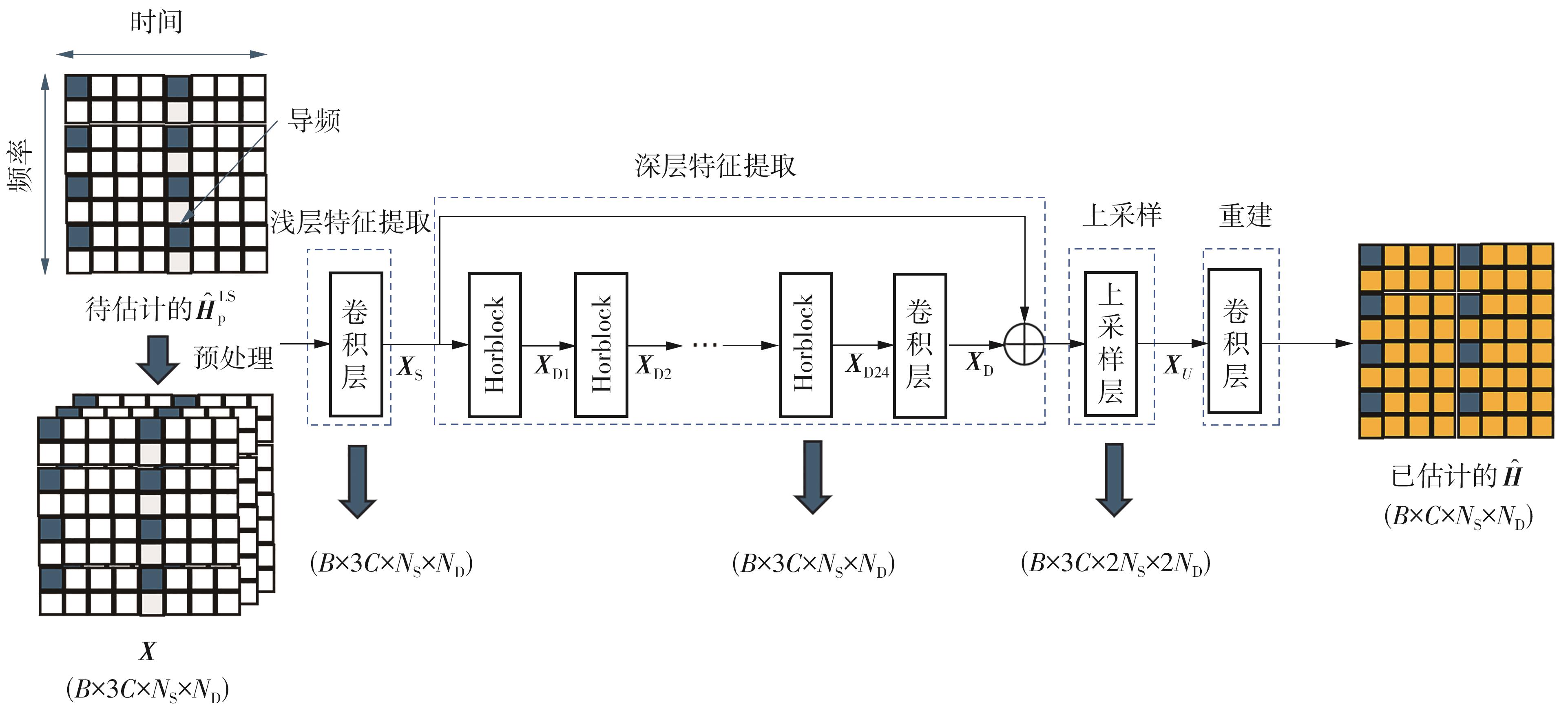
In high-mobility scenarios, wireless communications undergo time and frequency doubly selective fa-ding, making channel estimation essential for accurately obtaining channel state information (CSI), which in turn enhances the perfor-mance of communication systems. The Time-Frequency Doubly Selective Channel is a channel model that characterizes signal fading with selective properties in both time and frequency dimensions. To address the challenges of channel estimation in such environments, deep learning methods have been widely adopted in recent years. Networks that originally excelled in computer vision and natural language processing, such as Convolutional Neural Networks (CNN) and Long Short-Term Memory networks (LSTM), have been applied to channel estimation techniques. However, due to significant differences in data characteristics and task objectives between channel estimation and image processing, these approaches still face numerous challenges. This study introduced a novel channel estimation deep learning algorithm based on a Channel Enhanced Deep Horblock Network (CEHNet). The proposed algorithm treats the time-frequency grid of the doubly selective channel as a two-dimensional image and employs a Super-Resolution (SR) network to reconstruct the CSI. Additionally, a preprocessing method that increases amplitude features is utilized to expand the dataset, and Lasso regression is incorporated as a constraint to accelerate the network convergence speed. Experimental results demonstrate that, across various channel models, the proposed CEHNet algorithm outperforms traditional channel estimation methods such as Super-Resolution Convolutional Neural Networks (SRCNN) when the number of pilots is limited. Furthermore, CEHNet exhibits significantly faster convergence rates, achieving a fourfold performance improvement over SRCNN at a signal-to-noise ratio (SNR) of 22 dB.
LIU Jiaojiao , WANG Ruochen , MA Biyun . Channel Estimation Method Based on Channel Enhanced Deep Horblock Network[J]. Journal of South China University of Technology(Natural Science), 2026 , 54(1) : 53 -59 . DOI: 10.12141/j.issn.1000-565X.240594
| [1] | 廖勇,罗渝,荆亚昊 .6G新型时延多普勒通信范式:OTFS的技术优势、设计挑战、应用与前景[J].电子与信息学报,2024,46(5):1827-1842. |
| LIAO Yong, LUO Yu, JING Yahao .6G new time-delay doppler communication paradigm:technical advantages,design challenges,applications and prospects of OTFS[J].Journal of Electronics & Information Technology,2024,46(5):1827-1842. | |
| [2] | YE H, LI G Y, JUANG B H .Power of deep learning for channel estimation and signal detection in OFDM systems[J].IEEE Wireless Communications Letters,2017,7(1):114-117. |
| [3] | OSINSKY A, IVANOV A, YAROTSKY D .Bayesian approach to channel interpolation in massive MIMO receiver[J].IEEE Communications Letters,2020,24(12):2751-2755. |
| [4] | WANG Y, CHANG J, LU Z,et al .Channel estimation of 5G OFDM system based on ConvLSTM network[C]∥ Proceeding of the 7th International Conference on Communication, Image and Signal Processing (CCISP).Chengdu:IEEE,2022:62-66. |
| [5] | SOLTANI M, POURAHMADI V, MIRZAEI A,et al .Deep learning-based channel estimation[J].IEEE Communications Letters,2019,23(4):652-655. |
| [6] | PENG Q, LI J, SHI H .Deep learning based channel estimation for OFDM systems with doubly selective channel[J].IEEE Communications Letters,2022,26(9):2067-2071. |
| [7] | FOLA E, LUO Y, LUO C .AttenReEsNet:attention-aided residual learning for effective model-driven channel estimation[J].IEEE Communications Letters,2024,28(8):1855-1859. |
| [8] | LEE S,SIM D .Deep learning-based channel estimation method for MIMO systems in spatially correlated channels[J].IEEE Access,2024,12:79082-79090. |
| [9] | SON H, KWON G, PARK H,et al .A novel pilot design and channel estimation in 5G multi-numerology systems[C]∥ Proceeding of the 2022 IEEE 95th Vehicular Technology Conference:(VTC2022-Spring).Helsinki,Finland:IEEE,2022:1-5. |
| [10] | WU F, WANG L, LIU J .Efficient pilot design for channel estimation in dual-selective fading channels in 5G systems[J].IEEE Transactions on Vehicular Technology,2023,72(4):6607-6620. |
| [11] | SESIA S, BAKER M, TAUFIK I .LTE:the UMTS long term evolution:from theory to practice[M].Hoboken:Wiley Publishing,2009. |
| [12] | CHEN W, WANG X .Optimized pilot insertion for efficient channel estimation in LTE-Advanced systems [J].IEEE Transactions on Communications,2022,70(6):3735-3746. |
| [13] | LIM B,SON S, KIM H,et al .Enhanced deep residual networks for single image super-resolution [C]∥ Proceeding of 2017 IEEE Conference on Computer Vision and Pattern Recognition Workshops (CVPRW).Honolulu:IEEE,2017:1132-1140. |
| [14] | RAO Y, ZHAO W L .HorNet:efficient high-order spatial interactions with recursive gated convolutions [C]∥ Proceeding of the 2022 Computer Vision and Pattern Recognition(CVPR).Louisiana:IEEE,2022:1428-1436. |
| [15] | 刘奇,陈莹 .正则化机制下多粒度神经网络剪枝方法研究[J].电子学报,2023,51(8):2202-2212. |
| LIU Qi, CHEN Ying .Research on multi-granularity neural network pruning method with regularization mechanism[J].Acta Electronica Sinica,2023,51(8):2202-2212. | |
| [16] | MEHLFUHRER C, IKUNO J C, SIMKO M,et al. The Vienna LTE simulators—enabling reproducibility in wireless communications research[J].EURASIP Journal on Advances in Signal Processing.2011,29(1):45-60. |
| [17] | MINOH J, ALEX D, MARTINA C .Functional pro-perties of the Ziv-Zakai bound with arbitrary inputs [C]∥ Proceeding of the 2023 IEEE International Symposium on Information Theory(ISIT).Taipei:IEEE,2023:2087-2092 |
/
| 〈 |
|
〉 |