
Journal of South China University of Technology(Natural Science) >
An Investigation into Expressway Merging Behavior and Safety Based on ExiD Data
Received date: 2024-08-29
Online published: 2025-01-13
Supported by
the National Natural Science Foundation of China(52372329)
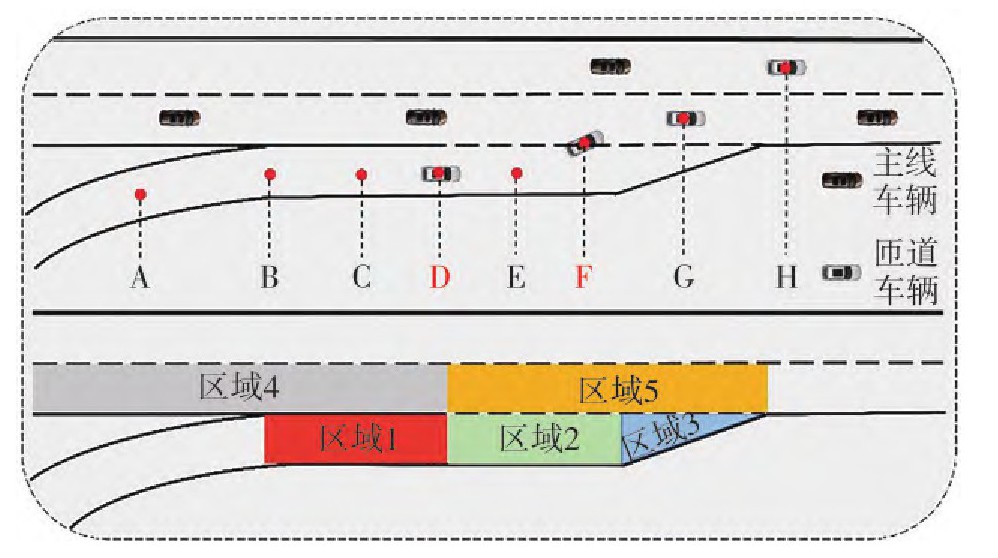
Expressway merging areas are characterized by frequent lane changes, complex driving environments, and intense traffic conflicts, making them high-risk zones for traffic accidents. Accurately understanding the relationship between vehicle operating status and traffic safety in these merging areas can provide a foundation for real-time accident risk prediction and the development of effective traffic safety control strategies. This study is based on vehicle trajectory data from the German ExiD dataset. By analyzing the changes in the relative positions of mainline outer-lane vehicles during the process from a vehicle entering the acceleration lane to merging into the mainline, the merging patterns in expressway merging areas were classified. To systematically describe the safety risks associated with merging, this study introduced the Time to Collision theory and developed a risk representation framework. This framework includes two levels of indicators: (1) a merging moment risk indicator based on two-dimensional TTC, which evaluates potential conflict at the moment of merging; and (2) a merging process risk indicator based on collision exposure time, which reflects the accumulated risk throughout the merging process. For model development, four machine learning algorithms—XGBoost, LightGBM, GBDT, and Random Forest—were used to build a classification model for merging risk. In addition, SHAP was applied to interpret the model and analyzed the key factors influencing merging risk. Experimental results show that the XGBoost-based risk identification model for expressway merging areas outperforms other models, achieving an overall accuracy of 95.52%. It also demonstrates superior performance in terms of accuracy, precision, recall, and F1-score. Furthermore, comparison among models indicates that incorporating merging duration and urgency significantly improves risk identification accuracy. SHAP analysis further reveals that merging risk is closely related to several factors, including the ave-rage and maximum speed differences with the leading vehicle on the mainline, the average distance to the leading vehicle, merging duration, the standard deviation of longitudinal acceleration during merging, and the speed of the merging vehicle.
WEN Huiying , HUANG Kunhuo , CHEN Zhe , ZHAO Sheng , HU Yuqing , HUANG Junda . An Investigation into Expressway Merging Behavior and Safety Based on ExiD Data[J]. Journal of South China University of Technology(Natural Science), 2025 , 53(8) : 50 -60 . DOI: 10.12141/j.issn.1000-565X.240437
| [1] | 查文贵 .高速公路合流区交通冲突预测与安全评价研究[D].重庆:重庆交通大学,2022. |
| [2] | 阎莹,盛彦婷,袁华智,等 .高速公路出入口区域行车风险评价及车速控制[J].交通运输工程学报,2011,11(2):90-96. |
| YAN Ying, SHENG Yanting, YUAN Huazhi,et al .Driving risk evaluation and speed control in passageway areas of freeway[J].Journal of Traffic and Transportation Engineering,2011,11(2):90-96. | |
| [3] | WANG X, HADIUZZAMAM M, QIU T Z,et al .Sensitivity analysis of freeway capacity at a complex weaving segment[C]∥Proceeding of the CICTP 2014:Safe,Smart,and Sustainable Multimodal Transportation Systems.Virginia:ASCE,2014:596-608. |
| [4] | 谢济铭,秦雅琴,彭博,等 .多车道交织区车辆跟驰行为风险判别与冲突预测[J].交通运输系统工程与信息,2021,21(3):131-139. |
| XIE Jiming, QIN Yaqin, PENG Bo,et al .Risk discrimination and conflict prediction of vehicle-following behavior in multi-lane weaving sections[J].Journal of Transportation Systems Engineering and Information Techno-logy,2021,21(3):131-139. | |
| [5] | 温惠英,黄坤火,赵胜 .基于机器学习的高速公路大型货车追尾风险预测[J].中国安全科学学报,2023,33(9):173-180. |
| WEN Huiying, HUANG Kunhuo, ZHAO Sheng,et al .Prediction of rear-end collision risk of large trucks based on machine learning[J].China Safety Science Journal,2023,33(9):173-180. | |
| [6] | 翁楚滨 .多车环境下智能车辆换道风险预测与轨迹规划方法[D].广州:华南理工大学,2023. |
| [7] | 王伟 .基于车辆轨迹重构的高速公路合流区换道冲突计算方法[D].广州:华南理工大学,2022. |
| [8] | 杜胜品,马永锋 .基于冲突点的交织区复杂度量化研究[J].交通运输系统工程与信息,2014,14(1):53-58. |
| DU Shengpin, MA Yongfeng .Quantitative analysis on complexity of weaving segment with conflicts[J].Journal of Transportation Systems Engineering and Information Technology,2014,14(1):53-58. | |
| [9] | TANAKA S, HASEGAWA N, IIZUKA D,et al .Evaluation of vehicle control algorithm to avoid conflicts in wea-ving sections under fully-controlled condition in urban expressway[J].Transportation Research Procedia,2017,21:199-207. |
| [10] | WANG L, ABEL-ATY M, SHI Q,et al .Real-time crash prediction for expressway weaving segments[J].Transportation Research Part C:Emerging Technologies,2015,61:1-10. |
| [11] | YUAN J, ABEL-ATY M, CAI Q,et al .Investigating drivers’ mandatory lane change behavior on the weaving section of freeway with managed lanes:a driving simulator study[J].Transportation Research Part F:Tra-ffic Psychology and Behaviour,2019,62:11-32. |
| [12] | LI S, XIANG Q, MA Y,et al .Crash risk prediction modeling based on the traffic conflict technique and a microscopic simulation for freeway interchange merging areas[J].International Journal of Environmental Research and Public Health,2016,13(11):1157. |
| [13] | GU X, ABDEL-ATY M, XIANG Q,et al .Utilizing UAV video data for in-depth analysis of drivers’ crash risk at interchange merging areas[J].Accident Analysis & Prevention,2019,123:159-169. |
| [14] | MOERS T, VATER L, KRAJEWSKI R,et al .The exid dataset:a real-world trajectory dataset of highly interactive highway scenarios in germany[C]∥Procee-ding of the 2022 IEEE Intelligent Vehicles Symposium (Ⅳ).[S.L.]:IEEE,2022:958-964. |
| [15] | 叶云涛 .考虑交通行为特性的高速公路交通冲突预测模型研究[D].西安:长安大学,2022. |
| [16] | 张方方,王长君,王俊骅 .城市快速路匝道合流区车辆交互行为模式[J].中国公路学报,2022,35(9):66-79. |
| ZHANG Fangfang, WANG Changjun, WANG Junhua .Vehicle interaction patterns at on-ramp merging area of urban expressway[J].China Journal of Highway and Transport,2022,35(9):66-79. | |
| [17] | MINDERHOUD M M, BOVY P H L. Extended time-to-collision measures for road traffic safety assessment[J].Accident Analysis & Prevention,2001,33(1):89-97. |
| [18] | BONELA S R, KADALI B R .Review of traffic safety evaluation at T-intersections using surrogate safety measures in developing countries context[J].IATSS Research,2022,46(3):307-321. |
| [19] | 高阳 .对多重共线性检测指标的一些研究[D].兰州:兰州大学,2019. |
| [20] | 王兆华,刘杰,王博,等 .融合机器学习与SHAP值算法的居民需求响应个体异质性因素挖掘与应用研究[J].系统工程理论与实践,2024,44(7):2247-2259. |
| WANG Zhaohua, LIU Jie, WANG Bo,et al .Research on mining and applications of individual heterogeneity factors in resident demand response by integra-ting machine learning and SHAP value algorithm[J].Systems Engineering-Theory & Practice,2024,44(7):2247-2259. | |
| [21] | 曲大义,戴守晨,陈意成,等 .基于轨迹数据的车辆博弈切出及汇入行为建模[J/OL].吉林大学学报(工学版).[2024-03-05].. |
| QU Dayi, DAI Shouchen, CHEN Yicheng,et al .Modeling of vehicle game cut-out and merging behavior based on trajectory data[J/OL].Journal of Jilin University (Engineering and Technology Edition).[2024-03-05].. | |
| [22] | 李传华,吴昊,孙一帆 .基于交通冲突的山区高速公路可变限速控制方法[J].长安大学学报(自然科学版),2018,38(5):154-161. |
| LI Chuanhua, WU Hao, SUN Yifan .Variable speed limit method of mountainous expressway based on traffic conflicts index[J].Journal of Chang’an University (Natural Science Edition),2018,38(5):154-161. |
/
| 〈 |
|
〉 |