
Journal of South China University of Technology(Natural Science) >
The Effect of Hypoxic Environment on the Enhancement of Collagen Content in Tissue-Engineered Vascular Grafts
Received date: 2024-03-25
Online published: 2024-05-11
Supported by
the Guangdong S & T Programme(2023B110009);the Program of Ji Hua Laboratory(X210111TD210)
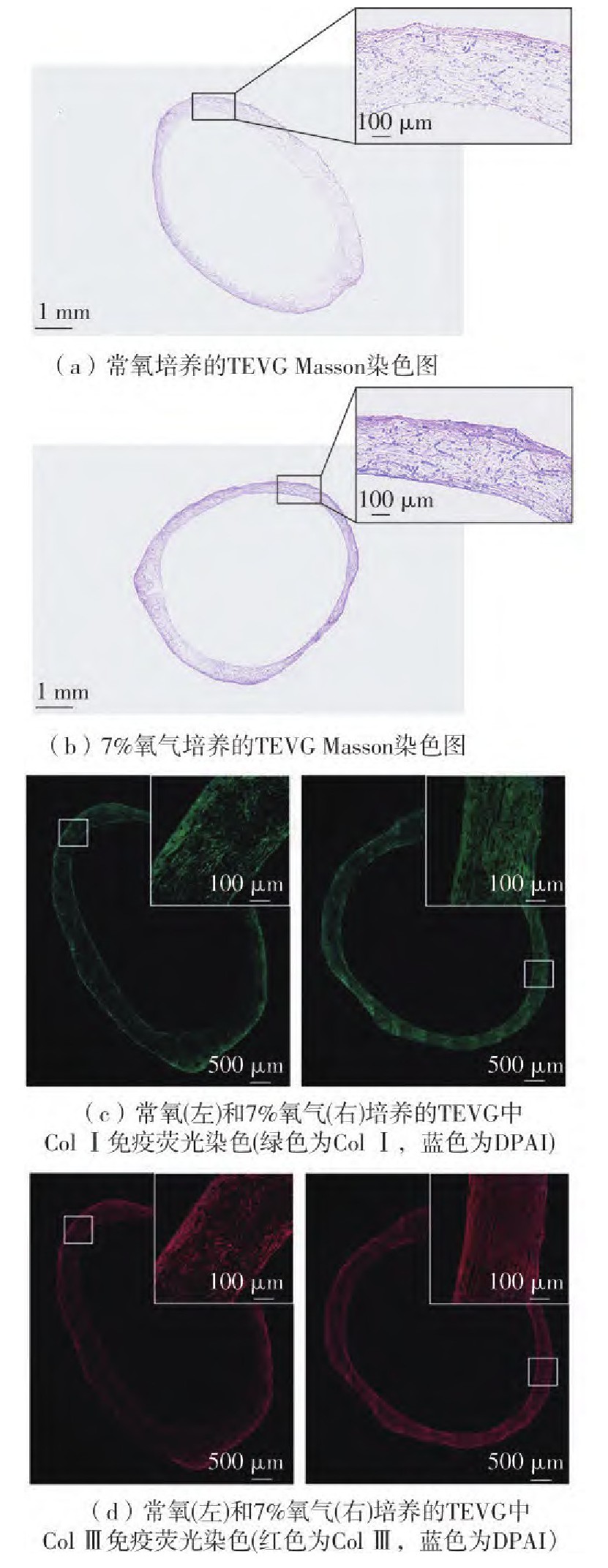
In the field of vascular tissue engineering, current technological advancements are focused on the proli-feration and secretion of collagen-rich extracellular matrix (ECM) by vascular smooth muscle cells (VSMCs) in vitro, coupled with specific mechanical stimuli to reconstruct biomaterials with desired mechanical properties. The optimal oxygen concentration is crucial for three-dimensional cell culture in vitro. However, there is a lack of sufficient research regarding its application in tissue-engineered vascular graft (TEVG). To this end, this study designed varying oxygen concentration environments to determine the optimal value for VSMCs culture by assessing cell proliferation activity. Furthermore, collagen gene expression and protein secretion were measured under normoxic and hypoxic conditions, along with quantification of total collagen content deposited in the cell layer using hydroxyproline assay. Subsequently, VSMCs were seeded on polyglycolic acid (PGA) scaffolds for three-dimensional culturing to form TEVG, and the effects of hypoxic conditions on TEVG cultivation were observed through histological staining and total collagen quantification. The results indicate that VSMC cell activity increased most rapidly at 7% oxygen concentration; under hypoxic conditions, an upregulation of type I (Col I) and type Ⅲ (Col Ⅲ) collagen gene expression was observed, with an increased secretion of collagen into the culture medium between days 5 and 9, particularly Col Ⅲ. Furthermore, the total collagen content on the 11th day demonstrates a 3.1-fold increase relative to the normoxic group. The 7% oxygen concentration facilitated collagen deposition during the three-dimensional culture of VSMCs on PGA scaffolds, resulting in a 2.09-fold increase in total collagen content compared to the normoxic group. Additionally, the formation of more dense collagen fibrils was observed. These findings indicate that the utilization of a hypoxic environment can enhance the collagen content in TEVG, thereby providing a foundation for the further optimization of in vitro culture conditions for TEVG.
LIN Zhanyi , XIAO Cong , XU Jianyi , LIU Qin , SUN Xuheng , FANG Lijun . The Effect of Hypoxic Environment on the Enhancement of Collagen Content in Tissue-Engineered Vascular Grafts[J]. Journal of South China University of Technology(Natural Science), 2025 , 53(1) : 129 -135 . DOI: 10.12141/j.issn.1000-565X.240137
| 1 | TSAO C W, ADAY A W, ALMARZOOQ Z I,et al .Heart disease and stroke statistics-2022 update:a report from the American Heart Association[J].Circulation,2022,145(8):e153-e639. |
| 2 | World Health Organization .A global brief on hypertension[R].Geneva:World Health Organization,2013. |
| 3 | LLOYD-JONES D, ADAMS R, CARNETHON M, et al .Heart disease and stroke statistics—2009 update:a report from the American Heart Association Statistics Committee and Stroke Statistics Subcommittee[J].Circulation,2009,119(3):e21-e181. |
| 4 | HUANG Y, GLOVICZKI P, NOEL A A,et al .Early complications and long-term outcome after open surgical treatment of popliteal artery aneurysms:is exclusion with saphenous vein bypass still the gold standard?[J].Journal of Vascular Surgery,2007,45(4):706 -713. |
| 5 | SWAIN T W, CALLIGARO K D, DOUGHERTY M D .Management of infected aortic prosthetic grafts[J].Vascular and Endovascular Surgery,2004,38(1):75-82. |
| 6 | GEELHOED W J, MORONI L, ROTMANS J I .Utili-zing the foreign body response to grow tissue engineered blood vessels in vivo[J].Journal of Cardiovascular Translational Research,2017,10:167-179. |
| 7 | NIKLASON L E, GAO J, ABBOTT W M,et al .Functional arteries grown in vitro[J].Science,1999,284(5413):489-493. |
| 8 | NAEGELI K M, KURAL M H, LI Y,et al .Bioengineering human tissues and the future of vascular replacement[J].Circulation Research,2022,131(1):109-126. |
| 9 | WANG H W, CHENG C W, LI C W,et al .Fabrication of pillared PLGA microvessel scaffold using femtosecond laser ablation[J].International Journal of Nanomedicine,2012,7:1865-1873. |
| 10 | PENNINGS I, van HAAFTEN E E, JUNGST T,et al .Layer-specific cell differentiation in bi-layered vascular grafts under flow perfusion[J].Biofabrication,2019,12(1):015009/1-13. |
| 11 | MCFETRIDGE P S,ABE K, HORROCKS M,et al .Vascular tissue engineering:bioreactor design considerations for extended culture of primary human vascular smooth muscle cells[J].ASAIO Journal,2007,53(5):623-630. |
| 12 | TSCHOEKE B, FLANAGAN T C, KOCH S,et al .Tissue-engineered small-caliber vascular graft based on a novel biodegradable composite fibrin-polylactide scaffold[J].Tissue Engineering Part A,2009,15(8):1909-1918. |
| 13 | FATHOLLAHIPOUR S, PATIL P S, LEIPZIG N D .Oxygen regulation in development:lessons from embryogenesis towards tissue engineering[J].Cells Tissues Organs,2019,205(5/6):350-371. |
| 14 | van VLIMMEREN M A A, DRIESSEN-MOL A, van DEN BROEK M,et al .Controlling matrix formation and cross-linking by hypoxia in cardiovascular tissue engineering[J]?.Journal of Applied Physiology,2010,109(5):1483-1491. |
| 15 | SHIMODA L A .Cellular pathways promoting pulmonary vascular remodeling by hypoxia[J].Physiology,2020,35(4):222-233. |
| 16 | FRANTZ C, STEWART K M, WEAVER V M .The extracellular matrix at a glance[J].Journal of Cell Science,2010,123(24):4195-4200. |
| 17 | von der MARK K .Localization of collagen types in tissues[J].International Review of Connective Tissue Research,1981,9:265-324. |
| 18 | NIKLASON L E, LAWSON J H .Bioengineered human blood vessels[J].Science,2020,370(6513):eaaw8682/1-9. |
| 19 | DELLA ROCCA Y, FONTICOLI L, RAJAN T S,et al .Hypoxia:molecular pathophysiological mechanisms in human diseases[J].Journal of Physiology and Biochemistry,2022,78(4):739-752. |
| 20 | FANG L, MEI J, YAO B,et al .Hypoxia facilitates proliferation of smooth muscle cells derived from pluripotent stem cells for vascular tissue engineering[J].Journal of Tissue Engineering and Regenerative Medicine,2022,16(8):744-756. |
| 21 | HU C, HUANG S, WU F,et al .MicroRNA?219?5p participates in cyanotic congenital heart disease progression by regulating cardiomyocyte apoptosis[J].Experimental and Therapeutic Medicine,2021,21:36/1-7. |
| 22 | YANG G, LIN C .Long noncoding RNA SOX2‐OT exacerbates hypoxia‐induced cardiomyocytes injury by regulating miR‐27a‐3p/TGFβR1 axis[J].Cardiovascular Therapeutics,2020,2020(1):2016259/1-11. |
| 23 | BROWER G L, GARDNER J D, FORMAN M F, et al .The relationship between myocardial extracellular matrix remodeling and ventricular function[J].European Journal of Cardio-Thoracic Surgery,2006,30(4):604-610. |
| 24 | MIENALTOWSKI M J, BIRK D E .Structure,physiology,and biochemistry of collagens[J].Advances in Experimental Medicine and Biology,2013,802:5-29. |
| 25 | TOBA H, CANNON P L, YABLUCHANSKIY A,et al .Transgenic overexpression of macrophage matrix metalloproteinase-9 exacerbates age-related cardiac hypertrophy,vessel rarefaction,inflammation,and fibrosis[J].American Journal of Physiology-Heart and Circulatory Physiology,2017,312(3):H375-H383. |
| 26 | LIU X, WU H, BYRNE M,et al .Type III collagen is crucial for collagen I fibrillogenesis and for normal cardiovascular?development[J].Proceedings of the National Academy of Sciences of the United States of America,1997,94(5):1852-1856. |
| 27 | FLEISCHMAJER R, MACDONALD E D, PERLISH J S,et al .Dermal collagen fibrils are hybrids of type I and type III collagen molecules[J].Journal of Structural Biology,1990,105(1/2/3):162-169. |
| 28 | RONG N, MISTRIOTIS P, WANG X,et al .Restoring extracellular matrix synthesis in senescent stem cells[J].The FASEB Journal,2019,33(10):10954-10965. |
| 29 | ERYILMAZ E, TEIZER W, HWANG W .In vitro analysis of the co-assembly of type-I and type-III collagen[J]?.Cellular and Molecular Bioengineering,2017,10:41-53. |
| 30 | GAO J, GUO Z, ZHANG Y,et al .Age-related changes in the ratio of Type I/III collagen and fibril diameter in mouse skin[J].Regenerative Biomaterials,2023,10:rbac110/1-9. |
/
| 〈 |
|
〉 |