
Journal of South China University of Technology(Natural Science) >
Synthesis and Emulsifying Effect of Nonionic Waterborne Epoxy Resin Emulsifiers
Received date: 2024-03-18
Online published: 2024-04-26
Supported by
the National Natural Science Foundation of China(52073099)
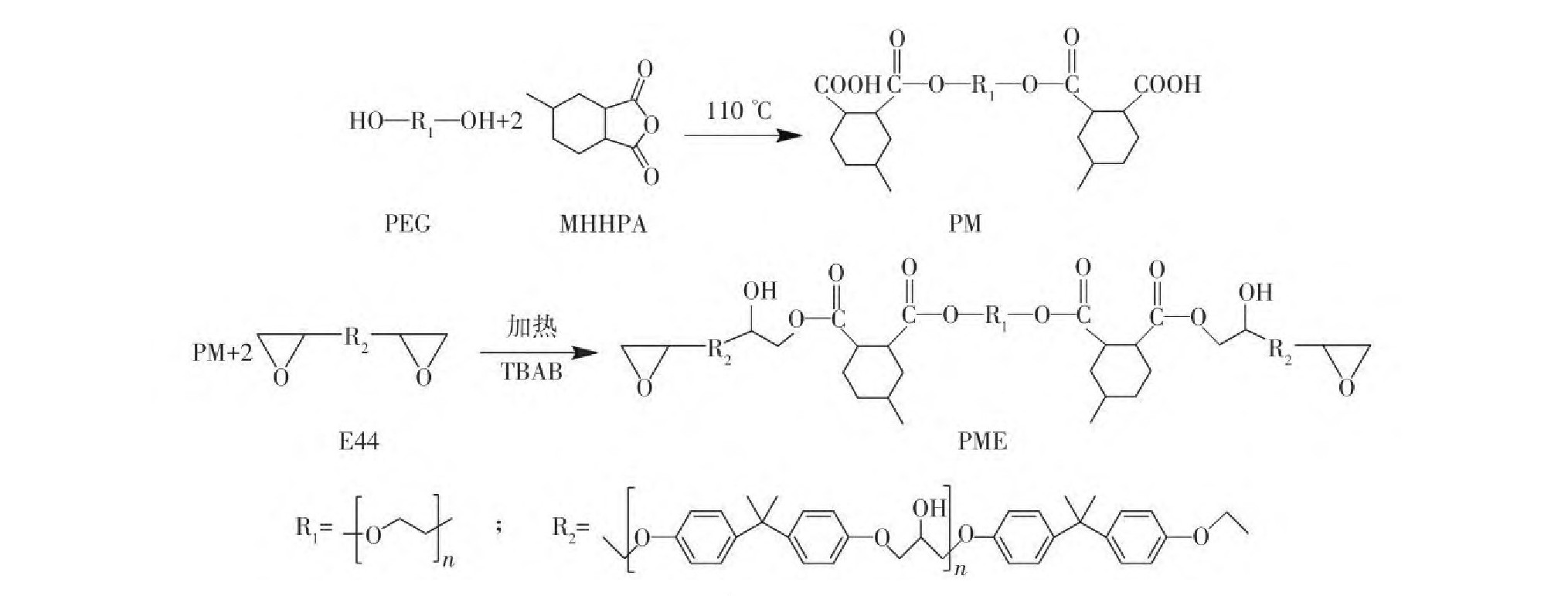
In order to improve the emulsifying agent compatibility with epoxy resin, a series of nonionic waterborne epoxy emulsifiers with A-B-A (A is epoxy chain segment, B is hydrophilic chain segment) structure were synthesized by two-step method using polyethylene glycol (PEG6000, PEG4000, PEG2000), methyl hexahydrophthalic anhydride (MHHPA) and epoxy resin (E44) as raw materials. The structure of the emulsifier was characterized by infrared spectrum analysis, and the optimal synthesis process was determined by infrared spectrum analysis and acid titration: esterification reaction was carried out with PEG and MHHPA in the molar ratio of 1∶2.1 under the temperature of 110 ℃ for 3 h; then E44 in the same number of moles of MHHPA was added in and the epoxy ring-opening reaction was carried out under the catalyst tetrabbutylammonium bromide (TBAB, 1% of the amount of epoxy resin) at 110 ℃ for 3 h. Waterborne epoxy emulsion was prepared by using the synthesized emulsifier on epoxy resin E44. Then it studied the effects of relative molecular mass of PEG, emulsifier content, emulsifying temperature and stirring speed on the stability of the emulsion. After comprehensive consideration of emulsion stability, particle size and distribution, the results show that the emulsifier synthesized by PEG6000 has better emulsifying effect, with HLB value of 16.5 and turbidity point of 90 ℃, which is superior to PEG4000 and PEG2000. When the emulsion solid content is about 45%, the emulsifier content is 20%, emulsifying at 75 ℃ and stirring speed of 2 000 r/min, the water-based epoxy emulsion with small average particle size and narrow distribution can be obtained, and shows good emulsion stability.
Key words: nonionic; emulsifier; synthesis; phase inversion method 责任编辑:张娜娜
LI Wenbo YI Die . Synthesis and Emulsifying Effect of Nonionic Waterborne Epoxy Resin Emulsifiers[J]. Journal of South China University of Technology(Natural Science), 2025 , 53(1) : 101 -107 . DOI: 10.12141/j.issn.1000-565X.240128
| 1 | JIN F L, LI X, PARK S J .Synthesis and application of epoxy resins:a review[J].Journal of Industrial and Engineering Chemistry,2015,29:1-11. |
| 2 | PRADHAN S, MOHANTY S, NAYAK S K .Waterborne epoxy adhesive derived from epoxidized soybean oil and dextrin:synthesis and characterization[J].International Journal of Polymer Analysis and Characterization,2017,22(4):318-329. |
| 3 | LEE S B, LEE H J, HONG I K .Diluent filler particle size effect for thermal stability of epoxy type resin[J].Journal of Industrial and Engineering Chemistry,2012,18(2):635-641. |
| 4 | LV X Y, LIANG Y S, ZHONG J,et al .Organic silicone-modified waterborne epoxy coatings using aqueous curing agents technology[J].Pigment & Resin Technology,2022,53(4):434-441. |
| 5 | WANG F, FU H, LIU G X,et al .Preparation optimization and performance evaluation of waterborne epoxy resin for roads[J].Advances in Civil Engineering,2021,2021:1-12. |
| 6 | SHIKHA D, KAMANI P K, SHUKLA M C .Studies on synthesis of water-borne epoxy ester based on RBO fatty acids[J].Progress in Organic Coatings,2003,47(2):87-94. |
| 7 | 彭军,杜柱康,张习文 .环氧树脂水性化技术和改性方法的研究进展[J].化工新型材料,2021,49(10):236-239. |
| PENG Jun, DU Zhukang, ZHANG Xiwen .Research progress on waterborne technology and modification of epoxy resin[J].New Chemical Materials,2021,49(10):236-239. | |
| 8 | 聂长华,陈君华,胡剑青,等 .环氧树脂水性化的研究进展[J].精细化工,2019,36(7):1279-1285,1293. |
| NIE Chang-hua, CHEN Jun-hua, HU Jian-qing,et al .Research progress of waterborne epoxy resin[J].Fine Chemicals,2019,36(7):1279-1285,1293. | |
| 9 | LIU L Z, HU G K, ZHANG X R,et al .The effects of ultrasonication on epoxy resin and its emulsion[J].Pigment Resin Technology,2018,47(4):300-307. |
| 10 | LIU C Z, SUN M M, ZHANG B,et al .Preparation and properties of acetylene-terminated benzoxazine/epoxy copolymers[J].Reactive & Functional Polymers,2017,120:98-103. |
| 11 | PERAZZO A, PREZIOSI V, GUIDO S .Phase inversion emulsification:current understanding and applications[J].Advances in Colloid and Interface Science,2015,222:581-599. |
| 12 | YANG Z Z .Progress in phase inversion emulsification for epoxy resin waterborne dispersions[J].Chinese Journal of Polymer Science,2007,25(2):137-143. |
| 13 | KOJIMA S, WATANABE Y .Development of high performance,waterborne coatings.Part I:emulsification of epoxy resin[J].Polymer Engineering & Science,1993,33(5):253-259. |
| 14 | 李晋,李鹏,蔡晴,等 .非离子型水性环氧树脂乳液的合成与性能研究 [J].化工新型材料,2015,43(1):178-181. |
| LI Jin, LI Peng, CAI Qing,et al .Study on synthesis and property of nonionic waterborne epoxy resin emulsion[J].New Chemical Materials,2015,43(1):178-181. | |
| 15 | WANG K J, LI Y Y, SANG S L,et al .Preparation and properties of nonionic waterborne epoxy resin[J].Journal of Applied Polymer Science,2022,139(7):51655/1-12. |
/
| 〈 |
|
〉 |