
Journal of South China University of Technology(Natural Science) >
Preparation of Pineapple Peel Cellulose Nanocrystals and Their Environment Stability in Pickering Emulsions
Received date: 2021-08-22
Online published: 2021-11-22
Supported by
the National Natural Science Foundation of China(32172132)
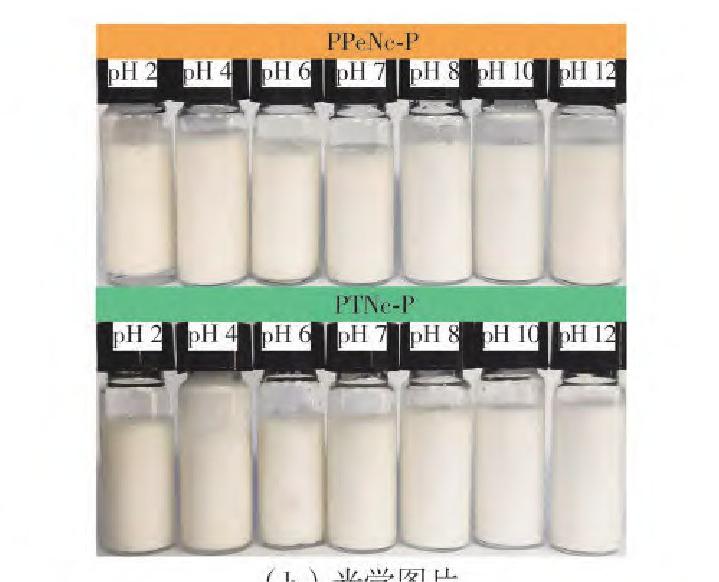
In recent years, with the gradual increase of pineapple sales, the resource waste problem of pineapple peel needs to be urgently solved. Pineapple peel residue is rich in insoluble cellulose, which provides a possibility for the derivative development of cellulose extracted from pineapple peel residue. In order to discuss the potential in the preparation and application of pineapple peel cellulose nanocrystals (PCNCs), this paper prepared pineapple peel residue cellulose nanocrystals PPeNc and PTNc by sulfuric acid hydrolysis and 2,2,6,6-tetramethylpiperidine oxide (TEMPO) oxidation, respectively, and applied them to the Pickering emulsion (made into PPeNc-P and PTNc-P) for the environmental stability study. Fourier transform infrared spectroscopy, X-ray diffraction and thermal gravimetric analysis show that both PPeNc and PTNc retain the original structure of cellulose, but the crystallinity and thermal stability of PTNc are lower than those of PPeNc. Atomic force microscopy show that the aspect ratio of PTNc is as high as 54.11. As compared with PPeNc, PTNc exhibits higher aspect ratio and longer diameter. Furthermore, it is found that the stability of PTNc-P is better than that of PPeNc-P in the range of pH = 2 ~ 12, and the ionic strength is below 70 mmol/L or the oil-water ratio is below 5∶5. The storage experiment shows that the storage period of PPeNc-P is within 70 days, while PTNc-P can be stored stably for more than five months. The research results in this paper indicate that PCNCs prepared by TEMPO oxidation show greater potential in stabilizing Pickering emulsion, which provides a theoretical basis for the storage and further application of PTNc in Pickering emulsion. It is conducive to realizing the high-value utilization of pineapple peel residue.
Huihua HUANG , Lu TANG , Yushan LIU , Jing LIAO , Xingyu CHEN , Minxuan XIAO , Huishuang YIN . Preparation of Pineapple Peel Cellulose Nanocrystals and Their Environment Stability in Pickering Emulsions[J]. Journal of South China University of Technology(Natural Science), 2022 , 50(8) : 1 -11 . DOI: 10.12141/j.issn.1000-565X.210521
| 1 | LIN N, DUFRESNE A .Nanocellulose in biomedicine:current status and future prospect[J].European Polymer Journal,2014,59:302-325. |
| 2 | DAI H, HUANG Y, HUANG H .Enhanced performances of polyvinyl alcohol films by introducing tannic acid and pineapple peel-derived cellulose nanocrystals[J].Cellulose,2018,25(8):4623-4637. |
| 3 | DAI H,OU S, HUANG Y,et al .Utilization of pineapple peel for production of nanocellulose and film application[J].Cellulose,2018,25(3):1743-1756. |
| 4 | DUFRESNE A .Nanocellulose: a new ageless bionanomaterial[J].Materials Today,2013,16(6):220-227. |
| 5 | 罗苏芹,戴宏杰,黄惠华 .不同制备方法对菠萝皮渣纳米纤维素的结构影响[J].包装与食品机械,2018,36(5):1-6. |
| 5 | LUO Su-qin, DAI Hong-jie, HUANG Hui-hua .Effect of different preparation methods on the structure of nanoce-llulose in pineapple peels[J].Packaging and Food Machinery,2018,36(5):1-6. |
| 6 | 张燕,张铭涛,沈晓飞,等 .纳米纤维素的最新制备进展 Ⅰ. 化学法[J].纤维素科学与技术,2020,28(3):49-58. |
| 6 | ZHANG Yan, ZHANG Ming-tao, SHEN Xiao-fei,et al .Recent progress of preparation of nano-cellulose Ⅰ. The chemical methods[J].Journal of Cellulose Science and Technology,2020,28(3):49-58. |
| 7 | 张欢,戴宏杰,陈媛,等 .离子液体-球磨法制备柠檬籽纤维素纳米纤丝及其结构表征[J].食品科学,2021,42(7):120-127. |
| 7 | ZHANG Huan, DAI Hongjie, CHEN Yuan,et al .Preparation and structure characterization of lemon seed cellulose nanofibrils using ionic liquid-assisted ball milling[J].Food Science,2021,42(7):120-127. |
| 8 | ISOGAI A, SAITO T, FUKUZUMI H .TEMPO-oxidized cellulose nanofibers[J].Nanoscale,2011,3(1):71-85. |
| 9 | MAO L, MA P, LAW K,et al .Studies on kinetics and reuse of spent liquor in the TEMPO-mediated selective oxidation of mechanical pulp[J].Industrial & Engineering Chemistry Research,2010,49(1):113-116. |
| 10 | SIQUEIRA P, SIQUEIRA é, DE LIMA A E,et al .Three-dimensional stable alginate-nanocellulose gels for biomedical applications:towards tunable mechanical properties and cell growing[J].Nanomaterials,2019,9(1):78. |
| 11 | JIANG Y, ZHAO Y, FENG X,et al .TEMPO-mediated oxidized nanocellulose incorporating with its derivatives of carbon dots for luminescent hybrid films[J].RSC Advances,2016,6(8):6504-6510. |
| 12 | CHEVALIER Y, BOLZINGER M A .Emulsions stabilized with solid nanoparticles:Pickering emulsions[J].Colloids and Surfaces A:Physicochemical and Engineering Aspects,2013,439:23-34. |
| 13 | TANG L, LIAO J, DAI H,et al .Comparison of ce-llulose nanocrystals from pineapple residues and its preliminary application for Pickering emulsions[J].Nanotechnology,2021,32(49):495708. |
| 14 | LI Q, WU Y, FANG R,et al .Application of nanocellulose as particle stabilizer in food Pickering emulsion:scope,merits and challenges[J].Trends in Food Science & Technology,2021,110:573-583. |
| 15 | ZHAI X, LIN D, LIU D,et al .Emulsions stabilized by nanofibers from bacterial cellulose:new potential food-grade Pickering emulsions[J].Food Research International,2018,103:12-20. |
| 16 | KARGAR M, FAYAZMANESH K, ALAVI M,et al.Investigation into the potential ability of Pickering emu-lsions (food-grade particles) to enhance the oxidative stability of oil-in-water emulsions[J].Journal of Colloid and Interface Science,2012,366(1):209-215. |
| 17 | KALASHNIKOVA I, BIZOT H, BERTONCINI P,et al .Cellulosic nanorods of various aspect ratios for oil in water Pickering emulsions[J].Soft Matter,2013,9(3),952-959. |
| 18 | HU X, WANG J, HUANG H .Impacts of some macromolecules on the characteristics of hydrogels prepared from pineapple peel cellulose using ionic liquid[J].Cellulose,2013,20(6):2923-2933. |
| 19 | CHEN A, GUAN Y J, Bustamante M,et al .Production of renewable fuel and value-added bioproducts using pineapple leaves in Costa Rica[J].Biomass and Bioenergy,2020,141:105675. |
| 20 | HOSSAIN M A, RAHMAN S M M .Total phenolics, flavonoids and antioxidant activity of tropical fruit pineapple[J].Food Research International,2011,44(3):672-676. |
| 21 | GIL L S, MAUPOEY P F .An integrated approach for pineapple waste valorization. Bioethanol production and bromelain extraction from pineapple residues[J].Journal of Cleaner Production,2018,172:1224-1231. |
| 22 | RODSAMRAN P, SOTHORNVIT R .Preparation and characterization of pectin fraction from pineapple peel as a natural plasticizer and material for biopolymer film[J].Food and Bioproducts Processing,2019,118:198-206. |
| 23 | YE W, HU Y, MA H,et al .Comparison of cast films and hydrogels based on chitin nanofibers prepared using TEMPO/NaBr/NaClO and TEMPO/NaClO/NaClO2 systems[J].Carbohydrate Polymers,2020,237:116125. |
| 24 | OH S Y, YOO D I, SHIN Y,et al .FTIR analysis of cellulose treated with sodium hydroxide and carbon dio-xide[J].Carbohydrate Research,2005,340(3):417-428. |
| 25 | LIU Z, HUANG H .Preparation and characterization of cellulose composite hydrogels from tea residue and carbohydrate additives[J].Carbohydrate Polymers,2016,147:226-233. |
| 26 | HAAFIZ M K M, HASSAN A, ZAKARIA Z,et al .Isolation and characterization of cellulose nanowhiskers from oil palm biomass microcrystalline cellulose[J].Carbohydrate Polymers,2014,103:119-125. |
| 27 | FENG X, MENG X, ZHAO J,et al .Extraction and preparation of cellulose nanocrystals from dealginate kelp residue:structures and morphological characterization[J].Cellulose,2015,22(3):1763-1772. |
| 28 | 刘瑞,付时雨 .H型和Na型羧基纤维素表面改性接枝己内酯的比较研究[J].中国造纸学报,2017,32(1):32-39. |
| 28 | LIU Rui, FU Shi-yu .The comparison of grafting polycaprolactone on carboxylate cellulose in H or Na form[J].Transactions of China Pulp and Paper,2017,32(1):32-39. |
| 29 | FRENCH A D .Idealized powder diffraction patterns for cellulose polymorphs[J].Cellulose,2014,21(2):885-896. |
| 30 | 王晓宇,张洋,江华,等 .氧化降解法制备纳米纤维素的特性分析[J].西北林学院学报,2016,31(4):246-251. |
| 30 | WANG Xiao-yu, ZHANG Yang, JIANG Hua,et al .Analysis of the characteristic for the cellulose nanocrystals prepared with oxidative degradation[J].Journal of Northwest Forestry University,2016,31(4):246-251. |
| 31 | SHARMA P R, VARMA A J .Thermal stability of ce-llulose and their nanoparticles: effect of incremental increases in carboxyl and aldehyde groups[J].Carbohydrate Polymers,2014,114:339-343. |
| 32 | MARIANO M, KISSI N EL, DUFRESNE A .Cellulose nanomaterials:size and surface influence on the thermal and rheological behavior[J].Polímeros,2018,28:93-102. |
| 33 | 申玲玲,张放,任浩,等 .氧化纤维对纳米纤维素气凝胶微球的影响[J].纤维素科学与技术,2017,25(3):1-7. |
| 33 | SHEN Ling-ling, ZHANG Fang, REN Hao,et al .Effect of oxidized fibril on cellulose nanofiber based aerogel microsphere[J].Journal of Cellulose Science and Technology,2017,25(3):1-7. |
| 34 | 戴磊,程婷,王岩,等 .TEMPO氧化纤维素纳米纤维在膜材料中的研究进展[J].陕西科技大学学报,2020,38(1):115-123. |
| 34 | DAI Lei, CHENG Ting, WANG Yan,et al .TEMPO-oxidized cellulose nanofibers in film materials:a review[J].Journal of Shaanxi University of Science & Technology,2020,38(1):115-123. |
| 35 | MORAIS J P S, DE FREITAS R M, NASCIMENTO L D,et al .Extraction and characterization of nanocellulose structures from raw cotton linter[J].Carbohydrate Polymers,2013,91(1):229-235. |
| 36 | LI T, ZHONG Q, ZHAO B,et al .Effect of surface charge density on the ice recrystallization inhibition activity of nanocelluloses[J].Carbohydrate Polymers,2020,234:115863. |
| 37 | QI W, YU J, ZGANG Z,et al .Effect of pH on the aggregation behavior of cellulose nanocrystals in aqueous medium[J].Materials Research Express,2019,6(12):125078. |
| 38 | ZHANG T, ZHOU P, ZHAN Y,et al .Pectin/lysozyme bilayers layer-by-layer deposited cellulose nanofibrous mats for antibacterial application[J].Carbohydrate Polymers,2015,117:687-693. |
| 39 | TZOUMAKI M V, MOSCHAKIS T, KIOSSEOGLOU V,et al .Oil-in-water emulsions stabilized by chitin nanocrystal particles[J].Food Hydrocolloids,2011,25(6):1521-1529. |
| 40 | DAI H, LI Y, MA L,et al .Fabrication of cross-linked β-lactoglobulin nanoparticles as effective stabilizers for Pickering high internal phase emulsions[J].Food Hydrocolloids,2020,109:106151. |
| 41 | QI W, LI T, ZHANG Z,et al .Preparation and cha-racterization of oleogel-in-water Pickering emulsions stabilized by cellulose nanocrystals[J].Food Hydroco-lloids,2021,110:106206. |
| 42 | LEE L L, NIKNAFS N, HANCOCKS R D,et al .Emulsification:mechanistic understanding[J].Trends in Food Science & Technology,2013,31(1):72-78. |
| 43 | TANAKA R, SAITO T, ISOGAI A .Cellulose nanofibrils prepared from softwood cellulose by TEMPO/NaClO/NaClO2 systems in water at pH 4.8 or 6.8[J].International Journal of Biological Macromolecules,2012,51(3):228-234. |
/
| 〈 |
|
〉 |