
Journal of South China University of Technology(Natural Science) >
Effect of Caffeic Acid/Chlorogenic Acid on Digestion and Retrogradation Properties of Chestnut Starch Under Heat-Moisture Treatment
Received date: 2021-08-22
Online published: 2021-09-26
Supported by
the National Key Research and Development Project during the “13th Five-Year Plan”(2019YFD1002305);the National Natural Science Foundation of China(32172167)
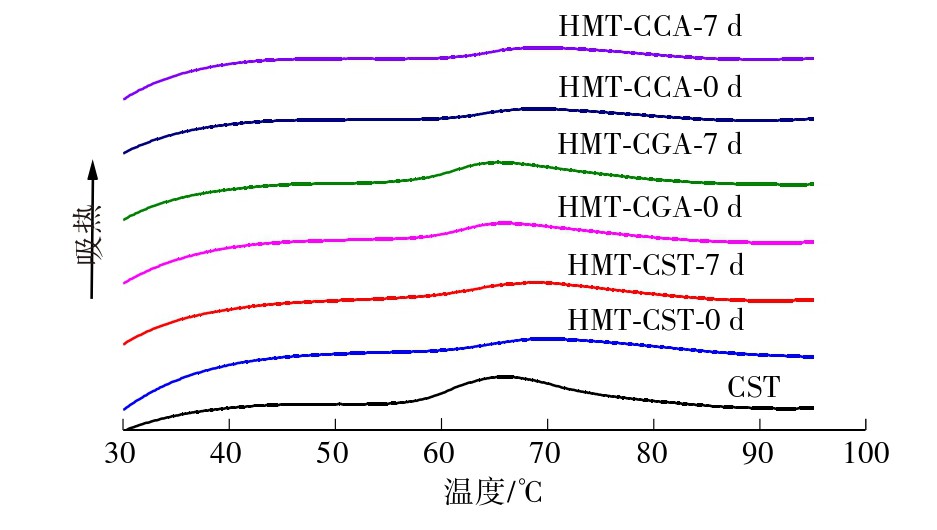
Chinese chestnut is a Chinese characteristic economic forest fruit, and its planting area and output in China ranked in the world’s top. It is favored by consumers as one of the most important snack foods and food supplements. However, the content of starch in chestnut is relatively high. After processing, the content of fast-digested starch is significantly increased, which can easily lead to blood glucose disorder and can increase the risk of chronic metabolic diseases such as type 2 diabetes and obesity. In addition, chestnut starch is easy to suffer retrogradation during storage, which affects the processing quality of chestnut food. Therefore, to improve the nutritional function and processing quality of chestnut-based products, chestnut starch was modified by heat-moisture treatment (HMT) together with the composition of polyphenols. The effects of structure of caffeic acid (CCA)/chlorogenic acid (CGA) on the multi-scale structure, digestion and retrogradation performance of chestnut starch-polyphenol complexes were studied by modern analytical technologies. The results show that the addition of CCA/CGA during HMT can significantly reduce the digestibility of chestnut starch. And the content of anti-enzymatic components of chestnut starch, HMT treated chestnut starch, starch-CGA complex and starch-CCA complex are 15.53%, 17.77%, 19.72% and 22.73%, respectively. Moreover, as compared with CGA, small molecular volume of CCA is more likely to form anti-enzymatic hydrolysis structure domains (short-range ordered structures and V-type crystalline structures) with chestnut starch. Low temperature storage for 7 days can promote the retrogradation of chestnut starch granules and its polyphenol complexes. During the retrogradation process, the aggregation and re-arrangement of starch molecular chains will promote the formation of more ordered short-range ordered structures and crystalline structures, but the whole retrogradation is not obvious.As compared with HMT treated chestnut starch, the addition of polyphenols can hinder the aggregation and rearrangement of starch molecular chains to form long-range ordered crystalline structures, therefore inhibiting the retrogradation of starch granules and improving their storage stability. Overall, as compared with CGA, the addition of CCA can endow chestnut starch with great anti-digestion and anti-retrogradation performance, thus providing a new way and technical support for creating high quality and healthy chestnut starch food.
CHEN Jin, HE Dawei, CHEN Ling . Effect of Caffeic Acid/Chlorogenic Acid on Digestion and Retrogradation Properties of Chestnut Starch Under Heat-Moisture Treatment[J]. Journal of South China University of Technology(Natural Science), 2022 , 50(8) : 41 -48 . DOI: 10.12141/j.issn.1000-565X.210527
| 1 | PIZZOFERRATO L, ROTILIO G, PACI M .Modification of structure and digestibility of chestnut starch upon cooking: a solid state 13C CP MAS NMR and enzymatic degradation study[J].Journal of Agricultural and Food Chemistry,1999,47(10):4060-4063. |
| 2 | 张瑞菊,孙强,张洪坤 .板栗的营养、生产现状及前景展望[J].山东商业职业技术学院学报,2014,14(4):106-107. |
| 2 | ZHANG Rui-ju, SUN Qiang, ZHANG Hong-kun .Nutrition,production status and prospect of Chinese chestnut[J].Journal of Shandong Institute of Commerce and Technology,2014,14(4):106-107. |
| 3 | WANG Q, LI L, ZHENG X .Recent advances in heat-moisture modified cereal starch:structure,functionality and its applications in starchy food systems[J].Food Chemistry,2021,344:128700/1-15. |
| 4 | CHEN X, HE X, FU X,et al .In vitro digestion and physicochemical properties of wheat starch/flour modified by heat-moisture treatment[J].Journal of Cereal Science,2015,63:109-115. |
| 5 | MIYOSHI E .Effects of heat-moisture treatment and lipids on gelatinization and retrogradation of maize and potato starches[J].Cereal Chemistry,2002,79(1):72-77. |
| 6 | WILLIAMSON G .The role of polyphenols in modern nutrition[J].Nutr Bull,2017,42(3):226-235. |
| 7 | ZHU F, CAI Y-Z, SUN M,et al .Effect of phenolic compounds on the pasting and textural properties of wheat starch[J].Starch/St?rke,2008,60(11):609-616. |
| 8 | 食品安全国家标准 食品中淀粉的测定: [S]. |
| 9 | WANG H, WANG Z, LI X,et al .Multi-scale structure,pasting and digestibility of heat moisture treated red adzuki bean starch[J].International Journal of Biological Macromolecules,2017,102:162-169. |
| 10 | FROST K, KAMINSKI D, KIRWAN G,et al .Crystallinity and structure of starch using wide angle X-ray scattering[J].Carbohydrate Polymers,2009,78(3):543-548. |
| 11 | 王宏伟 .湿热处理和脂肪酸复合作用调控大米淀粉消化性能及营养功能的研究[D].广州:华南理工大学,2017. |
| 12 | HAN M, BAO W, WU Y,et al .Insights into the effects of caffeic acid and amylose on in vitro digestibility of maize starch-caffeic acid complex[J].International Journal of Biological Macromolecules,2020,162:922-930. |
| 13 | 杨景峰,罗志刚,罗发兴 .淀粉晶体结构研究进展[J].食品工业科技,2007,28(7):240-243. |
| 13 | YANG Jing-feng, LUO Zhi-gang, LUO Fa-xing .Research progress on crystal structure of starch[J].Science and Technology of Food Industry,2007,28(7):240-243. |
| 14 | PUTSEYS J, DERDE L, LAMBERTS L,et al .Production of tailor made short chain amylose-lipid complexes using varying reaction conditions[J].Carbohydrate Polymers,2009,78:854-861. |
| 15 | FU Z, CHEN J, LUO S J,et al .Effect of food additives on starch retrogradation:a review[J].Starch/St?rke,2015,67(1/2):69-78. |
/
| 〈 |
|
〉 |