Traffic & Transportation Engineering

Energy Saving Optimization of Metro Train Working Diagram Under Regenerative Braking

Expand
  • School of Civil Engineering and Transportation,South China University of Technology,Guangzhou 510640,Guangdong,China
郑亚晶 ( 1982-) ,男,博士,讲师,主要从事轨道交通运输组织优化研究。E-mail:ctyjzheng@scut.edu.cn

Received date: 2020-09-10

  Revised date: 2020-12-13

  Online published: 2021-07-01

Supported by

Supported by the National Natural Science Foundation of China for Youths ( 61603140)
Abstract

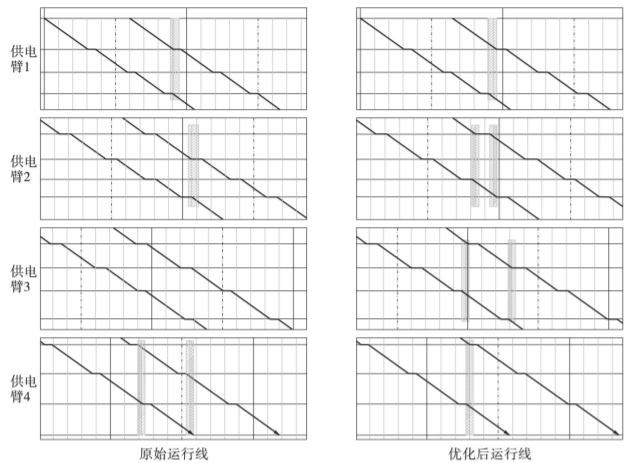
Increasing the utilization rate of regenerative braking power can effectively improve the energy-saving effect of metro system and reduce the catenary voltage fluctuation. In this paper,by fine-tuning the departure interval and stop time,the optimization model of metro train working diagram was constructed on the basis of not changing the train operation scheme. The goal is to maximize the overlap between the“generated energy”period of train arrival and the“used energy”period of train departure under the same power section,and to ensure that the departure interval and stop time do not exceed the acceptable range of normal operation of rail transit. The model was solved by using the classical time-space local rolling optimization method and commercial optimization software and verified by an actual metro train working diagram. The results show that the average utilization rate of regenerative braking energy of metro train can be increased to more than 15% ,and the metro train operation diagram for energy saving is effectively optimized.

Cite this article

ZHENG Yajing, LI Yaohui, LI Yuheng, et al . Energy Saving Optimization of Metro Train Working Diagram Under Regenerative Braking[J]. Journal of South China University of Technology(Natural Science), 2021 , 49(7) : 1 -7 . DOI: 10.12141/j.issn.1000-565X.200552

Outlines

/