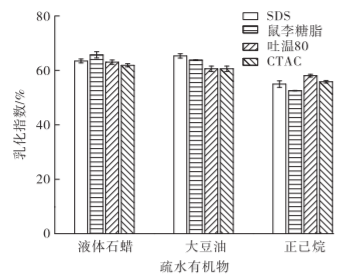
The rhamnolipids components that fermented by Pseudomonas aeruginosa 1.10452 were analyzed by high performance liquid chromatography-mass spectrometry (HPLC-MS) in order to explore the potential of rhamnolipids as biosurfactants, and the critical micelle concentration (CMC), emulsifying activity, foam property and antibacterial activity of rhamnolipids were measured. The results of component analysis shows that the rhamnolipids are mainly composed of 9 homologues, and dirhamnolipid is the main component. The critical micelle concentration of rhamnolipids is 80mg/L and its surface activity is better than that of sodium dodecyl sulfate (SDS). Compared with the control group, rhamnolipids shows excellent emulsifying properties on soybean oil (63.75%), liquid para-ffin (65.69%) and n-hexane (52.54%). The foaming ability and foam stability of rhamnolipids are close to that of SDS in pure water, but significantly better than that of SDS in hard water. Furthermore, rhamnolipids exhibits good surface activity and emulsifying activity at different temperature (-20~121℃), ionic strength (0~25 g/L) and pH (6~13). The results of inhibition zone test show that rhamnolipids has strong inhibition ability to Staphylococcus aureus, Escherichia coli and Candida albicans.
LUO Zhigang YANG Huan QI Liang
. Study on the Properties of Rhamnolipids as Biosurfactants[J]. Journal of South China University of Technology(Natural Science), 2022
, 50(1)
: 30
-37
.
DOI: 10.12141/j.issn.1000-565X.210069
