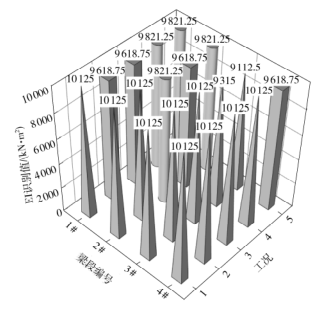
In order to develop an optimal method to identify the initial bending stiffness of a simply supported beam, the beam was segmented to directly measure or indirectly calculate the rotation angles at the segmentation cross-sections under a known static load based on the idea of virtual segmentation. The bending stiffness of various girder segments was inversely obtained by establishing a relationship between the rotation angle and bending stiffness of each girder segment. The correctness and validity of the proposed method was proved by a finite element analysis and the experiment data. The condition number of a matrix was applied to analyze the influence of the number of girder segments and the magnitudes, types, numbers, and positions of the acting forces on the stability of the identification equation set, and the influence of rotation angle measurement error on identification accuracy. The results show that the number of girder segments, number of forces, and positions of the forces were the key factors influencing the stability of the identification equation set; the acceptable rotation angle measurement noise increased with the decrease of the number of girder segments and the increase of sensor accuracy; under proper loading and test conditions, the proposed method shows high robustness in identification of initial bending stiffness of beams. The proposed method is simple and practical because it requires no complex inversion algorithm, support of a finite element model, or pre-measurement of parameters such as girder cross-section dimension, reinforcement, or mate-rial properties.
YANG Yuhou, YANG Lufeng, QIN Bingxian, et al
. Rotation Angle-Based Identification Method of Initial Bending Stiffness of Simply Supported Beams[J]. Journal of South China University of Technology(Natural Science), 2021
, 49(8)
: 75
-84
.
DOI: 10.12141/j.issn.1000-565X.200557
