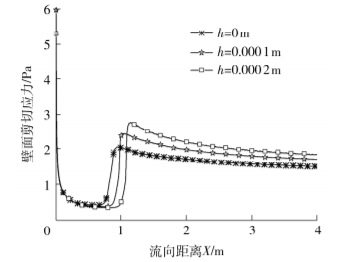
The γ-Reθt transition model was used to numerically simulate the boundary layer on the surface of the plate. The development of the boundary layer in the normal and the flow direction, as well as the effect of factors such as wall roughness,incoming wind speed,turbulence intensity, and pressure gradient on the boundary layer were studied. The study show that, in the transition interval, skin-friction coefficient and the total pressure at a certain height from the wall undergo abrupt changes; in the flow direction, the boundary layer continues to thicken but its growth rate continues to decline; in the laminar boundary layer, the viscous stress is dominant, but in the turbulent boundary layer, the sub-layer is firstly dominated by viscous stress, then the viscous stress decreases rapidly and the Reynolds stress increases rapidly, finally Reynolds stress is dominant in the log-law region. During the transition process, the maximum value of the viscous stress near the wall continues to increase but its attenuation becomes faster. The maximum value of Reynolds stress continues to increase but the normal height corresponding to the maximum value continues to decrease. The increase in roughness makes the viscous sub-layer of the turbulent boundary layer disappears and the log-law layer moves down. The increase of turbulence intensity and wind speed advances the transition, shortens the transition interval, and reduces the growth rate of the turbulent boundary layer. The pressure gradient has a great influence on the growth rate of the turbulent boundary layer, and the adverse pressure gradient thickens the boundary layer quickly.
HE Shengtai LAN Wei HU Xingjun
. Numerical Simulation of Flow Pattern Structure in Boundary Layer on Flat Plate Surfaces[J]. Journal of South China University of Technology(Natural Science), 2021
, 49(6)
: 9
-18
.
DOI: 10.12141/j.issn.1000-565X.200454
