Computer Science & Technology

Partial Multi-view Clustering Based on StarGAN and Subspace Learning

Expand
  • School of Mathematics,South China University of Technology,Guangzhou 510640,Guangdong,China
刘小兰(1979-),女,博士,副教授,主要从事优化算法与机器学习研究。

Received date: 2020-03-24

  Revised date: 2020-07-04

  Online published: 2020-11-05

Supported by

Supported by the National Natural Science Foundation of China (61502175) and the Natural Science Founda-tion of Guangdong Province (2020A1515010699)
Abstract

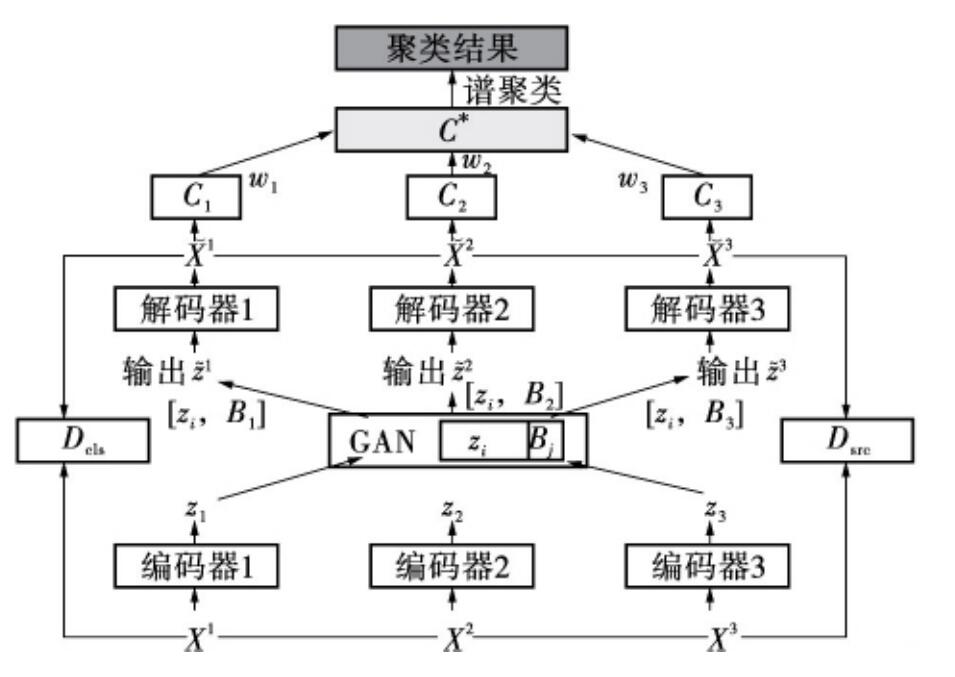
The traditional multi-view clustering method assumes that the data of each view is complete. However,there is a lack of data in some views in real life,and thus leads to the problem of partial multi-view clustering.Most of the existing partial multi-view clustering methods are based on kernel matrix and non-negative matrix de-composition,and most of them are just learning a common clustering structure,rather than making full use of the existing data information to infer the missing data. Based on StarGAN and subspace learning,a partial multi-view clustering algorithm (SSPMVC) was proposed in this study. SSPMVC makes full use of the existing data informa-tion to generate the missing data with the generation model based on StarGAN,captures the integrity and consisten-cy global structure of the data,and then clusters the completed multi-view data in the subspace. The generation model and clustering model were trained jointly by SSPMVC,and the generation model and clustering model were alternately optimized. The experimental results show that the algorithm proposed in this paper is superior to the classical multi-view clustering method.

Cite this article

LIU Xiaolan YE Zehui . Partial Multi-view Clustering Based on StarGAN and Subspace Learning[J]. Journal of South China University of Technology(Natural Science), 2020 , 48(11) : 87 -98 . DOI: 10.12141/j.issn.1000-565X.200128

Outlines

/