Energy, Power & Electrical Engineering

Passivity-Based Control of Primary-Side and Secondary-Side Rectifier Bridge in Wireless Power Transfer System for Electric Vehicle

Expand
  • School of Electrical Power,South China University of Technology,Guangzhou 510640,Guangdong,China
杨金明(1963-),男,博士,教授,主要从事无线电能传输和新能源发电研究。E-mail: jmyang@ scut. edu. cn

Received date: 2019-11-20

  Revised date: 2020-05-07

  Online published: 2020-09-14

Supported by

Supported by the National Natural Science Foundation of China (51877085)
Abstract

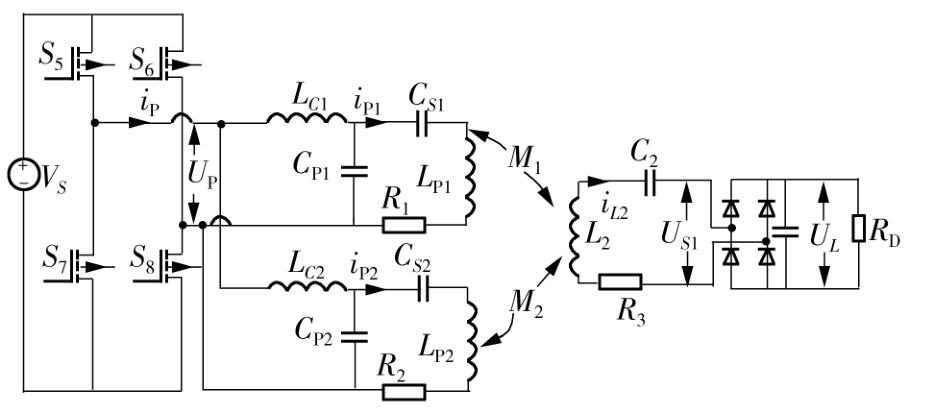
A passivity-based control method for primary-side and secondary-side rectifier bridges of dynamic wire-less power transfer system for electric vehicle (EV) was proposed in this paper. It can realize power factor correc-tion and constant voltage control on both sides under the fluctuation of mutual inductance and load. Firstly,the control target was proposed,and the Euler-Lagrange (EL) model of the bridge was established. Then,based on the characteristics of dynamic wireless power transfer system,the passivity-based control law based on PI correction was designed. The control algorithm was verified by simulation in SIMULINK and the feasibility of the control me-thod was proved in the experimental platform.

Cite this article

YANG Jinming SUN Jieshan LIU Runpeng . Passivity-Based Control of Primary-Side and Secondary-Side Rectifier Bridge in Wireless Power Transfer System for Electric Vehicle[J]. Journal of South China University of Technology(Natural Science), 2020 , 48(10) : 11 -18,47 . DOI: 10.12141/j.issn.1000-565X.190847

Outlines

/