Architecture & Civil Engineering

Optimization of Force State of Stiffened Long Cantilever Concrete Box Girder During Construction

Expand
  • School of Civil Engineering,Central South University,Changsha 410075,Hunan,China
宋旭明(1974-),男,博士,副教授,主要从事桥梁设计、极限承载力研究。E-mail: ctysxm@163. com

Received date: 2019-11-22

  Revised date: 2020-04-25

  Online published: 2020-05-09

Supported by

Supported by the National Natural Science Foundation of China (51978667)
Abstract

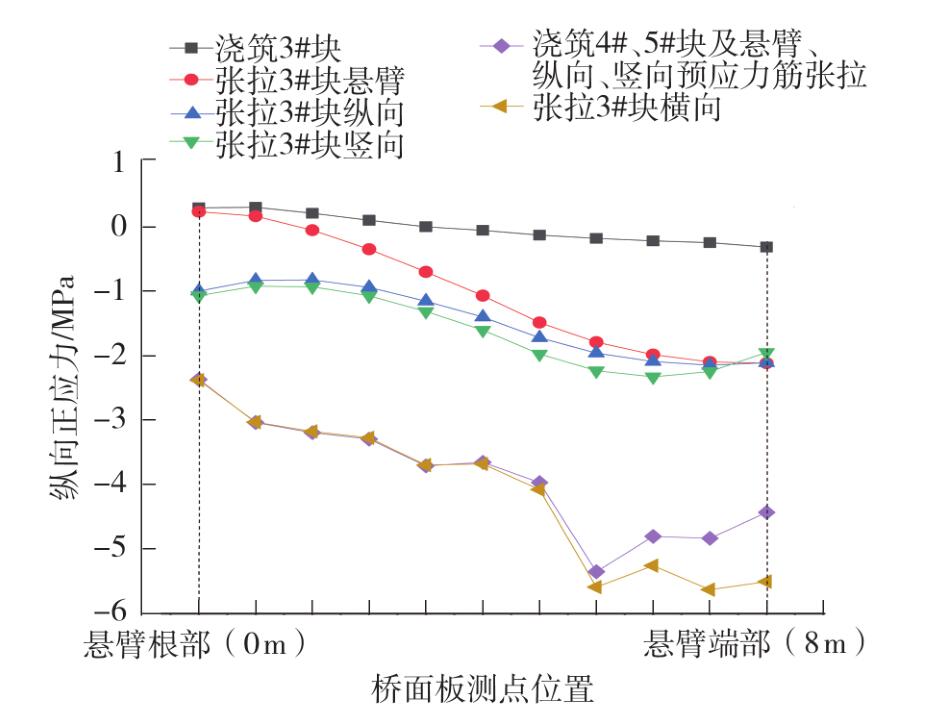
The prestressed concrete box girder bridge with long cantilever plates often has lateral and oblique cracks at the segmental junction during the construction process. In order to formulate reasonable measures to improve the cracks,the mechanism of crack development was studied. The bridge segment model was established by MIDAS FEA software and the shear lag effect under self-weight and pre-stress was analyzed. The finite element model was verified by comparing the finite element results with the measured values. By changing the tension sequence of the prestressed tendons,the stress state of the sections under different working conditions was studies. The results show that the insufficient compressive stress caused by shear lag effect at the end of the cantilever plate is one of the fac-tors contributed to the cracks at the cantilever end,and this can be improved by adding reinforcement at the canti-lever end. By reasonably changing the tension sequence of the prestressed tendons,the structural pretreatment and stress state can be effectively improved and the cracks during construction process can be reduced.

Cite this article

SONG Xuming, LI Mengran, LAI Mingyuan, et al . Optimization of Force State of Stiffened Long Cantilever Concrete Box Girder During Construction[J]. Journal of South China University of Technology(Natural Science), 2020 , 48(10) : 67 -75 . DOI: 10.12141/j.issn.1000-565X.190854

Outlines

/