Mechanical Engineering

Thermal Performance Characterization of Hydrostatic Thrust Bearing Under High Speed and Heavy Load Working Conditions

Expand
  • MOE Key Laboratory of Advanced Manufacturing and Intelligent Technology,Harbin University of Science and Technology,Harbin 150080,Heilongjiang,China
于晓东 (1971-),男,博士,教授,主要从事摩擦磨损与润滑及数控技术研究。

Received date: 2019-10-28

  Revised date: 2020-04-30

  Online published: 2020-09-01

Supported by

Supported by the Natural Science Foundation of Heilongjiang Province (E2016040)
Abstract

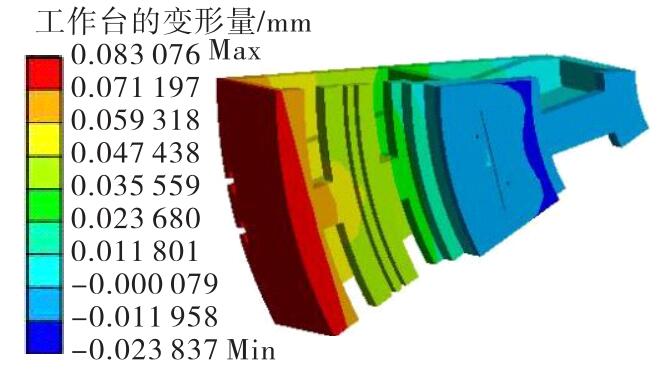
Due to the dual effects of strong shear and strong extrusion,oil-film has a large heat generation and the uneven rise of temperature leads to thermal deformation in the hydrostatic thrust bearing under high speed heavy load working conditions. The convective heat transfer of hydrostatic thrust bearing under different conditions is dif-ferent,which further causes uneven thermal deformation of the worktable and the base. In order to characterize its thermal characteristics,an equal-area segmentation method was proposed to calculate the convective heat transfer coefficient of hydrostatic thrust bearing under different conditions. The temperature distribution and thermal defor-mation of the workbench and the base was simulated by using ANSYS Workbench,and the thermal deformation dis-tribution and influence of load and rotational speed on their deformation were obtained and were verified by the built experimental setup. The results show that when the load is 0 ~8t,the deformation increases with the increase of the load and the decrease of the rotational speed; when the load is 8 ~24t,the deformation gradually decreases as the load increases and the speed decreases; when the load is 24 ~32t,the rotary table is Z negative deformation,and the maximum deformation is at the edge of the table. The maximum deformation of the base is concentrated on the lowermost rib part of the base. The deformation of the base is smaller than that of the rotary table. The deformation of the hydrostatic rotary table decreases when the load is 16 ~30t,and the optimal load is 16 ~30 t. It is recom-mended to further improve the thermal deformation resistance by optimizing its internal structure or enhancing heat dissipation.

Cite this article

YU Xiaodong, GAO Weicheng, WU Guangpeng, et al . Thermal Performance Characterization of Hydrostatic Thrust Bearing Under High Speed and Heavy Load Working Conditions[J]. Journal of South China University of Technology(Natural Science), 2020 , 48(9) : 79 -85 . DOI: 10.12141/j.issn.1000-565X.190774

Outlines

/