
Journal of South China University of Technology(Natural Science) >
Dynamic Response of Aortic Valve of Occupant to Blunt Thoracic Impact in Traffic Accident
Received date: 2020-05-06
Revised date: 2020-08-14
Online published: 2020-06-19
Supported by
Supported by the National Natural Science Foundation of China ( 51775193) and the National Automobile Accident In-Depth Investigation System Funding Project ( ZL-ZHGT-2020014)
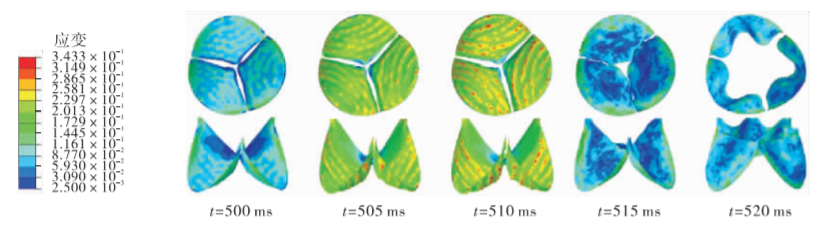
In traffic accidents,aortic valve dysfunction resulting from blunt thoracic impact of occupant and pedestrians can cause congestive heart failure or death. To investigate the effects of thoracic impact timing related to the cardiac cycle on aortic valve injury,a fluid-structure interaction ( FSI) model of aortic valve and blood was established based on smoothed particle dynamics ( SPH) method,and was validated by the valve movement under normal physiological conditions. To ensure the boundaries of the physiological properties,the dynamic blood pressure of animal tests and physiological pressure of human body were combined to load on the coupling model,and the biomechanical response of the aortic valve in different impact timing was simulated. The results show that different impact moments ( diastolic or systolic period) lead to different valve stress and strain fields,valve opening and closing rates. When the valve is open ( like the middle diastolic period) ,it is less likely to suffer from impact injury; when the valve is closed ( like the middle and late diastolic period) ,it is more vulnerable to injury.
Key words: biomechanics; aortic valve; fluid-structure interaction; impact injury
TONG Fang, LAN Fengchong, CHEN Jiqing, et al . Dynamic Response of Aortic Valve of Occupant to Blunt Thoracic Impact in Traffic Accident[J]. Journal of South China University of Technology(Natural Science), 2021 , 49(1) : 113 -122,152 . DOI: 10.12141/j.issn.1000-565X.200213
/
| 〈 |
|
〉 |