Fluid Power & Electromechanical Control Engineering

Research on Energy Saving of Linear Actuator Based on Hydraulic Transformer

Expand
  • 1. School of Mechatronics Engineering,Harbin Institute of Technology,Harbin 150080,Heilongjiang,China; 2. State Key Laboratory of Fluid Power and Mechatronic Systems,Zhejiang University,Hangzhou 310027,Zhejiang,China; 3. Department of Mechatronics Engineering,University of Shanghai for Science and Technology,Shanghai 200093,China
姜继海(1957-),男,博士,教授,主要从事液压传动基础理论及应用研究。E-mail: jjhlxw@hit.edu.cn

Received date: 2019-10-08

  Online published: 2020-03-18

Supported by

Supported by the National Natural Science Foundation of China ( 51775131) ,Open Foundation of the State Key Laboratory of Fluid Power and Mechatronic Systems of Zhejiang University ( GZKF-201708) and the Natural Science Founda- tion of Shanghai ( 19ZR1435400)
Abstract

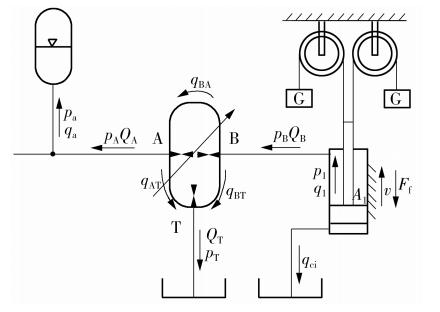
The hydraulic transformer can theoretically control the speed of the linear actuator without throttling loss and can recover and reuse the energy of the load. In order to improve the energy efficiency of the hydraulic transformer,, thea total efficiency model of the energy-saving system iwas designed in this paper. Based on To achieve the highest total efficiency,, the numerical value of the hydraulic accumulator volume iwas calculated by optimization algorithm,and t. The variation curve of gas pressure in the process of energy recovery iwas analyzed,, and the parameter of the hydraulic accumulator was the parameter matching of the hydraulic accumulator is completed. The Simulinkmathematical model of Simulink for of energy-saving system iwas established. The speed of movement was controlled Twith the fuzzy PID control strategy is used to control the motion speed when the load is falling. The simulation results show that the control strategy performs well in speed controlcan well control the motion speed.

Cite this article

JIANG Jihai, DU Zhi, SHEN Wei, et al . Research on Energy Saving of Linear Actuator Based on Hydraulic Transformer[J]. Journal of South China University of Technology(Natural Science), 2020 , 48(2) : 116 -121,136 . DOI: 10.12141/j.issn.1000-565X.190686

Outlines

/