Architecture & Civil Engineering

Comparative Study of the Vulnerability of Canonical Structures in Different Intensity Regions

Expand
  • 1. School of Civil Engineering, Northeast Forestry University, Harbin 150030, Heilongjiang, China; 2. School of Civil Engineering, Southwest Jiaotong University, Chengdu 614202, Sichuan, China
李思齐(1983-),男,讲师,博士生,主要从事结构抗震方面研究。E-mail:9654127@qq.com

Received date: 2019-06-10

  Revised date: 2019-09-29

  Online published: 2020-03-01

Supported by

Supported by the National Natural Science Foundation of China (51608452) and the General Program of China Postdoctoral Science Foundation (2017M621594) 
Abstract

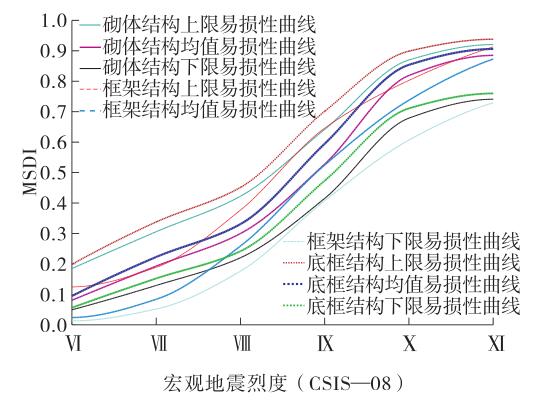
In order to study the earthquake vulnerability difference of canonical structures in different intensity regions, the seismic damage data of 7099 buildings in Dujiangyan, including masonry structure, reinforced concrete frame structure and bottom frame-seismic wall masonry structure after Wenchuan earthquake, were analyzed. Considering the number of floors, coupling effect of chronological and seismic fortification factors, the probability matrices of actual seismic damage and the comparative analysis model curves of various structural types were developed. The actual seismic vulnerability matrices and its non-linear continuous regression model were constructed in different intensity zones, and the vulnerability curves of transcendence probability of actual seismic damage and seismic damage grade were drawn respectively. A vulnerability matrix model of mean seismic damage index (MSDI) was put forward, and it was verified by the actual seismic damage matrix of canonical structures. Based on the validation results, the vulnerability matrix and multi-dimensional curve model of the city based on this parameter were established.

Cite this article

LI Siqi YU Tianlai ZHANG Ming . Comparative Study of the Vulnerability of Canonical Structures in Different Intensity Regions[J]. Journal of South China University of Technology(Natural Science), 2020 , 48(3) : 67 -75,90 . DOI: 10.12141/j.issn.1000-565X.190320

Outlines

/