Special Welding Robot

Effect of the Direction of Droplet Impingement on the Bead Quality

  • ZHANG Zhanhui XUE Jiaxiang
Expand
  • School of Mechanical and Automotive Engineering,South China University of Technology,Guangzhou 510640,Guangdong,China
张占辉(1987-),男,博士生,主要从事电弧焊接及电流波形调控研究. E-mail:mezhangzh@mail. scut. edu. cn

Received date: 2018-12-29

  Online published: 2020-03-17

Supported by

Supported by the National Natural Science Foundation of China(51875213) and the Natural Science Foundation of Fu- jian Province(2018J01503)
Abstract

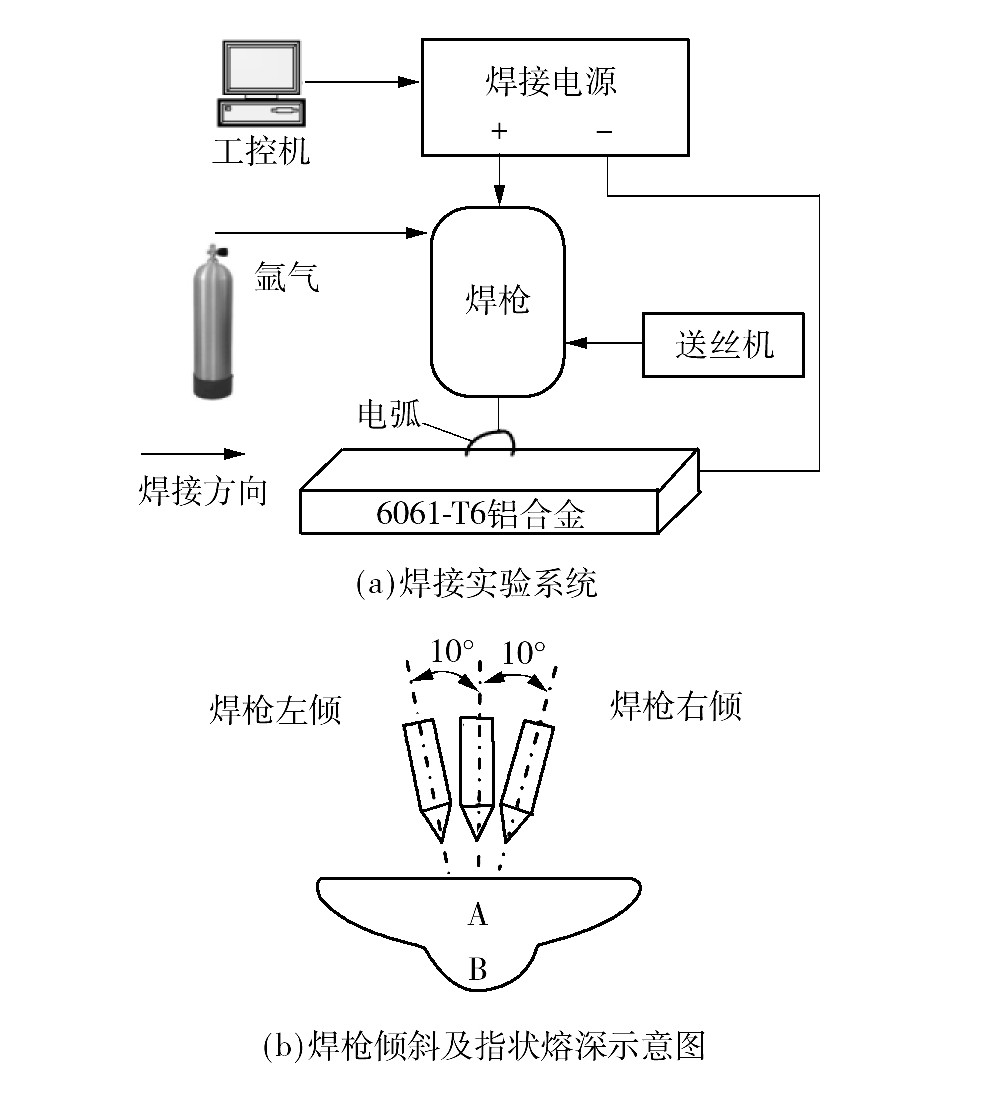
Bead-on-plate welding was conducted on a 6061 aluminum alloy sheet by pulsed gas metal arc welding (P-GMAW) with welding torch inclined in transverse plate,in order to investigate the effect of droplet impingement direction on spatters,profile of welding pool,microstructure,porosities and cracks. Results show that when the torch is inclined,the spatter is dramatically increased and is on the same side with the inclined torch. Meanwhile, the grains can be refined by the effect of droplet impingement. Taking the welding torch inclined to right-hand as an example,because of an asymmetric driving forces within the molten pool,the highest point of the bead does not co- incide with the center line of the lower penetration; the biggest deviation from the bottom center line is 20. 1% of the maximum bead width. Heat affected zone and the micro-hardness zone are wider on the right side that the left. Porosity and crack distribute separately on the two sides of the bead,respectively. Most pores are formed and trapped on the left side,while a substantial number of cracks emerge on the right side. This distribution of porosity and crack is attributed to the molten metal flow pattern which is driven by droplet impingement. The molten metal flow prevents the air hole from escaping on the left side,but facilitates the cracks to appear on the right side.

Cite this article

ZHANG Zhanhui XUE Jiaxiang . Effect of the Direction of Droplet Impingement on the Bead Quality[J]. Journal of South China University of Technology(Natural Science), 2019 , 47(4) : 138 -144 . DOI: 10.12141/j.issn.1000-565X.180655

References

 
Outlines

/