Special Welding Robot

Droplet Transfer Behavior of High-current GMAW and Its Control

  • XIAO Lei FAN Ding ZHENG Falei HUANG Jiankang YANG Wenyan
Expand
  • 1. School of Material Science and Engineering,Lanzhou University of Technology,Lanzhou 730050,Gansu,China; 2. State Key Laboratory of Advanced Processing and Recycling of Non-ferrous Metals,Lanzhou University of Technology,Lanzhou 730050, Gansu,China; 3. Central Research Institute,Zoomlion Limited Liability Company,Changsha 410000,Hunan,China
肖磊(1991-),男,博士生,主要从事高效焊接方法及焊接过程数值模拟研究. E-mail:xxxiaolei@ aliyun. com

Received date: 2019-01-02

  Online published: 2020-03-17

Supported by

Supported by the National Natural Science Foundation of China(51775256)
Abstract

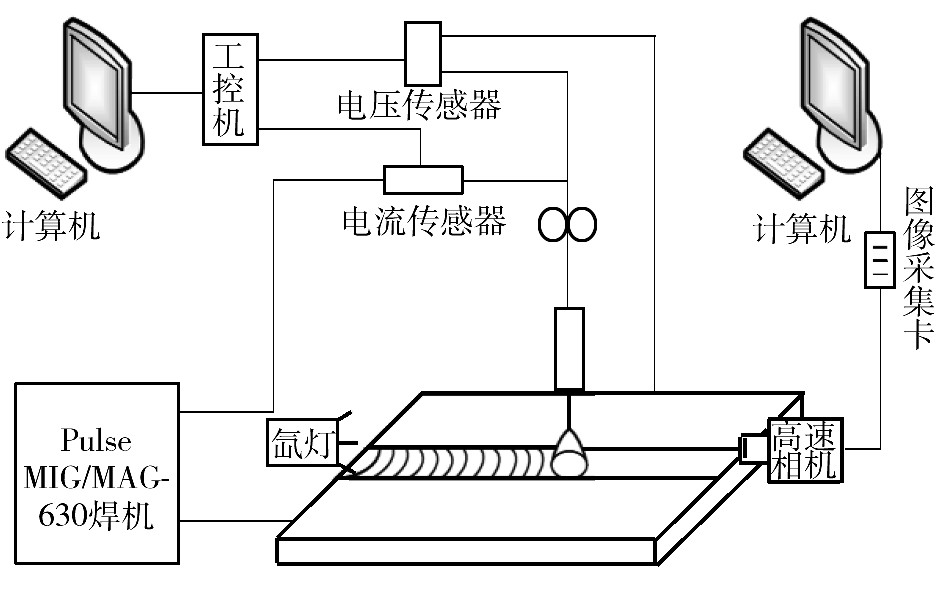
Single wire high-current GMAW welding methods with steady metal transfer processes has irreplaceable advan- tages over other high-efficiency GMAW welding methods. Based on the high-speed photography and electric signals se- lecting technology in metal transfer process of GMAW,the differences between MIG and MAG welding were discussed, and the impacts of current or shielding gas constitution on transfer frequency were highlighted. The results indicate that metal transfer style of high-current MIG welding is rotating spray transfer,and the rotating frequency of MIG welding de- crease at first and then increase with the increase of welding current; while in the MAG welding,it becomes a mixing rotating and swing transfer style,and the rotating frequency or swing frequency increases when the flow beam contacts with the weld pool in high current condition. In addition,the external magnetic field can change the rotation direction of large current GMAW flow beam and arc,and reduce the rotation angle. This discovery provides a new idea for the research and development of high efficiency GMAW welding process with single wire over 400A.

Cite this article

XIAO Lei FAN Ding ZHENG Falei HUANG Jiankang YANG Wenyan . Droplet Transfer Behavior of High-current GMAW and Its Control[J]. Journal of South China University of Technology(Natural Science), 2019 , 47(4) : 127 -131,137 . DOI: 10.12141/j.issn.1000-565X.180654

References

 
Outlines

/