Traffic & Transportation Engineering

Short-term Prediction of Passenger Flow on Bus Routes Based on K-means Clustering Combination Models

  • CHEN Weiya PAN Xin FANG Xiaoping
Expand
  • School of Traffic and Transportation Engineering,Central South University,Changsha 410075,Hunan,China
陈维亚(1981-),男,博士,副教授,主要从事交通运输规划与管理研究. E-mail:wychen@ csu. edu. cn

Received date: 2018-09-29

  Online published: 2020-03-17

Supported by

Supported by the National Natural Science Foundation of China(61203162)and the Natural Science Foundation of Hunan Province(2018JJ2537)
Abstract

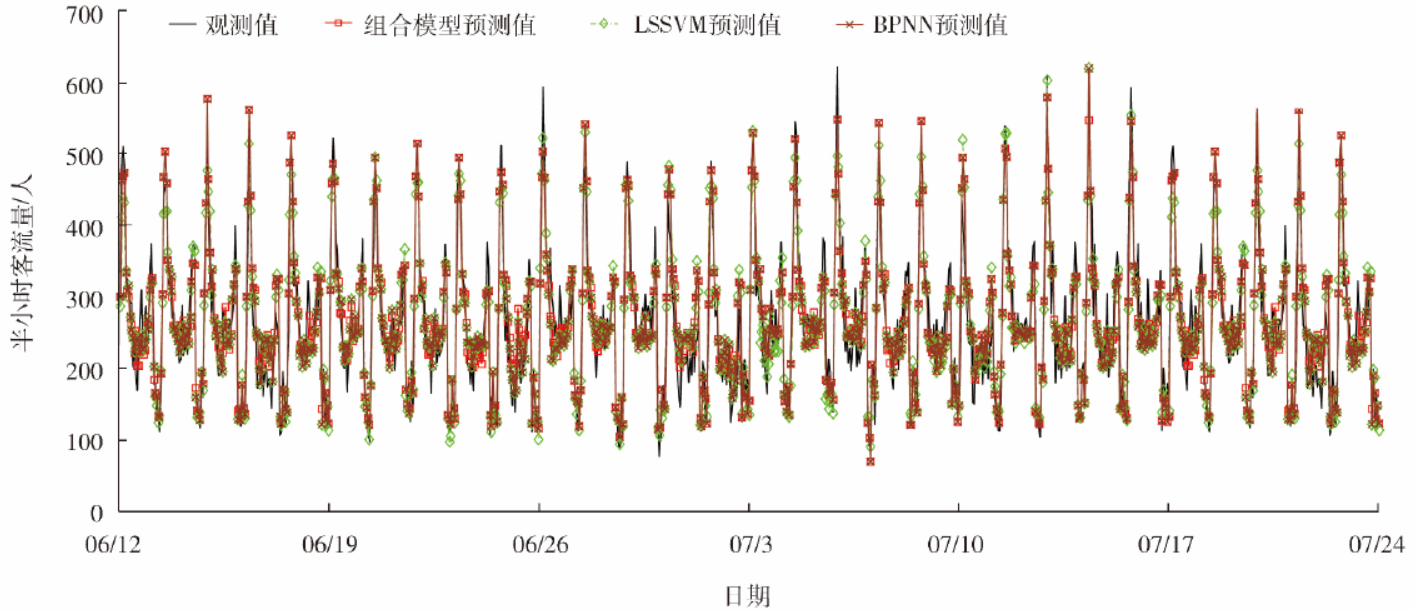
The prediction of the short-term passenger flow on a bus route plays a key role in the daily dynamic bus dispatching system. A combined forecasting model based on K-means clustering algorithm was constructed through analyzing passenger flow characteristics. The historical short-term passenger demand data was divided into different clusters by using K-means algorithm according to the similarity of time-varying demand. Each cluster of the passen- ger demand was predicted individually by using Least Squares Support Vector Machine (LSSVM),Back Propaga- tion Neural Network (BPNN) and Auto-regressive Moving Average (ARMA). The parameters of LSSVM and BPNN were optimized by the genetic algorithms. The weather effects on passenger flow were also considered. The combination models were formed by a combination of the best prediction models for each cluster. The passenger flow data of Route 104 in Changsha of China was used for the case studies. The results show that the model combinations depend on the differences of the time-varying passenger flow. The K-means clustering method has the ability to classify the time-varying passenger flow data in different periods,which is conducive to improving the prediction performance. The K-means clustering combination models are a promising tool to predict the short-term passenger flow on a bus route,especially when considering the weather effects.

Cite this article

CHEN Weiya PAN Xin FANG Xiaoping . Short-term Prediction of Passenger Flow on Bus Routes Based on K-means Clustering Combination Models[J]. Journal of South China University of Technology(Natural Science), 2019 , 47(4) : 83 -89,113 . DOI: 10.12141/j.issn.1000-565X.180489

References

 
Outlines

/