Computer Science & Technology

Incentive Mechanism of Crowdsensing Based on Loss Aversion

  • LIU Jiaqi GAO Mu
Expand
  • School of Computer Science of Engineering,Central South University,Changsha 410075,Hunan,China
刘佳琦(1983-),女,博士后,副教授,主要从事分布式与移动计算、软件工程研究.

Received date: 2018-10-26

  Revised date: 2019-06-16

  Online published: 2019-08-01

Supported by

Supported by the National Natural Science Foundation of China(61572528)
Abstract

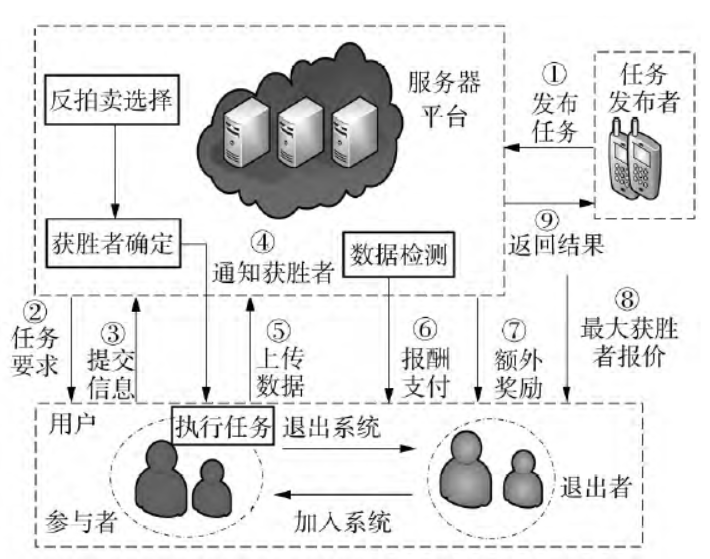
At present,the incentive mechanism of crowdsensing is mostly based on traditional economics,while the study of behavioral economics shows that users do not always pursue the maximization of their economic utility because of loss aversion,and the incentive mechanism based on traditional economics can not fully and effectively motivate users. Therefore,an incentive mechanism based on loss aversion (LA-RAIM) was designed. This mecha- nism sets reward factor based on user's loss aversion. By giving users additional rewards during the incentive time, users feel that they will lose if they do not participate in the system,so as to motivate more users to participate. Compared with the classical RVA-IM,the simulation results show that LA-RAIM can not only increase the number of participants,but improve the platform utility and user average utility.

Cite this article

LIU Jiaqi GAO Mu . Incentive Mechanism of Crowdsensing Based on Loss Aversion[J]. Journal of South China University of Technology(Natural Science), 2019 , 47(8) : 96 -104 . DOI: 10.12141/j.issn.1000-565X.180534

References

 
Outlines

/