Traffic & Transportation Engineering

Incorporating the Heterogeneity into Travelers' Green Traveling Choice Model

Expand
  •  School of Civil Engineering and Transportation,South China University of Technology,Guangzhou 510640,Guangdong,China
刘建荣(1984-),男,博士,讲师,主要从事出行行为选择研究. E-mail:ctjrliu@ scut. edu. cn

Received date: 2018-07-16

  Revised date: 2019-02-15

  Online published: 2019-06-01

Supported by

Supported by the National Natural Science Foundation of China(51578247)
Abstract

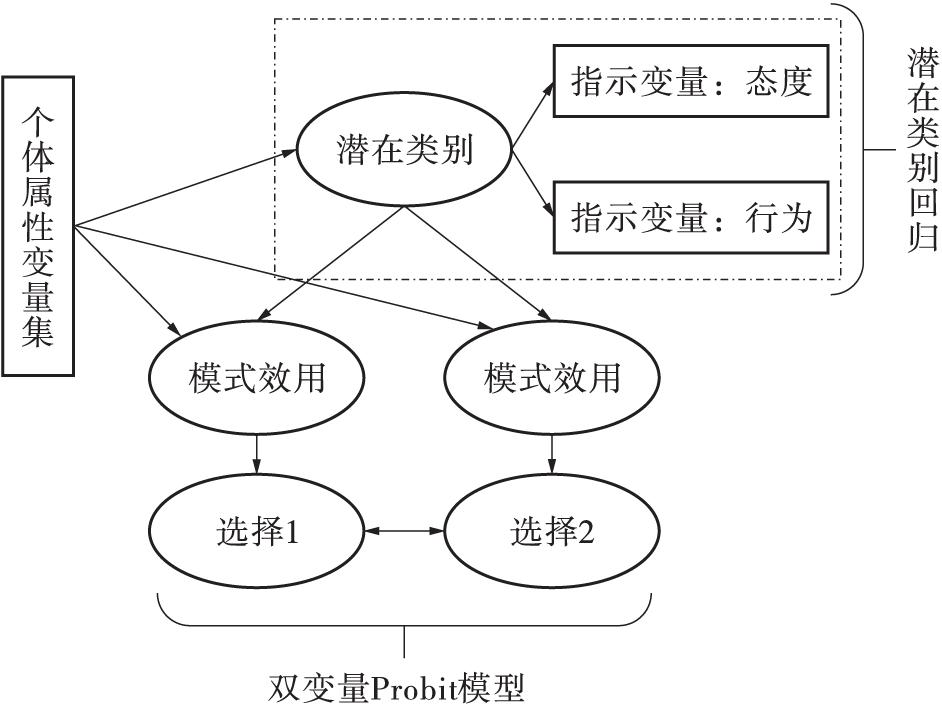
Restricting privates car use and promoting pure electric vehicles use are two important ways to realize green travel in China cities. In order to analyze the impact of travelers' environmental awareness on green travel, travelers were categorized with the latent class analysis based on travelers' attitude towards environment and trave- ling behaviors. Then travelers' latent class was introduced into the traditional bi-variate probit model as explanatory independent variables. And the impact of travelers' latent class on the approval of private car restriction policies and the purchase intention of pure electric vehicles were analyzed. The results show that according to their attitude towards environment and traveling behaviors,travelers can be categorized into three latent classes: the environ- mentalist,the non-environmentalist,the pseudo-environmentalist. There is a higher degree of fitting when incor- porating travelers' latent class into the bivariate probit model. And travelers' latent classes have great impacts on their green traveling choice.

Cite this article

LIU Jianrong HAO Xiaoni . Incorporating the Heterogeneity into Travelers' Green Traveling Choice Model[J]. Journal of South China University of Technology(Natural Science), 2019 , 47(7) : 99 -104,120 . DOI: 10.12141/j.issn.1000-565X.180365

References

 
Outlines

/