Materials Science & Technology

Flame-Retarded Nylon 6 by the Synergy of Melamine Stannous Phosphate Glass with Aluminum Diethylphosphinate

Expand
  •  School of Materials Science and Engineering,South China University of Technology,Guangzhou 510640,Guangdong,China
刘述梅( 1968-) ,女,博士,教授,博士生导师,主要从事高分子材料改性研究

Received date: 2018-09-20

  Revised date: 2018-12-20

  Online published: 2019-04-01

Supported by

 Supported by the National Natural Science Foundation of China( 51573054)
Abstract

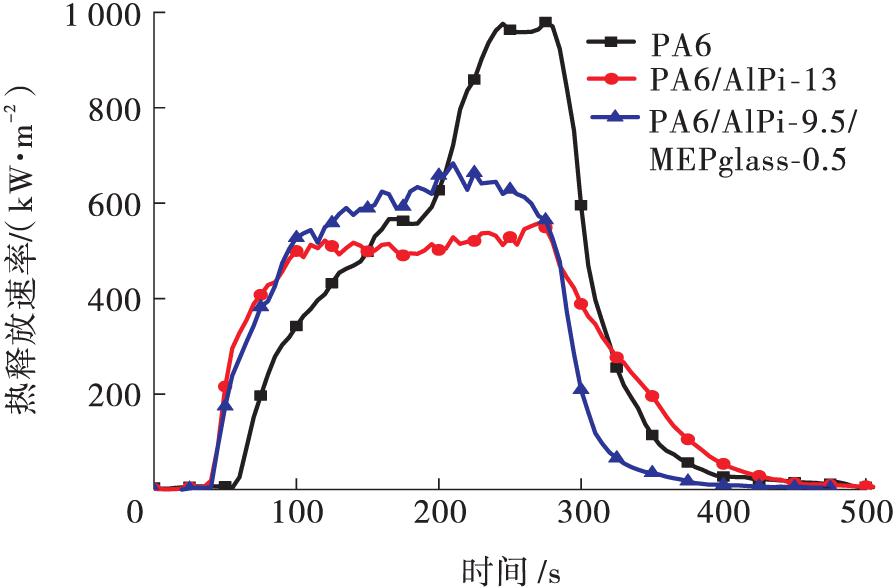
Stannous phosphate glass was prepared by melting stannous oxide and phosphorus pentoxide at a molar ratio of 50∶50 at 500 ℃,which was then combined with melamine by ionic bond to form melamine stannous phosphate glass ( MEPglass) . Finally,MEPglass and aluminum diethylphosphinate ( AlPi) were employed to obtain halogen-free flame-retardancy of PA6. It is found that 0. 5% MEPglass and 9% AlPi can induce PA6 to reach UL94 V-0 @ 3. 2 mm rating,with a total relative addition reduction of 26. 9% ,as compared with the addition ( 13% ) of single AlPi,while the tensile strength improves by 8. 5% and the melt flow rate increases by 13. 3% . Moreover,the results obtained from the cone calorimeter,thermogravimetry-infrared spectroscopy and thermogravimetric analysis of the samples,and scanning electron microscopy and X-ray energy spectrum analysis of carbon residue indicate that there is strong flame-retardant synergy of MEPglass and AlPi on PA6 in both the gas phase and the condensed phase.

Cite this article

LIU Shumei XIA Wei ZHU Ruizhe CAI Jianan ZHAO Jianqing . Flame-Retarded Nylon 6 by the Synergy of Melamine Stannous Phosphate Glass with Aluminum Diethylphosphinate[J]. Journal of South China University of Technology(Natural Science), 2019 , 47(5) : 39 -47 . DOI: 10.12141/j.issn.1000-565X.180470

References

 
Outlines

/