Traffic & Transportation Engineering

Resource Allocation Model Based on Multi-objective Path Planning in Emergency Management

  • ZHAO Xing JI Kang LIN Hao XU Peng
Expand
  •  College of Civil and Transportation Engineering,Hohai University,Nanjing 210098,Jiangsu,China
赵星(1986-),女,博士,副教授,主要从事交通运输规划与管理研究.

Received date: 2018-08-31

  Revised date: 2018-11-29

  Online published: 2019-03-01

Supported by
 

Abstract

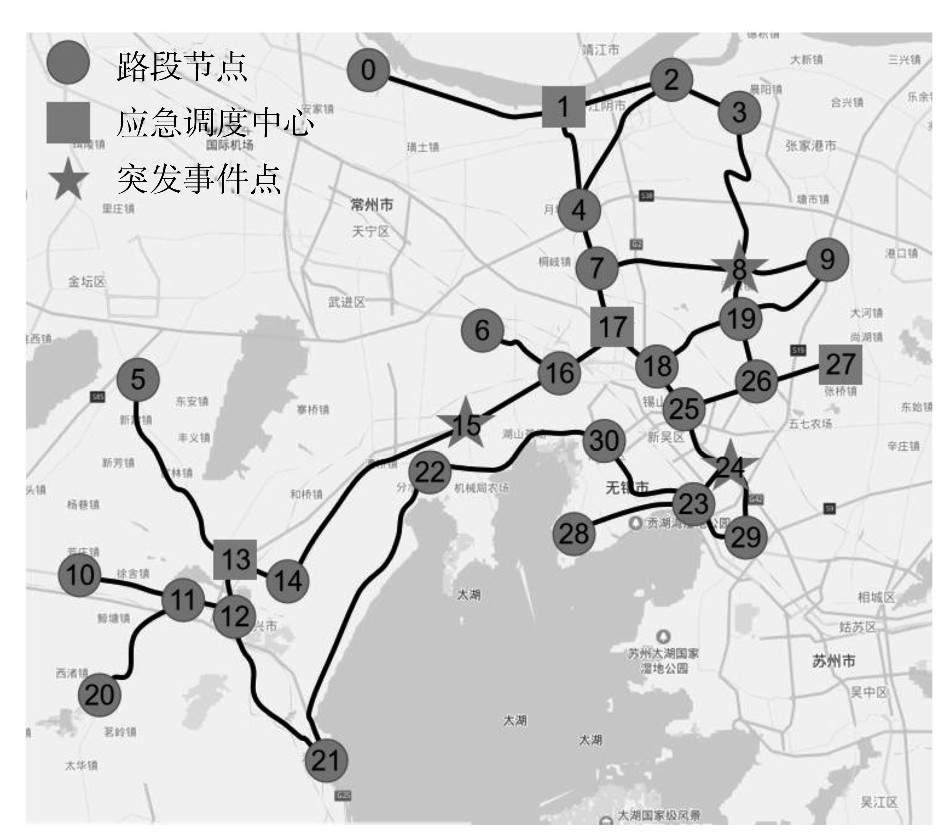
With the increasing emergencies,resource allocation in emergency management is vital for fast rescue operation and reducing property loss. A resource allocation model was constructed based on multi-objective path planning,aiming at solving two problems: path planning and resource allocation. Considering impacts of emergen- cies on the road network,the model conducted path planning with two optimization goals: (1) timeliness: obtain the path travel time based on BPR (Bureau of Public Road of United States) road impedance function; (2) relia- bility: evaluate the path travel time reliability degree based on historical traffic volume data. An algorithm integra- ting Tabu Search and non-dominated sorting was devised to acquire the Pareto solution set. By setting index weights,the optimal paths from dispatch centers to emergency areas could be determined. Secondly,according to the optimal paths and the level of emergencies,utility coefficient was introduced to establish the total resource utili- ty function. To achieve the maximum total resource utilization benefits,Lingo was used to obtain the optimal re- source allocation scheme. At last,a cases study which verified the effectiveness of the proposed model and solving method,was presented based on the historical data of Wuxi road network.

Cite this article

ZHAO Xing JI Kang LIN Hao XU Peng . Resource Allocation Model Based on Multi-objective Path Planning in Emergency Management[J]. Journal of South China University of Technology(Natural Science), 2019 , 47(4) : 76 -82 . DOI: 10.12141/j.issn.1000-565X.180437

References

 
Outlines

/