Journal of South China University of Technology(Natural Science Edition) ›› 2026, Vol. 54 ›› Issue (2): 112-122.doi: 10.12141/j.issn.1000-565X.250163
• Architecture & Civil Engineering • Previous Articles Next Articles
Research and Application of an Evaluation System for the Flexural Cost Performance Ratio of UHPC Beam Components
FAN Xueming, YE Xiaohang, ZHOU Xiaopeng, YIN Shiling
- School of Civil Engineering and Transportation,South China University of Technology,Guangzhou 510640,Guangdong,China
-
Received:2025-06-04Online:2026-02-25Published:2025-09-05 -
About author:范学明(1979—),男,博士,讲师,主要从事超高性能混凝土材料、设计、结构、施工和检测一体化全产业研究。E-mail: fanxm@scut.edu.cn -
Supported by:the National Natural Science Foundation of China(52278501);the Open Fund Project of Guangdong Key Laboratory of Earthquake Engineering and Applied Technology(2017B030314068)

CLC Number:
Cite this article
FAN Xueming, YE Xiaohang, ZHOU Xiaopeng, YIN Shiling. Research and Application of an Evaluation System for the Flexural Cost Performance Ratio of UHPC Beam Components[J]. Journal of South China University of Technology(Natural Science Edition), 2026, 54(2): 112-122.
share this article
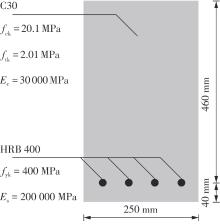
Fig.1
Schematic diagram of standard bending component cross-section"
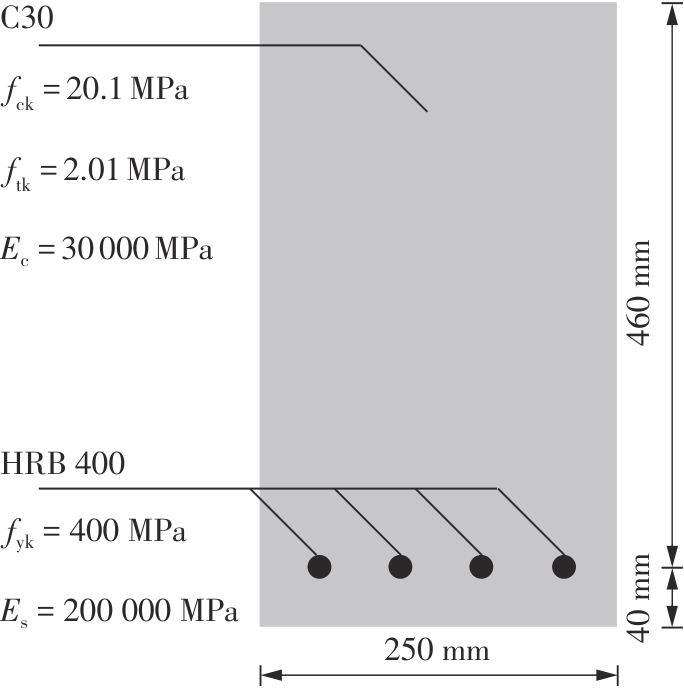
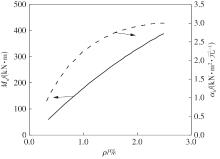
Fig.2
Bending capacity and cost performance ratio curves of singly reinforced rectangular beams"
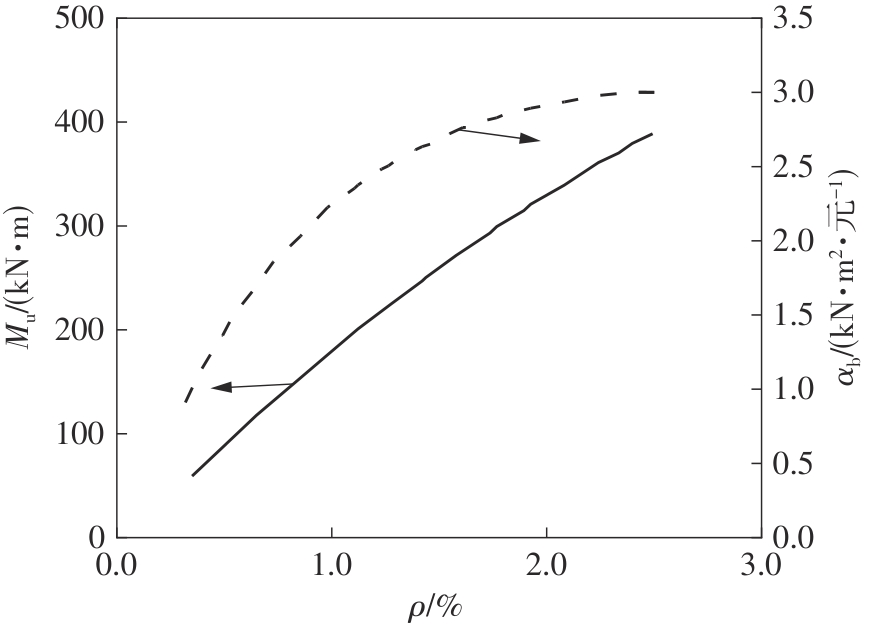

Fig.3
Schematic diagram of flexural cost performance ratio scaling for beam components"


Table 1
Relevant variables of α¯b"
| 变量名称 | 变量符号 | 分布区间 |
|---|---|---|
| 截面配筋面积 | As | |
| 截面高度 | h | |
| 保护层厚度 | as | |
| 钢筋抗拉强度 | fyk | |
| 混凝土抗压强度 | fck | |
| 单位体积钢筋价格 | ps | |
| 单位体积混凝土价格 | pc |
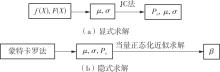
Fig.4
Flow chart of merit degree analysis"
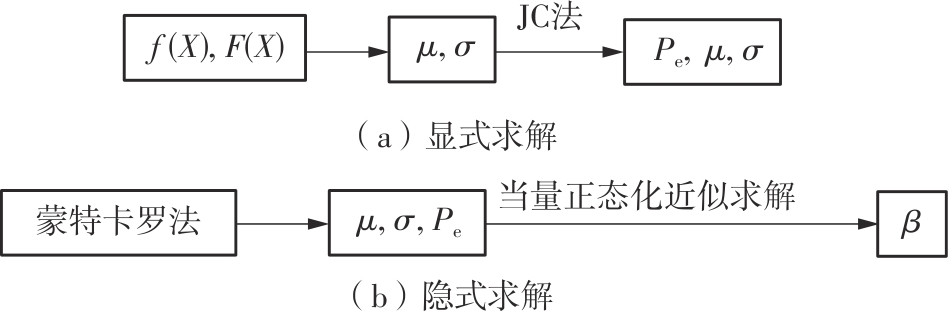
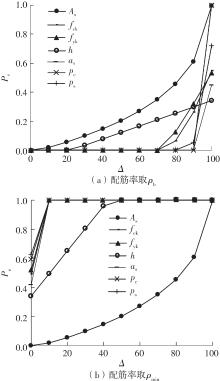
Fig.5
Inferior-value probability curves of balanced reinforcement ratio for each variable"
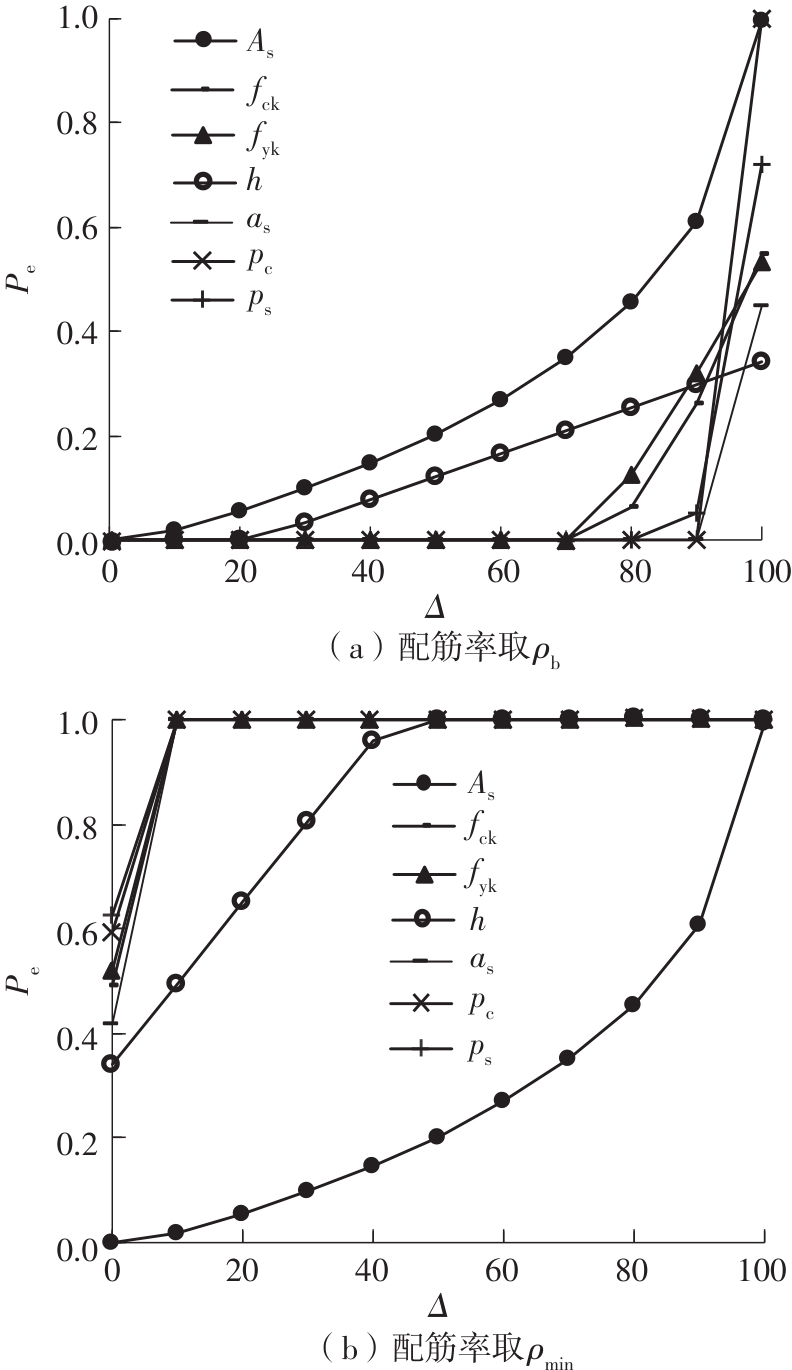
Table 2
Empirical grading of flexural cost performance ratio for beam-type components"
| 抗弯性价比等级 | |
|---|---|
| < 0 | 需改进 |
| [0,17) | 合格 |
| [17,42) | 一般 |
| [42,65) | 较好 |
| [65,83) | 良好 |
| [83,100) | 优秀 |
| ≥ 100 | 卓越 |
Fig.6
Schematic diagram of beam component cross-section types"
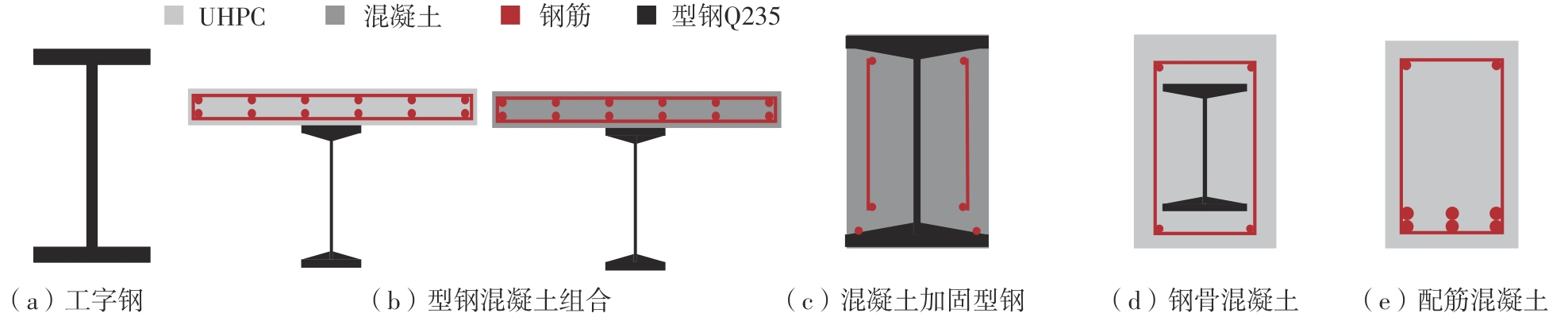
Table 3
Statistical results of standard values of flexural cost performance ratio for beam components with different structural forms"
| 构件编号 | 截面类型 | 抗弯性价比等级 | |
|---|---|---|---|
| 1 | 工字钢 | -20.00 | 需改进 |
| 2 | -20.13 | 需改进 | |
| 3 | -20.86 | 需改进 | |
| 4 | -21.50 | 需改进 | |
| 5 | -21.77 | 需改进 | |
| 6 | 6.05 | 合格 | |
| 7 | 4.27 | 合格 | |
| 8 | 型钢混凝土组合 | 16.48 | 合格 |
| 9 | 21.39 | 一般 | |
| 10 | 混凝土加固型钢 | 20.66 | 一般 |
| 11 | 18.43 | 一般 | |
| 12 | 18.52 | 一般 | |
| 13 | 钢骨混凝土 | -0.54 | 需改进 |
| 14 | 1.69 | 合格 | |
| 15 | 3.60 | 合格 | |
| 16 | 2.41 | 合格 | |
| 17 | 5.66 | 合格 | |
| 18 | 8.60 | 合格 | |
| 19 | 配筋混凝土 | -0.87 | 需改进 |
| 20 | 8.30 | 合格 | |
| 21 | 44.03 | 较好 | |
| 22 | 63.44 | 较好 | |
| 23 | 73.88 | 良好 |

Fig.7
Schematic diagram of reinforced concrete beam cross-sections"

Table 4
Price statistical results of high-strength steel bars"
| 材料类型 | 材料等级 | 价格/(元·t-1) |
|---|---|---|
| 高强钢筋 | HRB600 | 4 526 |
| HRB635 | 5 294 | |
| 高强混凝土 | C60 | 276 |
Table 5
Statistical results of standard values of flexural cost performance ratio for reinforced concrete beams"
| 构件编号 | 截面类型 | 抗弯性价比等级 | 构件编号 | 截面类型 | 抗弯性价比等级 | ||||
|---|---|---|---|---|---|---|---|---|---|
| 1 | UHPC矩形 | -6.68 | 需改进 | 27 | UHPC方形 | 12.48 | 合格 | ||
| 2 | -12.82 | 需改进 | 28 | 29.66 | 一般 | ||||
| 3 | -12.39 | 需改进 | 29 | UHPC T字形 | -11.23 | 需改进 | |||
| 4 | -11.37 | 需改进 | 30 | -4.01 | 需改进 | ||||
| 5 | -22.58 | 需改进 | 31 | 普通混凝土方形 | 65.84 | 良好 | |||
| 6 | -15.12 | 需改进 | 32 | 82.81 | 良好 | ||||
| 7 | -0.48 | 需改进 | 33 | 83.14 | 优秀 | ||||
| 8 | 5.46 | 合格 | 34 | 90.99 | 优秀 | ||||
| 9 | 0.22 | 合格 | 35 | 88.95 | 优秀 | ||||
| 10 | 7.01 | 合格 | 36 | 89.61 | 优秀 | ||||
| 11 | 16.01 | 合格 | 37 | 93.87 | 优秀 | ||||
| 12 | 13.73 | 合格 | 38 | 93.72 | 优秀 | ||||
| 13 | -7.75 | 需改进 | 39 | 91.04 | 优秀 | ||||
| 14 | -1.38 | 需改进 | 40 | 88.06 | 优秀 | ||||
| 15 | 9.29 | 合格 | 41 | 75.22 | 良好 | ||||
| 16 | 10.70 | 合格 | 42 | 93.01 | 优秀 | ||||
| 17 | -12.24 | 需改进 | 43 | 84.05 | 优秀 | ||||
| 18 | -4.03 | 需改进 | 44 | 92.21 | 优秀 | ||||
| 19 | 27.94 | 一般 | 45 | 115.99 | 卓越 | ||||
| 20 | 45.32 | 较好 | 46 | 100.53 | 卓越 | ||||
| 21 | 54.66 | 较好 | 47 | 98.43 | 优秀 | ||||
| 22 | 25.18 | 一般 | 48 | 98.94 | 优秀 | ||||
| 23 | 30.59 | 一般 | 49 | 96.52 | 优秀 | ||||
| 24 | 12.77 | 合格 | 50 | 122.08 | 卓越 | ||||
| 25 | 20.36 | 一般 | 51 | 普通混凝土矩形 | -19.49 | 需改进 | |||
| 26 | UHPC工字形 | -12.22 | 需改进 | ||||||
Fig.8
Schematic diagram of cross-sections of novel UHPC beam components"
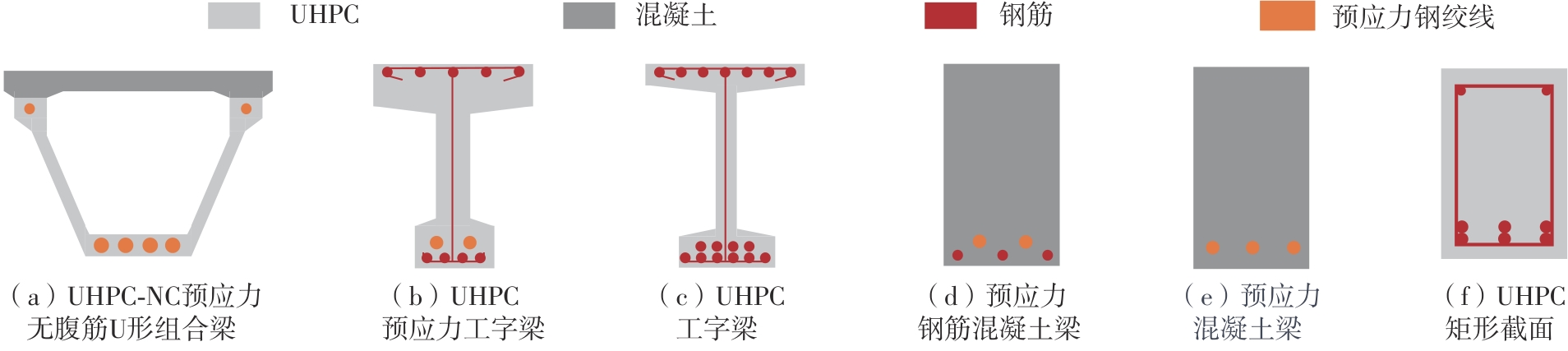
Table 6
Statistical results of standard values of flexural cost performance ratio for UHPC beam components"
| 构件编号 | 构件类型 | 抗弯性价比等级 | |
|---|---|---|---|
| 1 | UHPC-NC预应力无腹筋U形组合梁 | 868 | 卓越 |
| 2 | UHPC预应力工字梁 | 156 | 卓越 |
| 3 | 58 | 较好 | |
| 4 | 69 | 良好 | |
| 5 | 67 | 良好 | |
| 6 | 68 | 良好 | |
| 7 | UHPC工字梁 | 39 | 一般 |
| 8 | 预应力钢筋混凝土梁 | 268 | 卓越 |
| 9 | 预应力混凝土梁 | 302 | 卓越 |
| 10 | UHPC矩形截面 | 25 | 一般 |
| 11 | 31 | 一般 | |
| 12 | 13 | 合格 | |
| 13 | 20 | 一般 |
| [1] | 钟蕴为,吴永魁,文许高媛,等 .超高性能混凝土(UHPC)基本性能研究综述[J].混凝土与水泥制品,2021(9):1-4. |
| ZHONG Yun-wei, WU Yong-kui, WEN Xu-gao-yuan,et al .Summary of research on basic performance of ultra-high performance concrete[J].China Concrete and Cement Products,2021(9):1-4. | |
| [2] | 李玲,明阳,陈平,等 .超高性能混凝土国内外研究与应用进展[J].水泥工程,2020(2):85-90. |
| LI Ling, MING Yang, CHEN Ping,et al .Research and application progress of ultra high performance concrete at home and abroad[J].Cement Engineering,2020(2):85-90. | |
| [3] | 付军,闵亦斌,王发洲,等 .配筋UHPC梁抗弯性能试验与承载力简化计算[J].混凝土,2023(11):1-6. |
| FU Jun, MIN Yibin, WANG Fazhou,et al .Experimental of flexural performance and simplified calculation of bearing capacity of reinforcement UHPC beams[J].Concrete,2023(11):1-6. | |
| [4] | 周云,聂晶鑫,张保证,等 .全预制拼接槽形UHPC梁抗弯抗剪性能试验研究[J].湖南大学学报(自然科学版),2023,50(7):1-11. |
| ZHOU Yun, NIE Jingxin, ZHANG Baozheng,et al .Experimental study on flexural and shear behavior of full precast splicing channel-shaped UHPC beams[J].Journal of Hunan University (Natural Sciences),2023,50(7):1-11. | |
| [5] | 高育欣,朱文凯,罗遥凌,等 .配筋超高性能混凝土(UHPC)梁弯曲试验研究[J].混凝土与水泥制品,2021(7):67-70. |
| GAO Yu-xin, ZHU Wen-kai, LUO Yao-ling,et al .Research on bending behavior of reinforced ultra-high performance concrete(UHPC) beams[J].China Concrete and Cement Products,2021(7):67-70. | |
| [6] | 梁兴文,汪萍,徐明雪,等 .配筋超高性能混凝土梁受弯性能及承载力研究[J].工程力学,2019,36(5):110-119. |
| LIANG Xing-wen, WANG Ping, XU Ming-xue,et al .Investigation on flexural capacity of reinforced ultra high performance concrete beams[J].Engineering Mecha-nics,2019,36(5):110-119. | |
| [7] | 范俊奇,郭鹏,谢晓庚,等 .弯曲荷载下钢纤维对配筋UHPC梁结构性能和非均匀变形的影响[J].防护工程,2023,45(4):7-13. |
| FAN Junqi, GUO Peng, XIE Xiaogeng,et al .The effect of steel fiber on UHPC beam structural performance and non-uniform deformation under bending load[J].Protective Engineering,2023,45(4):7-13. | |
| [8] | 王敏,高立强,王康宁,等 .高强钢筋UHPC梁抗弯性能及承载力试验研究[J].桥梁建设,2022,52(6):87-94. |
| WANG Min, GAO Li-qiang, WANG Kang-ning,et al .Experimental study on flexural behavior and bearing capacity of UHPC beams reinforced with high-strength steel bars[J].Bridge Construction,2022,52(6):87-94. | |
| [9] | 邓宗才,王义超,肖锐,等 .高强钢筋UHPC梁抗弯性能试验研究与理论分析[J].应用基础与工程科学学报,2015,23(1):68-78. |
| DENG Zongcai, WANG Yichao, XIAO Rui,et al .Flexural test and theoretical analysis of UHPC beams with high strength rebars[J].Journal of Basic Science and Engineering,2015,23(1):68-78. | |
| [10] | 唐长久 .超高性能混凝土型钢梁受弯性能试验研究[D].长沙:湖南大学,2019. |
| [11] | 王有成 .预制混凝土板加固钢梁的抗弯性能研究[D].济南:山东大学, 2023. |
| [12] | 刘君平,徐帅,陈宝春 .钢-UHPC组合梁与钢-普通混凝土组合梁抗弯性能对比试验研究[J].工程力学,2018,35(11):92-98,145. |
| LIU Jun-ping, XU Shuai, CHEN Bao-chun .Experimental study on flexural behaviors of steel-UHPC composite girders and steel-conventional concrete composite girders[J].Engineering Mechanics,2018,35(11):92-98,145. | |
| [13] | 李立峰,范昕,石雄伟,等 .大比例预应力UHPC-T形梁抗弯性能试验研究[J].土木工程学报,2018,51(5):84-94,102. |
| LI Lifeng, FAN Xin, SHI Xiongwei,et al .Experimental study on flexural behavior of large-scale prestressed UHPC T-shaped beams[J].China Civil Engineering Journal,2018,51(5):84-94,102. | |
| [14] | 杨剑,方志 .预应力超高性能混凝土梁的受弯性能研究[J].中国公路学报,2009,22(1):39-46. |
| YANG Jian, FANG Zhi .Research on flexural behaviors of prestressed ultra high performance concrete beams[J].China Journal of Highway and Transport,2009,22(1):39-46. | |
| [15] | 邵旭东,管亚萍,晏班夫 .预制超高性能混凝土π形梁桥的设计与初步试验[J].中国公路学报,2018,31(1):46-56. |
| SHAO Xu-dong, GUAN Ya-ping, YAN Ban-fu .Design and preliminary experiments of UHPC π-shaped girder bridges[J].China Journal of Highway and Transport,2018,31(1):46-56. | |
| [16] | SUN X, MA Y, JIANG F,et al .Bending resistance mechanism of prestressed ultra-high performance concrete-reinforced concrete beam based on a full-scale experiment[J].Advances in Structural Engineering,2024,27(10):1746-1761. |
| [17] | STENGEL T, SCHIEßL P .Life cycle assessment (LCA) of ultra high performance concrete (UHPC) structures[M].Eco-efficient construction and building materials.Cambridge:Woodhead Publishing,2014:528-564. |
| [18] | 王青 .纤维网格增强超高性能混凝土加固钢筋混凝土梁受剪性能试验研究[J].菏泽学院学报,2023,45(5):65-71. |
| WANG Qing .Experimental study on shear behavior of reinforced concrete beams strengthened with fiber grid reinforced ultra-high performance concrete[J].Journal of Heze University,2023,45(5):65-71. | |
| [19] | 郭启雯,才鸿年,王富耻,等 .材料适用性评价指标体系构建研究[J].材料工程,2009(9):9-12. |
| GUO Qi-wen, CAI Hong-nian, WANG Fu-chi,et al .Construction of index system of materials applicability evaluation[J].Journal of Materials Engineering,2009(9):9-12. | |
| [20] | 孟斌 .轻型钢结构建筑结构构件节点分析与综合评价体系框架初探[D].南京:东南大学,2018. |
| [21] | 邓海旺 .混凝土预制构件生产质量风险评价研究[D].北京:北京交通大学,2020. |
| [22] | 陈汉宇 .基于精益建造理论的桥梁预制构件生产质量评价研究[D].徐州:中国矿业大学, 2021. |
| [23] | 韩佳丽 .绿色智能建造评价体系研究及案例分析[D].青岛:青岛理工大学,2024. |
| [24] | 徐洛屹,杨再银 .我国墙体材料评价体系研究[J].建筑材料学报,2006,9(1):77-85. |
| XU Luo-yi, YANG Zai-yin .Estimating system on the wall materials of China[J].Journal of Building Materials,2006,9(1):77-85. | |
| [25] | 汪振双,王立国 .绿色建筑背景下建筑材料绿色度评价和认证体系研究[J].建筑经济,2015,36(1):108-112. |
| WANG Zhenshuang, WANG Liguo .Research on the green degree evaluation and certification system of building materials under the background of green building[J].Construction Economy,2015,36(1):108-112. | |
| [26] | 高宇 .在用混凝土桥梁构件耐久性指标体系的研究[D].重庆:重庆交通大学,2012. |
| [27] | 任晓宇,周亚萍,郭树荣 .全生命周期视角下装配式建筑可持续发展评价体系研究[J].建筑经济,2019,40(9):95-99. |
| REN Xiaoyu, ZHOU Yaping, GUO Shurong .Research on evaluation system of prefabricated building sustainable development from the perspective of life cycle[J].Construction Economy,2019,40(9):95-99. | |
| [28] | 蒋水珍,罗若帆,叶永富,等 .适筋梁与超筋梁极限承载力不同计算方法对比[J].江西建材,2019 (3):108-109,111. |
| JIANG Shuizhen, LUO Ruofan, YE Yongfu,et al .Comparison of different calculation methods for ultimate bearing capacity of reinforced beams and over-reinforced beams[J].Jiangxi Building Materials,2019(3):108-109,111. | |
| [29] | 混凝土结构设计规范:(2015年版)[S]. |
| [30] | 中国水泥网 .水泥价格行情查询平台[DB/OL].(2024-06-14)[2024-09-12].. |
| [31] | 我的钢铁网 .钢材价格查询平台[DB/OL].(2024-06-14)[2024-09-12].. |
| [32] | 王铁成 .混凝土结构设计原理[M].北京:中国建筑工业出版社,2016. |
| [33] | 朱明 .数据挖掘[M].合肥:中国科学技术大学出版社,2002. |
| [34] | 卜良桃,刘华刚 .粘贴钢板加固型钢梁受弯试验研究[J].公路工程,2020,45(3):38-43. |
| BU Liangtao, LIU Huagang .Experimental study on the flexural capacity of steel beams strengthened by steel plate[J].Highway Engineering,2020,45(3):38-43. | |
| [35] | 陈安英,邓松,高鹏,等 .HRB600级钢筋混凝土梁受弯性能试验研究[J].合肥工业大学学报(自然科学版),2023,46(2):212-220. |
| CHEN Anying, DENG Song, GAO Peng,et al .Experimental study on flexural performance of concrete beams with HRB600 steel bars[J].Journal of Hefei University of Technology (Natural Science Edition),2023,46(2):212-220. | |
| [36] | 宋鹏程,沈毅,种迅,等 .配置HRB635高强钢筋的混凝土梁受弯性能试验研究[J].地震工程与工程振动,2024,44(2):108-115. |
| SONG Pengcheng, SHEN Yi, CHONG Xu,et al .Experimental study on flexural performance of reinforced concrete beams with HRB635 high-strength reinforcement[J].Earthquake Engineering and Enginee-ring Dynamics,2024,44(2):108-115. | |
| [37] | 张利梅,赵顺波,黄承逵 .预应力高强混凝土梁延性性能分析与试验研究[J].工程力学,2005,22(3):166-171. |
| ZHANG Li-mei, ZHAO Shun-bo, HUANG Cheng-kui .Experimental study of ductility of prestressed high-strength concrete beams[J].Engineering Mechanics,2005,22(3):166-171. |
| [1] | LI Tao, HE Zhengbo, WEI Guozheng, CAO Hongyou. Study on Axial Compression Performance of UHPC Fully Encased Q690 High-Strength Steel Composite Stub Columns [J]. Journal of South China University of Technology(Natural Science Edition), 2025, 53(8): 87-99. |
| [2] | FAN Xueming, ZHOU Xiaopeng, YE Xiaohang, ZHAO Kun. Cost-Performance Analysis of Thin-Layer UHPC Encased I-Beam Shear Resistance [J]. Journal of South China University of Technology(Natural Science Edition), 2025, 53(4): 40-49. |
| [3] | LI Yan, WU Bo, ZHENG Shuya, WU Xiang. Analysis of Mechanical Performance of Precast Concrete Floor Slabs Containing Recycled Components [J]. Journal of South China University of Technology(Natural Science Edition), 2025, 53(12): 71-81. |
| [4] | LI Xiao, HU Zhijian, HE Yan. Anti-Cracking Property of UHPC-NC Structure in the Negative Moment Zone of PC Beam Bridge [J]. Journal of South China University of Technology(Natural Science Edition), 2022, 50(11): 35-43. |
| [5] | LI Li, CHEN Cai, JIN Zekun, et al. Microbial Diversity Analysis of Biotrickling Filter and Screening of VOC Degrading Bacteria [J]. Journal of South China University of Technology (Natural Science Edition), 2021, 49(11): 57-68. |
| [6] | Huang Xiao-ming Xu Tao Huang Cheng-zao. Effects of Dynamic Mechanical Properties of Grading Macadam on Tunnel Pavement Stress [J]. Journal of South China University of Technology (Natural Science Edition), 2009, 37(2): 92-97. |
| [7] | Wang Hai-nian Hao Pei-wen Pang Li-guo Di Jian-hong. Investigation into Grading Characteristic of Coarse Aggregate via Digital Image Processing Technique [J]. Journal of South China University of Technology (Natural Science Edition), 2007, 35(11): 54-58,62. |
| [8] | Ai Jiao-yan Zhu Xue-feng. Application of ART2 Classifier Based on Modified Algorithm to Glass-ceramic Color Garding#br# [J]. Journal of South China University of Technology(Natural Science Edition), 2003, 31(1): 74-78. |
| Viewed | ||||||
|
Full text |
|
|||||
|
Abstract |
|
|||||