Journal of South China University of Technology(Natural Science Edition) ›› 2026, Vol. 54 ›› Issue (2): 152-166.doi: 10.12141/j.issn.1000-565X.250099
• Architecture & Civil Engineering • Previous Articles Next Articles
Inverse Method for Assembly Tolerance Itervals of Cable-Stayed Bridge Based on Proactive Fault Tolerance
WANG Xiaoming1, SUN Chenjing1, ZHU Chuanchao2, FENG Boshun1, GAO Lixiang1, QIU Hongjie1
- 1.School of Highway,Chang’an University,Xi’an 710064,Shaanxi,China
2.Wanhua Chemical Group Co. ,Ltd. ,Yantai 264000,Shandong,China
-
Received:2025-04-08Online:2026-02-25Published:2025-08-15 -
Contact:孙晨景(2000―),男,硕士生,主要从事斜拉桥施工控制研究。 E-mail:1928285181@qq.com -
About author:王晓明(1983―),男,教授,博士生导师,主要从事桥梁智能建造研究。E-mail: wxm@chd.edu.cn -
Supported by:the National Natural Science Foundation of China(52178104)

CLC Number:
Cite this article
WANG Xiaoming, SUN Chenjing, ZHU Chuanchao, FENG Boshun, GAO Lixiang, QIU Hongjie. Inverse Method for Assembly Tolerance Itervals of Cable-Stayed Bridge Based on Proactive Fault Tolerance[J]. Journal of South China University of Technology(Natural Science Edition), 2026, 54(2): 152-166.
share this article
Fig.1
Inversion framework for assembly tolerance interval of cable-stayed bridges"
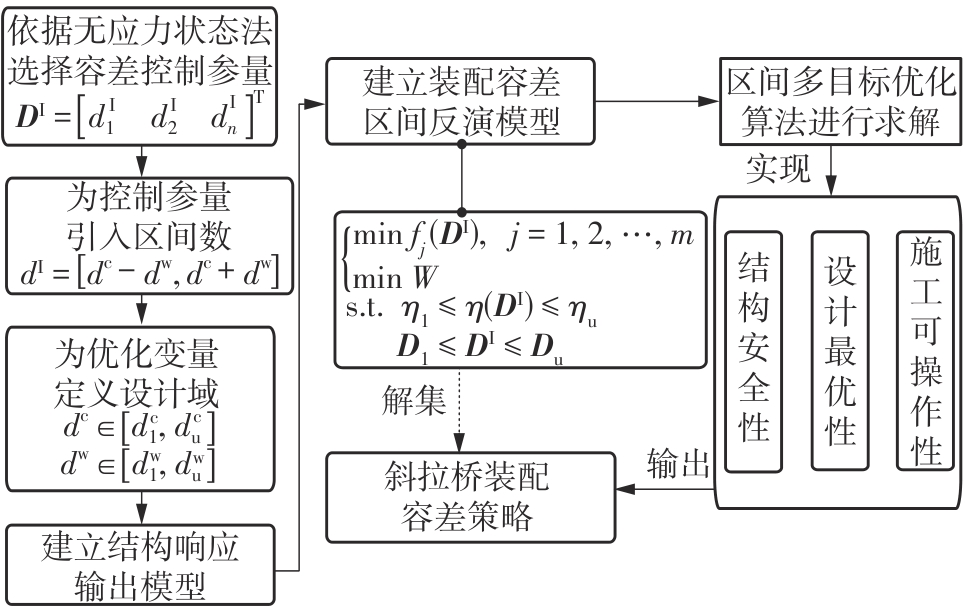
Fig.2
Active fault-tolerance-oriented framework for assembly tolerance interval inversion of cable-stayed bridges"
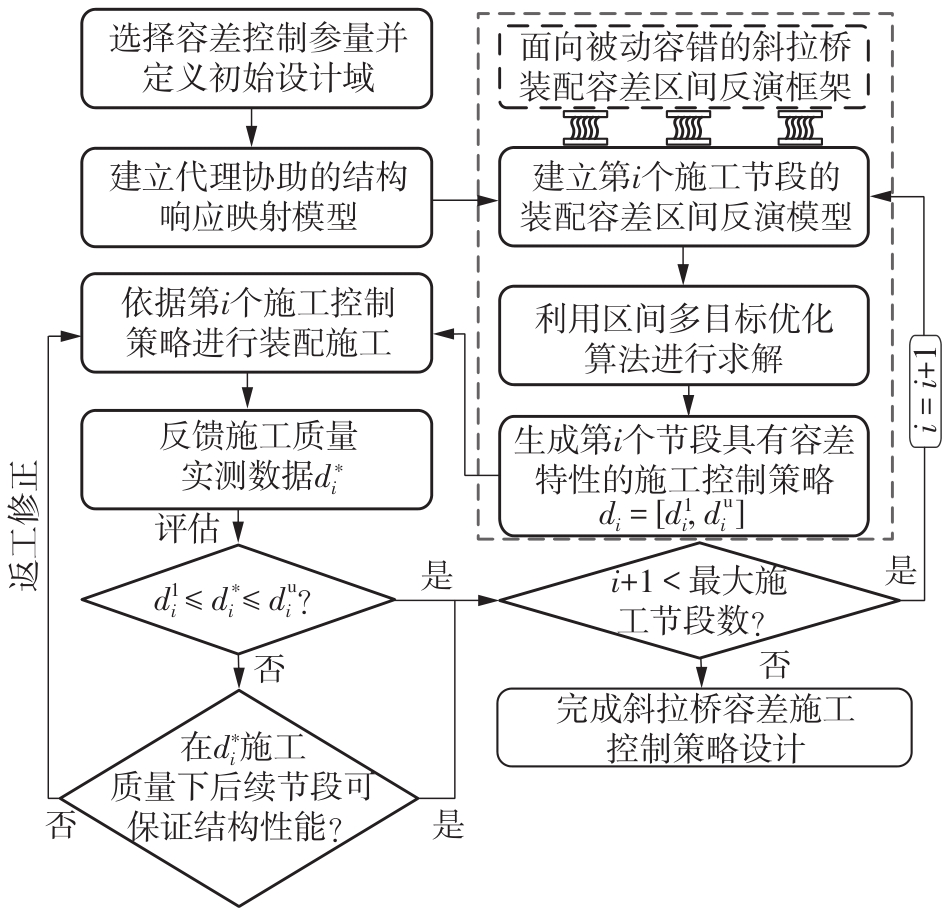
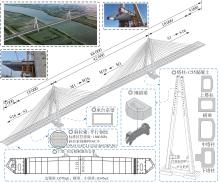
Fig.3
Overall layout of cable-stayed bridges (Unit:cm)"
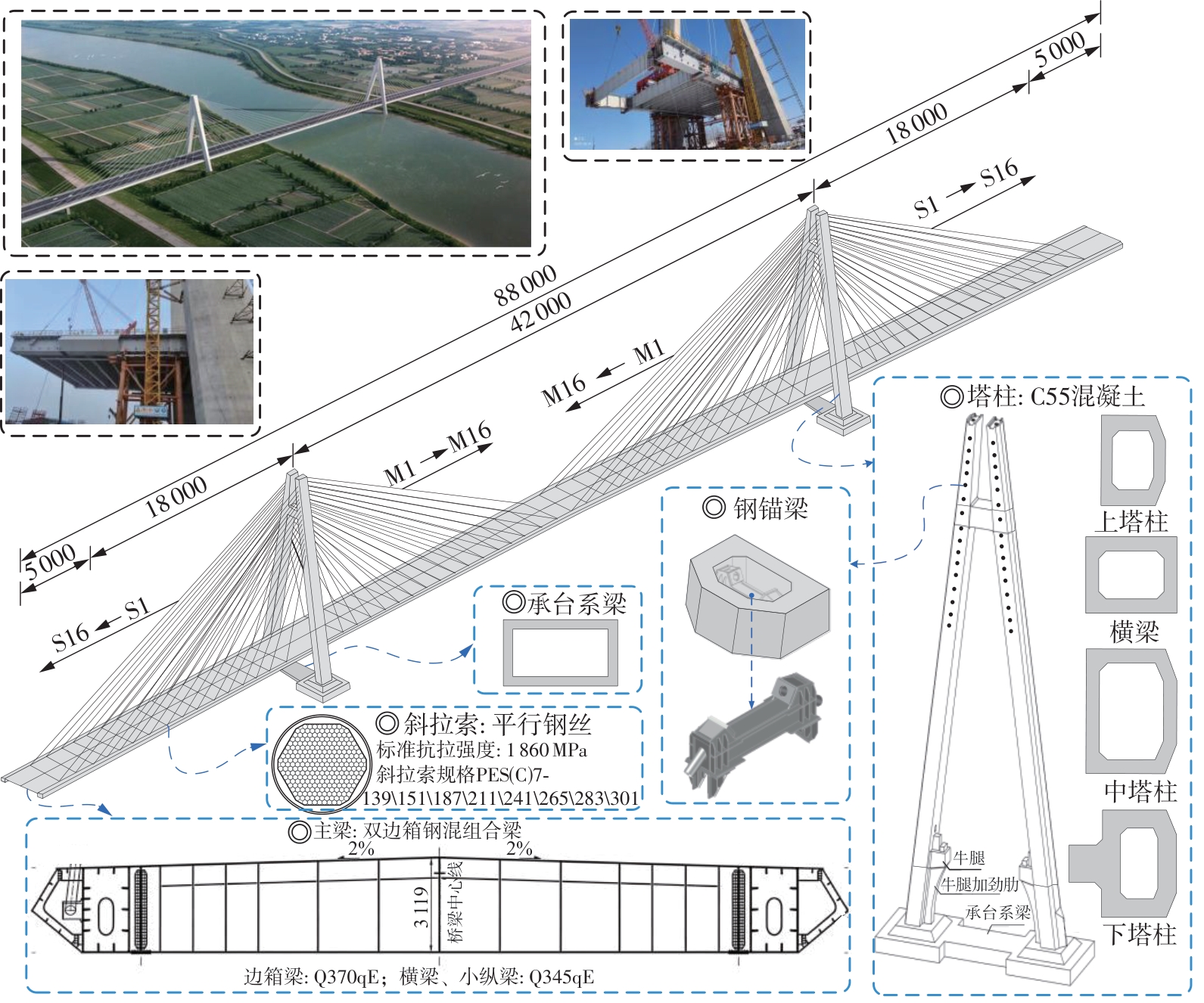

Table 1
Summary of completed-bridge cable forces for cable-stayed bridges"
| 斜拉索编号 | 索力/kN | 斜拉索编号 | 索力/kN | ||
|---|---|---|---|---|---|
| S16 | 7 086 | M1 | 3 180 | ||
| S15 | 6 709 | M2 | 3 144 | ||
| S14 | 6 091 | M3 | 3 113 | ||
| S13 | 5 476 | M4 | 3 212 | ||
| S12 | 5 152 | M5 | 3 608 | ||
| S11 | 4 907 | M6 | 3 830 | ||
| S10 | 4 701 | M7 | 4 017 | ||
| S9 | 4 479 | M8 | 4 220 | ||
| S8 | 4 388 | M9 | 4 401 | ||
| S7 | 4 079 | M10 | 4 799 | ||
| S6 | 3 744 | M11 | 4 988 | ||
| S5 | 3 652 | M12 | 5 461 | ||
| S4 | 3 510 | M13 | 5 730 | ||
| S3 | 3 328 | M14 | 6 063 | ||
| S2 | 3 316 | M15 | 6 356 | ||
| S1 | 3 357 | M16 | 6 546 | ||
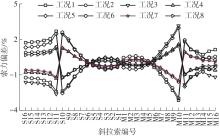
Fig.4
Statistics of cable force deviation of completed bridge under various error conditions"
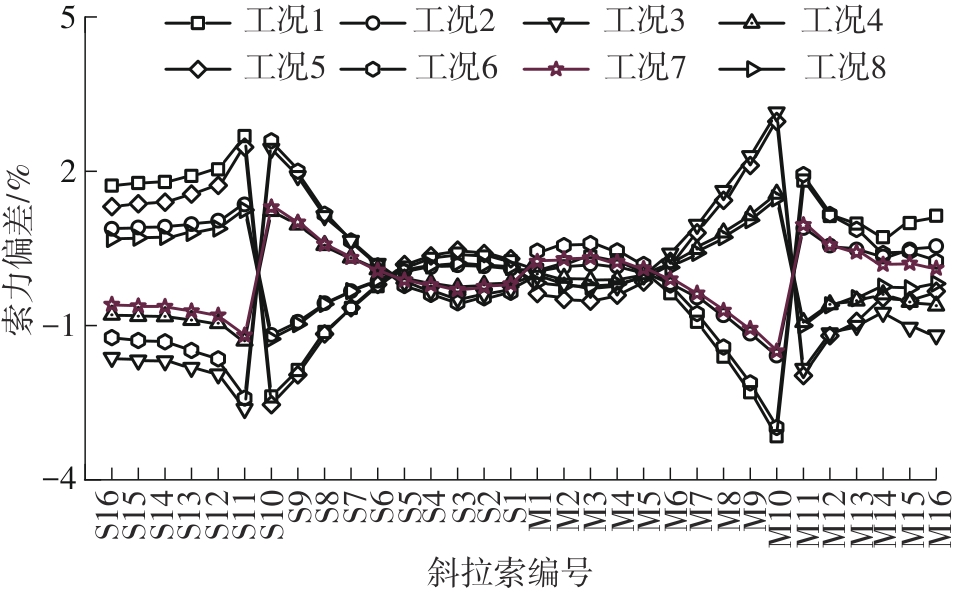
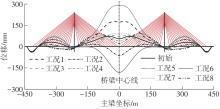
Fig.5
Schematic diagram of main beam deformation under random working conditions"
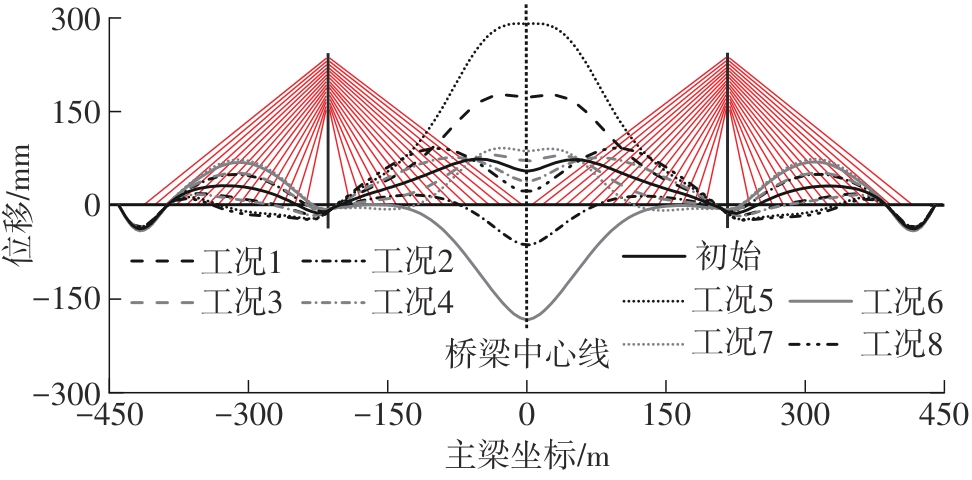
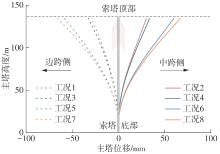
Fig.6
Schematic diagram of cable tower deviation under random working conditions"
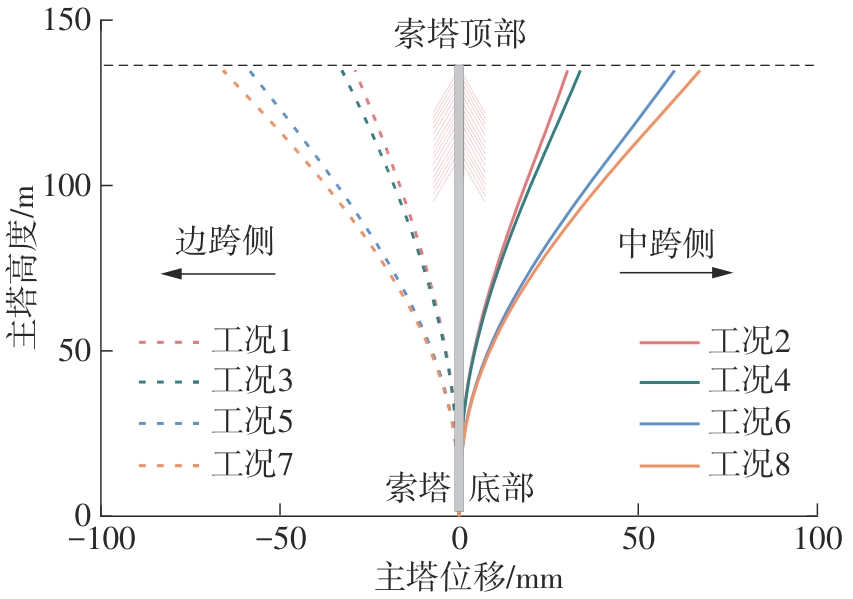
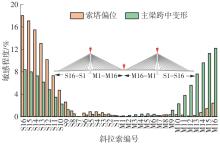
Fig.7
Sensitivity of tower top deviation and mid-span deformation of main beam to various cable forces"
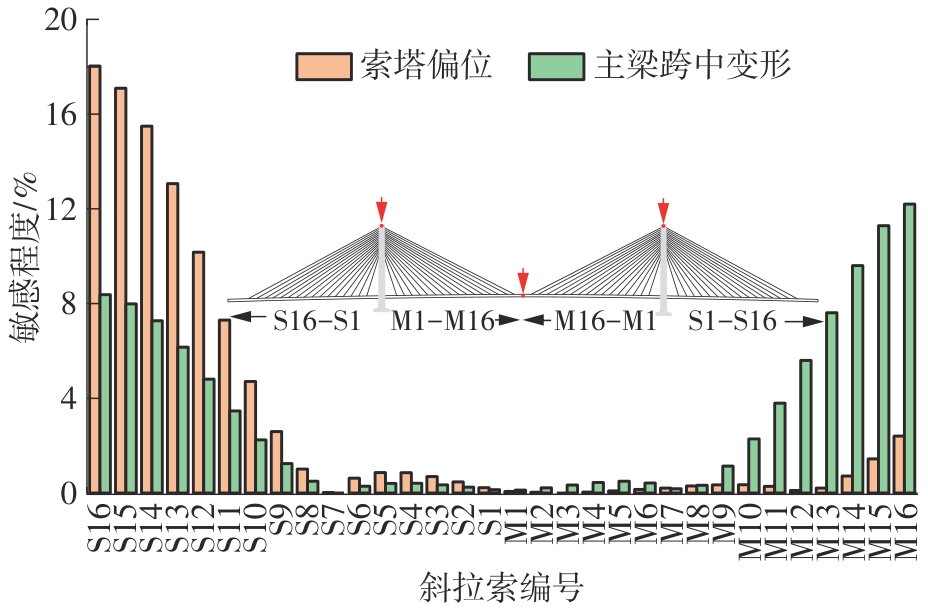
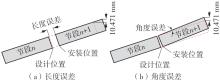
Fig.8
Schematic diagram of main beam assembly error"
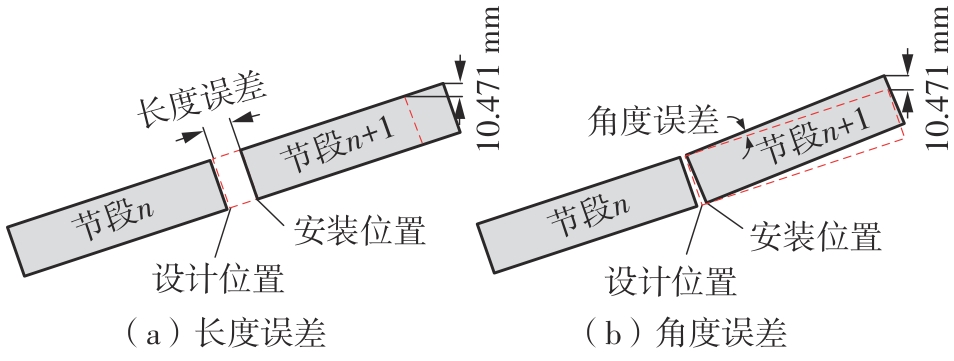
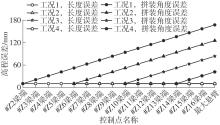
Fig.9
Transmission law of main beam assembly error"
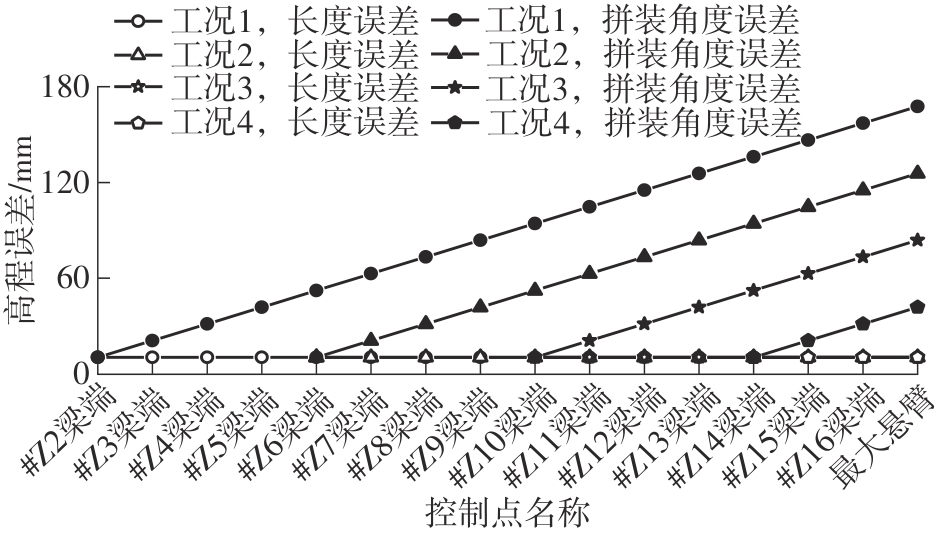
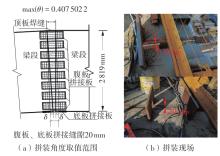
Fig.10
Schematic diagram of the value range for main beam splicing angle and the on-site splicing scene"
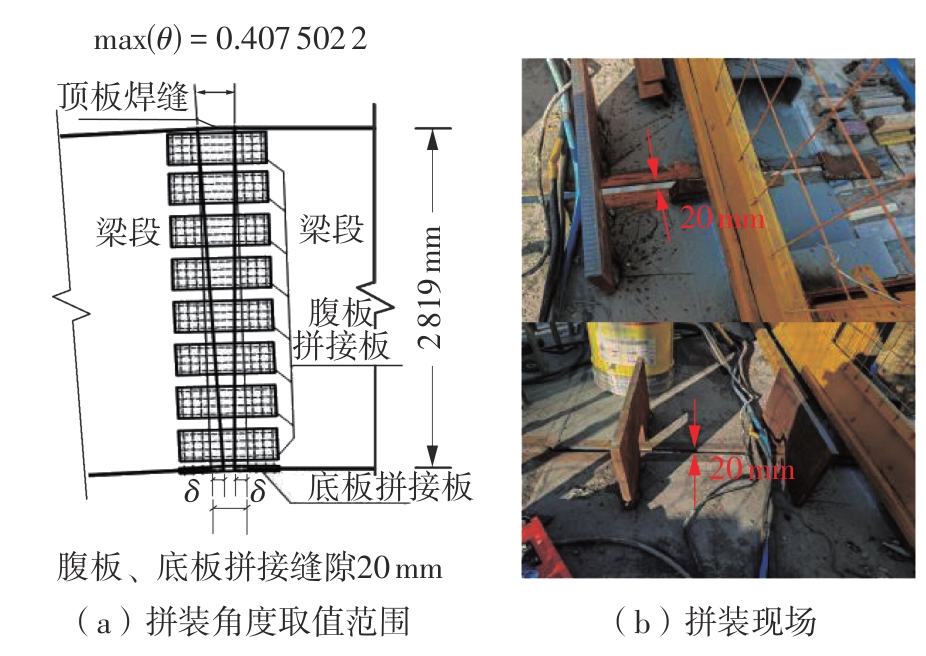
Fig.11
Schematic diagram of cable force deviation for completed bridges under various working conditions"
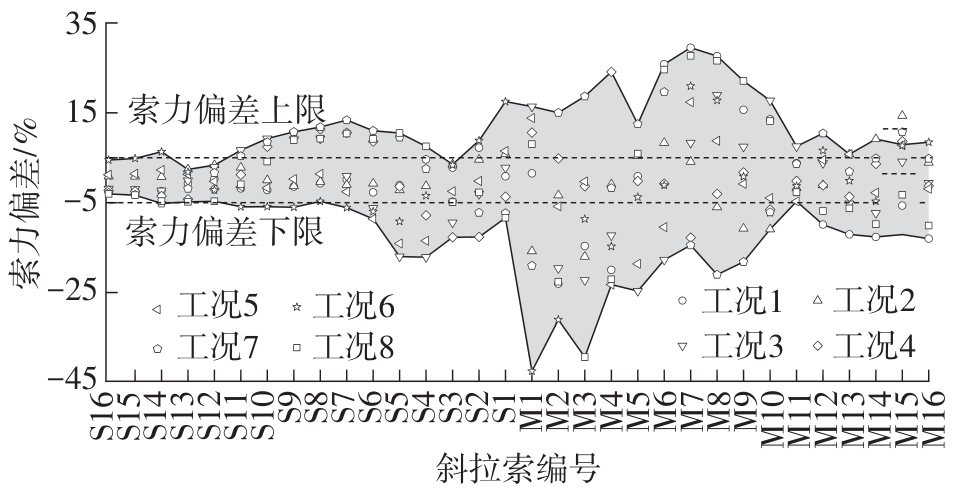
Fig.12
Influence of assembly angle error on the elevation of the main beam of the completed bridges"
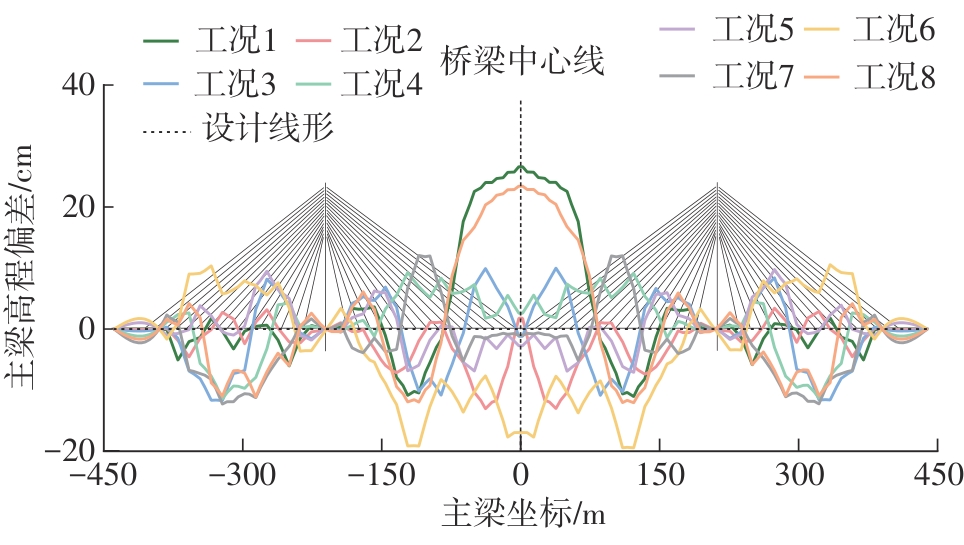
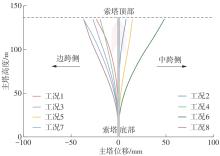
Fig.13
Influence of assembly angle error on bridge tower deviation"
Table 2
Design domain of optimization variables"
| 优化变量 | 设计域下界 | 设计域上界 |
|---|---|---|
| d | 230.836 5 | 230.912 9 |
| d | 219.041 0 | 219.114 6 |
| d | 207.334 4 | 207.403 0 |
| d | 79.256 5 | 79.283 6 |
| d | 72.260 0 | 72.284 2 |
| d | 71.500 1 | 71.524 6 |
| d | 78.154 1 | 78.181 0 |
| d | 204.172 3 | 204.240 4 |
| d | 215.790 7 | 215.865 1 |
| d | 227.535 3 | 227.610 7 |
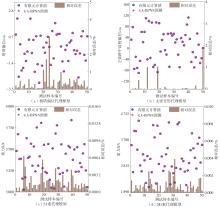
Fig.14
Evaluation of proxy model accuracy"
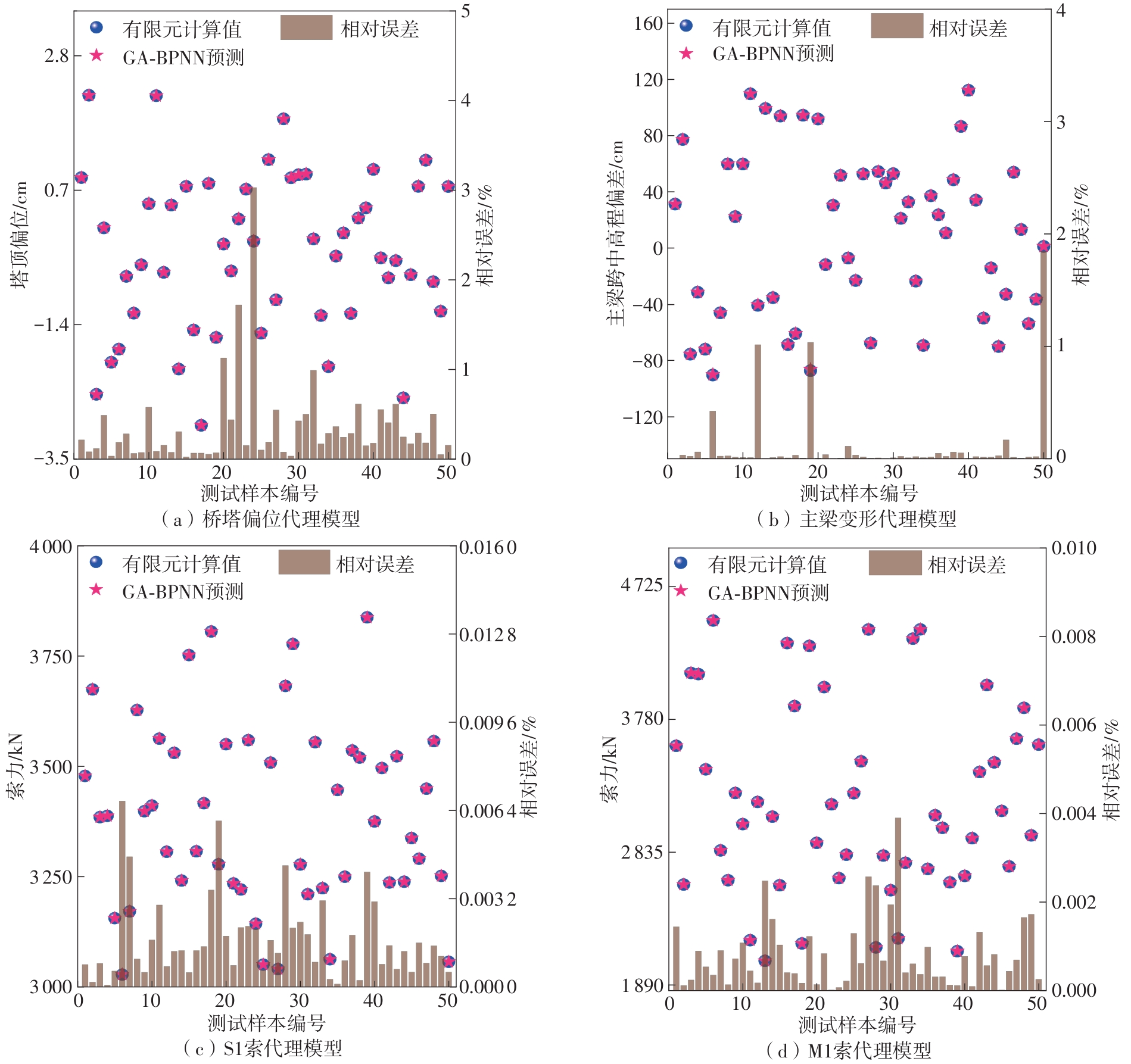
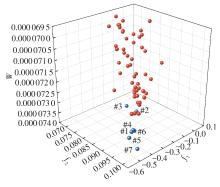
Fig.15
Pareto optimal solution set for assembly tolerance inversion of all cables and beam components of cable-stayed bridge"
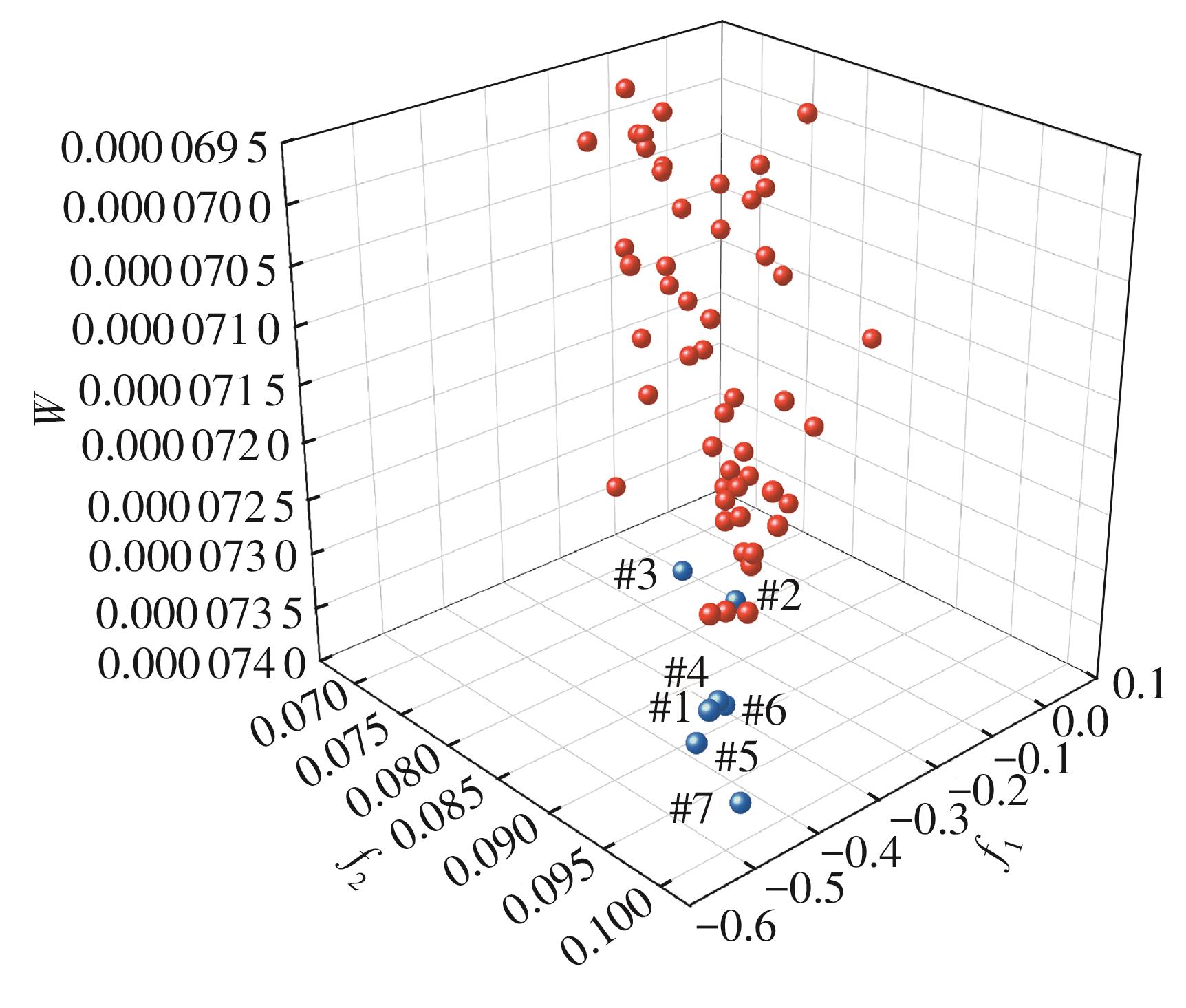
Table 3
Tolerance intervals of stress-free parameters for strategy # 7"
| 无应力参量 | 控制参量编号 | 参量值 | 区间中点 | 容差半径 | 容差区间 | 与设计值的最大偏差 |
|---|---|---|---|---|---|---|
| 长度/m | S16 | 230.874 6 | 230.874 2 | 0.014 2 | [230.860 0,230.888 4] | 0.014 6 |
| S15 | 219.077 7 | 219.080 9 | 0.017 2 | [219.063 7,219.098 1] | 0.020 4 | |
| S14 | 207.368 6 | 207.376 7 | 0.014 5 | [207.362 2,207.391 2] | 0.022 6 | |
| S2 | 79.270 1 | 79.273 2 | 0.007 4 | [79.265 8,79.280 6] | 0.010 5 | |
| S1 | 72.272 1 | 72.272 7 | 0.004 9 | [72.267 8,72.277 6] | 0.005 5 | |
| M1 | 71.512 3 | 71.515 2 | 0.004 2 | [71.511 0,71.519 4] | 0.007 1 | |
| M2 | 78.167 5 | 78.168 7 | 0.005 6 | [78.163 1,78.174 3] | 0.006 8 | |
| M14 | 204.206 3 | 204.207 8 | 0.016 7 | [204.191 1,204.224 5] | 0.018 2 | |
| M15 | 215.827 8 | 215.832 9 | 0.014 4 | [215.818 5,215.847 3] | 0.019 5 | |
| M16 | 227.573 0 | 227.575 3 | 0.013 8 | [227.561 5,227.589 1] | 0.016 1 | |
| G2 | 179.905 2 | 179.893 9 | 0.011 6 | [179.882 3,179.905 5] | 0.022 9 | |
| G3 | 179.926 9 | 179.944 7 | 0.011 1 | [179.933 6,179.955 8] | 0.028 9 | |
| Z2 | 179.943 0 | 179.952 7 | 0.018 2 | [179.934 5,179.970 9] | 0.027 9 | |
| Z3 | 179.948 3 | 179.944 0 | 0.049 4 | [179.894 6,179.993 4] | 0.053 7 |
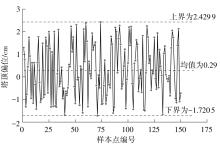
Fig.16
Deviation fluctuation of bridge towers within the tolerance range of stress free parameters"
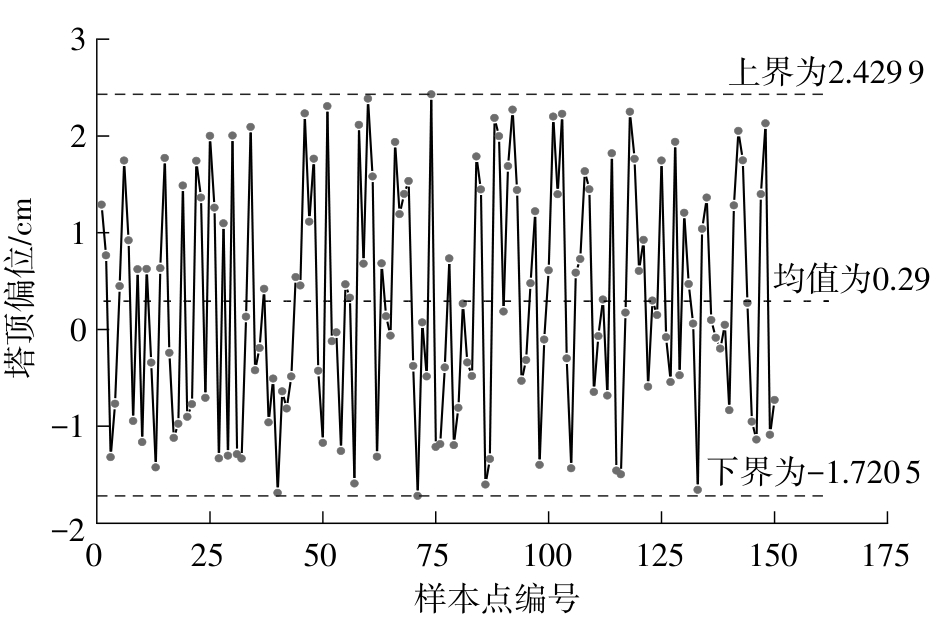
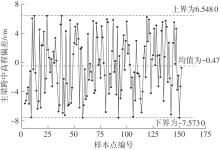
Fig.17
Fluctuation of mid-span elevation deviation of main beam within the tolerance range of stress-free parameters"
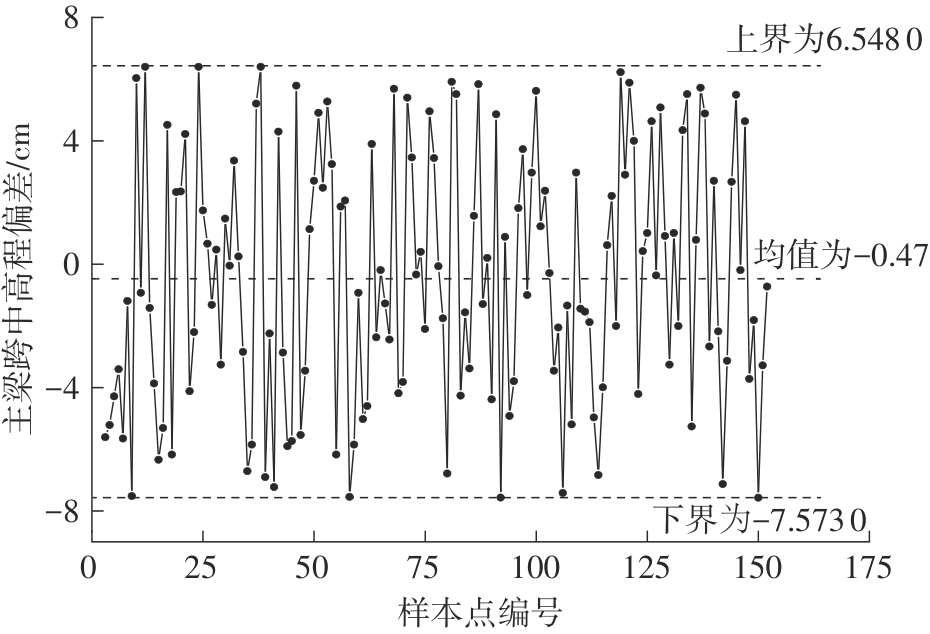
Table 4
Comparison of completed bridge cable force deviations under the control of strategy # 7"
| 斜拉索编号 | 索力/kN | 偏差/% | |
|---|---|---|---|
| 设计成桥 | 容差控制下 | ||
| S1 | 3 357 | 3 243~3 480 | -3.40~3.66 |
| S2 | 3 316 | 3 153~3 413 | -4.92~2.92 |
| S3 | 3 328 | 3 286~3 404 | -1.27~2.28 |
| S4 | 3 510 | 3 481~3 555 | -0.83~1.28 |
| S5 | 3 652 | 3 629~3 683 | -0.63~0.85 |
| S6 | 3 744 | 3 732~3 757 | -0.32~0.35 |
| S7 | 4 079 | 4 063~4 091 | -0.40~0.29 |
| S8 | 4 388 | 4 356~4 412 | -0.74~0.54 |
| S9 | 4 479 | 4 413~4 529 | -1.49~1.12 |
| S10 | 4 701 | 4 596~4 781 | -2.22~1.71 |
| S11 | 4 907 | 4 760~5 021 | -3.00~2.32 |
| S12 | 5 152 | 4 937~5 320 | -4.18~3.24 |
| S13 | 5 476 | 5 318~5 589 | -2.90~2.05 |
| S14 | 6 091 | 5 792~6 301 | -4.91~3.44 |
| S15 | 6 709 | 6 442~6 974 | -3.98~3.95 |
| S16 | 7 086 | 6 875~7 364 | -2.97~3.94 |
| M1 | 3 180 | 3 020~3 335 | -4.94~4.87 |
| M2 | 3 144 | 2 993~3 298 | -4.80~4.90 |
| M3 | 3 113 | 3 071~3 164 | -1.35~1.64 |
| M4 | 3 212 | 3 173~3 248 | -1.21~1.12 |
| M5 | 3 608 | 3 575~3 636 | -0.91~0.78 |
| M6 | 3 830 | 3 802~3 852 | -0.73~0.57 |
| M7 | 4 017 | 4 002~4 030 | -0.37~0.32 |
| M8 | 4 220 | 4 211~4 232 | -0.21~0.28 |
| M9 | 4 401 | 4 387~4 422 | -0.32~0.48 |
| M10 | 4 799 | 4 774~4 838 | -0.52~0.81 |
| M11 | 4 988 | 4 954~5 039 | -0.68~1.02 |
| M12 | 5 461 | 5 417~5 529 | -0.81~1.25 |
| M13 | 5 730 | 5 679~5 803 | -0.89~1.27 |
| M14 | 6 063 | 5 866~6 253 | -3.25~3.13 |
| M15 | 6 356 | 6 122~6 509 | -3.68~2.41 |
| M16 | 6 546 | 6 306~6 740 | -3.67~2.96 |
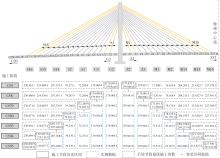
Fig.18
Control scheme for stress free parameters of components throughout the construction process"
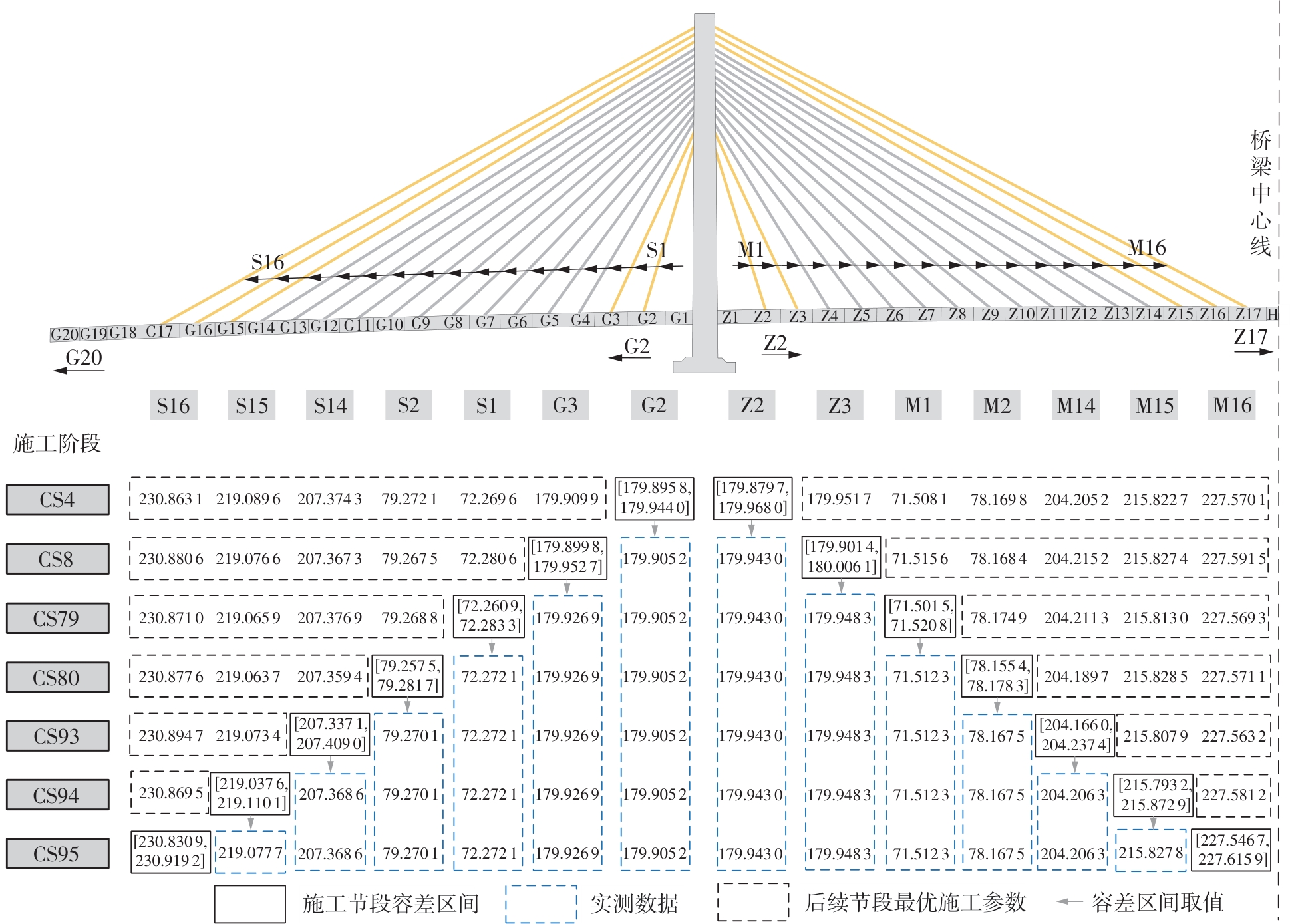
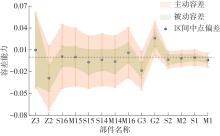
Fig.19
Comparison of tolerance capabilities between two design concepts"
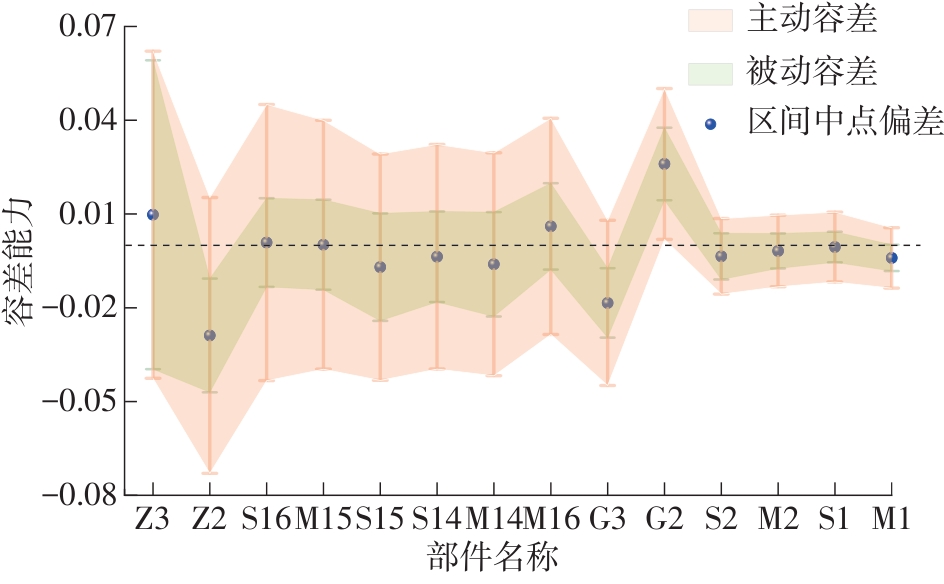
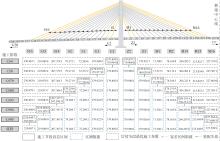
Fig.20
Adaptive adjustment construction scheme for cable-stayed bridge assembly failure"
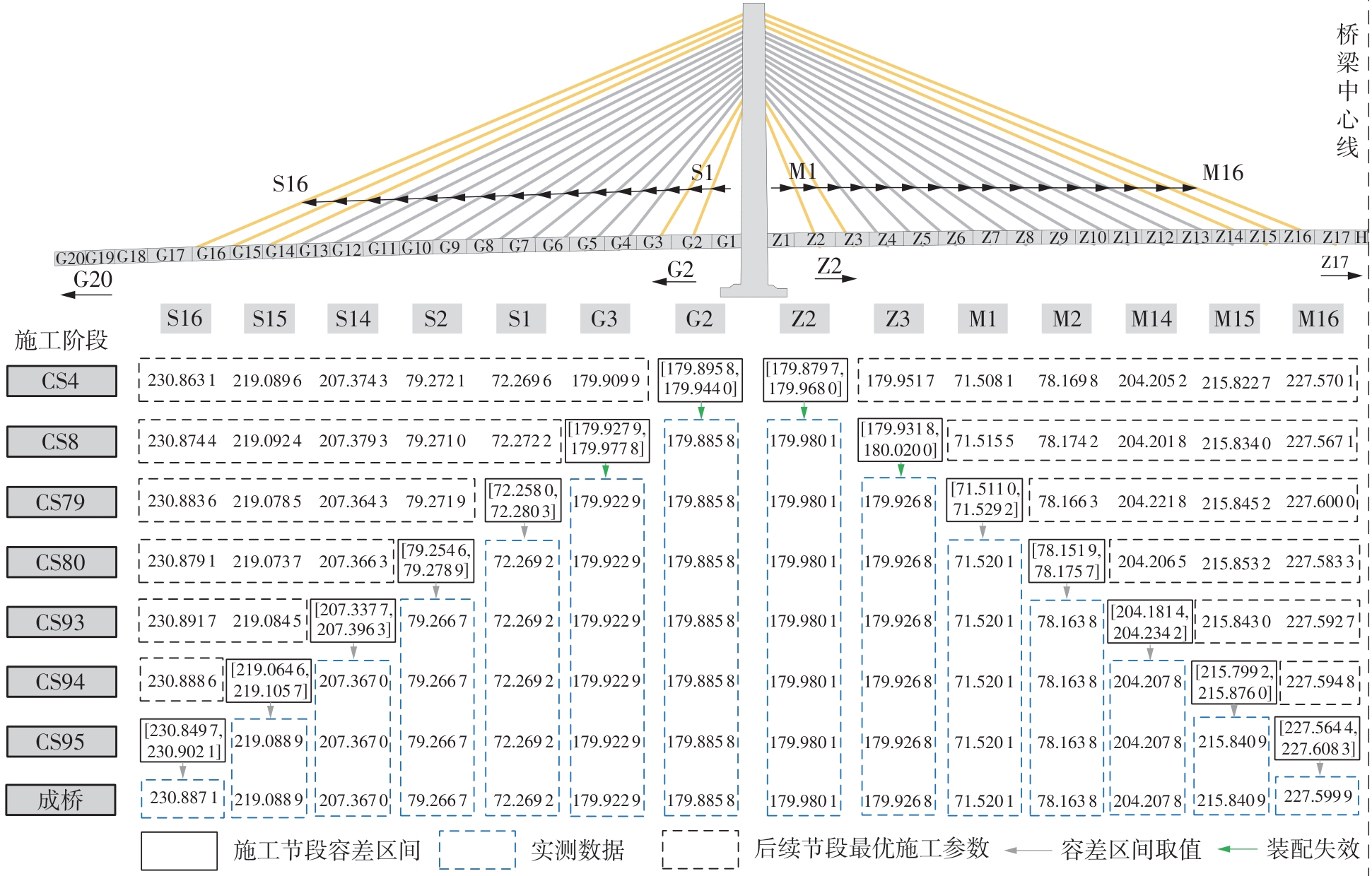
Table 5
Comparison of completed bridge cable force deviations under the adaptive control scheme"
| 斜拉索编号 | 设计成桥索力/kN | 调控后索力/kN | 偏差/% |
|---|---|---|---|
| S1 | 3 357 | 3 352 | -0.15 |
| S2 | 3 316 | 3 308 | -0.24 |
| S3 | 3 328 | 3 290 | -1.14 |
| S4 | 3 510 | 3 486 | -0.68 |
| S5 | 3 652 | 3 634 | -0.49 |
| S6 | 3 744 | 3 737 | -0.19 |
| S7 | 4 079 | 4 086 | 0.17 |
| S8 | 4 388 | 4 412 | 0.55 |
| S9 | 4 479 | 4 531 | 1.16 |
| S10 | 4 701 | 4 783 | 1.74 |
| S11 | 4 907 | 5 021 | 2.32 |
| S12 | 5 152 | 5 320 | 3.26 |
| S13 | 5 476 | 5 559 | 1.52 |
| S14 | 6 091 | 6 047 | -0.72 |
| S15 | 6 709 | 6 555 | -2.30 |
| S16 | 7 086 | 6 923 | -2.30 |
| M1 | 3 180 | 3 194 | 0.44 |
| M2 | 3 144 | 3 164 | 0.64 |
| M3 | 3 113 | 3 108 | -0.16 |
| M4 | 3 212 | 3 205 | -0.22 |
| M5 | 3 608 | 3 602 | -0.17 |
| M6 | 3 830 | 3 824 | -0.16 |
| M7 | 4 017 | 4 015 | -0.05 |
| M8 | 4 220 | 4 224 | 0.09 |
| M9 | 4 401 | 4 411 | 0.23 |
| M10 | 4 799 | 4 820 | 0.44 |
| M11 | 4 988 | 5 017 | 0.58 |
| M12 | 5 461 | 5 505 | 0.81 |
| M13 | 5 730 | 5 784 | 0.94 |
| M14 | 6 063 | 6 115 | 0.86 |
| M15 | 6 356 | 6 307 | -0.77 |
| M16 | 6 546 | 6 371 | -2.67 |
| [1] | WANG X M, WANG X D, DONG Y,et al .A novel construction technology for self-anchored suspension bridge considering safety and sustainability performance [J].Sustainability,2020,12(7):2973/ 1-23. |
| [2] | 项贻强,竺盛,赵阳 .快速施工桥梁的研究进展[J].中国公路学报,2018,31(12):1-27. |
| XIANG Yi-qiang, ZHU Sheng, ZHAO Yang .Research and development on accelerated bridge construction technology[J].China Journal of Highway and Transport,2018,31(12):1-27. | |
| [3] | 刘红平,邢江,陈浩,等 .短线预制悬拼连续梁施工误差实桥试验及安装线形分析[J].中国公路学报,2024,37(8):170-178. |
| LIU Hong-ping, XING Jiang, CHEN Hao,et al .Construction deviation field test and geometry analysis of continuous beam assembled by short-line match casting segments[J].China Journal of Highway and Transport,2024,37(8):170-178. | |
| [4] | YU X, ZHU Y, CHEN D,et al .Accelerated construction and geometry control for cable-stayed bridge using novel cable crane method[J].Proceedings of the Institution of Civil Engineers-Civil Engineering,2025,178(1):40-52. |
| [5] | 苑仁安,秦顺全 .无应力状态法在钢绞线斜拉索施工中的应用[J].桥梁建设,2012,42(3):75-79. |
| YUAN Ren-an, QIN Shun-quan.Application of unstressed state method to construction of steel strand stay cable [J].Bridge Construction,2012,42(3):75-79. | |
| [6] | 秦竟熙,苑仁安,但启联 .基于无应力状态量的桥梁成桥内力与成桥线形关系研究[J].桥梁建设,2025,55(2):94-99. |
| QIN Jingxi, YUAN Renan, DAN Qilian .Study on internal stress and shape control of bridge during final construction stage based on stress-free state theory[J].Bridge Construction,2025,55(2):94-99. | |
| [7] | WANG X, WANG H, SUN Y,et al .Process-independent construction stage analysis of self-anchored suspension bridges[J].Automation in Construction,2020,117:103227/1-24. |
| [8] | 张开富 .飞机部件装配误差累积分析与容差优化方法研究[D].西安:西北工业大学,2006. |
| [9] | 宜亚丽,杨泽宇,卫锐,等 .基于改进雅可比旋量模型的大尺寸薄壁壳体装配偏差分析与调控[J].华南理工大学学报(自然科学版),2024,52(12):32-42. |
| YI Yali, YANG Zeyu, WEI Rui,et al .Analysis and control of assembly deviation of large-size thin-walled shell based on improved Jacobian-torsor model[J].Journal of South China University of Technology(Natural Science Edition),2024,52(12):32-42. | |
| [10] | 周浩,郑建新,朱浩 .重庆白居寺长江大桥施工控制关键技术[J].桥梁建设,2024,54(4):141-148. |
| ZHOU Hao, ZHENG Jianxin, ZHU Hao .Key construction control techniques of Baijusi Changjiang River bridge in Chongqing[J].Bridge Construction,2024,54(4):141-148. | |
| [11] | GHALI M, ELGHALI S, AIFAOUI N .Associated tolerance optimization approach using manufacturing difficulty coefficients and genetic algorithm[J].Assembly Automation,2022,42(6):782-795. |
| [12] | HELING B, ASCHENBRENNER A, WALTER M S J,et al .On connected tolerances in statistical tolerance-cost-optimization of assemblies with interrelated dimension chains[J].Procedia CIRP, 2016,43:262-267. |
| [13] | 施祥玲,徐小明,苏林林,等 .基于NSGA-Ⅱ算法的航天产品装配公差多目标优化[J].上海航天(中英文),2020,37(3):121-125,146. |
| SHI Xiangling, XU Xiaoming, SU Linlin,et al .Multi-objective optimization based on NSGA-Ⅱ algorithm for assembly tolerance of aerospace products[J].Aerospace Shanghai(Chinese & English),2020,37(3):121-125,146. | |
| [14] | PENG H P, JIANG X Q, LIU X J .Concurrent optimal allocation of design and process tolerances for mechanical assemblies with interrelated dimension chains[J].International Journal of Production Research,2008,46(24):6963-6979. |
| [15] | 荆涛,田锡天 .基于蒙特卡洛-自适应差分进化算法的飞机容差分配多目标优化方法[J].航空学报,2022,43(3):577-588. |
| JING Tao, TIAN Xitian .Multi-objective optimization method for aircraft tolerance allocation based on Monte Carlo-adaptive differential evolution algorithm[J].Acta Aeronautica et Astronautica Sinica,2022,43(3):42578/1-12. | |
| [16] | 李英子 .钢桁梁节段拼装误差传递分析研究[D].长沙:长沙理工大学,2023. |
| [17] | BAI Y, WANG X, ZHAO Z,et al .Active fault-tolerant control to prevent hanger bending during configuration transformation of 3D cable system in suspension bridges[J].Applied Sciences,2025,15(6): 3249/1-21. |
| [18] | JIANG C, XIE H C, ZHANG Z G,et al .A new interval optimization method considering tolerance design [J].Engineering Optimization,2014,47(12):1637-1650. |
| [19] | 王犇 .考虑拼接误差的钢管混凝土拱桥分段成形优化方法研究[D].重庆:重庆交通大学,2023. |
| [20] | 胡杰 .大跨度钢桁架拱桥施工误差敏感性分析[D].武汉:武汉理工大学,2017. |
| [21] | 许诺 .垫塞钢板对悬拼拱桥扣索力与主拱线形的影响研究[D].重庆:重庆交通大学,2020. |
| [22] | 林拥军,陈皓,郭松 .基于GA-BPNN代理模型的混合式黏滞阻尼器构造优化[J].振动与冲击,2024,43(9):249-260,290. |
| LIN Yongjun, CHEN Hao, GUO Song .Structural parametric optimization of hybrid viscous damper based on GA-BPNN surrogate model[J].Journal of Vibration and Shock,2024,43(9):249-260,290. | |
| [23] | WANG W W, ZHANG H L, SONG Y J,et al .Fluid flow and thermal performance of the pulsating heat pipes facilitated with solar collectors:experiments,theories and GABPNN machine learning[J].Renewable Energy,2022,200:1533-1547. |
| [24] | YIN Z, JIAO J, XIE P,et al .Multi-objective optimization control for shield cutter wear and cutting performance using LightGBM and enhanced NSGA-Ⅱ[J].Automation in Construction,2025,171:105957/1-19. |
| [1] | YANG Yonghui, LI Zhixian, WANG Minhui, XU Hanming, CHEN Yingcong, WEN Shangsheng. UWB/INS Indoor Positioning Method Based on Self-Resetting Genetic Particle Filtering [J]. Journal of South China University of Technology(Natural Science Edition), 2026, 54(1): 83-93. |
| [2] | ZHAO Hu GOU Hongye NI Yingsheng. Shear Lag Effect of Corrugated Steel-Concrete Composite Multi-Box Cable-Stayed Bridge [J]. Journal of South China University of Technology (Natural Science Edition), 2020, 48(7): 93-103. |
| [3] | LIU Xiaoling, WANG Bing, HUANG Qiao, et al. Condition Assessment Model for Cable-Stayed Bridges Based on Evidence Reasoning Framework [J]. Journal of South China University of Technology (Natural Science Edition), 2020, 48(6): 69-76. |
| [4] | SONG Xuming, LI Mengran, LAI Mingyuan, et al. Optimization of Force State of Stiffened Long Cantilever Concrete Box Girder During Construction [J]. Journal of South China University of Technology (Natural Science Edition), 2020, 48(10): 67-75. |
| [5] | XU Yan TONG Chuan LI Jianzhong. Simplified Dynamic Model for Cable-Stayed Bridge with Longitudinal Viscous Damper [J]. Journal of South China University of Technology(Natural Science Edition), 2019, 47(4): 90-98. |
| [6] | Xu Yan Huang Yong-fu Li Jian-zhong. Simplified Calculation of Longitudinal Seismic Response of Cable-Stayed Bridges Subjected to Pulsed Ground Motions [J]. Journal of South China University of Technology (Natural Science Edition), 2015, 43(2): 41-47. |
| [7] | Liang Zhuo-rui Xu Xiang-min. Adaptive Adjustment of Control-Display Mapping Relationship for Visual Gesture Interaction [J]. Journal of South China University of Technology (Natural Science Edition), 2014, 42(8): 52-57. |
| [8] | Ma Ming-lei Ma Ru-jin Chen Ai-rong. Safety of Cables and Full Structure of a Cable-Stayed Bridge Exposed to Fires on Deck [J]. Journal of South China University of Technology (Natural Science Edition), 2014, 42(10): 117-124. |
| [9] | Su Cheng Chen Zhao-shuan Xu Yu-feng Pang Jian. Probability Analysis of Shrinkage and Creep Effect of Prestressed Concrete Cable-Stayed Bridges [J]. Journal of South China University of Technology(Natural Science Edition), 2012, 40(7): 8-14. |
| [10] | Xu Yan Duan Xin-zhi Li Jian-zhong. Analysis of Nonlinear Seismic Response of Cable-Stayed Bridge Subjected to Longitudinal Strong Ground Motions [J]. Journal of South China University of Technology(Natural Science Edition), 2012, 40(6): 132-138. |
| [11] | Li Xiao-nian Chen Ai-rong Ma Ru-jin. Influence of Temperature on Modal Parameters of Bridge [J]. Journal of South China University of Technology(Natural Science Edition), 2012, 40(4): 138-143. |
| [12] | . Modal Parameter Identification of Cable-Stayed Bridge Based on Multiple Reference DOFs Stabilization Diagram [J]. Journal of South China University of Technology (Natural Science Edition), 2011, 39(9): 41-47,53. |
| [13] | Zhang Yang-yong Sun Bin Xiao Ru-cheng . Optimization of Cable Force for Cable-Stayed Bridges with Ultra Kilometer Span Under Dead Loads [J]. Journal of South China University of Technology (Natural Science Edition), 2009, 37(6): 142-146. |
| [14] | Wen Hui-ying Xu Jian-min Lin Zheng-chun. Genetic Algorithm for Route Optimization of Vehicle Navigation in Logistics Distribution [J]. Journal of South China University of Technology (Natural Science Edition), 2009, 37(2): 82-86,91. |
| [15] | Xu Jin-yong Yan Quan-sheng wang Wei-feng Han Da-jian. Section Deformation of Flat Hollow Steel Box Girder of Cable-Stayed Bridge During Cantilever Erection [J]. Journal of South China University of Technology (Natural Science Edition), 2007, 35(3): 127-131. |
| Viewed | ||||||
|
Full text |
|
|||||
|
Abstract |
|
|||||