Journal of South China University of Technology(Natural Science Edition) ›› 2025, Vol. 53 ›› Issue (11): 112-121.doi: 10.12141/j.issn.1000-565X.240592
• Intelligent Transportation System • Previous Articles Next Articles
Hotspot Segments Identification of Collisions Between Electric Vehicles and Pedestrians/Non-Motor Vehicles
YANG Miaoyan1, DONG Chunjiao1, XIONG Zhihua1, ZHUANG Yan2, XU Bo1
- 1.School of Traffic and Transportation,Beijing Jiaotong University,Beijing 100044,China
2.China Center for Information Industry Development,Beijing 100846,China
-
Received:2024-12-20Online:2025-11-25Published:2025-06-18 -
Contact:熊志华(1979—),女,博士,副教授,主要从事交通安全可靠性、交通规划研究。 E-mail:zhhxiong@bjtu.edu.cn -
About author:杨妙言(2002—),女,博士生,主要从事交通安全、交通出行与规划研究。E-mail: 24110253@bjtu.edu.cn -
Supported by:the National Natural Science Foundation of China(72371017)

CLC Number:
Cite this article
YANG Miaoyan, DONG Chunjiao, XIONG Zhihua, ZHUANG Yan, XU Bo. Hotspot Segments Identification of Collisions Between Electric Vehicles and Pedestrians/Non-Motor Vehicles[J]. Journal of South China University of Technology(Natural Science Edition), 2025, 53(11): 112-121.
share this article
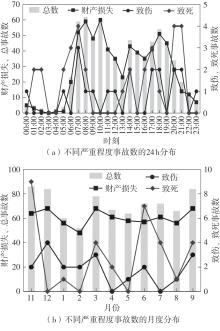
Fig.1
Time distribution of collisions between electric vehicles and pedestrians/non-motor vehicles from November 2020 to September 2021"

Table 1
Comprehensive impact indicators for identifying hotspot segments of electric vehicle traffic accidents"
| 影响指标 | 分类描述及对应取值1) | |
|---|---|---|
道路设施 因素 | 信号灯密度 | 实际值 |
| 中央隔离设施 | 有硬隔离(1) | |
| 无硬隔离(0) | ||
| 非机动车道 | 有(1) | |
| 无(0) | ||
| 双向车道数 | 实际值 | |
| 道路类型R | 公路(1) | |
| 城市道路(2) | ||
| 其他道路(3) | ||
| 事故参与者因素 | 事故参与者年龄A | 25岁以下(1) |
| 25~45岁(2) | ||
| 45岁以上(3) | ||
| 环境因素 | 天气W | 晴(1) |
| 非晴(2) | ||
| 经济因素 | GDP | 实际值 |
| 参加失业保险人数 | 实际值 | |
| 60岁及以上占人口比例 | 实际值 | |
| 事故后果 | 事故严重程度S | 财产损失(1) |
| 受伤(4) | ||
| 死亡(6) | ||
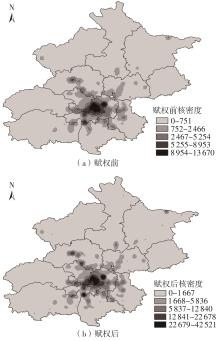
Fig.2
Comparison of network kernel density spatial features before and after weighting in collisions between electric vehicles and pedestrians/non-motor vehicles"
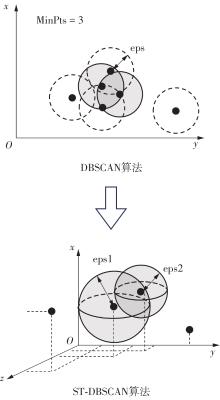
Fig.3
Improvement idea of ST-DBSCAN clustering algorithm"
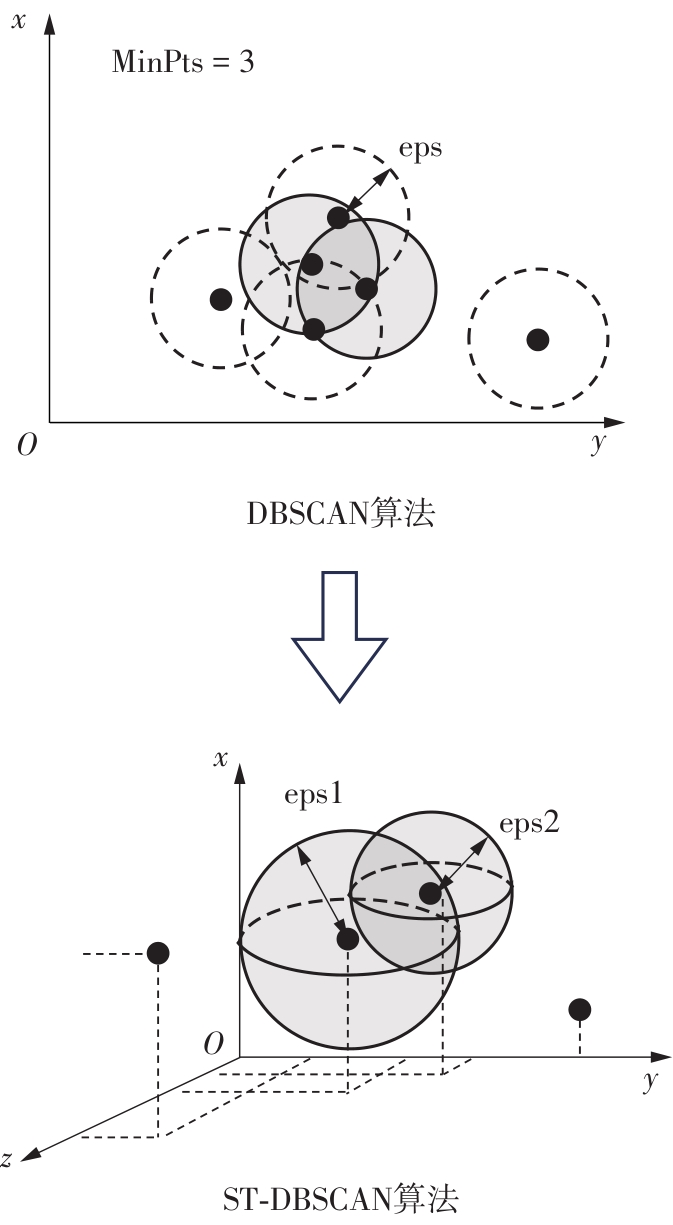
Table 2
Spatial clustering effect for collisions between electric vehicles and pedestrians/non-motor vehicles"
| 算法 | 轮廓系数 | DBI | CHI |
|---|---|---|---|
| DBSCAN | 0.41 | 2.16 | 184.38 |
| OPTICS | 0.17 | 5.51 | 32.14 |
| Mean Shift | 0.42 | 1.06 | 144.26 |
| DPC | 0.60 | 0.27 | 204.77 |
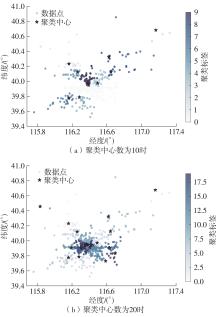
Fig.4
Clustering results obtained by DPC algorithm for collisions between electric vehicles and pedestrians/non-motor vehicles"
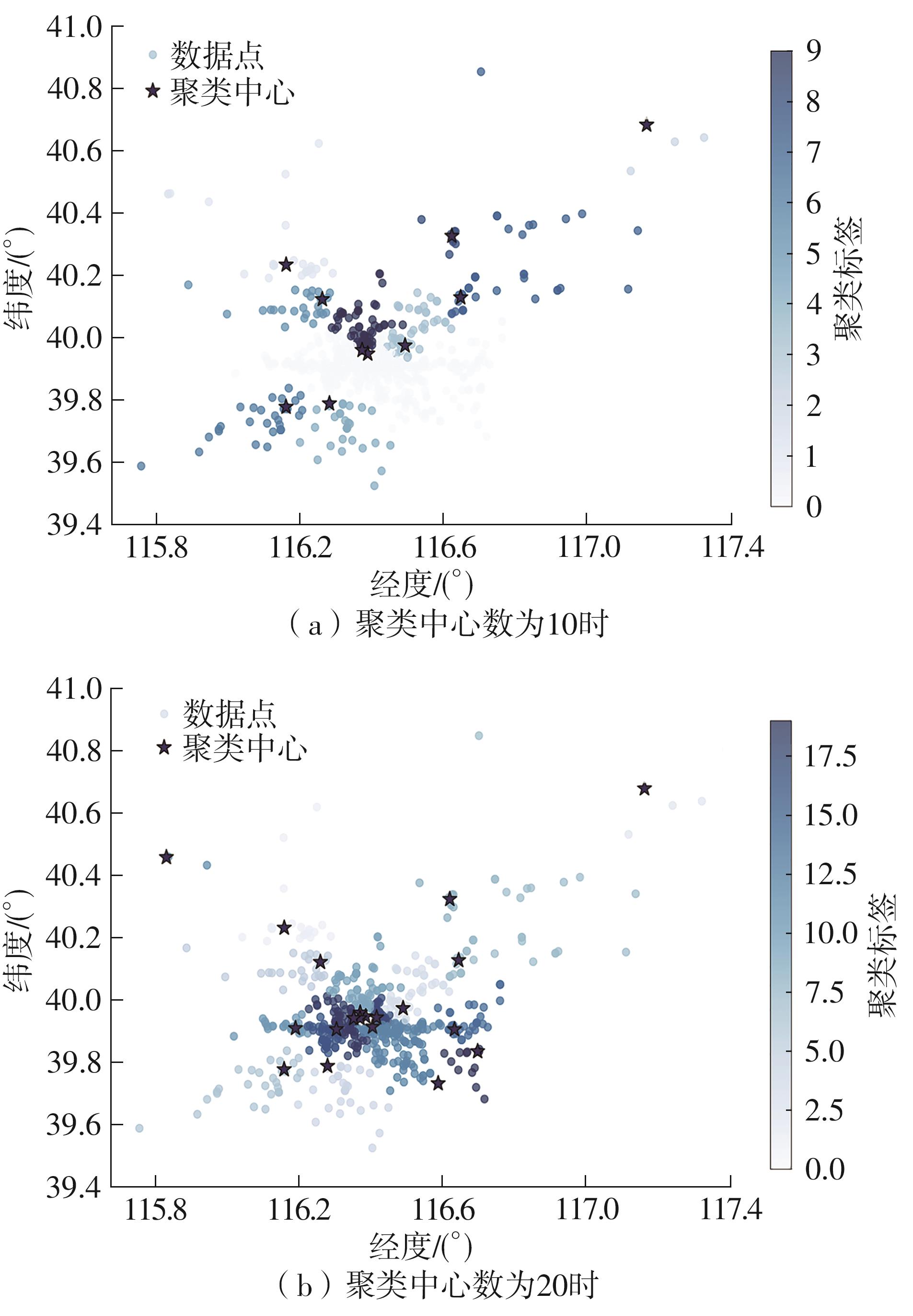
Fig.5
Identification results of spatial hotspot segments for accidents"
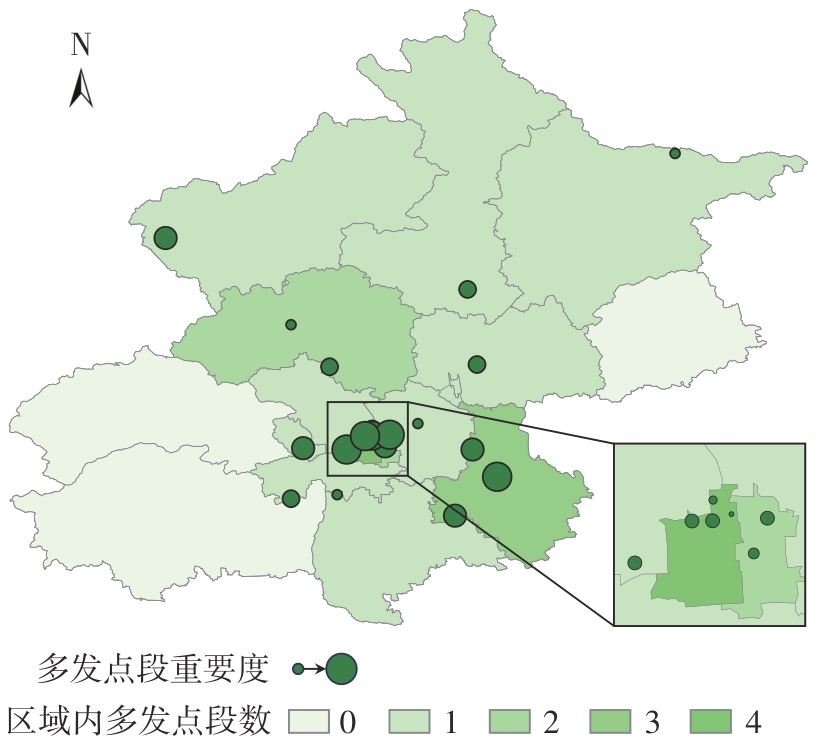
Table 3
Spatio-temporal clustering effect for collisions between electric vehicles and pedestrians/non-motor vehicles"
| 算法 | 轮廓系数 | DBI | CHI |
|---|---|---|---|
| ST-DBSCAN | 0.52 | 1.47 | 245.79 |
| ST-OPTICS | 0.14 | 1.57 | 15.61 |
| ST-DPC | 0.13 | 1.36 | 70.63 |
| ST-Mean Shift | 0.16 | 1.17 | 156.28 |
Fig.6
Spatio-temporal clustering results obtained by ST-DBSCAN algorithm for collisions between electric vehicles and pedestrians/non-motor vehicles"
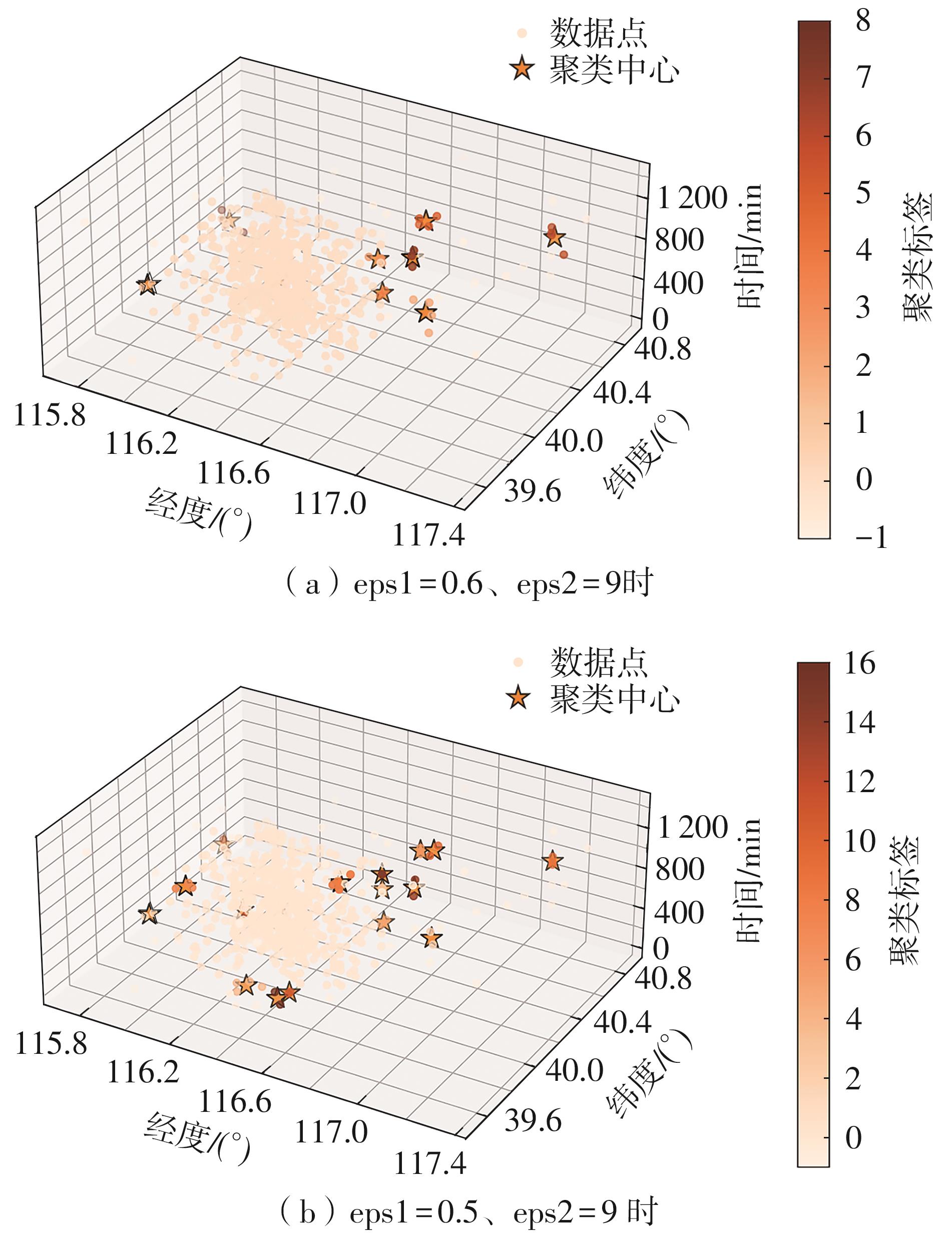
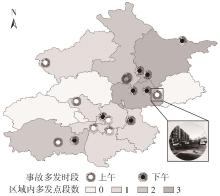
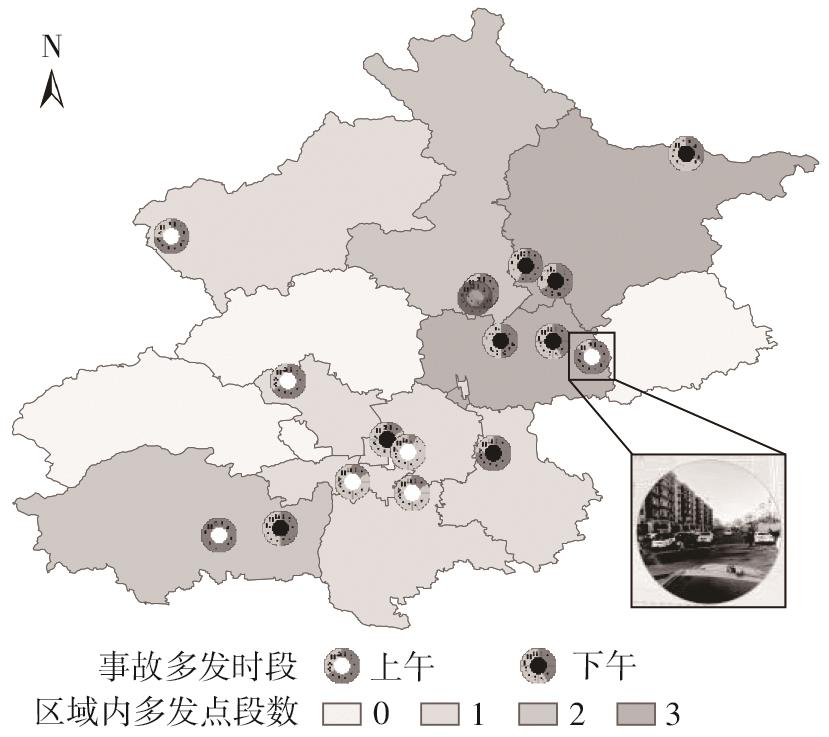
Fig.7
Identification results of spatio-temporal hotspot segments for accidents"
| [1] | 陆化普,罗圣西,李瑞敏 .基于GIS分析的深圳市道路交通事故空间分布特征研究[J].中国公路学报,2019,32(8):156-164. |
| LU Hua-pu, LUO Sheng-xi, LI Rui-min .GIS-based spatial patterns analysis of urban road traffic crashes in Shenzhen[J].China Journal of Highway and Transport,2019,32(8):156-164. | |
| [2] | CUI H, DONG J, ZHU M,et al .Identifying accident black spots based on the accident spacing distribution[J].Journal of Traffic and Transportation Engineering (English Edition),2022,9(6):1017-1026. |
| [3] | 刘尧,王颖志,王立君,等 .交通事故的时空热点分析[J].浙江大学学报(理学版),2020,47(1):52-59. |
| LIU Yao, WANG Yingzhi, WANG Lijun,et al .Spatial-temporal hotspots analysis on traffic accidents[J].Journal of Zhejiang University (Science Edition),2020,47(1):52-59. | |
| [4] | 吴佩洁,孟祥海,曹梦迪 .城市交通事故多发点鉴别与时空模式挖掘[J].中国安全科学学报,2020,30(11):127-133. |
| WU Peijie, MENG Xianghai, CAO Mengdi .Identification of black spots in urban roads and spatiotemporal patterns mining[J].China Safety Science Journal,2020,30(11):127-133. | |
| [5] | LI Y, ABDEL A M, YUAN J,et al .Analyzing traffic violation behavior at urban intersections:a spatio-temporal kernel density estimation approach using automated enforcement system data[J].Accident Analysis & Prevention,2020,141:105509/1-11. |
| [6] | 庄焱,董春娇,米雪玉,等 .基于改进网络核密度和负二项回归的事故黑点鉴别[J].华南理工大学学报(自然科学版),2024,52(1):119-126. |
| ZHUANG Yan, DONG Chunjiao, MI Xueyu,et al .Identification of accident black spots based on improved network kernel density and negative binomial regression[J].Journal of South China University of Technology (Natural Science Edition),2024,52(1):119-126. | |
| [7] | HARIRFOROUSH H, BELLALITE L .A new integrated GIS-based analysis to detect hotspots: a case study of the city of Sherbrooke[J].Accident Analysis & Prevention,2019,130:62-74. |
| [8] | DEBRABANT B, HALEKOH U, BONAT W H,et al .Identifying traffic accident black spots with Poisson-Tweedie models[J].Accident Analysis & Prevention,2018,111:147-154. |
| [9] | 郭璘,周继彪,董升,等 .基于改进K-means算法的城市道路交通事故分析[J].中国公路学报,2018,31(4):270-279. |
| GUO Lin, ZHOU Jibiao, DONG Sheng,et al .Analysis of urban road traffic accidents based on improved K-means algorithm[J].China Journal of Highway and Transport,2018,31(4):270-279. | |
| [10] | FAN Z, LIU C, CAI D,et al .Research on black spot identification of safety in urban traffic accidents based on machine learning method[J].Safety Science,2019,118:607-616. |
| [11] | GREGORIADES A, MOUSKOS K C .Black spots identification through a Bayesian Networks quantification of accident risk index[J].Transportation Research Part C:Emerging Technologies,2013,28:28-43. |
| [12] | 杨洋,胡嫣然,袁振洲,等 .高速公路交通事故时空影响动态效应的传播分析[J].华南理工大学学报(自然科学版),2023,51(1):123-133. |
| YANG Yang, HU Yanran, YUAN Zhenzhou,et al .Analysis on propagation of spatio-temporal dynamic effects towards freeway traffic crash[J].Journal of South China University of Technology (Natural Science Edition),2023,51(1):123-133. | |
| [13] | DERELI M A, ERDOGAN S .A new model for determining the traffic accident black spots using GIS-aided spatial statistical methods[J].Transportation Research Part A:Policy and Practice,2017,103:106-117. |
| [14] | 王颖志,王立君 .基于网络时空核密度的交通事故多发点鉴别方法[J].地理科学,2019,39(8):1238-1245. |
| WANG Yingzhi, WANG Lijun .An identification me-thod of traffic accident black point based on street-network spatial-temporal kernel density estimation[J].Scientia Geographica Sinica,2019,39(8):1238-1245. | |
| [15] | 张道文,董鑫驰,雷毅,等 .新能源汽车与行人交通事故严重程度分析[J].安全与环境学报,2024,24(3):1061-1069. |
| ZHANG Daowen, DONG Xinchi, LEI Yi,et al .Analysis of the severity of traffic accidents between new energy vehicles and pedestrians[J].Journal of Safety and Environment,2024,24(3):1061-1069. | |
| [16] | SCHUBERT A, BABISCH S, SCANLON J M,et al .Passenger and heavy vehicle collisions with pedes-trians:assessment of injury mechanisms and risk[J].Accident Analysis & Prevention,2023,190:107139. |
| [17] | 《中国公路学报》编辑部 .中国汽车工程学术研究综述·2023[J].中国公路学报,2023,36(11):1-192. |
| Editorial Department of China Journal of Highway and Transport .Review on China’s Automotive Engineering Research Progress: 2023[J].China Journal of Highway and Transport,2023,36(11):1-192. | |
| [18] | 刘永涛,张慧臣,袁诗泉,等 .基于FP-growth的老年行人交通事故损伤致因研究[J].中国安全生产科学技术,2024,20(6):176-182. |
| LIU Yongtao, ZHANG Huichen, YUAN Shiquan,et al .Research on traffic accident injury causation of elderly pedestrian based on FP-growth[J].Journal of Safety Science and Technology,2024,20(6):176-182. | |
| [19] | RODRIGUEZ A, LAIO A .Clustering by fast search and find of density peaks[J].Science,2014,344(6191):1492-1496. |
| [20] | ESTER M, KRIEGEL H P, SANDER J,et al .A density-based algorithm for discovering clusters in large spatial databases with noise[C]∥ Proceedings of the National Conferences on Aritificial Intelligence, KDD-96 Proceedings. Portland:Association for the Advan-cement of Artificial Intelligence,1996:226-231. |
| [21] | BIRANT D,KUT A .ST-DBSCAN: an algorithm for clustering spatial-temporal data[J].Data & Knowle-dge Engineering,2007,60(1):208-221. |
| [1] | WANG Qingrong, GAO Huanyi, ZHU Changfeng, HE Runtian, MU Zhuangzhuang. Traffic Congestion Prediction Based on Dynamic Adaptive Gated Graph Convolutional Networks [J]. Journal of South China University of Technology(Natural Science Edition), 2025, 53(9): 31-47. |
| [2] | ZHU Shaopeng, MAO Jingyang, LIU Dongqing, YIN Yuming, CHEN Huipeng, XU Yekai. Design of Acceleration Slip Regulation Multi-Mode Control Strategy of Distributed Drive Electric Vehicle [J]. Journal of South China University of Technology(Natural Science Edition), 2025, 53(6): 44-55. |
| [3] | XIE Kun, XING Xinyuan, DONG Honghui, DONG Chunjiao, CHEN Yuanduo. Method for Workplace and Residence Identification and Travel Activity Classification Driven by Trajectory Data [J]. Journal of South China University of Technology(Natural Science Edition), 2025, 53(6): 131-139. |
| [4] | BI Jun, WANG Jianing, WANG Yongxing. Short-Term Operation State Prediction of Charging Station Based on LSTM-FC Model [J]. Journal of South China University of Technology(Natural Science Edition), 2025, 53(2): 58-67. |
| [5] | SHANGGUAN Wenbin, YUE Lian, LÜ Hui, et al. Fatigue Test and Calculation Methods for Battery Package Based on Load Spectrum [J]. Journal of South China University of Technology(Natural Science Edition), 2024, 52(3): 50-56. |
| [6] | LIN Peiqun, GONG Minping, ZHOU Chuhao. User Portrait Method of Freeway Freight Car for Risk Identification of Freight Transportation [J]. Journal of South China University of Technology(Natural Science Edition), 2023, 51(6): 1-9. |
| [7] | DONG Ping, WEI Shuyang, LIU Mingbo. Scheduling Strategies for Electric Vehicle Participation in Electricity Markets Under Multi-Network Collaboration [J]. Journal of South China University of Technology(Natural Science Edition), 2023, 51(12): 83-94. |
| [8] | PEI Mingyang, ZHU Hongyu. Modeling Method for Optimizing Dynamic Wireless Charging Lane of Electric Vehicles [J]. Journal of South China University of Technology(Natural Science Edition), 2023, 51(10): 135-151. |
| [9] | LUO Yutao, WU Zhiqiang . Online Joint Estimation of Main States of Lithium-Ion Battery Based on DAEKF Algorithm [J]. Journal of South China University of Technology(Natural Science Edition), 2023, 51(1): 84-94. |
| [10] | LÜ Hui, ZHAO Jiawei, MAO Haikuan, et al. Analysis of the Powertrain Mount Systems of Electric Vehicles by Considering the Correlation of Probabilistic Parameters [J]. Journal of South China University of Technology(Natural Science Edition), 2022, 50(3): 65-72. |
| [11] | LIU Xiaolan, SHI Zongyu, YE Zehui, et al. Anchor Graph Based Low-Rank Incomplete Multi-View Subspace Clustering [J]. Journal of South China University of Technology(Natural Science Edition), 2022, 50(12): 60-70. |
| [12] | ZHANG Xin CUI Yuxuan XUE Qicheng. Torque Coordinated Control Strategy of PHEV Engine Starting in Motion Process [J]. Journal of South China University of Technology(Natural Science Edition), 2021, 49(8): 129-139. |
| [13] | LIU Hanwu, LEI Yulong, FU Yao, et al. Adaptive Regenerative Braking Control Strategy of Range-Extended Electric Vehicle Based on Multi-Objective Optimization [J]. Journal of South China University of Technology (Natural Science Edition), 2021, 49(7): 42-50,65. |
| [14] | GUO Lie, GE Pingshu, XU Linna, et al. Stability Control for Distributed Drive Electric Vehicle Under Steering Condition [J]. Journal of South China University of Technology (Natural Science Edition), 2020, 48(3): 100-107. |
| [15] | YANG Jinming SUN Jieshan LIU Runpeng. Passivity-Based Control of Primary-Side and Secondary-Side Rectifier Bridge in Wireless Power Transfer System for Electric Vehicle [J]. Journal of South China University of Technology(Natural Science Edition), 2020, 48(10): 11-18,47. |
| Viewed | ||||||
|
Full text |
|
|||||
|
Abstract |
|
|||||