收稿日期: 2023-06-21
网络出版日期: 2023-08-16
基金资助
国家自然科学基金资助项目(32372276,32172167)
Effect of Chitosan on the Hot-Extrusion 3D Printing Formability of Oxidized Starch Gel
Received date: 2023-06-21
Online published: 2023-08-16
Supported by
the National Natural Science Foundation of China(32372276,32172167)
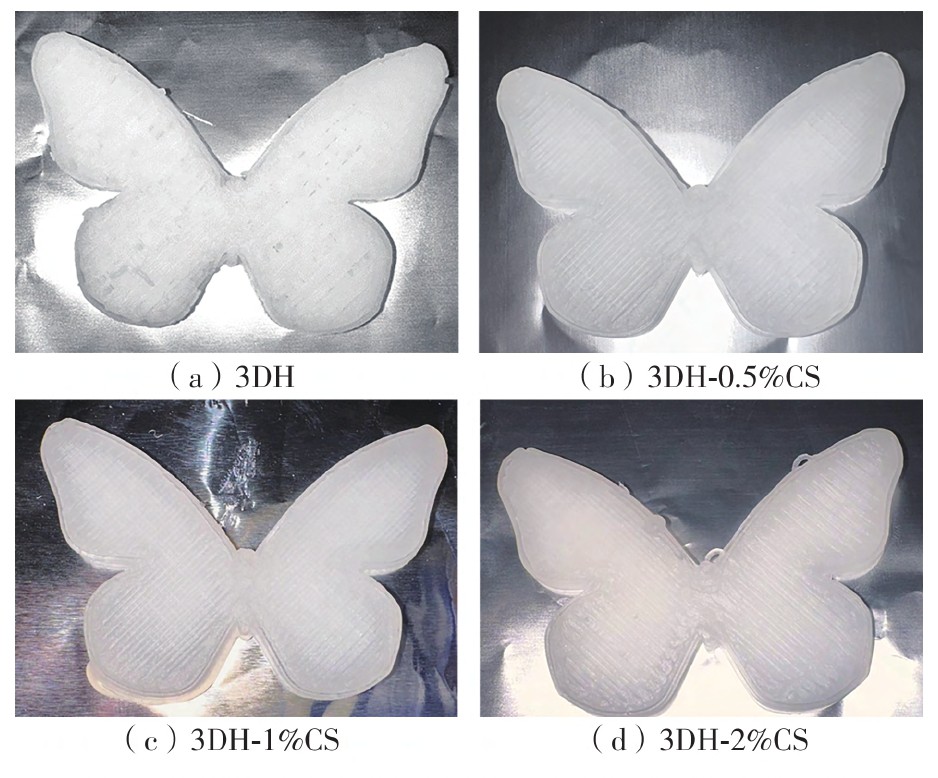
氧化淀粉凝胶材料因其具有亲水性和电荷性、易反应与组装等优势,成为近年来食品及生物医药等领域研究和应用的热点材料,但其作为热挤压3D打印凝胶材料时却存在打印成型性较差及凝胶强度较低等缺陷。本研究提出利用壳聚糖与氧化淀粉分子间的非共价及化学交联作用对其进行调控,探究不同壳聚糖添加量对氧化淀粉凝胶材料的流变性能、打印成型性和凝胶强度的影响。结果表明:壳聚糖与氧化淀粉糊特性依然呈现典型的剪切稀化特征,随着壳聚糖添加量增加(0.5%~2%),氧化淀粉-壳聚糖凝胶体系中存在氢键及静电吸引等非共价相互作用导致黏度增大,触变性先提升后下降,流动应力(τf)先减小后增大、屈服应力(τy)先增大后减小。相比于氧化淀粉凝胶,氧化淀粉-壳聚糖凝胶均具有良好的打印成型性,尤其是当壳聚糖添加量为1%时,复合凝胶触变性最好,流动应力(τf)最小、屈服应力(τy)最大,因此打印成型性与打印精度最佳。此外,由于壳聚糖与氧化淀粉的非共价相互作用以及希夫碱化学交联作用,使得氧化淀粉凝胶网络结构更加致密,稳定性提升,凝胶强度显著增大,且随壳聚糖添加量增加变化趋势愈加明显。本研究结果可为氧化淀粉凝胶材料的性能改善及适合热挤压3D打印加工需求的氧化淀粉-壳聚糖凝胶材料设计与应用提供理论依据和技术支撑。
陈玲, 吕嘉宇, 邱志鹏 . 壳聚糖对氧化淀粉凝胶热挤压3D打印成型性的影响[J]. 华南理工大学学报(自然科学版), 2024 , 52(3) : 1 -9 . DOI: 10.12141/j.issn.1000-565X.230433
Oxidized starch gel material has become a hot material in fields such as food and biomedicine because of its advantages of hydrophilicity, chargeability, easy reaction and assembly in recent year. However, when used as a hot-extrusion 3D printing (HE-3DP) gel material, it has defects such as poor printability and low gel strength. This study investigated the influence of different chitosan addition amount on the rheological properties, printing formability and gel strength of oxidized starch-chitosan gel materials by adding different amounts of chitosan and utilizing non-covalent and chemical cross-linking between chitosan and oxidized starch. The results show that the oxidized starch-chitosan pastes exhibit typical shear-thinning characteristics. As chitosan is added in varying concentrations (0.5%~2%), non-covalent interactions such as hydrogen bonding and electrostatic attraction lead to an increase in the viscosity of the system. The thixotropic property initially increases and then decreases, while the flow stress (τf) first decreases, and then increases; and the yield stress (τy) increases first and then decreases. Compared with oxidized starch gel, oxidized starch-chitosan gel has good printing formability. Especially when the amount of chitosan added is 1%, the composite gel has the best thixotropic property, the minimum flow stress (τf) and the largest yield stress (τy), so the printing formability and printing accuracy is the best. Additionally, due to the non-covalent interaction between chitosan and oxidized starch and the schiff base chemical cross-linking, the oxidized starch-chitosan gel forms a dense network structure to improve gel stability and gel strength significantly. These effects are more significant with a higher chitosan content. The results can provide a theoretical basis and technical support for the performance improvement of oxidized starch gel material and the design and application of oxidized starch-chitosan gel materials suitable for HE-3DP.
| 1 | PUSHPAMALAR J, MEGANATHAN P, TAN H L,et al .Development of a polysaccharide-based hydrogel drug delivery system (DDS):an update[J].Gels,2021,7(4):153/1-22. |
| 2 | RADULESCU D M, NEACSU I A, GRUMEZESCU A M,et al .New insights of scaffolds based on hydrogels in tissue engineering[J].Polymers,2022,14(4):799/1-30. |
| 3 | SHI Y, ZHANG M, BHANDARI B .Effect of addition of beeswax based oleogel on 3D printing of potato starch-protein system[J].Food Structure,2021,27(1):100176/1-10. |
| 4 | CHEN H, XIE F, CHEN L,et al .Effect of rheological properties of potato,rice and corn starches on their hot-extrusion 3D printing behaviors[J].Journal of Food Engineering,2019,244:150-158. |
| 5 | 陈玲,杜安林,唐煜括,等 .不同糊化度淀粉材料结构演变对其热挤压3D打印成型性的影响[J].华南理工大学学报(自然科学版),2021,49(3):62-70,87. |
| CHEN Ling, DU Anlin, TANG Yukuo,et al .Effects of structural evolution of starch materials with different gelatinization degrees on materials’ printability of hot-extrusion 3D printing[J].Journal of South China University of Technology(Natural Science Edition),2021,49(3):62-70,87. | |
| 6 | ZHANG J, LI Y, CAI Y,et al .Hot extrusion 3D printing technologies based on starchy food:A review[J].Carbohydrate Polymers,2022,294:119763/1-12. |
| 7 | ZHU W, MA X, GOU M,et al .3D printing of functional biomaterials for tissue engineering[J].Current Opinion in Biotechnology,2016,40:103-112. |
| 8 | CHAUNIER L, GUESSASMA S, BELHABIB S,et al .Material extrusion of plant biopolymers:opportunities & challenges for 3D printing[J].Additive Manufacturing,2018,21:220-233. |
| 9 | WANG Y J, WANG L .Physicochemical properties of common and waxy corn starches oxidized by different levels of sodium hypochlorite[J].Carbohydrate Polymers,2003,52(3):207-217. |
| 10 | WANG W, MENG Q, LI Q,et al .Chitosan derivatives and their application in biomedicine[J].International Journal of Molecular Sciences,2020,21(2):487/1-26. |
| 11 | QING L, NA J, LIU X,et al .Rapid gelling,self-healing,and fluorescence-responsive chitosan hydrogels formed by dynamic covalent crosslinking[J].Carbohydrate Polymers,2020,246:116586/1-10. |
| 12 | SHAGHAYEGH A, POURIA S, ELAHEH A,et al .Chitosan/dialdehyde starch hybrid in situ forming hydrogel for ocular delivery of betamethasone[J].Materials Today Communications,2022,33:104873/1-9. |
| 13 | JI Y, LIN X, YU J .Preparation and characterization of oxidized starch-chitosan complexes for adsorption of procyanidins[J].LWT,2020,117:108610/1-6. |
| 14 | LIU Y, CHEN L, XU H,et al .Understanding the digestibility of rice starch-gallic acid complexes formed by high pressure homogenization[J].International Journal of Biological Macromolecules,2019,134:856-863. |
| 15 | NAUREEN B, MIANA G A, SHAHID K,et al .Iron (Ⅲ) and zinc (Ⅱ) monodentate Schiff base metal complexes:synthesis,characterisation and biological activities[J].Journal of Molecular Structure,2021,1231:129946/1-12. |
| 16 | QIU Z, ZHENG B, XU J,et al .3D-printing of oxidized starch-based hydrogels with superior hydration properties[J].Carbohydrate Polymers,2022,292:119686/1-9. |
/
| 〈 |
|
〉 |
地址:广州 五山 华南理工大学17号楼 邮政编码:510640
电话: 020-87111794 邮箱:journal@scut.edu.cn