收稿日期: 2024-08-14
网络出版日期: 2025-03-10
基金资助
国家自然科学基金项目(52172319);国家自然科学基金项目(71971138)
Collaborative Control for Urban Expressway Mainline and On-Ramp Metering in Connected-Vehicle Environment
Received date: 2024-08-14
Online published: 2025-03-10
Supported by
the National Natural Science Foundation of China(52172319)
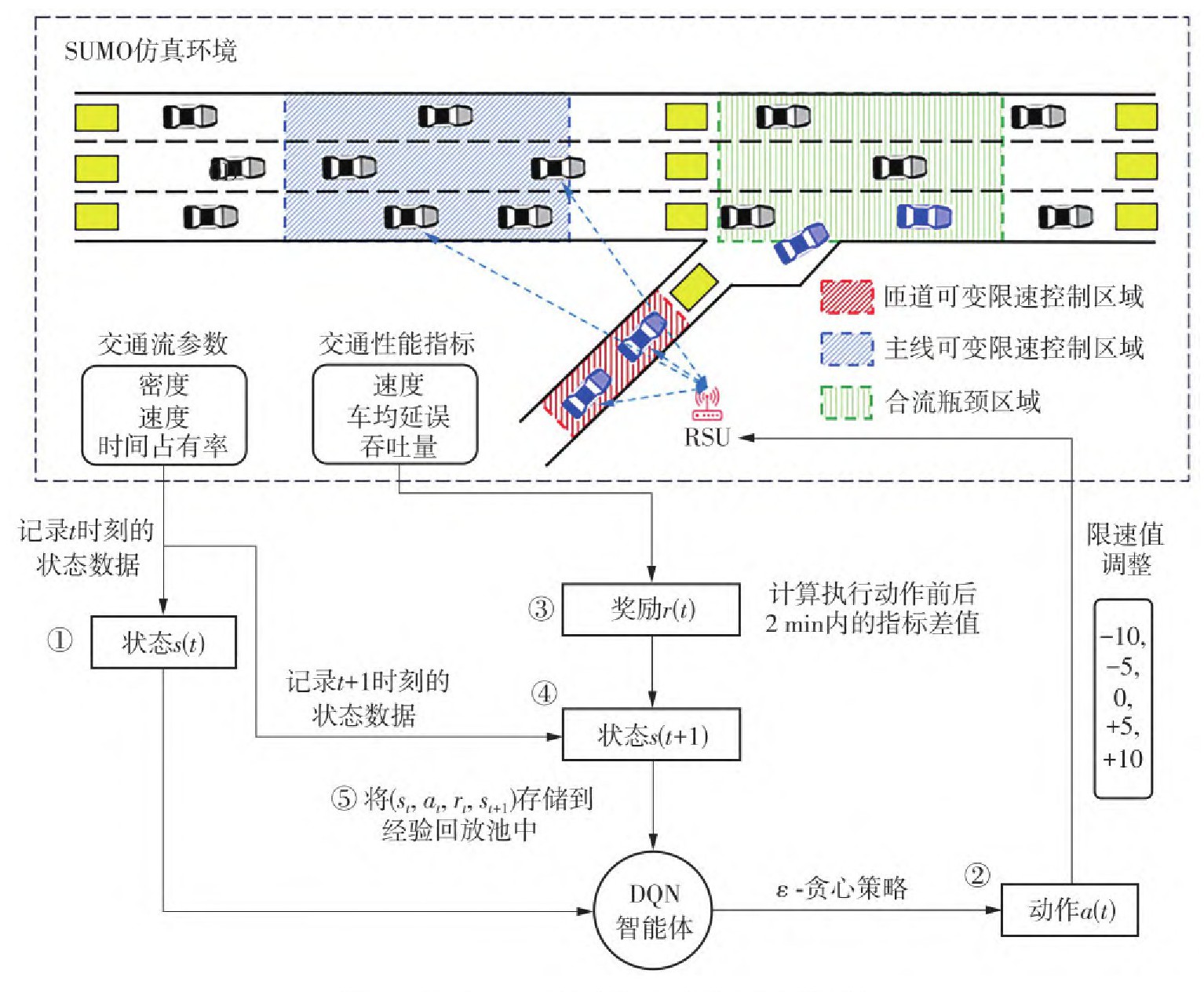
随着智能网联车辆(CAV)技术在主动交通管理领域的深入应用,可变限速(VSL)策略成为提升道路交通流通行效率和安全性的关键。针对城市快速路合流区域的交通冲突导致通行能力下降和车速急剧变化问题,提出了一种面向车联网环境下快速路主线和入口匝道的协同可变限速控制策略方法。首先,采用基于Motorway Traffic Flow Network Model(METANET)的主线交通流预测模型,以总行程时间和距离最小构建双目标函数,通过应用模型预测控制(MPC)进行优化求解;然后,将可变限速控制问题抽象为马尔可夫决策过程,以平均速度、吞吐量和车均延误为指标构建复合奖励函数,通过引入深度Q网络(DQN)计算不同交通流状态下最优匝道限速,通过路侧设施(I2V)向CAV发布限速信息;最后,以徐州市北三环快速路为实例对提出的协同控制策略方法进行仿真测试。基于Simulation of Urban Mobility (SUMO)仿真实验结果表明:提出的策略方法与仅对主线进行限速控制的场景相比,路网车辆总行程时间减少8.51%,平均速度提升14.49%,交通密度波动降低14.81%,证明了该策略方法在车联网环境下能有效提升合流区通行效率,减小主线和入口匝道车辆的速度差异,缩小交通拥堵时空范围,从而提高城市快速路交通流的稳定性。
吴昊都 , 石杨 , 赵骏腾 , 孙健 . 车联网环境下城市快速路主线与入口匝道协同控制[J]. 华南理工大学学报(自然科学版), 2025 , 53(8) : 73 -86 . DOI: 10.12141/j.issn.1000-565X.240403
With the increasing application of Connected and Autonomous Vehicle (CAV) technologies in active traffic management, Variable Speed Limit (VSL) strategies have become crucial for improving traffic flow efficiency and safety. To address the issues of decreased traffic capacity and abrupt speed variations caused by traffic conflicts in urban expressway merging areas, a cooperative variable speed limit (VSL) control strategy was proposed for the mainline and on-ramp under a connected vehicle environment. Firstly, a mainline traffic flow prediction model based on Motorway Traffic Flow Network Modle (METANET) was adopted, constructing a bi-objective function to minimize the total travel time and distance, using Model Predictive Control (MPC). Then, the variable speed limit control problem was modelled as a Markov decision process, with a composite reward function based on average speed, throughput, and vehicle delay. By introducing Deep Q-network (DQN), the optimal on-ramp speed limits under different traffic flow conditions were calculated and disseminated to CAVs through Vehicle-to-Infrastructure (V2I) communication. Finally, the proposed coordinated control strategy was simulated and tested using the North Third Ring Expressway in Xuzhou, China as a case study. The empirical results based on SUMO microsimulation demonstrate that the proposed strategy, compared to the scenario with speed control only on the mainline, reduces the total travel time of network vehicles by 8.51%, increases the average speed by 14.49%, and reduces traffic density fluctuations by 14.81%. These results demonstrate that the proposed method can effectively improve traffic flow efficiency in merging areas under a connected vehicle environment, reduce speed differences between mainline and ramp vehicles, and shrink the spatiotemporal scope of congestion, thereby enhancing the stability of urban expressway traffic flow.
| [1] | ZHAO J, MA W, XU H .Increasing the capacity of the intersection downstream of the freeway off-ramp using presignals[J].Computer-Aided Civil and Infrastructure Engineering,2017,32(8):674-690. |
| [2] | KHONDAKER B, KATTAN L .Variable speed limit:an overview[J].Transportation Letters,2015,7(5):264-278. |
| [3] | 余向华 .快速路瓶颈通行能力陡降动态建模与交通控制机理解析[D].杭州:浙江大学,2023. |
| [4] | PAPAGEORGIOU M, KOSMATOPOULOS E, PAPAMICHAIL I .Effects of variable speed limits on motorway traffic flow[J].Transportation Research Record,2008,2047(1):37-48. |
| [5] | HEGYI A, DE SCHUTTER B, HELLENDOORN H .Model predictive control for optimal coordination of ramp metering and variable speed limits[J].Transportation Research Part C:Emerging Technologies,2005,13(3):185-209. |
| [6] | LIU H, ZHANG L, SUN D,et al .Optimize the se-ttings of variable speed limit system to improve the performance of freeway traffic[J].IEEE Transactions on Intelligent Transportation Systems,2015,16(6):3249-3257. |
| [7] | 周浩,胡坚明,张毅,等 .快速路可变限速与匝道控制协同优化策略[J].交通运输系统工程与信息,2017,17(2):68-75. |
| ZHOU Hao, HU Jianming, ZHANG Yi,et al .A coordinated optimization strategy of variable speed limit and ramp metering for expressway[J].Journal of Transportation Systems Engineering and Information Technology,2017,17(2):68-75. | |
| [8] | ARORA K, KATTAN L .Operational and safety impacts of integrated variable speed limit with dynamic hard shoulder running[J].Journal of Intelligent Transportation Systems,2023,27(6):769-798. |
| [9] | MCCARTT A T, NORTHRUP V S, RETTING R A .Types and characteristics of ramp-related motor vehicle crashes on urban interstate roadways in Northern Virginia[J].Journal of Safety Research,2004,35(1):107-114. |
| [10] | GUO Y, LI Z, SAYED T .Analysis of crash rates at freeway diverge areas using Bayesian Tobit modeling framework[J].Journal of The Transportation Research Board,2019,2673(4):652-662. |
| [11] | CHENG M, ZHANG C H, JIN H,et al .Adaptive coordinated variable speed limit between highway mainline and on-ramp with deep reinforcement learning[J].Journal of Advanced Transportation,2022(1): 2435643/1-11. |
| [12] | WALRAVEN E, SPAAN M T J, BAKKER B .Traffic flow optimization:a reinforcement learning approach[J].Engineering Applications of Artificial Intelligence,2016,52:203-212. |
| [13] | ZHU F, UKKUSURI S V .Accounting for dynamic speed limit control in a stochastic traffic environment:a reinforcement learning approach[J].Transportation Research Part C:Emerging Technologies,2014,41:30-47. |
| [14] | GREGURI? M, KU?I? K, VRBANI? F,et al .Variable speed limit control based on deep reinforcement learning:A possible implementation[C]∥Proceedings of the 2020 International Symposium ELMAR.[S.l.]:IEEE, 2020:67-72. |
| [15] | 白如玉,焦朋朋,陈越,等 .基于强化学习的车道级可变限速控制策略[J].交通信息与安全,2024,42(1):105-114. |
| BAI Ruyu, JIAO Pengpeng, CHEN Yue,et al .Di-fferential variable speed limit control strategy based on reinforcement learning[J].Journal of Transport Information and Safety,2024,42(1):105-114. | |
| [16] | 韩磊,张轮,郭为安 .混合交通流环境下基于改进强化学习的可变限速控制策略[J].交通运输系统工程与信息,2023,23(3):110-122. |
| HAN Lei, ZHANG Lun, GUO Weian .Variable speed limit control based on improved dueling double deep Q network under mixed traffic environment[J].Journal of Transportation Systems Engineering and Information Technology,2023,23(3):110-122. | |
| [17] | WU J, QU X .Intersection control with connected and automated vehicles: a review[J].Journal of Intelligent and Connected Vehicles,2022,5(3):260-269. |
| [18] | VRBANI? F, TI?LJARI? L, MAJSTOROVI? ?,et al .Reinforcement learning-based dynamic zone placement variable speed limit control for mixed traffic flows using speed transition matrices for state estimation[J].Machines,2023,11(4):479-494. |
| [19] | WANG X, ZHANG R, GOU Y,et al .Variable speed limit control method of freeway mainline in intelligent connected environment[J].Journal of Advanced Transportation,2021(1):8863487/1-12. |
| [20] | 邵敬波,黄轲,张兆磊,等 .高速公路连续瓶颈混合交通流可变限速与换道协同控制方法[J].交通信息与安全,2023,41(3):59-68,79. |
| SHAO Jingbo, HUANG Ke, ZHANG Zhaolei,et al .A cooperative control method of variable speed limit and lane change for mixed traffic flow on continuous bottlenecks of freeway[J].Journal of Transport Information and Safety,2023,41(3):59-68,79. | |
| [21] | KONTORINAKI M, SPILIOPOULOU A, RONCOLI C,et al .First-order traffic flow models incorporating capacity drop:overview and real-data validation[J].Transportation Research Part B:Methodological,2017,106:52-75. |
| [22] | PAPAGEORGIOU M, PAPAMICHAIL I, SPILIOPOULOU A D,et al .Real-time merging traffic control with app-lications to toll plaza and work zone management[J].Transportation Research Part C:Emerging Technologies,2008,16(5):535-553. |
| [23] | HADIUZZAMAN M, QIU T Z, LU X Y .Variable speed limit control design for relieving congestion caused by active bottlenecks[J].Journal of Transportation Engineering,2013,139(4):358-370. |
| [24] | DERVISOGLU G, GOMES G, KWON J,et al .Automatic calibration of the fundamental diagram and empirical observations on capacity[C]∥Proceedings of the Transportation Research Board 88th Annual Meeting. Washington D C:TRB,2009:31-59. |
| [25] | GAO H, JIA H, WU R,et al .Variable speed limit control for mixed traffic flow on highways based on deep-reinforcement learning[J].Journal of Transportation Engineering,Part A:Systems,2024,150(3):04023147/1-19. |
| [26] | AHMIC K, TAHIRBEGOVIC A, TAHIROVIC A,et al .Simulation framework for platooning based on gazebo and SUMO[C]∥Proceedings of the 2020 IEEE 3rd Connected and Automated Vehicles Symposium (CAVS). Victoria:IEEE,2020:1-7. |
| [27] | 姚志洪,顾秋凡,徐桃让,等 .考虑时延的智能网联汽车混合交通流稳定性分析[J].控制与决策,2022,37(6):1505-1512. |
| YAO Zhihong, GU Qiufan, XU Taorang,et al .Stability of mixed traffic flow with intelligent connected vehicles considering time delay[J].Control and Decision,2022,37(6):1505-1512. | |
| [28] | JIA D, NGODUY D, VU H L .A multiclass microscopic model for heterogeneous platoon with vehicle-to-vehicle communication[J].Transportmetrica B:Transport Dynamics,2019,7(1):311-335. |
| [29] | 秦严严,王昊,王炜,等 .混有协同自适应巡航控制车辆的异质交通流稳定性解析与基本图模型[J].物理学报,2017,66(9):094502/1-9. |
| QIN Yanyan, WANG Hao, WANG Wei,et al .Stability analysis and fundamental diagram of heterogeneous traffic flow mixed with cooperative adaptive cruise control vehicles[J].Acta Physica Sinica,2017,66(9):094502/1-9. | |
| [30] | 孙健,宋茂星,邱果,等 .基于电动汽车大数据的多等级充电站选址与服务能力研究[J].中国公路学报,2024,37(4):48-60. |
| SUN Jian, SONG Maoxing, QIU Guo,et al .Location and service capability of multilevel charging stations based on electric vehicle big data[J].China Journal of Highway and Transport,2024,37(4):48-60. |
/
| 〈 |
|
〉 |
地址:广州 五山 华南理工大学17号楼 邮政编码:510640
电话: 020-87111794 邮箱:journal@scut.edu.cn