收稿日期: 2024-07-05
网络出版日期: 2024-08-22
基金资助
国家自然科学基金项目(22466024)
Dissolution Mechanism and Kinetics Analysis of Fe From Copper Smelting Slag by Acid Leaching at Atmospheric Pressure
Received date: 2024-07-05
Online published: 2024-08-22
Supported by
the National Natural Science Foundation of China(22466024)
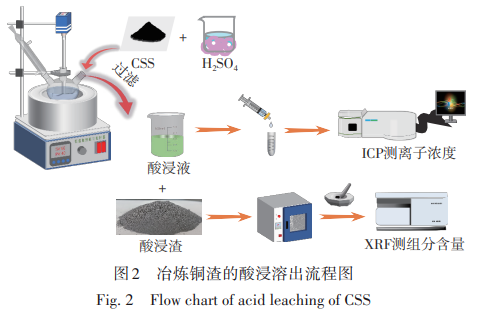
冶炼铜渣富含Fe、Si等有价元素,具有优异的二次资源特性,可作为原料构建高附加值硅铁基功能材料。掌握酸浸条件下Si、Fe元素的可控释放规律及矿物相的有效分离机制,是其高值资源化利用的关键。该文采用HSC 6.0模拟硅铁物系在不同pH和电位条件下的优势物种,研究H2SO4酸浸条件下渣中含铁矿物相的溶出条件及Si、Fe元素的可控释放规律,考察了酸浸温度、H2SO4浓度、粒径和搅拌速度等因素对Fe浸出率的影响。结果表明:酸浸温度与H2SO4浓度对Fe浸出率呈正向影响,粒径对Fe浸出率呈负向影响,而搅拌速度的影响甚微;在H2SO4浓度为2.0 mol/L、酸浸温度为90 ℃、铜渣粒径为(45,88] μm的条件下,酸浸60 min后,铁的浸出率可达95.73%。选择收缩未反应芯模型来描述该酸浸过程,在反应初始阶段,其反应速率主要受化学反应过程的控制,其活化能为40.99 kJ/mol,随后转为内扩散控制,活化能为8.70 kJ/mol。在化学反应控制阶段,计算得到H2SO4浓度和铜渣粒径的影响指数分别为0.558和-0.759,从而确定了H2SO4常压浸取冶炼铜渣的宏观动力学方程。
阎崔蓉 , 张浩 , 周新涛 , 罗中秋 , 蔡秀楠 , 高梓猛 , 时金钰 . 冶炼铜渣中Fe的常压酸浸溶出规律及动力学分析[J]. 华南理工大学学报(自然科学版), 2025 , 53(3) : 127 -138 . DOI: 10.12141/j.issn.1000-565X.240354
The copper smelting slag, abundant in valuable elements such as Fe and Si, exhibits excellent secondary resource characteristics and can be utilized as a raw material for constructing high-value-added silicon-iron-based functional materials. Understanding the controllable release patterns of Si and Fe elements under acid leaching conditions and the effective separation mechanisms of mineral phases is crucial for their high-value resource utilization.This study employed HSC 6.0 to simulate the dominant species in the silicon-iron system under varying pH and potential conditions, investigating the dissolution conditions of iron-containing mineral phases in the slag and the controllable release patterns of Si and Fe elements under H2SO4 acid leaching conditions. The effects of acid leaching temperature, H2SO4 concentration, particle size, and stirring speed on Fe leaching rate were analyzed. The results indicate that acid leaching temperature and H2SO4 concentration have a positive impact on the Fe leaching rate, while particle size exerts a negative influence, and stirring speed has minimal effect. Under conditions of 2.0 mol/L H2SO4 concentration, 90 ℃ acid leaching temperature, and copper slag particle size ranging from (45, 88]μm, the iron leaching rate can reach 95.73% after 60 minutes of acid leaching. The shrinking unreacted core model was used to describe the leaching process. In the initial stage of the reaction, the reaction rate is primarily controlled by the chemical reaction process, with an activation energy of 40.99 kJ/mol, and subsequently shifts to internal diffusion control, with an activation energy of 8.70 kJ/mol. During the chemical reaction control stage, the influence indices for H2SO4 concentration and copper slag particle size were calculated to be 0.558 and -0.759, respectively, thereby establishing the macrokinetic equation for the atmospheric pressure leaching of copper smelting slag with H2SO4.
| 1 | GUO H, WANG Z, AN D,et al .Collaborative design of cement-based composites incorporated with cooper slag in considerations of engineering properties and microwave-absorbing characters[J].Journal of Cleaner Production,2021,283:124614/1-14. |
| 2 | ZUO Z, YU Q, LUO S,et al .Effects of CaO on two-step reduction characteristics of copper slag using biochar as reducer:thermodynamic and kinetics[J].Energy Fuels,2020,34(1):491-500. |
| 3 | GUO Z, PAN J, ZHU D,et al .Green and efficient utilization of waste ferric-oxide desulfurizer to clean waste copper slag by the smelting reduction-sulfurizing process [J].Journal of Cleaner Production,2018,199:891-899. |
| 4 | 殷素红,管海宇,胡捷,等 .碱激发粉煤灰-矿渣灌浆材料的流变性与流动性[J].华南理工大学学报(自然科学版),2019,47(8):120-128,135. |
| YIN Suhong, GUAN Haiyu, HU Jie,et al . Rheological properties and fluidity of alkali-activated fly ash-slag grouting material[J]. Journal of South China University of Technology(Natural Science Edition),2019,47(8):120-128,135. | |
| 5 | YANG Z, QIAN J, YU A,et al .Singlet oxygen mediated iron-based Fenton-like catalysis under nanoconfinement[J].Proceedings of the National Academy of Sciences of the United States of America,2019,116(14):6659-6664. |
| 6 | WANG G, ZHOU A, XU Q . α-Ferrous oxalate with different micro scale:synthesis and catalytic degradation effect to rhodamine B[J].Solid State Sciences,2019,91:54-60. |
| 7 | WANG J, BAI Z .Fe-based catalysts for heterogeneous catalytic ozonation of emerging contaminants in water and wastewater[J].Chemical Engineering Journal,2017,312:79-98. |
| 8 | CLARIZIA L, RUSSO D, DI SOMMA I,et al .Homogeneous photo-Fenton processes at near neutral pH:a review[J].Applied Catalysis B:Environmental,2017,209:358-371. |
| 9 | GAI L, JIANG H, CUI D,et al .Room temperature blue-green photoluminescence of MCM-41,MCM-48 and SBA-15 mesoporous silicas in different conditions[J].Microporous and Mesoporous Materials,2009,120(3):410-413. |
| 10 | ST?BER W, FINK A, BOHN E .Controlled growth of monodisperse silica spheres in the micron size range[J]. Journal of Colloid Interface Sciences,1968,26(1):62-69. |
| 11 | WANG P, WANG X, YU S,et al .Silica coated Fe3O4 magnetic nanospheres for high removal of organic pollutants from wastewater[J].Chemical Engineering Journal,2016,306:280-288. |
| 12 | TEIMURI-MOFRAD R, TAHMASEBI S, PAYAMI E .Fe3O4@SiO2@Im-bisethylFc [HC2O4] as a novel recyclable heterogeneous nanocatalyst for synthesis of bis-coumarin derivatives[J].Applied Organometallic Chemistry,2019,33(6):4773/1-16. |
| 13 | HUANG X, WU S, KE X,et al .Phosphonated pillar[5]arene-valved mesoporous silica drug delivery systems[J]. ACS Applied Materials and Interfaces,2017,9(23):19638-19645. |
| 14 | LIN F-C, ZINK J I .Probing the local nanoscale heating mechanism of a magnetic core in mesoporous silica drug-delivery nanoparticles using fluorescence depolarization[J].Journal of the American Chemical Society,2020,142(11):5212-5220. |
| 15 | ZHANG T, ZHANG Q, GE J,et al .A self-templated route to hollow silica microspheres[J].Journal of Physical Chemistry C,2009,113(8):3168-3175. |
| 16 | WANG L, SU Q,IAN H,et al .Leaching behavior and occurrence of metal elements in copper slag:the key to recycling metals in copper slag[J].Journal of Hazardous Materials Advances,2023,12:100374/1-9. |
| 17 | ZHANG S, ZHU N, MAO F,et al .A novel strategy for harmlessness and reduction of copper smelting slags by alkali disaggregation of fayalite (Fe2SiO4) coupling with acid leaching[J].Journal of Hazardous Materials,2021,402:123791/1-9. |
| 18 | SHI G, LIAO Y, SU B,et al .Kinetics of copper extraction from copper smelting slag by pressure oxidative leaching with sulfuric acid[J].Separation and Purification Technology,2020,241:116699/1-10. |
| 19 | LI L, WU G D, TIAN F G .Immobilization of fluorides from spent carbon cathode in a copper smelting slag[J].Journal of Mining and Metallurgy,Section B:Metallurgy,2022,58(1):129-139. |
| 20 | LUO Y, ZHOU X, LUO Z,et al .A novel iron phosphate cement derived from copper smelting slag and its early age hydration mechanism[J].Cement and Concrete Composites,2022,133:104653/1-13. |
| 21 | WOOD C E, QAFOKU O, LORING J S,et al .Role of Fe(Ⅱ) content in olivine carbonation in wet supercritical CO2 [J].Environmental Science & Technology Letters,2019,6(10):592-599. |
| 22 | TAO L, WANG L, YANG K,et al .Leaching of iron from copper tailings by sulfuric acid:behavior,kinetics and mechanism[J].RSC Advances,2021,11(10):5741-5752. |
| 23 | ALKAN M, DO?N M, NAMLI H .Dissolution kinetics and mechanism of ulexite in oxalic acid solutions [J].Industrial & Engineering Chemistry Research,2004,43(7):1591-1598. |
| 24 | CAI X, TIAN L, CHEN M,et al .Construction of a C-decorated and Cu-doped (Fe,Cu)S/CuFe2O4 solid solution for photo-Fenton degradation of hydrophobic organic contaminant:enhanced electron transfer and adsorption capacity[J].Chemosphere,2022,296:134005/1-13. |
| 25 | 温婧,姜涛,余唐霞,等 .钒铬渣锰盐焙烧酸浸过程中钒、铬的分离行为[J].中国有色金属学报,2021,31(4):977-983. |
| WEN Jing, JIANG Tao, YU Tang-xia,et al .Separation of vanadium and chromium from vanadium-chromium slag by manganese salt roasting[J].The Chinese Journal of Nonferrous Metals,2021,31(4):977-983. | |
| 26 | ZHANG L, ZHU Y, YIN W,et al .Isothermal coal-based reduction kinetics of fayalite in copper slag[J].ACS Omega,2020,5(15):8605-8612. |
| 27 | MANJARREZ L, NIKVAR-HASSANI A, SHADNIA R,et al .Experimental study of geopolymer binder synthesized with copper mine tailings and low-calcium copper slag[J].Journal of Materials in Civil Engineering,2019,31(8):04019156/1-14. |
| 28 | WANG W-W, YAO J-L .Synthesis and magnetic property of silica/iron oxides nanorods[J].Materials Letters,2010,64(7):840-842. |
| 29 | XIAO W, LIU X, ZHAO Z .Kinetics of nickel leaching from low-nickel matte in sulfuric acid solution under atmospheric pressure[J].Hydrometallurgy,2020,194:105353/1-11. |
| 30 | RATH P C, PARAMGURU R K, JENA P K .Kinetics of dissolution of zinc sulphide in aqueous ferric chloride solution[J].Hydrometallurgy,1981,6(3/4):219-225. |
| 31 | 高凌宇,杨喜云,吴玉楼,等 .蛇纹石酸浸渣碱溶脱硅反应动力学[J].中国有色金属学报,2023,33(8):2718-2728. |
| GAO Ling-yu, YANG Xi-yun, WU Yu-lou,et al .Kinetics of alkali-dissolving desilication reaction of serpentine acid leaching slag[J].The Chinese Journal of Nonferrous Metals,2023,33(8):2718-2728. | |
| 32 | SILVA G DA .Kinetics and mechanism of the bacterial and ferric sulphate oxidation of galena[J].Hydrometallurgy,2004,75(1/2/3/4):99-110. |
/
| 〈 |
|
〉 |
地址:广州 五山 华南理工大学17号楼 邮政编码:510640
电话: 020-87111794 邮箱:journal@scut.edu.cn