收稿日期: 2023-12-04
网络出版日期: 2024-02-07
基金资助
国家重点研发计划项目(2018YFB1600902);东北林业大学中央高校基本科研业务费专项资金资助项目(2572022AW62)
Classification and Identification of Risky Driving Behavior Based on Hybrid Strategy Improved ASO-LSSVM
Received date: 2023-12-04
Online published: 2024-02-07
Supported by
the National Key Research and Development Program of China(2018YFB1600902)
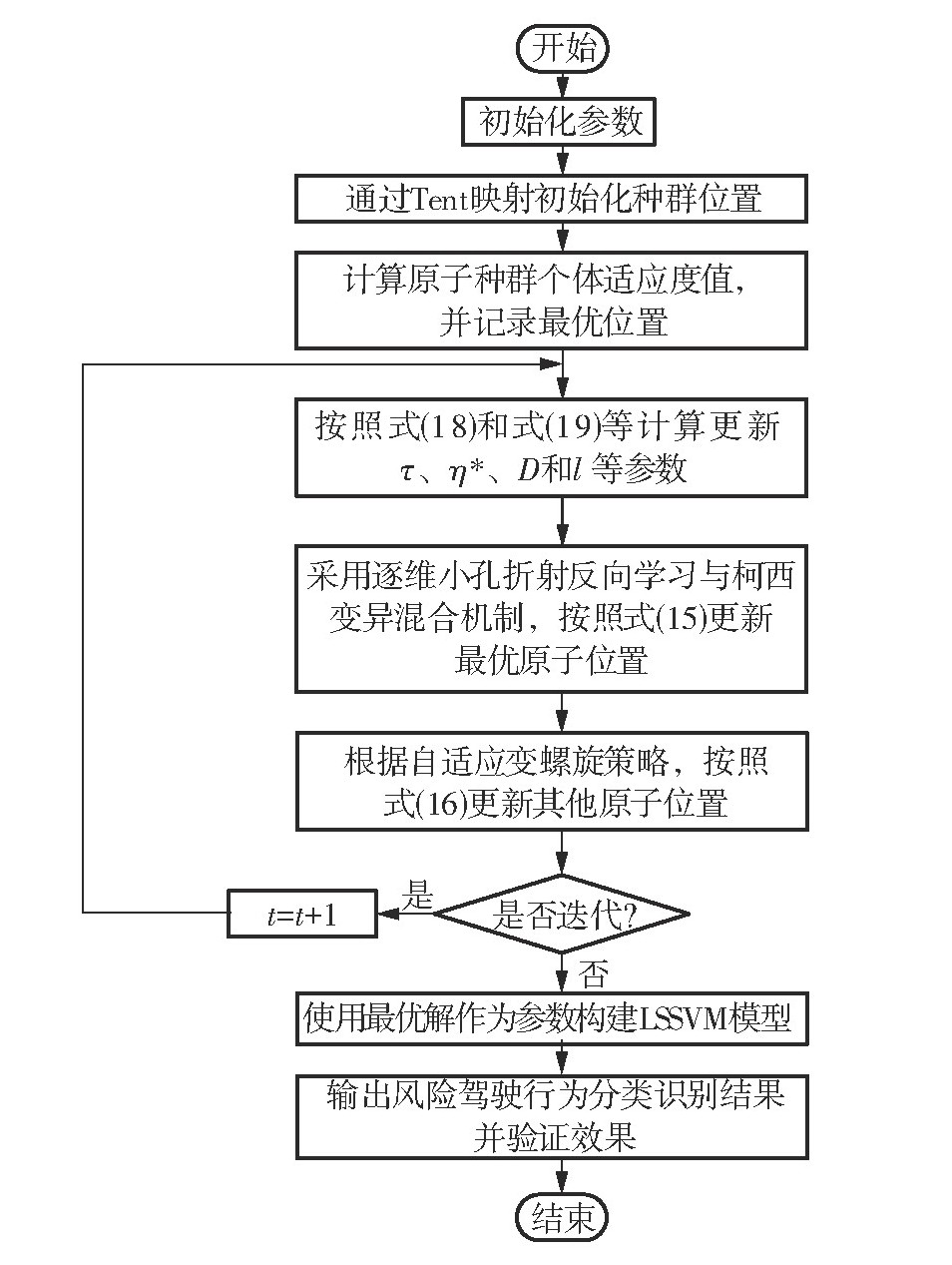
为解决现有智能算法在优化支持向量机识别风险驾驶行为过程中收敛速率缓慢和误差较大的问题。首先,采用Tent映射取代原子搜索优化算法(ASO)种群初始化随机设置的方式,增加原子种群多样性和质量;其次,使用逐维小孔成像反向学习与柯西变异混合机制,提高原子个体择优位置的多样性,克服ASO算法易陷入局部最优和过早收敛的问题;最后,通过引入自适应变螺旋搜寻策略改进原子个体位置更新过程,以提升ASO算法的全局搜索能力,实现全局搜索和局部开发间关系的有效平衡,缓解ASO算法易陷入局部最优和收敛精度不足的问题。以上海北横通道出口匝道车辆轨迹数据为输入,使用混合策略改进ASO算法寻优求解最小二乘支持向量机(LSSVM)参数,构建基于混合策略改进原子搜索优化最小二乘支持向量机IASO-LSSVM的快速路出口匝道风险驾驶行为分类识别模型。数值仿真实验结果表明:IASO算法在12个基准测试函数数值仿真结果的平均值、标准差、最佳适应度和最差适应度等方面均更接近最佳优化值。IASO-LSSVM模型相较于ASO-LSSVM和LSSVM等模型的风险驾驶行为分类识别结果误差指标正确率、精确率、召回率和F1值分别增加11.5~24.5、14.1~29.0、15.1~28.6和14.7~31.2个百分点,且在不同类型风险驾驶行为识别结果中误差变化范围最小。IASO算法参数寻优求解精度和收敛速率优于ASO算法,且IASO-LSSVM模型可用于不同类型风险驾驶行为精准识别,可为车辆行驶轨迹状态合理判别,制定风险驾驶行为预警防控措施提供数据支撑与理论依据。
何庆龄 , 裴玉龙 , 董春彤 , 刘静 , 潘胜 . 基于混合策略改进ASO-LSSVM的风险驾驶行为分类识别[J]. 华南理工大学学报(自然科学版), 2024 , 52(9) : 131 -141 . DOI: 10.12141/j.issn.1000-565X.230753
This paper aims to solve the problem of slow convergence rate and large error of existing intelligent algorithms in the process of optimizing support vector machine to identify risky driving behavior. Firstly, Tent mapping was used to replace the random setting of population initialization of ASO algorithm to increase the diversity and quality of atomic population. Secondly, the hybrid mechanism of dimension-by-dimension pinhole imaging reverse learning and Cauchy mutation was used to improve the diversity of preferred positions of atomic individuals and overcome the problem that ASO algorithm is easy to fall into local optimum and premature convergence. Finally, the adaptive variable spiral search strategy was introduced to improve the atomic individual position update process, so as to improve the global search ability of ASO algorithm, realize the effective balance between global search and local development, and alleviate the problem that ASO algorithm is easy to fall into local optimum and lack of convergence accuracy. Taking the vehicle trajectory data of the exit ramp of Shanghai North Cross Channel as the input, the study used the hybrid strategy to improve the ASO algorithm so as to optimize the LSSVM parameters. And it constructed the classification and identification model of the risk driving behavior of the expressway exit ramp based on IASO-LSSVM. Numerical simulation results show that the average value, standard deviation, best fitness and worst fitness of the numerical simulation results of the IASO algorithm in 12 benchmark test functions are closer to the best optimization value. Compared with ASO-LSSVM and LSSVM, the accuracy, precision, recall and F1 value of risk driving behavior classification and identification results of IASO-LSSVM model increased by 11.5~24.5, 14.1~29.0,15.1~28.6, 14.7~31.2 percentage points respectively, and the error range was the smallest in different types of risky driving behavior identification results. The accuracy and convergence rate of IASO algorithm are better than those of ASO algorithm, and the IASO-LSSVM model can be used for accurate identification of different types of risk driving behavior, which can provide data support and theoretical basis for reasonable discrimination of vehicle driving trajectory state and formulation of early warning and prevention measures of risk driving behavior.
| 1 | TUBTIMHIN S, LAOHASIRIWONG W, PITAKSANURAT S,et al .Clustering of road traffic injuries during the 7-day Songkran Holiday,Thailand:a spatial analysis[J].Kathmandu University Medical Journal,2019,67(3):184-189. |
| 2 | 陈永恒,熊帅,白乔文,等 .快速路入口匝道车辆汇入位置的分布特征分析[J].华南理工大学学报(自然科学版),2018,46(11):125-131. |
| CHEN Yongheng, XIONG Shuai, BAI Qiaowen,et al .Analysis of the distribution characteristics of on-ramp vehicle merging positions on expressway[J].Journal of South China University of Technology(Natural Science Edition),2018,46(11):125-131. | |
| 3 | 郭淼,赵晓华,姚莹,等 .基于驾驶行为和交通运行状态的事故风险研究[J].华南理工大学学报(自然科学版),2022,50(9):29-38. |
| GUO Miao, ZHAO Xiaohua, YAO Ying,et al .Accident risk research based on driving behavior and traffic operation status[J].Journal of South China University of Technology (Natural Science Edition),2022,50(9):29-38. | |
| 4 | CHEN Y, WANG K, LU J J .Feature selection for driving style and skill clustering using naturalistic driving data and driving behavior questionnaire[J].Accident Analysis & Prevention,2023,185(6):1-16. |
| 5 | MA L, QU S, SONG L,et al .Human-like car-following modeling based on online driving style recognition[J].Electronic Research Archive,2023,31(6):3264-3290. |
| 6 | PENG J, SHAO Y .Intelligent method for identifying driving risk based on V2V multisource big data[J].Complexity,2018(1):1-9. |
| 7 | ZHU S, LI C, FANG K,et al .An optimized algorithm for dangerous driving behavior identification based on unbalanced data[J].Electronics,2022,11(10):57-72. |
| 8 | JAHANGIRI A, BERARDI V J, MACHIANI S G .Application of real field connected vehicle data for aggressive driving identification on horizontal curves[J].IEEE Transactions on Intelligent Transportation Systems,2017,19(7):2316-2324. |
| 9 | WEI L, LIANG L, LEI T,et al .On-board unit (OBU)-supported longitudinal driving behavior monitoring using machine learning approaches[J].Sensors,2023,23(15):67-75. |
| 10 | SHANGGUAN Q, FU T, WANG J,et al .A proactive lane-changing risk prediction framework considering driving intention recognition and different lane-changing patterns[J].Accident Analysis & Prevention,2022,164(1):1-14. |
| 11 | SUN Q, WANG C, FU R,et al .Lane change strategy analysis and recognition for intelligent driving systems based on random forest[J].Expert Systems with Applications,2021,186(10):1-14. |
| 12 | CHEN S, YAO H, QIAO F,et al .Vehicles driving behavior recognition based on transfer learning[J].Expert Systems with Applications,2023,213(12):119-254. |
| 13 | ZHAO D, ZHAO S .Sparse least squares support vector machine based methods for vehicle driving behavior recognition[J].Proceedings of the Institution of Mechanical Engineers,Part D:Journal of Automobile Engineering,2024,238(6):1392-1404. |
| 14 | RAVI C, TIGGA A, REDDY G T,et al .Driver identification using optimized deep learning model in smart transportation[J].ACM Transactions on Internet Technology,2022,22(4):1-17. |
| 15 | ALJOHANI A A .Real-time driver distraction recognition:a hybrid genetic deep network based approach[J].Alexandria Engineering Journal,2023,66(2):377-389. |
| 16 | ZHAO W, WANG L, ZHANG Z .Atom search optimization and its application to solve a hydrogeologic parameter estimation problem[J].Knowledge-Based Systems,2019,163(1):283-304. |
| 17 | GAO Z M, ZHAO J, ZHANG Y J .Review of chaotic mapping enabled nature-inspired algorithms[J].Mathematical Biosciences and Engineering,2022,19(8):8215-8258. |
| 18 | 余修武,黄露平,刘永,等 .融合柯西折射反向学习和变螺旋策略的WSN象群定位算法[J].控制与决策,2022,37(12):3183-3189. |
| YU Xiu-wu, HUANG Lu-ping, LIU Yong,et al .Cauchy refraction opposition-based learning and variable helix mechanism of elephant herding localization algorithm in WSN[J].Control and Decision,2022,37(12):3183-3189. |
/
| 〈 |
|
〉 |
地址:广州 五山 华南理工大学17号楼 邮政编码:510640
电话: 020-87111794 邮箱:journal@scut.edu.cn