收稿日期: 2023-05-08
网络出版日期: 2023-11-09
基金资助
国家自然科学基金资助项目(52072263)
Coupling Analysis of Rail Transit Stations’ Network Centrality, Ridership and Spatial Heat Map
Received date: 2023-05-08
Online published: 2023-11-09
Supported by
the National Natural Science Foundation of China(52072263)
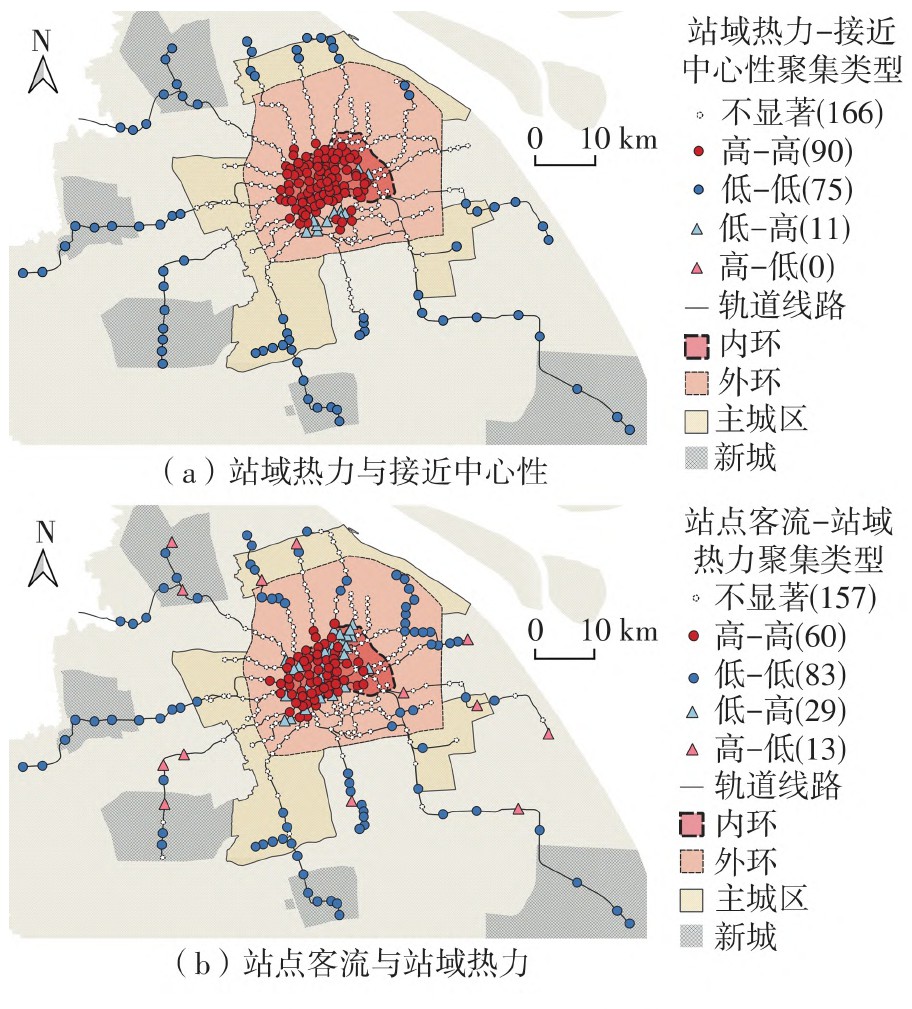
城市空间热力反映了人口聚集与街道活力。为探究城市轨道交通与空间热力分布的互动关系,从微观层面的轨道站点切入,采用百度热力图和轨道站点客流数据,以上海为例,对轨道站点的网络中心性、客流与站域空间热力进行耦合分析。首先采用Pearson双变量相关性研究两类轨道站点属性与空间热力的总体耦合关系,然后引入双变量空间自相关和地理加权回归分析方法分别挖掘网络中心性与站域热力、站域热力与站点客流的空间关联模式,并对比两类耦合性的空间差异。结果表明:轨道站点的网络中心性与空间热力的耦合性明显优于轨道客流与空间热力的耦合性,交通区位优势通常能够形成较高的空间热力,客流水平的影响因素则更为复杂;空间热力更适合量化核心区以外区域的轨道交通与城市空间互动关系,轨道交通网络化对空间热力提升具有乘数效应,而在开发密度低的区域提升空间热力更有助于刺激轨道客流;利用空间热力数据评估城市核心区以外区域的新建站点客流潜力具有可行性,但仅用热力预测客流具有局限性;轨道站点周边城市更新可参考不同空间区位站点的两类耦合性差异进行优化。该研究探索了结合城市空间热力分布完善轨道交通线网布局、针对不耦合因素优化轨道站点公共交通导向型开发(TOD)的分析框架,为微观层面衡量城市轨道交通“人-地”关系提供了新视角。
吴娇蓉, 陈彩婷, 邓泳淇 . 轨道站网络中心性、客流与空间热力耦合分析[J]. 华南理工大学学报(自然科学版), 2024 , 52(5) : 31 -42 . DOI: 10.12141/j.issn.1000-565X.230302
Urban spatial heat map reflects population aggregation and street vitality. In order to explore the interactive relationship between urban rail transit and spatial heat map, this study used Baidu heat map and rail transit station ridership data to analyze the coupling characteristics between network centrality, ridership and nearby spatial heat index of rail transit stations on a micro level, taking Shanghai as a case study. Firstly, it investigated the overall coupling relationship between two categories of station attributes and spatial heat through Pearson bivariate correlation analysis. Then, bivariate spatial autocorrelation and geographically weighted regression analysis methods were introduced to explore the spatial association patterns between network centrality and spatial heat, as well as between spatial heat and ridership, followed by a spatial differentiation comparison between the two coupling types. The results show that the coupling relationship between rail network centrality and spatial heat is obviously better than that between ridership and spatial heat at station level, since traffic location advantage can usually develop higher spatial heat, while ridership may be affected by more complex factors. Spatial heat map is more suitable for quantifying the interaction between rail transit and urban space in areas outside the urban core, where increasing rail network centrality has a multiplier effect on spatial heat improvement, but improving spatial heat in areas with low-density development is more conducive to stimulating ridership. It is feasible to evaluate the ridership potential of new stations outside the urban core area by using spatial heat map, but this data alone is not enough to predict ridership. The urban renewal around rail transit stations can be optimized by referring to the differences between the two types of coupling at different spatial locations. This study explored the analytical framework for improving the layout of rail transit network based on urban spatial heat map, and optimizing TOD (Transit-Oriented Development) stations for factors negatively affecting their coupling. It provides a new perspective for measuring the man-land relationship of urban rail transit on the micro level.
| 1 | 吴志强,叶锺楠 .基于百度地图热力图的城市空间结构研究——以上海中心城区为例[J].城市规划,2016,40(4):33-40. |
| WU Zhiqiang, YE Zhongnan .Research on urban spatial structure based on Baidu heat map:a case study on the central city of Shanghai[J].City Planning Review,2016,40(4):33-40. | |
| 2 | 郭翰,郭永沛,崔娜娜 .基于多元数据的北京市六环路内昼夜人口流动与人口聚集区研究[J].城市发展研究,2018,25(12):107-112,121. |
| GUO Han, GUO Yongpei, CUI Nana .Research on typical population aggregation districts in the Beijing’s Sixth Ring Road based on Baidu’s heat map and points of interest[J].Urban Development Studies,2018,25(12):107-112,121. | |
| 3 | 叶锺楠,陈懿慧 .基于网络数据的轨道交通站点周边空间使用量化研究——以上海地铁10号线沿线为例[J].上海城市规划,2017(6):122-128. |
| YE Zhongnan, CHEN Yihui .Quantitative study on space use around urban rail transit station based on network data:a case of Shanghai Metro Line 10[J].Shanghai Urban Planning Review,2017(6):122-128. | |
| 4 | 闵忠荣,丁帆 .基于百度热力图的街道活力时空分布特征分析——以江西省南昌市历史城区为例[J].城市发展研究,2020,27(2):31-36. |
| MIN Zhongrong, DING Fan .Analysis of temporal and spatial distribution characteristics of street vitality based on Baidu thermal diagram:the case of the historical city of Nanchang City,Jiangxi Province[J].Urban Development Studies,2020,27(2):31-36. | |
| 5 | 谭章智,李少英,黎夏,等 .城市轨道交通对土地利用变化的时空效应[J].地理学报,2017,72(5):850-862. |
| TAN Zhangzhi, LI Shaoying, LI Xia,et al .Spatio-temporal effects of urban rail transit on complex land-use change[J].Acta Geographica Sinica,2017,72(5):850-862. | |
| 6 | 陈弢,潘海啸 .上海轨道交通与人口和就业岗位布局的耦合分析[J].城市规划学刊,2020(5):32-38. |
| CHEN Tao, PAN Haixiao .Coupling metro network with household and employment pattern:a case study of Shanghai[J].Urban Planning Forum,2020(5):32-38. | |
| 7 | 吴娇蓉,邓泳淇,陈彩婷 .上海郊区轨道站客流与站域出行活力匹配性研究[J].同济大学学报(自然科学版),2023,51(7):1105-1113. |
| WU Jiaorong, DENG Yongqi, CHEN Caiting .Matching degree between ridership and vitality of Shanghai suburban rail sites[J].Journal of Tongji University (Natural Science),2023,51(7):1105-1113. | |
| 8 | 宫同伟 .基于百度热力地图的城市轨道交通站区时空聚集研究[J].统计与决策,2019,35(24):59-63. |
| GONG Tongwei .Spatio-temporal population agglomeration in the service areas of urban rail transit stations based on Baidu heat map[J].Statistics & Decision,2019,35(24):59-63. | |
| 9 | 周雨霏,杨家文,周江评,等 .基于热力图数据的轨道交通站点服务区活力测度研究——以深圳市地铁为例[J].北京大学学报(自然科学版),2020,56(5):875-883. |
| ZHOU Yufei, YANG Jiawen, ZHOU Jiangping,et al .Evaluating vitality of metro station service area with heat map:a case study on Shenzhen subway[J].Acta Scientiarum Naturalium Universitatis Pekinensis,2020,56(5):875-883. | |
| 10 | 徐益娟,顾大治,孟庆贺 .大数据视角下轨道交通站点空间活力量化及提升策略研究——以合肥轨道交通2号线为例[J].青岛理工大学学报,2022,43(5):48-58. |
| XU Yijuan, GU Dazhi, MENG Qinghe .Research on quantification and promotion strategy of spatial vitality of rail transit stations based on big data:a case study of Hefei Rail Transit Line 2[J].Journal of Qingdao University of Technology,2022,43(5):48-58. | |
| 11 | YANG J W, CAO J, ZHOU Y F .Elaborating non-linear associations and synergies of subway access and land uses with urban vitality in Shenzhen[J].Transportation Research Part A:Policy and Practice,2021,144(2):74-88. |
| 12 | 潘海啸,任春洋 .轨道交通与城市公共活动中心体系的空间耦合关系——以上海市为例[J].城市规划学刊,2005(4):76-82. |
| PAN Haixiao, REN Chunyang .Study on spatial coupling between the metro and urban activity center—case study in Shanghai[J].Urban Planning Forum,2005(4):76-82. | |
| 13 | 曹哲静 .城市商业中心与交通中心的叠合与分异:基于复杂网络分析的东京轨道交通网络与城市形态耦合研究[J].国际城市规划,2020,35(3):42-53. |
| CAO Zhejing .Configuration of urban commercial centers and transport centers:evidence from Tokyo transit network and urban morphology based on the complex network analysis[J].Urban Planning International,2020,35(3):42-53. | |
| 14 | 王玉萍,陈宽民,马超群 .城市轨道交通网络与城市形态协调性的量化分析[J].铁道工程学报,2008(11):11-15. |
| WANG Yu-ping, CHEN Kuan-min, MA Chao-qun .Quantitative analysis of coordination between rail transit network configuration and urban form[J].Journal of Railway Engineering Society,2008(11):11-15. | |
| 15 | 史瑞利 .北京市轨道交通网络与人口分布协调发展研究[D].北京:北京交通大学,2016. |
| 16 | BERTOLINI L .Nodes and places:complexities of railway station redevelopment[J].European Planning Studies,1996,4(3):331-345. |
| 17 | CAO Z J, ASAKURA Y, TAN Z B .Coordination between node,place,and ridership:comparing three transit operators in Tokyo[J].Transportation Research Part D:Transport and Environment,2020,87(10):102518/1-19. |
| 18 | 张志健,高顺祥,陈越,等 .基于改进节点-场所模型的城市轨道交通TOD评估[J].交通运输研究,2022,8(3):143-153,165. |
| ZHANG Zhi-jian, GAO Shun-xiang, CHEN Yue,et al .Evaluation of urban rail transit TOD based on enhanced node-place model[J].Transport Research,2022,8(3):143-153,165. | |
| 19 | 周青峰,刘苏,王耀武 .城市轨道交通站点周边土地利用与交通协调关系研究[J].铁道运输与经济,2018,40(4):100-106. |
| ZHOU Qing-feng, LIU Su, WANG Yao-wu .A study on the coordinative relation of land use and transport around the metro station[J].Railway Transport and Economy,2018,40(4):100-106. | |
| 20 | 刘泉 .轨道站点地区TOD规划管理中的指标控制[J].规划师,2018,34(1):48-58. |
| LIU Quan .Indices control of TOD planning management[J].Planners,2018,34(1):48-58. | |
| 21 | 白同舟,蔡乐,朱家正,等 .轨道交通与城市协同发展的空间差异性分析:以北京市为例[J].交通运输系统工程与信息,2020,20(3):14-19. |
| BAI Tong-zhou, CAI Le, ZHU Jia-zheng,et al .Spatial differentiation of rail transit and urban development coordination:a case study of Beijing[J].Journal of Transportation Systems Engineering and Information Technology,2020,20(3):14-19. | |
| 22 | 王亚洁 .国外城市轨道交通与站域土地利用互动研究进展[J].国际城市规划,2018,33(1):111-118. |
| WANG Yajie .International studies on the interaction between urban rail transit and land use of station areas[J].Urban Planning International,2018,33(1):111-118. | |
| 23 | 韩寒 .深圳市轨道交通结构与商业活力空间关联分析[J].经济地理,2021,41(3):86-96. |
| HAN Han .Spatial correlation between rail transit structure and commercial vitality in Shenzhen[J].Economic Geography,2021,41(3):86-96. | |
| 24 | 宋成镇,陈延斌,殷冠文,等 .交通网络中心性与土地利用强度的相关性及空间异质性研究——以青岛市主城区为例[J].西安理工大学学报,2022,38(2):201-211. |
| SONG Chengzhen, CHEN Yanbin, YIN Guanwen,et al .Correlation and spatial heterogeneity between road network centrality and land use intensity:a case study of Qingdao City[J].Journal of Xi’an University of Technology,2022,38(2):201-211. | |
| 25 | 张海林 .基于百度热力图的人口活动数量提取与规划应用[J].城市交通,2021,19(3):103-111. |
| ZHANG Hailin .Extracting active population data based on Baidu heat maps for transportation planning applications[J].Urban Transport of China,2021,19(3):103-111. | |
| 26 | 谭欣,黄大全,赵星烁,等 .基于百度热力图的职住平衡度量研究[J].北京师范大学学报(自然科学版),2016,52(5):622-627. |
| TAN Xin, HUANG Daquan, ZHAO Xingshuo,et al .Jobs housing balance based on Baidu thermodynamic diagram[J].Journal of Beijing Normal University(Natural Science),2016,52(5):622-627. | |
| 27 | SHI Z B, ZHANG N, LIU Y,et al .Exploring spatiotemporal variation in hourly metro ridership at station level:the influence of built environment and topological structure[J].Sustainability,2018,10(12):4564/1-16. |
| 28 | 孔祥夫,杨家文 .土地利用视角下的轨道站点客流预测——以深圳市为例[J].地理科学,2018,38(12):2074-2083. |
| KONG Xiangfu, YANG Jiawen .A new method for forecasting station-level transit ridership from land-use perspective:the case of Shenzhen City[J].Scientia Geographica Sinica,2018,38(12):2074-2083. |
/
| 〈 |
|
〉 |
地址:广州 五山 华南理工大学17号楼 邮政编码:510640
电话: 020-87111794 邮箱:journal@scut.edu.cn