收稿日期: 2022-04-17
网络出版日期: 2022-09-29
基金资助
国家自然科学基金资助项目(51878281)
Research on Audio-Visual Integration Based on Architectural Acoustic Simulation
Received date: 2022-04-17
Online published: 2022-09-29
Supported by
the National Natural Science Foundation of China(51878281)
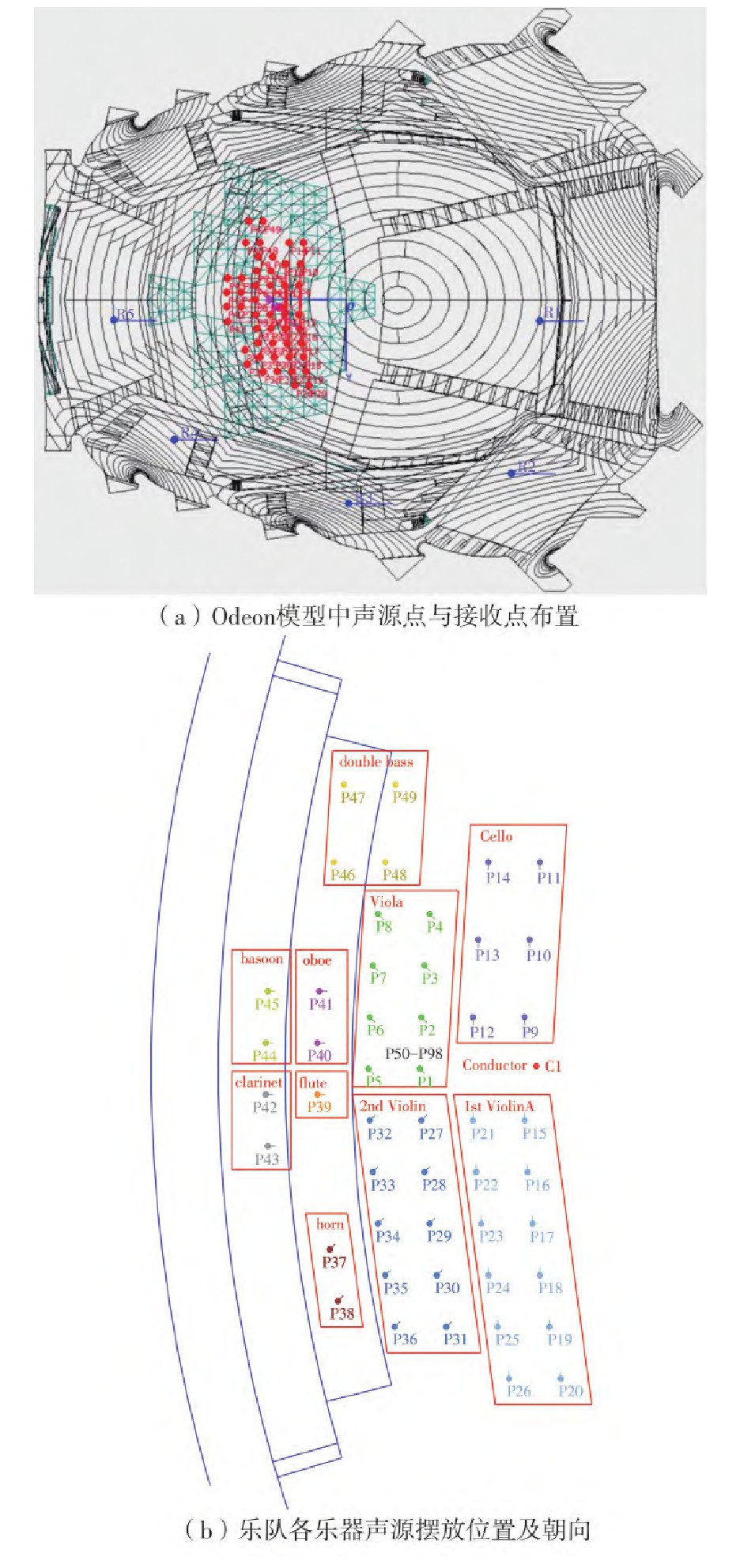
文中选取莫扎特第四十交响乐多通道录音信号作为声源干信号,以天津文化中心音乐厅为例,通过建筑声学模拟软件ODEON进行声场模拟,将乐队按照乐器划分为49个点声源并分别对应各个乐器的指向性,在观众席设置5个典型接收点位置,分别计算每个声源点至接收点的双耳脉冲响应,再与每个声源点对应的乐器干信号进行卷积,将卷积得到的49个听音信号同步播放合成乐队多声源可听化信号。同时按照传统点声源的可听化方法,在交响乐队中心位置设置一个点声源,计算点声源至接收点的双耳脉冲响应,再与乐队49个干信号进行卷积同步播放得到交响乐单声源可听化信号。视觉方面首先在Sketch up中建立音乐厅的三维真实模型并给各个界面赋予真实材质,将Sketch up的视觉模型输出至VR虚拟现实模拟软件SimLab Composer,调整灯光、材质、环境等参数,对调整好信息参数的虚拟模型进行渲染以获得更好的沉浸感,通过HTC VIVE Cosmos眼镜输出VR虚拟场景,模拟厅堂的三维视觉。在建筑声学视听实验时分别对比多声源与单声源卷积的可听化信号分别在有无VR视觉信号的条件下混响感与ASW(感知声源宽度)这两个建筑声学空间感音质指标的主观评价差别。实验结果表明:采用多声源卷积的可听化信号可以显著提升听音的混响感和ASW;不同接收点位置的改善程度不同;由于单声源与多声源的可听化信号音质差异较为明显,实验过程中听音实验人员更多关注空间感音质的提升,加入VR视觉信号对可听化信号听音主观评价结果无显著提升。
孙海涛, 杨昱 . 基于建筑声学仿真模拟的视听一体化研究[J]. 华南理工大学学报(自然科学版), 2023 , 51(4) : 71 -79 . DOI: 10.12141/j.issn.1000-565X.220209
In the article, the multi-channel recording signal of Mozart's Symphony No. 40 was selected as the source dry signal, and the Tianjin Cultural Center concert hall was used as an example to simulate the sound field using the architectural acoustics simulation software ODEON. The symphony orchestra was divided into 49 point sound sources according to musical instrument, corresponding to the directivity of each musical instrument respectively. Five typical receiving point positions were set in the audience seat area, and the binaural impulse response from each sound source point to the receiving point was calculated respectively, then use binaural impulse response to convolve with the instrument signal corresponding to each sound source point, and finally the 49 resulting audio signals were synchronized and played together to synthesize the multi-source audible signal of the orchestra. At the same time, according to the traditional audibility method, set a point sound source in the center of the symphony orchestra, calculate the binaural impulse response from the point sound source to the receiving point, and then use binaural impulse response to convolve with the signal of the symphony composed of 49 dry signals and mix it into a single sound source audible signal. In terms of vision, firstly, the 3D model of the concert hall was established in sketch up and the real materials were given to each surface. The model of sketch up was output to the VR virtual reality simulation software SIMLAB composer, in which the parameters such as light, material and environment were adjusted. The virtual model was rendered and baked with adjusted information parameters to obtain a better sense of immersion. HTC VIVE Cosmos glasses were used to output VR virtual scenes and to simulate the three-dimensional vision of the hall. During the architectural acoustics audio-visual experiment, the subjective evaluation differences of Reverberance and ASW (Apparent Source Width) of audible signals convoluted by multiple sound sources and single sound source were compared under the condition of with or without VR visual signal. The experimental results show that the audible signal convoluted by multiple sound sources can significantly improve the Reverberance and ASW, and the improvement degree of different receiving points is different. Due to the significant difference in sound quality between the single-source and multi-source audible signals, the listening test participants in the architectural acoustics and audiovisual experiment focused more on the improvement of spatial sound quality. The addition of VR visual signals did not significantly improve the subjective evaluation results of the audible signals.
| 1 | 吴硕贤,赵越喆 .建筑环境声学的前沿领域[J].华南理工大学学报(自然科学版),2012,40(10):28-31. |
| WU Shuo-xian, ZHAO Yue-zhe .Frontiers of architectural and environmental acoustics [J].Journal of South China University of Technology (Natural Science Edition),2012,40(10): 28-31. | |
| 2 | OTONDO F, RINDEL J H .A new method for the radiation representation of musical instruments in auralizations[J].Acta Acust,2005,91(5):902-906. |
| 3 | VIGEANT M C, WANG L M, RINDEL J H. Investigations of orchestra auralizations using the multi-channel multi-source auralization technique[J].Acta Acustica united with Acustica,2008,94(6):866-882. |
| 4 | VIGEANT M C, WANG L M, RINDEL J H .Objective and subjective evaluations of the multi-channel auralization technique as applied to solo instruments[J].Appl Acoust,2011,72(6):311-323. |
| 5 | RINDEL J H, CHRISTENSEN C L. Auralisation of concert halls using multisource representation of a symphony orchestra[C]∥Proceedings of the International Conference on Auditorium Acoustics 2008.Oslo:Institute of Acoustics,2008:333-338. |
| 6 | 王鑫,郝欣言,王元中 .民族乐器的多通道可听化研究[J].中国传媒大学学报(自然科学版),2020,27(3):29-35,40. |
| WANG Xin, HAO Xin-yan, WANG Yuan-zhong .The research on multi-channel auralization for chinese traditional instruments[J].Journal of Communication University of China (Science and Technology),2020,27(3):29-35,40. | |
| 7 | SATO S I, WANG Shuo, ZHAO Yue-zhe, et al .Effects of acoustic and visual stimuli on subjective preferences for different seating positions in an Italian style theater[J].Acta Acustica and Acustica,2012,98(5):749-759. |
| 8 | WANG Shuo, ZHAO Yuezhe, WU Shuoxian .Seat selection system for theatres and concert halls based on audio-visual integration technology[C]∥Proceedings of the 22nd International Conference on Computer-Aided Architectural Design Research in Asia:Protocols,Flows and Glitches. Suzhou:The Association for Computer-Aided Architectural Design Research in Asia (CAADRIA),2017:157-165. |
| 9 | 王朔. 虚拟厅堂环境视听一体化[D].广州:华南理工大学,2014. |
| 10 | CASTRO D, BALLESTERO E, PLATT S .Walk-through auralization framework for virtual reality environments powered by game engine architectures[C]∥Proceedings of the Institute of Acoustics.Bristol:Institute of Acoustics,2018:151-160. |
| 11 | CASTRO Daniel, VERSTAPPEN André, PLATT Samuel .Walk-through auralization framework for virtual reality environments powered by game engine architectures,Part Ⅱ[C]∥Proceedings of the Annual Conference of the Australian Acoustical Society. Cape Schanck:Australian Acoustical Society,2020:495-505. |
| 12 | LEE Y,RYU J .A study on the auralization system using flexible rendering for virtual reality-based acoustic simulation[J].Journal of Advanced Mechanical Design Systems and Manufacturing,2019:13(5):1-15. |
| 13 | YAGUNOVA Yulia, POLETTI Mark A, TEAL Paul D .Ambisonics and sonic simulation in virtual reality[C]∥Proceedings of the IEEE Region 10 Annual International Conference.Auckland:Institute of Electrical and Electronics Engineers Inc,2021:369-374. |
| 14 | THERY D, POIRIER-QUINOT D, POSTMA B N .J,et al .Impact of the visual rendering system on subjective auralization assessment in VR[C]∥Proceedings of the 14 th International Conference on Virtual Reality and Augmented Reality.Laval:Springer,2017:105-118. |
| 15 | 孙海涛,赵越喆,吴硕贤,等 .建筑声学缩尺模型实验技术研究——以天津文化中心音乐厅为例[J].建筑学报,2015(S1):228-231. |
| SUN Hai-tao, ZHAO Yue-zhe, WU Shuo-xian,et al. A technique developed for room acoustic scaled model test in auditorium—case study the Concert Hall in Tianjin Cultural Center[J].Architectural Journal,2015(S1):228-231. | |
| 16 | 李青梅,吴硕贤 .关于厅堂音质响度指标的评价[J].建筑学报,2000(2):53-55,67-68. |
| LI Qing-Mei, WU Shuo-xian. Comment on the sonority norm of acoustic fidelity in the great hall[J]. Architectural Journal,2000(2):53-55,67-68. |
/
| 〈 |
|
〉 |
地址:广州 五山 华南理工大学17号楼 邮政编码:510640
电话: 020-87111794 邮箱:journal@scut.edu.cn