收稿日期: 2022-06-07
网络出版日期: 2022-07-08
基金资助
中国科协战略发展部资助项目(2021ZZZLFZB1207088);国家自然科学基金资助项目(52178015);亚热带建筑科学重点实验室开放课题资助项目(2022ZB07)
Study on Simulation and Design of Natural Ventilation for Patio Space of Multi Corridor Inpatient Building in Humid and Hot Areas
Received date: 2022-06-07
Online published: 2022-07-08
Supported by
the Strategic Development Dapartment of China Association for Science and Technology(2021ZZZLFZB1207088);the National Natural Science Foundation of China(52178015)
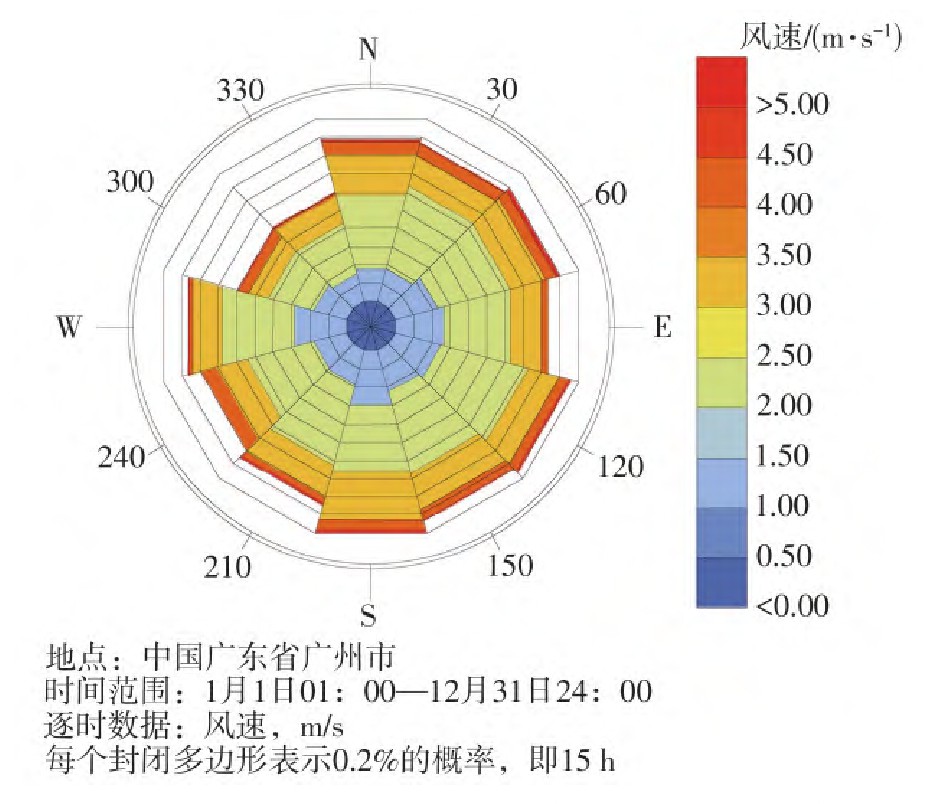
我国湿热地区气候特殊,医院通过空调系统进行通风导致其运行能耗巨大。医院住院部的大部分公共空间在合理分类和布局的情况下,可以并且有必要通过自然通风的手段和方法来满足使用者的热舒适要求,改善建筑内部空气质量,同时有效节能降耗。天井是湿热地区建筑常见的气候适应空间,文中以我国湿热地区代表性城市广州(23.1°N,113.3°E)作为研究地点,以复廊式住院楼为研究对象,通过设计医院住院楼模型的CFD模拟实验、分析湿热地区全年适宜自然通风的时段,探究天井空间的设计要素对复廊式住院楼护理单元公共空间自然通风性能的影响。结果表明:医院复廊式住院楼设计中,相较与无天井布局,天井空间可以有效改善复廊式住院楼护理单元公共空间自然通风性能;通过设置合理的天井的平面形式、位置和高度,可以使医院复廊式住院楼各层护理单元公共空间获得满足人体舒适的自然通风;合理设置住院楼建筑首层的进风口位置,可增大全年自然通风潜力,以广州地区为例,该区域除南向外,东南、东北和北向都有较高频率的自然风,因此,除在建筑首层南向外,还宜在东南、东北和北向设置部分进风口,以增大全年自然通风潜力。
张文宇, 张春阳, 王奕程 . 湿热地区复廊式住院楼天井空间自然通风模拟及设计研究[J]. 华南理工大学学报(自然科学版), 2023 , 51(4) : 61 -70 . DOI: 10.12141/j.issn.1000-565X.220361
Due to the special climate in the humid and hot areas of China, the ventilation of hospitals through air-conditioning system leads to huge energy consumption. Most public spaces in the inpatient department of a hospital can and should be naturally ventilated to meet the thermal comfort needs of users, improve indoor air quality, and effectively save energy and reduce consumption, given proper categorization and layout. Patio is a common climate adaptive space for buildings in humid and hot areas. The article took Guangzhou, a representative city in the hot and humid region of China (23.1°N, 113.3°E), as the research location and the corridor-type inpatient building as the research object. Through the CFD simulation experiment of designing a hospital inpatient building model and analyzing the suitable periods for natural ventilation in the hot and humid region throughout the year, the study explored the influence of design elements of courtyard space on the natural ventilation performance of the public space in the nursing unit of the multi-corridor inpatient building. The results show that compared with the building without patio, the multi corridor inpatient building with the patio space can effectively improve the natural ventilation performance of the nursing unit public space of the multi corridor inpatient building; By setting a reasonable plan form, position, and height for the courtyard, the public space of each nursing unit on all levels of the multi-corridor inpatient building can achieve natural ventilation that meets human comfort. By setting the position of the air inlet on the ground floor of the inpatient building reasonably, the potential for natural ventilation throughout the year can be increased. For example, in the Guangzhou area, besides the south-facing direction, there is a higher frequency of natural wind in the southeast, northeast, and north directions. Therefore, in addition to the south-facing direction on the ground floor of the building, it is also appropriate to set some air inlets in the southeast, northeast, and north directions to increase the potential for natural ventilation throughout the year.
| 1 | 刘超,周建民 .基于PKPM绿色建筑软件的医院建筑室内外风环境模拟及评价[J].建筑节能,2020,48(1):24-29. |
| LIU Chao, ZHOU Jian-min .Simulation and evaluation of indoor and outdoor wind environment of hospital buildings based on PKPM green building software[J].Journal of Building Energy Efficiency,2020,48(1):24-29. | |
| 2 | 刘鸣,任静薇 .医院建筑室内自然通风模拟优化研究[J].低温建筑技术,2017,39(5):126-129. |
| LIU Ming, REN Jingwei .Simulation optimization of indoor natural ventilation for hospital building[J].Low Temperature Architecture Technology,2017,39(5):126-129. | |
| 3 | 管兵,胥仁海,喻锟 .基于PHOENICS的办公楼通风效果的数值研究[J].湖南理工学院学报(自然科学版),2013,26(4):71-75. |
| GUAN Bing, XU Ren-hai, YU Kun .Numerical studies of office building ventilated effect based on the PHONEICS[J].Journal of Hunan Institute of Science and Technology (Natural Sciences),2013,26(4):71-75. | |
| 4 | 杜佳宁,王岳人,赵军凯 .既有医院建筑室内风环境模拟及评估[J].节能,2017,36(6):7-10. |
| DU Jia-ning, WANG Yue-ren, ZHAO Jun-kai .Simulation and evaluation of indoor wind environment in existing hospital buildings[J].Energy Conservation,2017,36(6):7-10. | |
| 5 | 陈奕慧,梁健,林红燕 .广州地区气温、相对湿度与医院感染的关系研究[J].咸宁学院学报(医学版),2012(2):108-111. |
| CHEN Yi-hui, LIANG Jian, LIN Hong-yan .The relationship of air temperature,relative humidity and nosocomial infection in Guangzhou[J].Journal of Xianning University(Medical Sciences),2012(2):108-111. | |
| 6 | 马天赐,解晓健,杭健,等 .理想街谷内单侧自然通风建筑污染物跨户传播模拟研究[J].建筑科学,2020,36(10):105-113. |
| MA Tianci, XIE Xiaojian, HANG Jian,et al .Numerical study of inter-unit dispersion of pollutant in single-sided naturally ventilated buildings among ideal street canyon[J].Building Science,2020,36(10):105-113. | |
| 7 | 许江英,陈宏,熊鱼雅 .国内外建筑自然通风研究比较——基于文献计量分析[J].南方建筑,2021(6):114-123. |
| XU Jiang-ying, CHEN Hong, XIONG Yu-ya .Comparison of natural ventilation of buildings in China and abroad based on bibliometric analyses[J].South Architecture,2021(6):114-123. | |
| 8 | 罗运湖 .现代医院建筑设计[M].北京:中国建筑工业出版社,2001. |
| 9 | 郭昊栩,易长文,邓孟仁 .竖井空间对医用建筑风环境影响的模拟分析[J].华南理工大学学报(自然科学版),2019,47(1):39-47. |
| GUO Haoxu,YI Changwen,DENG Mengren,Simulation analysis of shaft space’s influence on Hospital building ventilation[J].Journal of South China University of Technology (Natural Science Edition),2019,47(1):39-47. | |
| 10 | CHEN Q .Ventilation performance prediction for buildings:a method overview and recent applications[J].Building and Environment,2009,44(4):848-858. |
| 11 | ZHANG X, WEERASURIYA A U, TSE K T .CFD simulation of natural ventilation of a generic building in various incident wind directions:Comparison of turbulence modelling,evaluation methods,and ventilation mechanisms[J].Energy and Buildings,2020,229:110516. |
| 12 | EVOLA G, POPOV V .Computational analysis of wind driven natural ventilation in buildings[J].Energy and Buildings,2006,38(5):491-501. |
| 13 | RAMPONI R, BLOCKEN B .CFD simulation of cross-ventilation for a generic isolated building:Impact of computational parameters[J].Building and Environment,2012,53:34-48. |
| 14 | 张宇峰,王进勇,陈慧梅 .我国湿热地区自然通风建筑热舒适与热适应现场研究[J].暖通空调,2011,41(9):91-99. |
| ZHANG Yufeng,WANG Jinyong,CHEN Huimei,Thermal comfort and adaptation in naturally ventilated buildings in hot-humid area of China[J].Journal of HV & AC,2011,41(9):91-99. | |
| 15 | 陈慧梅,张宇峰,王进勇,等 .我国湿热地区自然通风建筑夏季热舒适研究——以广州为例[J].暖通空调,2010,40(2):96-101. |
| CHEN Huimei, ZHANG Yufeng, WANG Jinyong,et al .Thermal comfort in naturally ventilated buildings in hot-humid area of China in summer:an example study of Guangzhou[J].Journal of HV & AC,2010,40(2):96-101. | |
| 16 | 张宇峰 .夏热冬暖地区代表性城市与农村居住建筑热环境设计与计算指标[J].建筑科学,2014,30(6):10-18. |
| ZHANG Yufeng .Design and calculation indicators of thermal environments for urban and rural residential buildings in hot summer and warm winter zone[J].Building Sience,2014,30(6):10-18. | |
| 17 | CAUSONE F .Climatic potential for natural ventilation[J].Architectural Science Review,2016,59(3):212-228. |
| 18 | 民用建筑绿色性能计算标准: [S]. |
| 19 | LECHNER N .Heating,cooling,lighting:sustainable design methods for architects[M].Hoboken:John Wiley & Sons,2015. |
/
| 〈 |
|
〉 |
地址:广州 五山 华南理工大学17号楼 邮政编码:510640
电话: 020-87111794 邮箱:journal@scut.edu.cn