收稿日期: 2021-11-04
网络出版日期: 2022-03-15
基金资助
国家自然科学基金资助项目(52005237);浙江省自然科学基金资助项目(LQ21E050023);甘肃省自然科学基金资助项目(20JR10RA164);兰州理工大学省部共建有色金属先进加工与再利用国家重点实验室开放课题(SKLAB02019009);光机电装备技术北京市重点实验室开放基金资助项目(KF2019-01);甘肃省教育厅优秀研究生“创新之星”项目(2021CXZX-440)
Analysis of Arc Characteristics in Oxide Active TIG Welding Based on Spectroscopy Diagnosis
Received date: 2021-11-04
Online published: 2022-03-15
Supported by
the National Natural Science Foundation of China(52005237);the Natural Science Foundation of Zhejiang Province(LQ21E050023);the Natural Science Foundation of Gansu Province(20JR10RA164)
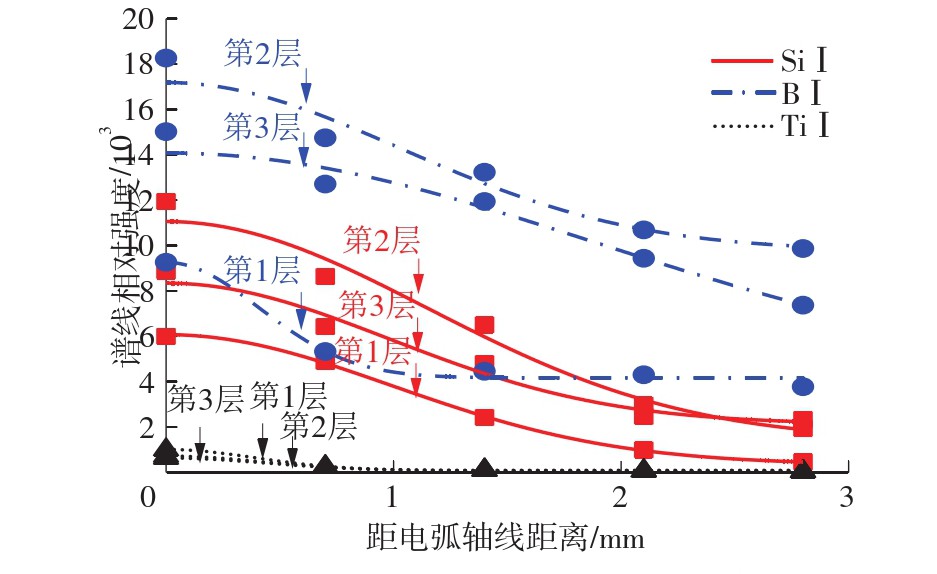
活性钨极氩弧焊(A-TIG焊)作为一种新型的焊接方法,通过在母材表面预先涂覆活性剂来增加焊缝熔深、提升焊接效率,在实际生产中已经得到了广泛的应用。氧化物作为A-TIG焊中最为常见的活性剂配方之一,其影响电弧行为的机制目前仍存在一定争议。为明晰氧化物对TIG焊电弧行为的影响机制,文中搭建了电弧形态与电弧空域光谱同步采集系统,研究了氧化物作用下电弧空域中活性剂粒子及氩、铁等带电粒子的谱线分布规律和电弧形貌特征,并基于Boltzmann作图法计算了不同区域的电弧电子温度。研究发现:电弧空间中的Ar Ⅱ谱线相对强度随距阴极区距离的增大逐渐减小,这是因为越靠近阴极区电弧能量密度越集中,越有利于促进Ar原子的电离;SiO2、B2O3能够促进Ar粒子的电离,TiO2能够抑制Ar粒子的电离;Fe Ⅱ谱线相对强度在轴向方向的分布规律与Ar Ⅱ谱线的相反,从阳极区附近到阴极区附近,谱线相对强度逐渐减小,这是因为越靠近熔池表面(阳极区附近),蒸发进入到电弧空间的铁蒸气浓度越高、电离越明显;3种氧化物活性剂的引入都会使Fe Ⅱ谱线的相对强度降低。涂覆TiO2活性剂的电弧空间中并未检测到明显的Ti Ⅰ特征谱线和电弧收缩现象,且电弧温度场并未发生明显的变化,因而TiO2活性剂对电弧行为的影响非常微弱;涂覆SiO2、B2O3活性剂的电弧空间中都检测到了Si Ⅰ、B Ⅰ特征谱线,且两种活性剂能够引起电弧收缩,但电弧收缩并不会对电弧温度场产生明显的影响。
李春凯, 丁彬, 石玗, 等 . 基于光谱诊断的氧化物活性TIG焊电弧特征分析[J]. 华南理工大学学报(自然科学版), 2022 , 50(8) : 128 -135 . DOI: 10.12141/j.issn.1000-565X.210699
As a new welding method, active tungsten argon arc welding (A-TIG welding), which increases weld pe-netration and improves welding efficiency by coating active agent on the surface of base metal, has been widely used in actual production. As one of the most common active flux formulations in A-TIG welding, oxide’s influence mechanism for arc behavior is still in debate. In order to clarify the influence mechanism of oxide on the arc beha-vior of TIG welding, a synchronous acquisition system of arc morphology and arc spatial spectrum was established. The spectral line distribution and arc morphology characteristics of active agent particles, argon, iron and other charged particles in the arc spatial space under the action of oxide were studied, and the arc electron temperature in different regions was calculated based on Boltzmann mapping method. It is found that the relative intensity of Ar Ⅱspectral lines in the arc space decreases gradually with the increase of the distance from the cathode region. This is because the closer the arc is to the cathode region, the more concentrated the arc energy density is, the more favo-rable it is to promote the ionization of Ar atoms. SiO2 and B2O3 can promote the ionization of Ar particles, while TiO2 can inhibit the ionization of Ar particles. The distribution law of the relative intensity of Fe Ⅱ spectral lines in the axial direction is opposite to that of Ar Ⅱ spectral lines. The relative intensity of the spectral lines gradually decreases from the vicinity of the anode region to the vicinity of the cathode region. This is because the closer it is to the surface of the molten pool (near the anode region), the higher the concentration of iron vapor evaporated into the arc space is and the more obvious the ionization is. The introduction of three kinds of oxide active agents can reduce the relative intensity of Fe Ⅱ spectral lines. In the arc space coated with TiO2 active agent, no obvious Ti Ⅰcharacteristic line and arc contraction phenomenon were detected, and the arc temperature field did not change significantly, which means that the influence of TiO2 active agent on the arc behavior is very weak. The characteristic spectral lines of Si Ⅰ and B Ⅰ were detected in the arc space coated with SiO2 and B2O3 active agents, and the two active agents can cause arc contraction, but the arc contraction has no obvious effect on the arc temperature field.
| 1 | XU J, WANG S, CHAI Z,et al .Comparison of the stress corrosion cracking behaviour of AISI 304 pipes welded by TIG and LBW[J].Acta Metallurgica Sinica (English Letters),2021,34(4):579-589. |
| 2 | GUREVICH S M, ZAMKOV V N, KUSHNIRENKO N A .Improving the penetration of titanium alloys when they are welded by tungsten arc process[J].Automatic Welding,1965,18(9):1-4. |
| 3 | AHMADI E, EBRAHIMI A, HOSEINZADEH A .Microstructure evolution and mechanical properties of 2219 aluminum alloy A-TIG welds[J].The Physics of Metals and Metallography,2020,121(5):483-488. |
| 4 | KULKARNI A, DWIVEDI D, VASUDEVAN M .Study of mechanism,microstructure and mechanical properties of activated flux TIG welded P91 steel-P22 steel dissimilar metal joint[J].Materials Science & Engineering A,2018,731:309-323. |
| 5 | BABBAR A, KUMAR A, JAIN V,et al .Enhancement of activated tungsten inert gas (A-TIG) welding using multi-component TiO2-SiO2-Al2O3 hybrid flux[J].Measurement,2019,148:106912. |
| 6 | LU S P, FUJII H, SUGIYAMA H,et al .Weld pe-netration and Marangoni convection with oxide fluxes in GTA welding[J].Materials Transactions Jim,2002,43(11):2926-2931. |
| 7 | LI C K, SHI Y, GU Y F,et al .Effect of oxide on surface tension of molten metal[J].RSC Advances,2017,7:53941-53950. |
| 8 | 赵玉珍,雷永平,史耀武 .A-TIG焊中氧含量对熔池流动方式影响的数值模拟[J].金属学报,2004,40(10):1085-1092. |
| 8 | ZHAO Yuzhen, LEI Yongping, SHI Yaowu .Numerical simulation of effect of oxygen content on molten pool flow pattern in A-TIG welding[J].Acta Metallurgica Sinica,2004,40(10):1085-1092. |
| 9 | LECONTE S, PAILLARD P, CHAPELLE P,et al .Effect of oxide fluxes on activation mechanisms of tun-gsten inert gas process[J].Science and Technology of Welding and Joining,2006,11(4):389-397. |
| 10 | MA S, GAO H, WU L .Modified Fowler-Milne method for the spectroscopic determination of thermal plasma temperature without the measurement of continuum radiation[J].Review of Scientific Instruments,2011,82(1):013104. |
| 11 | RIZZI D, SIBILLANO T, CALABRESE P,et al .Spectroscopic,energetic and metallographic investigations of the laser lap welding of AISI 304 using the response surface methodology[J].Optics and Lasers in Engineering,2011,49(7):892-898. |
| 12 | 叶大伦,胡建华 .实用无机物热力学数据手册[M].北京:冶金工业出版社,2002. |
| 13 | 陈炜煊 .磁场及金属蒸气对电弧特性的影响[D].兰州:兰州理工大学,2020. |
| 14 | TANAKA M, SHIMIZU T, TERASAKI T,et al .Effects of activating flux on arc phenomena in gas tungsten arc welding[J].Science and Technology of Welding and Joining,2000,5(6):397-402. |
| 15 | SIMONIK A, PETVIASHVILI V, IVANOV A .The effect of contraction of the arc discharge upon the introduction of electro-negative elements[J].Svar Proiz,1976,3:49-51. |
| 16 | TSENG K H, CHEN K L .Comparisons between TiO2- and SiO2-flux assisted TIG welding processes[J].Journal of Nanoscience and Nanotechnology,2012,12(8):6359-6367. |
/
| 〈 |
|
〉 |
地址:广州 五山 华南理工大学17号楼 邮政编码:510640
电话: 020-87111794 邮箱:journal@scut.edu.cn